Think On This…

Here’s the seed thought for this episode of Think On This

As far as the east is from the west, so far has He removed our transgressions from us. (Psalm 103:12)

Think on this: God has forgotten every sin of mine that He has ever forgiven!

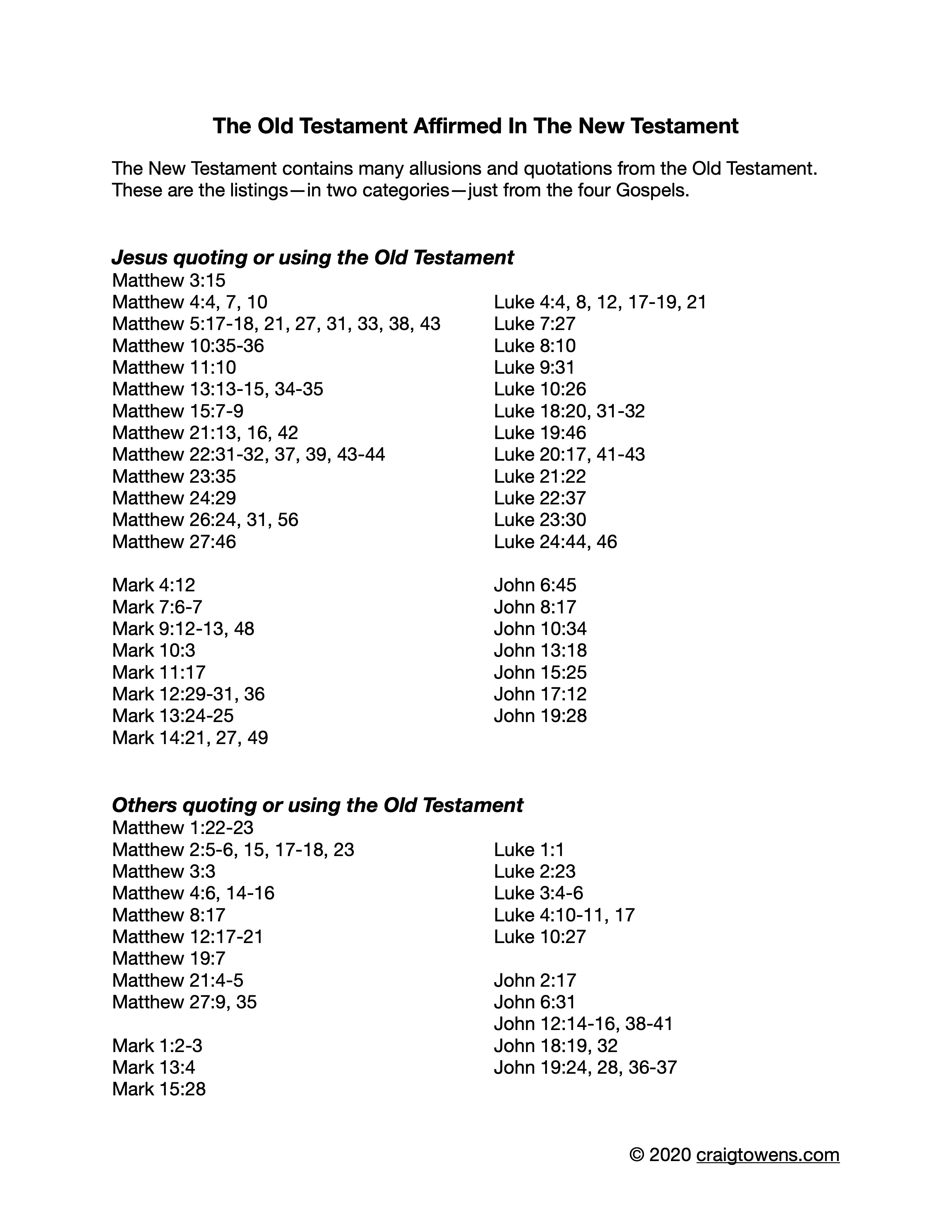
The Old Testament Affirmed In The New Testament

(click image for a larger view)

Sometimes, instead of referring to the two major divisions of the Bible as the Old Testament and the New Testament, I prefer to use the First Testament and the Second Testament. This helps me remember that “Old” doesn’t mean outdated and “New” doesn’t mean forgetting what came before it. 

I love how B.B. Warfield describes the First Testament as being like a mansion with richly-decorated, beautifully-ornate rooms, but which are dimly lit. With Christ’s Advent described in the Second Testament, the light is turned on and we can now appreciate the beauty that was always there! 

Sadly, there are far too many people who see the two divisions of the Bible as separate. In reality, the First Testament is affirmed over and over again in the Second Testament. In fulfilled prophesy alone, there is an abundance of evidence! 

But let’s get even more obvious: In just the four Gospels there are at least 100 direct mentions or quotations of passages from the Old Testament. Clearly, both Jesus and the Gospel writers saw the First Testament as an integral part of Christ’s ministry. 

Check out this list that I compiled and look up the references for yourself (a great place to look up Scriptures is on BibleGateway.com). 

If you would like to download a PDF version of this list, click here → Old Testament affirmed in the New Testament ← If you would like to use this document in a teaching session, just be sure to mention that you downloaded it from craigtowens.com. Thanks! 

More resource for your Bible study: 

“Alas!” To “Aha!”

Listen to the podcast of this post by clicking on the player below, and you can also subscribe on AppleSpotify, or Audible.

…oh no… (2 Kings 6:5, 15). 

The words “Oh no!” are actually a single word in the Hebrew language (Hebrew: ‘ahahh) that has been transliterated into English as “Aha!” 

But I think the old English translation is better in this context: ALAS! 

ALAS is usually a painful realization of the situation, not a cry of enlightened discovery. Here are the other times that this Hebrew/English word for ALAS! is used: 

  • Joshua said it after his army was defeated at Ai 
  • Gideon said it after realizing he had been face-to-face with God 
  • Jephtha cried it out after he knew that his daughter would have to be sacrificed
  • King Joram uttered this when he realized his troops and animals had no water in the desert 
  • Jeremiah said this to God after he was called to be a prophet, and after he was asked by God to speak countercultural words (he actually said ALAS! four times!) 
  • Ezekiel also cried out ALAS! four times when God asked him to do or to watch difficult things 
  • Joel cried it out when he saw the Day of the Lord quickly approaching 

(check out the above references by clicking here) 

In all of these ALAS! painful moments, these men were at their wits’ end, at the end of their own abilities—they couldn’t do anything to help themselves. 

In all of these ALAS! moments, they came to just one important realization: Only Yahweh can help me. That realization is truly the AHA! of an enlightened discovery! 

Calling on God turns a painful ALAS! moment into a God-glorifying AHA! moment. God alone can provide where no one else can.

Don’t despair in the ALAS! times, but cry it out loud to the only One who can help you, and then watch to see how He alone will turn your situation into a defining, God-glorifying AHA! testimony. 

►► Would you please prayerfully consider supporting this ministry? ◀︎◀︎

Now And Not Yet

Psalm 68 is a Christological Psalm. That means it points to Jesus and it is fulfilled through Christ’s First and Second Advents. These types of psalms don’t make sense if they are restricted strictly to the Old Testament. 

As I have explained previously, Hebrew literature often puts the key point in the middle—in the case of this psalm, that’s verses 18-20. The opening verse sets the stage, or the scene of battle, and then right in the middle of this psalm of David is the description of God’s victory won through Jesus. 

There are three Selahs in this psalm, and I want you to notice what’s happening at each one: 

  • When You marched through the wasteland (v. 7) 
  • Who daily bears our burdens (v. 18) 
  • Sing praise to the Lord (v. 32) 

Do you remember the three definitions of Selah? A pause to consider; a breath before the crescendo; a time to weigh what’s valuable. In this case, I believe we should lean more to the second definition. Why? Because all three of these Selahs shows us what God has done, what He is still doing, and what He will ultimately do in the eternity of Heaven. I believe we are living in the breath/Selah after Christ’s First Advent and leading up to the crescendo of His Second Advent. 

Jesus is BOTH the Immanuel that came to earth at His First Advent AND the returning King at His Second Advent. We are living in an era of BOTH “now” AND “not yet.” 

The apostle Paul looks back to this psalm (especially those middle verses of 18-20) even as he looks forward to the Second Advent. He captures the essence of “now” and “not yet” in all these passages:  

Jesus paid the price for our sin.
He broke the bonds of hell and death.
He prepared the way to Heaven.
He showed the way to Heaven.
He built our mansions in Heaven.
He WILL return to take us to be with Him in Heaven!


So how shall we now live in this time of “now” and “not yet”? In a word: AWARE… 

  • …of His ultimate victory (Psalm 68:1) 
  • …of the desperation of the enemy. Death, sin, and the devil have been defeated! We now deal with a broken army, a scattered foe in the final death throes, a wounded, dying warrior desperately lashing out. The prince of this earth is quickly failing, while God is liberally pouring out rewards that were purchased by Christ our King! 
  • …of the brevity of this life (v. 2)
  • …of the joy of living in God’s presence (v. 3) 
  • …of the power of worship (v. 4) 
  • …of our confidence in being heirs of God and co-heirs with Christ (vv. 5-6) 

Now is not the time for fainting, but fighting the good fight. Our Immanuel has won the battle, He will continue to strengthen us every day that we walk this Earth, and He will keep us by His side as He reigns for all eternity as King of kings and Lord of lords! 

If you’ve missed any of the previous posts in this series, you can check out the full list by clicking here. 

Poetry Saturday—The Creator Is Far Nobler

The mirror of the creatures lacks space
To bear the image of the Infinite.
‘Tis true the Lord has fairly writ His name,
And set His seal upon creation’s brow.

But as the skillful potter much excels
The vessel that He fashions on the wheel,
E’en so, but in proportion greater far,
Jehovah’s Self transcends His noblest works.

Earth’s ponderous wheels would break, her axles snap,
If freighted with the load of deity.
Space is too narrow for the Eternal’s rest,
And time too short a footstool for His throne. —Charles Spurgeon

*Charles Spurgeon explained in one of his sermons when and why he wrote this poem: “I have often heard the earth spoken of as the mirror of God’s image. But when I was traveling among the Alps and saw many of the grandest phenomena of creation such as glaciers, avalanches, and tempests, I was so impressed with the narrowness of visible things in comparison with God that I wrote such lines as these.”

Think On This…

Here’s the seed thought for this episode of Think On This

Do not answer a fool according to his folly, or you yourself will be just like him. Answer a fool according to his folly, or he will be wise in his own eyes. (Proverbs 26:4-5)

Think on this:

  1. Do I have a solid relationship with this person? 
  2. Do I need to respond for their benefit? 
  3. Can I ask any clarifying questions before I speak? 
  4. Can I respond in love?

Thursdays With Spurgeon—Be A Reflector

This is a weekly series with things I’m reading and pondering from Charles Spurgeon. You can read the original seed thought here, or type “Thursdays With Spurgeon” in the search box to read more entries.

Be A Reflector 

For it is the God who commanded light to shine out of darkness, who has shone in our hearts to give the light of the knowledge of the glory of God in the face of Jesus Christ. (2 Corinthians 4:6) 

     It is by the heart that we know God and Christ, and as our affections are purified, we become sensible of God’s presence in Christ. … Our beholding Him has purified the eyes that have gazed upon His purity. His brightness has helped our eyesight so that we see much already and will yet see more. …  

     Why did not everybody see the glory of God in Jesus Christ when He was here? It was conspicuous enough. Answer: It matters not how brightly the sun shines among blind men. … What, then, has happened to us? To eternal grace be endless praise! God Himself has shined into our hearts. That same God who said, ‘Light be,’ and light was, has shined into our hearts! … If you can delight in God in Christ Jesus, then remember, no man can say that Jesus is the Christ but by the Holy Spirit, and you have said it [Matthew 16:13-17]! …  

     You must not hoard up the light within yourself—it will not be light to you if you do. Only think of a person when his room is full of sunlight saying to his servant, ‘Quick, now! Close the shutters and let us keep this precious light to ourselves.’ Your room will be in the dark, my friend! … 

     A man of God, when he receives the light of Christ, can become so perfect a reflector that to common eyes, at any rate, he is brightness itself! … Scatter your light in all unselfishness. Wish to shine, not that others may say, ‘How great he is,’ but that they, getting the light, may rejoice in the Source from which it came to you and to them.

From The Glory Of God In The Face Of Jesus Christ

As the old hymn reminds us, “’Twas grace that taught my heart to fear, and grace my fears relieved; how precious did that grace appear the hour I first believed.” It is by God’s grace alone that we have been given light to see Jesus and to place our faith in Him! 

That light continues to grow within us the longer we gaze at the glory of God in the face of Jesus. Immerse yourself in the Gospels. Don’t read your Bible just to know the Word of God, but read to get to know the God of the Word better. Let the Holy Spirit purify your vision. 

Then you will become a reflector of God’s glory. The love and light of God are too wonderful to hoard to yourself! Ask God to bless you with a greater capacity to reflect the light of His Son to a dark, groping world.


Think On This…

Here’s the seed thought for this episode of Think On This

In the fifteenth year of Amaziah son of Joash king of Judah, Jeroboam son of Jehoash king of Israel became king in Samaria, and he reigned forty-one years. He did evil in the eyes of the Lord and did not turn away from any of the sins of Jeroboam son of Nebat, which he had caused Israel to commit. He was the one who restored the boundaries of Israel from Lebo Hamath to the Dead Sea, in accordance with the word of the Lord, the God of Israel, spoken through His servant Jonah son of Amittai, the prophet from Gath Hepher. The Lord had seen how bitterly everyone in Israel, whether slave or free, was suffering; there was no one to help them. And since the Lord had not said He would blot out the name of Israel from under heaven, He saved them by the hand of Jeroboam son of Jehoash. (2 Kings 14:23-27) 

Think on this: Just because God has used me to do something amazing doesn’t necessarily mean that I am free of sin. 

Reacting To Injustice

When Shechem…saw Dinah, he took her and he raped her (Genesis 34). 

There is no doubt that what Shechem did to Diana was abhorrent. The text is full of reminders:

  • an outrageous thing
  • a thing that should not be done 
  • Dinah had been defiled
  • their sister had been defiled 
  • he treated our sister like a prostitute 

Shechem never admits to his wrongdoing. We don’t even know if he told his father Hamor what he had done. Dinah was being kept in the city away from her family, so she didn’t tell her father Jacob. Somehow, however, Jacob found out and his response is curious: he did nothing about it (v. 5). Even as Shechem and Hamor address Jacob’s family, it’s Diana’s brothers who reply deceitfully, so either Jacob has left the meeting or he is still sitting there silently. 

Levi and Simeon have the same mother as Dinah. Their reaction to their sister’s defilement is extreme—they kill every male in Shechem’s hometown! 

Since Shechem hadn’t even mentioned his crime to his father, it’s possible that the rape of Dinah has been kept a secret from the rest of the citizens of his city. Perhaps if the other city leaders had found out, Shechem alone would have been punished, instead of the whole city being wiped out. 

Jacob’s silence and inaction to this injustice prompted an overreaction by his sons. 

When a leader’s response is inappropriate to injustice, the followers’ response is likely to become even more so. Injustices must be dealt with in a God-honoring way: quickly and appropriately. 

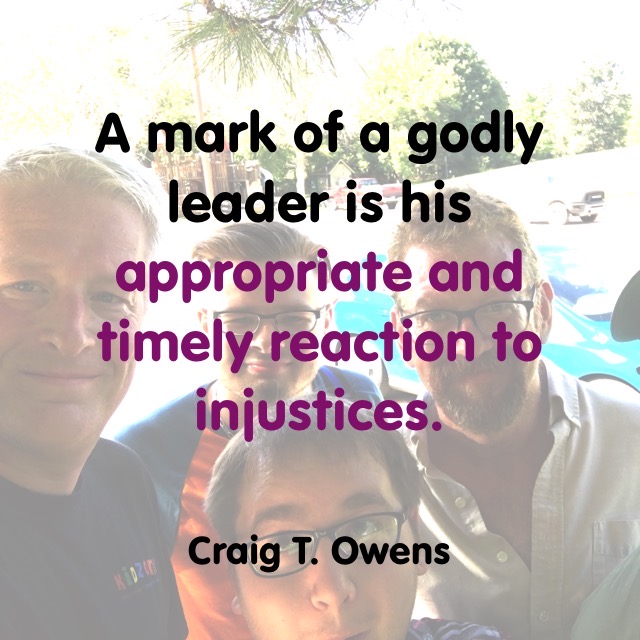
A mark of a godly leader is his appropriate and timely reaction to injustices.

This is part 50 in my series on godly leadership. You can check out all of my posts in this series by clicking here. 

He Who Laughs Last

Traced back to a play in the early 1600s, it still rings true: “He who laughs last, laughs best. 

The distraught father named Jairus hurriedly left his home. He was looking for this Man named Jesus. People said Jesus could perform miracles, and Jairus needed one. 

He found Jesus and quickly explained that his 12-year-old daughter was dying. They had tried everything they knew to do, but she kept inching closer and closer to death’s door. Jesus readily agreed to go with Jairus to his home. 

Along the way, Jesus was interrupted by another woman in desperate need, and He stopped to heal her. As Jairus was (im)patiently waiting for Jesus to continue on the journey, one of his servants ran up to Jairus with the sad news, “Your daughter is dead.” 

Jesus looked at this heartbroken father and simply said, “Don’t be afraid. Just believe, and your daughter will be well.” 

Jairus took Jesus at His word and continued walking with Jesus to his home. 

While Jairus was gone, family members and friends had shown up to mourn the death of this sweet girl. They were wailing loudly, but the clear voice of Jesus could be heard even over their woeful cries: “Stop crying. She is not dead, only asleep.” 

There was a pause, and then there was a totally unexpected and out-of-place response: laughter. 

Not joy-filled laughter, but mocking, derisive laughter at the utter foolishness of the words of Jesus. 

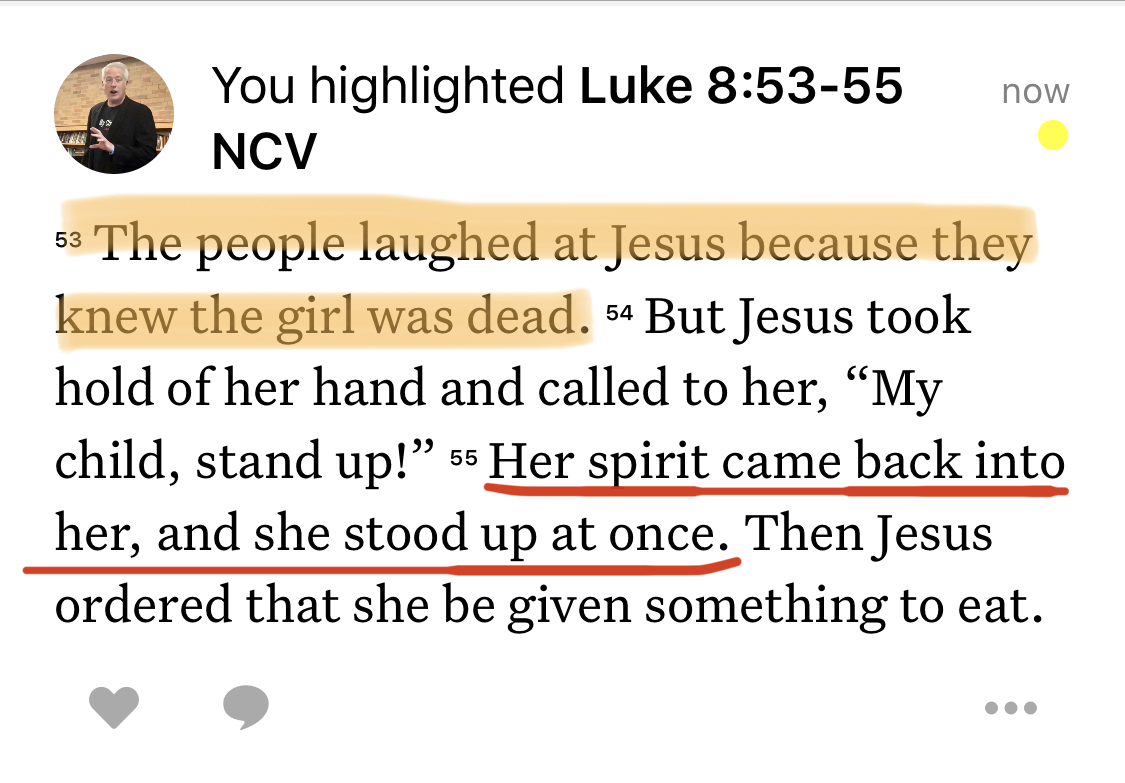
“What do you mean, ‘She isn’t dead’” they yelled. “We’ve been in her room. We’ve seen the cold, lifeless body! She is absolutely, undeniably dead!” And they continued to laugh at the sheer ridiculousness of what Jesus had pronounced. Many of the laughs probably turned to jeers as they began to mock His foolish, insensitive statement. The historian Luke wrote, “They knew the girl was dead.” 

Jesus took the grieving yet believing parents into the girl’s room, He took her lifeless hand in His hand, and simply said, “Little girl, get up.” 

And she did. Fully alive! 

Let me ask you something: Who was laughing now?! 

I’m sure the uncontainable joy of these parents burst out into laughter. And I think Jesus shared in the joyful laughter as well. 

“He who laughs last, laughs best.” 

Friend, what do you “know” right now? What’s gone wrong that cannot be fixed? What terminal diagnosis have the doctors given? What is approaching death’s door? What has already died? 

Listen again to the words of Jesus: “Don’t be afraid. Just believe.” 

Jesus gets the final word. Jesus gets the final laugh. Jesus will make all things new! 

The Sovereign Lord will wipe away the tears from all faces; He will remove His people’s disgrace from all the earth. (Isaiah 25:8) 

He will wipe every tear from their eyes. There will be no more death or mourning or crying or pain, for the old order of things has passed away. He who was seated on the throne said, “I am making everything new!” (Revelation 21:4-5) 

Don’t be afraid. Just believe. 

Jesus has secured the last—and best—laugh for both you and Himself! A laughter that will reverberate through all of eternity!