Homemade = Heartmade

God gave you a gift of 86,400 seconds today. Have you used one to say “I love you”?

My favorite Father’s Day gifts are the homemade, personalized cards that my children make for me. Throughout the years I’ve kept a number of those close to me as bookmarkers or framed reminders on my desk. To me homemade = heartmade.

Yesterday one of my children gave me a card which had this heart-tugging line: “I love you so very because you love me.” And then there was this P.S.: “Don’t stop loving.”

On Father’s Day or Mother’s Day or birthdays, it seems easy to express our love. After a hospital stay or a near-death experience, it seems required to express our love. And that’s as it should be. But what about all the “normal” days in between?

I believe one of the greatest gifts I can give my family is a personalized, “heartmade” gift that tells the recipient that I’m thinking about them. In other words, I need to be actively and deliberately finding ways to express my heartmade love to those close to me every day.

Of the 86,400 seconds I have today, it will only take me a few seconds to:

  • Text “I love you”
  • Give a gentle squeeze or love pat as they walk by
  • Jot a quick note to pack in someone’s lunch
  • Buy their favorite candy as I’m checking out of the store
  • Stick a friendly Post-It note message to their bathroom mirror
  • Start or end their day with a hug

As Gertrude Stein wrote, “Silent gratitude isn’t very much use to anyone.”

Don’t make those close to you GUESS you love them, make sure they KNOW you love them. It only takes a second or two.

How will you use your 86,400 seconds today?
Sharper Thoughts

John Maxwell said, “Some of my best thinking has been done by others.” I believe that what Dr. Maxwell was saying is that our creative thoughts can become even better when someone else helps sharpen them.

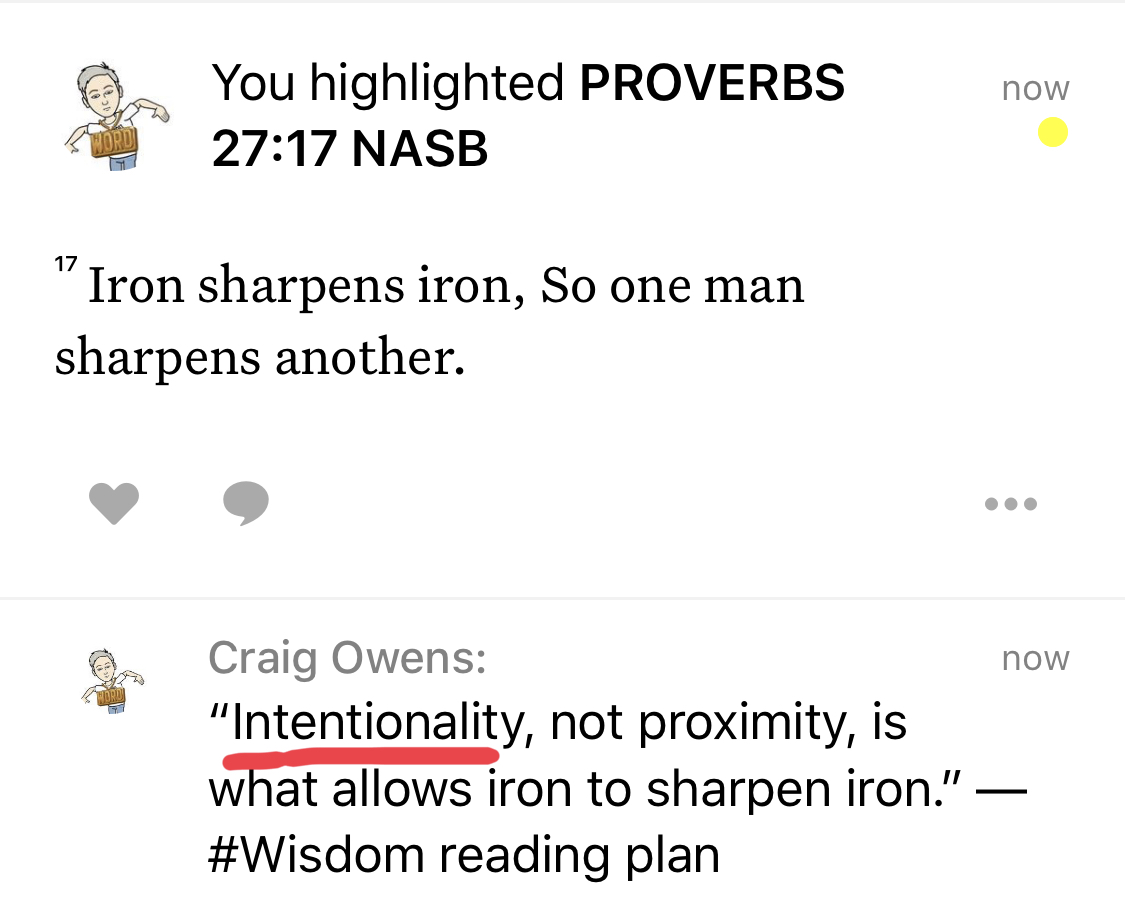
King Solomon, a pretty fair thinker himself, said the same thing when he wrote, “As iron sharpens iron, so one man sharpens another” (Proverbs 27:17). In other words, you need some pretty sharp people to help you think better thoughts, sharper thoughts.

Check out what John Stuart Mill wrote in On Liberty

“Nor is it enough that he should hear the arguments of adversaries from his own teachers, presented as they state them, and accompanied by what they offer as refutations. That is not the way to do justice to the arguments, or bring them into real contact with his own mind. He must be able to hear them from persons who actually believe them; who defend them in earnest, and do their very utmost for them. He must know them in their most plausible and persuasive form; he must feel the whole force of the difficulty which the true view of the subject has to encounter and dispose of; else he will never really possess himself of the portion of truth which meets and removes that difficulty. Ninety-nine in a hundred of what are called educated men are in this condition; even of those who can argue fluently for their opinions. Their conclusion may be true, but it might be false for anything they know: they have never thrown themselves into the mental position of those who think differently from them, and considered what such persons may have to say; and consequently they do not, in any proper sense of the word, know the doctrine which they themselves profess.”

General George C. Marshall, chief of staff of the Army during World War II, created the largest army the world had ever seen (13 million soldiers) in the shortest time possible. General Omar Bradley tells of being called into Marshall’s office in 1939, a week after the outbreak of war in Europe. Marshall was disappointed in Bradley, “You haven’t disagreed with a single thing I have done all week!” Marshall wanted to make sure he was doing his very best so he was calling on another sharp comrade to challenge his thinking.

Do you have some sharp people around you? Do you listen to those who disagree with you? If you do, your creative thoughts can become even sharper.

Doing Thinking Doing

To think or to act? That is the question. Or maybe the question should be, which comes first: the thinking or the acting? Do I think about something and then go do it? Or do I do something first and then think about what I’ve done and how I could do it better next time?

The answer, I believe, is yes.

You could be the most creative thinker in the world, your thoughts could be off on another plane, but if you do nothing with what you’re thinking, all of those great insights are wasted.

On the other hand, many people hold to the axiom that experience is the best teacher, so they just do and do and do. But experience is not the teacher; we only learn when we stop to think about what we’ve done.

William Wilberforce was already a rising star in British politics when he experienced a deeper understanding of his relationship to God. Suddenly this man of word and action wanted to do nothing more than meditate on the greatness of God. Wilberforce believed that he could best serve God by withdrawing from society and simply thinking about God.

His good friend and future prime minister William Pitt disagreed. Pitt wrote to Wilberforce, “Why then this preparation of solitude which can hardly avoid tincturing the mind either with melancholy or superstition? … Surely the principles as well as the practice of Christianity are simple and lead not to meditation but to action.” Or as the line from Amazing Grace has it, “We humbly suggest you can do both.”

I love Oswald Chambers’ counsel—

“God will never allow us to divide our lives into sacred and secular, into study and activity. We generally think of a student as one who shuts himself up and studies in a reflective way, but that is never revealed in God’s book. A Christian’s thinking ought to be done in activities, not in reflection, because we only come to right discernment in activities.”

Whether it starts with thinking or starts with action, successful thinking-doing must include both. Think about it → act on it → think about your results → do it again better than last time.

Paul wrote to the Romans how thinking and action work together when he said, “for their own conscience and thoughts either accuse them or tell them they are doing right” (Romans 2:5 NLT). The Amplified Bible renders this phrase, “their consciences (sense of right and wrong) also bear witness; and their decisions (their arguments of reason, their condemning or approving thoughts) will accuse or perhaps defend and excuse them.”

Think about it → do it → think about it → do it = the pattern for success.

I’ll Make You An Offer You Can’t Refuse (Book Review)

I'll Make You An Offer You Can't RefuseOkay, I’ll be honest with you, the title of Michael Franzese’s latest book sounds like a cliché—I’ll Make You An Offer You Can’t Refuse. Sounds like a line right out of “The Godfather” or “Goodfellas,” right? But if you’re involved in the world of business, Mr. Franzese’s book is exactly that: an offer (book) you can’t refuse. From how to craft a business plan, to picking the right people, to learning how to negotiate the best deals, Mr. Franzese uses his years of wiseguy street-smarts to give you an advantage.
From the very first page, this book engaged me because I felt like I was having a conversation with the author. His style is very relaxed, and his stories about his business successes and failures are compelling. It’s not often that a business book reads like a novel, but I’ll Make You An Offer does just that.

Throughout all of his lessons, Mr. Franzese makes the contrast between the principles spelled out in the mobster’s bible (The Prince by Machiavelli) and principles articulated in the Holy Bible (specifically the writings of Solomon). Although he learned his strategies from his years in La Cosa Nostra (“this thing of ours” or the mob life), he makes a strong case his strategies will work in the legit life. The difference is the motivation that drives the strategies: Machiavellian or biblical.

“A dictionary definition of success says it’s ‘the favorable or prosperous termination of attempts or endeavors.’ … But dictionary definitions are like sausage casings. It all depends on what you stuff inside” (quote from page 144).

Whether you are just getting started in a new business venture, or whether you are not satisfied with the results of your current business venture, you will find invaluable strategies here to help you. This former mob boss truly does make you an offer you can’t refuse.

Are You Out Of Your Mind?

I love this thinking thought from James William Fulbright—

“We must dare to think ‘unthinkable’ thoughts. We must learn to explore all the options and possibilities that confront us in a complex and rapidly changing world. We must learn to welcome and not to fear the voices of dissent. We must dare to think about ‘unthinkable things’ because when things become unthinkable, thinking stops and action becomes mindless.”

After you have identified the negative thoughts and you have started thinking creatively, you have to be able to take it further. You have to be able to think unthinkable things.

Too many times we don’t let our minds begin to go into “unknown” places, so we look at everything through the lens of what we’ve experienced in the past. Our thoughts are “in our minds.” When Albert Einstein began to propose that there were more dimensions to our universe than scientists had previously thought, people had a hard time following his reasoning. Even those in the scientific community thought he was “out of his mind.”

One of Einstein’s favorite books was called Flatland. In this book, Square lives in the two-dimensional world that Sphere came to visit. Because Square’s world only has length and width (no height), he can only see the part of Sphere that was on his level. As Sphere moves through Flatland, Square can see different parts of him, but he can never see all of him at the same time. If Sphere moves above Flatland, Square can still hear his voice but cannot see his shape.

So, too, with us. Many times we only perceive what moves through the “line of sight” we have previously experienced. We are—so to speak—in our minds.

But look what God has in store for you—

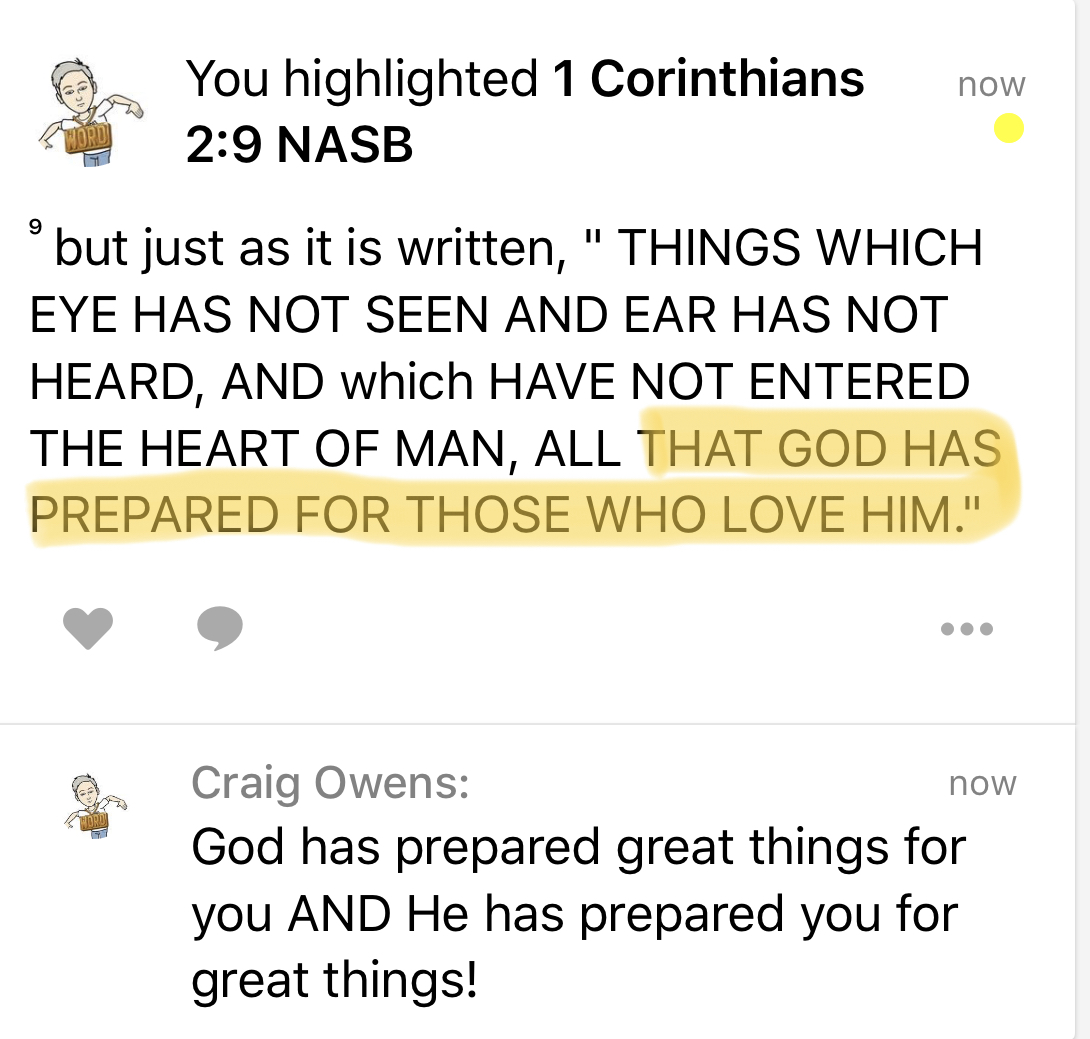
No eye has seen, no ear has heard, and no mind has imagined what God has prepared for those who love Him. (1 Corinthians 2:9 NLT)

So here’s how Scripture teaches us to pray—

I pray that from His glorious, unlimited resources He will empower you with inner strength through His Spirit. Then Christ will make His home in your hearts as you trust in Him. Your roots will grow down into God’s love and keep you strong. And may you have the power to understand, as all God’s people should, how wide, how long, how high, and how deep His love is. May you experience the love of Christ, though it is too great to understand fully. Then you will be made complete with all the fullness of life and power that comes from God. Now all glory to God, who is able, through His mighty power at work within us, to accomplish infinitely more than we might ask or think.(Ephesians 3:16-20 NLT)

God wants to do infinitely more than you can ask or think. He wants to show you new dimensions of His greatness and His love—notice that Paul goes out of his way to list four dimensions (wide, long, high, deep) even though we live in a three-dimensional world.

Here’s the question: are you OUT of your mind or IN your mind? In other words, are you only looking for things that you know can happen, or are you believing God for things that are completely OUT OF YOUR MIND?

Get Your Mind Out Of That Rut!

“Don’t become so well-adjusted to your culture that you fit into it without even thinking.” —Apostle Paul (Romans 12:2, The Message)

It’s important to think about your thinking—to analyze why certain thoughts are swirling through your mind. But after you identify unhealthy thoughts, you need some creative thinking to be able to move your life in a new direction. This requires a whole new set of thinking skills that are called critical thinking.

Stephen Brooking described it this way, “Critical thinkers are continually exploring new ways of thinking about their lives…. Critical thinking is complex and frequently perplexing, since it requires the suspension of belief and the jettisoning of assumptions previously accepted without question.”

  • What have you accepted without question?
  • What have you become so well-adjusted to that you simply accept it?
  • Are there things you do just because it’s always been done that way?
  • Are there some things that you won’t try because it’s never been done that way?

Two warning signs in your thinking are always and never. With the exception of God, everything changes. So when you start thinking in terms of always and never you are essentially saying, “Nothing changes. And I’ve got everything figured out.” This is mind-in-the-rut thinking!

You’ve probably heard this before but it is valuable enough to be repeated—If you always do what you’ve always done you’ll always get what you always got.

If you need a change in your life, start with a change in your thinking. Ask God to help you think in new ways. In talking to His people about what He had done for them in the past God said it was time to think in creative ways—

But forget all that—it is nothing compared to what I am going to do. For I am about to do something new. See, I have already begun! Do you not see it? I will make a pathway through the wilderness. I will create rivers in the dry wasteland. (Isaiah 43:18-19 NLT)

Don’t let your thinking stay stuck in a rut. Allow God to help you jettison the old ways of thinking and expand your horizons. God will give you greater creativity if you ask Him.

Thinking About What You’re Thinking About

When was the last time you thought something new for the first time? Atheist Bertrand Russell said something painful, but true, “Most men would rather die than think. Many do.”

I’ve written before about the most important and most lengthy conversation all of us have every day. It’s the conversation we have with ourselves—it’s called thinking. But for many people, their thinking is stuck in a rut.

I’ve often had conversations with people bucking against a new thought where I have asked them why they believe what they believe. Far too many times they tell me, “That’s just the way I was raised.” Okay, but what do you think about it? “I don’t know. That’s just the way I was raised.”

Two books that have really helped my thinking are As A Man Thinketh (James Allen) and Thinking For A Change (John Maxwell). Allen uses the analogy of our minds as gardens where we need to constantly pull out the weeds and plant the thoughts that will bear the fruit we desire. Maxwell challenges us to look differently at the way we think our thoughts.

The Apostle Paul tells us to take captive every thought and make it obedient to Christ (2 Corinthians 10:5). And then we can begin to change the way we think: Fix your thoughts on what is true, and honorable, and right, and pure, and lovely, and admirable. Think about things that are excellent and worthy of praise (Philippians 4:8).

“Rarely do we find men who willingly engage in hard solid thinking. There is an almost universal quest for easy answers and half-baked solutions. Nothing pains some people more than having to think.” —Martin Luther King, Jr.

If your thinking is ever going to go to a higher level it has to start with this: You have to be willing to think about what you’re thinking about.

In other words, why are you thinking what you’re thinking? Start capturing the thoughts running through your mind and ask them, “Why are you here?” Are you thinking what you’re thinking because you thought it, or because someone else thought it for you?

It is only by capturing the thoughts that are already in your head that you can sort out the healthy thoughts from the unhealthy thoughts.

Real Raw Emotions

This week I’ve been writing about my favorite book—the Bible—and why I find it so fascinating. Yesterday I talked about how the Bible helps me mentally. But we are not just mental creatures, we are emotional, too, and I have found my Bible to be an excellent way to express some of my deepest, rawest emotions.

(If you would like to read the other parts of this series, they are here, here, here, and here.)

Humans are created in God’s image, and God expresses emotion. In fact, God expresses emotion more deeply and purely than we humans can His sorrow is more bitter, His love is more intense, His jealousy is more pure.

Emotion is expressed throughout the Bible, but I’m particularly attracted to the emotional responses in the Psalms. These are prayers and songs which express the deepest emotions of angry, loving, hurting people. A few examples—

You know what I long for, Lord; You hear my every sigh. (Psalm 38:9 NLT)

Be merciful to me, O God, for men hotly pursue me; all day long they press their attack. My slanderers pursue me all day long; many are attacking me in their pride. (Psalm 56:1-2 NIV)

God, smash my enemies’ teeth to bits, leave them toothless tigers. Let their lives be buckets of water spilled, all that’s left, a damp stain in the sand. Let them be trampled grass worn smooth by the traffic. Let them dissolve into snail slime, be a miscarried fetus that never sees sunlight. Before what they cook up is half-done, God, throw it out with the garbage! (Psalm 58:6-9 The Message)

O my God, my life is cast down upon me and I find the burden more than I can bear…. (Psalm 42:6 AMP)

My God, my God, why have You forsaken me? Why are You so far from saving me, so far from the words of my groaning? O my God, I cry out by day, but You do not answer, by night, and am not silent…. I am poured out like water, and all my bones are out of joint. My heart has turned to wax; it has melted away within me. My strength is dried up like a potsherd, and my tongue sticks to the roof of my mouth…. Dogs have surrounded me; a band of evil men has encircled me, they have pierced my hands and my feet. …But you, O Lord, be not far off; O my Strength, come quickly to help me. (Psalm 22:1-2, 14-16, 19 NIV)

Jesus came to earth as fully God and fully man, able to experience the deepest, rawest emotions of anyone. “He was despised and rejected—a man of sorrows, acquainted with deepest grief” (Isaiah 53:3). Jesus knows what you feel because He felt it, too: “For we do not have a High Priest Who is unable to understand and sympathize and have a shared feeling with our weaknesses and infirmities and liability to the assaults of temptation” (Hebrews 4:15). As a result, “He lives forever to intercede with God on [our] behalf (Hebrews 7:25).

Don’t ever be afraid to express your rawest emotions in God’s presence—He knows profoundly what you are feeling. When you are struggling with deep emotion, the Bible knows how to speak your heart’s cry to God.

Winning The Argument Or The Battle

When I entered college, I did so as a science major: pre-med biomedical chemistry, to be exact. I still really enjoy all of the medical sciences: biology, microbiology, organic chemistry, inorganic chemistry, and the like.

As you might be aware many of the scientists today have a bent toward the theory of evolution. That means that a few of my professors and several of the authors I was reading taught and wrote from that paradigm.

This set up the environment for me to want to debate for my Creationist beliefs.

I had one professor who would specifically challenge me during lectures to refute what he had just said about evolution. An author who wrote a lengthy book about evolution carried on a year-long correspondence with me where we each brought out our best arguments. In all instances—although we believed passionately in our positions and could adequately defend them—the discussions never became shouting matches.

The Bible taught me how to do this.

(This week I’m discussing my favorite book—the Bible—from a couple of different aspects. You can read some of those thoughts here, here and here.)

At times I was tempted to “cross the line” to win the argument. And I may have won the argument, but I would have put myself in a position to lose the overall battle. There are two key passages of Scripture that I keep in mind to help me with this.

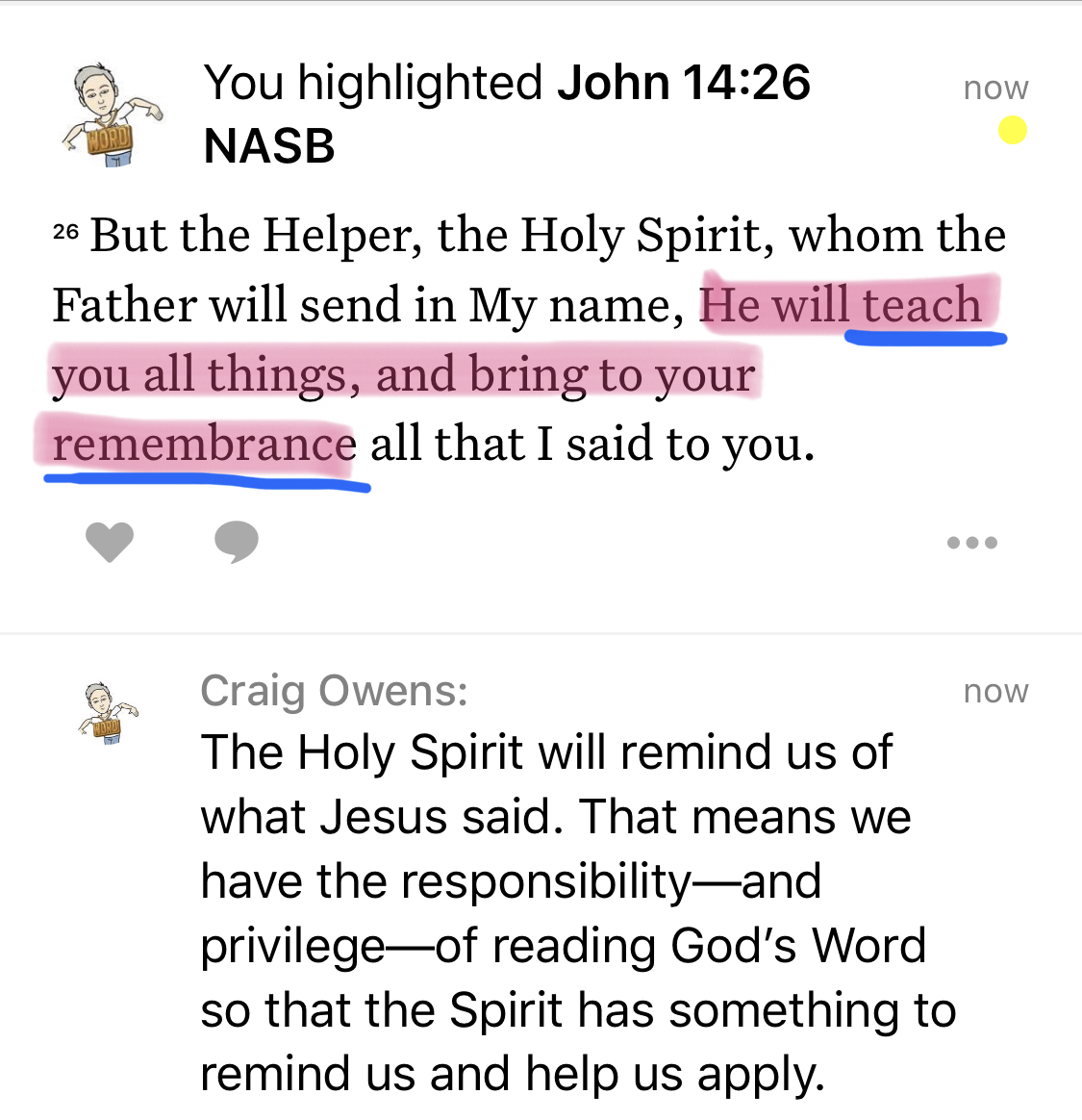
(1) In telling His followers about the Holy Spirit (John 14-16), Jesus said, “But when He, the Spirit of truth, comes, He will guide you into all truth” (John 16:13). And also, “But the Counselor, the Holy Spirit, whom the Father will send in My name, will teach you all things and will remind you of everything I have said to you” (John 14:26).

The Holy Spirit helps me apply biblical truths and principles to my everyday life. He guides me and reminds me of what I have studied.

(2) The second key passage is, “But in your hearts set apart Christ as Lord. Always be prepared to give an answer to everyone who asks you to give the reason for the hope that you have. But do this with gentleness and respect, keeping a clear conscience, so that those who speak maliciously against your good behavior in Christ may be ashamed of their slander” (1 Peter 3:15-16).

Yes, it is important for me to be prepared to give an answer, but this is the middle thought. First, I have to make sure what I’m saying is exalting Christ as Lord. Then I do my best to study and prepare to give an answer, but I must give that answer gently and respectfully.

Allowing the Holy Spirit to help you prepare from the Bible, and allowing Him to guide you into answering questions/critics gently and respectfully honors Christ. And that always wins the battle.

The Thinking Book

“The book to read is not the one which thinks for you, but the one which makes you think. No book in the world equals the Bible for that.” —James McCosh

My kids recently returned from a PK (Pastor’s Kids) Retreat weekend. Our Michigan Assembly of God District Youth Director Jeff Kennedy coordinates this weekend every year. A fun part of their time together is a take-off of Jeff Foxworthy’s “You might be a redneck if…” routine. It’s called “You might be a PK if….” Here are a couple of my favorites—

  • You might be a PK if you’ve used the church sound system as your personal stereo.
  • You might be a PK if National Take Your Kid To Work Day is any day you don’t have school.
  • You might be a PK if you’ve ever taken a bath in the baptismal tank.
  • You might be a PK if you occasionally take Sunday afternoon naps on a church pew.
  • You might be a PK if every answer your Dad gives you comes from the Bible.

Cute! And, for the most part, dead-on accurate!

But that last one got me thinking: do I do this? I sincerely hope (not just because I’m a pastor) that the answer is always “yes.”

I agree with James McCosh that no other book in the world compares to the Bible for challenging me to think. In the King James Version of the Bible, there is a phrase that James uses about God’s Word: he says that we should “receive with meekness the engrafted Word” (James 1:21).

The more I read the Bible, the more its principles become engrafted into my thought patterns. The more I think about the Bible, the more my attitude about life conforms to God’s attitude. And the more my attitude conforms to God, the more my actions and words align with the Bible.

You don’t have to read much every day for God’s Word to make a difference in your life. If you are honest with the Holy Spirit as He illuminates a passage of Scripture to you, you will see how God’s Word can be applied to your life today.

“The Bible is…a chart by which the Christian sails to eternity, the map by which he daily walks; the sundial by which he sets his life; the balance in which he weighs his actions.” —Thomas Watson

To be successful make sure you are looking often at the chart, the map, the sundial, and the balance of God’s Word.