A Powerful Prayer

“Bible study is love reading its Lover’s letters. Prayer is love keeping tryst.” —S.D. Gordon

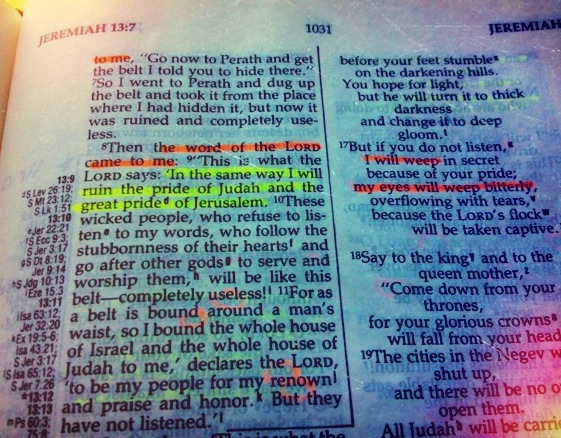
The Bible is God’s love letter to humanity; more specifically, to you and me. But did you know that the Bible can also be used as our love letter to God?

If you’re a parent, you know how powerful it is when one of your children quote you back to you. Like when my daughter reminds me, “Dad, you said that you would….” Even if I haven’t forgotten what I said, it’s still so nice to know that she was listening to me and remembered what I promised her.

God has never, ever forgotten His word to us. But as our Heavenly Father, He loves to know that we hear His words, that we remember His promises, and that we love Him. So one of the most powerful prayers you can pray is when you pray God’s own words back to Him.

Personalized prayer based on God’s Word is a powerful prayer.

Let me give you an example. Here’s a prayer I wrote out the other day from 1 Chronicles 22:19—

Now…

There is no time to wait, I have to begin now. I cannot put it off a moment longer. It’s never an interruption of my day for me to draw closer to You, my God. Now I come to You in love.

devote…

This is not a partial commitment. I’m giving You my all. I’m laying all of me on Your altar. I’m not holding anything back. It’s all Yours, God, all of me.

your…

This is mine to give, and I’m choosing to give it to You. I’m not living for someone else; I’m not riding anyone’s coattails. I’m giving You what is mine to give. I’m giving you me.

heart…

My dreams, my passions, my desires. They’re all Yours, Heavenly Father. I reserve no passions for my own selfish pursuits, but I only have passion for You.

soul…

My inmost being—who I really am—the part of me that’s truly me is all Yours. My mind, my will, my emotions, my personality is only alive because of You.

seeking…

My longing, my soul’s craving is for You. I look for You’re everywhere and in everything. I seek You in the bird’s song, in the ocean’s roar, in the mountain’s majesty, in the midnight’s silence, in the bee’s buzz, in my children’s laughter, in my wife’s kiss, in my friend’s counsel, in Your love letter to me.

the Lord…

You are Lord over all. There is not now, nor ever will there be, anyone to take Your place in my heart.

your God…

You are mine and I am Yours. Forever. Because You loved me I love You, my God.

Now devote your heart and soul to seeking the Lord your God (1 Chronicles 22:19).

Use your Bible to form your own powerfully intimate prayers to the Lover of your soul.

My Favorite Book

Listen to the podcast of this post by clicking on the player below, and you can also subscribe on Apple or Spotify.

“The Bible is alive, it speaks to me; it has feet, it runs after me; it has hands, it lays hold on me.” —Martin Luther

I love to read. So I read a whole lot of books every year. It’s not unusual for me to be working my way through four or five books at a time. I read the classics, poetry, history, biographies, autobiographies, devotionals, leadership training, personal development, marriage and parenting skills, and many other genres. I don’t have enough shelf space for all of the books I have!

But when people ask me my all-time favorite book, I don’t even have to hesitate. The book that is in a category all by itself is my Bible.

I say my Bible because I have made it my own. I highlight, I underline, I star, I jot notes in the margin, I circle keywords. Sometimes I even mark all the question marks in a passage!

My study Bible is one I’ve had for over 20 years. Each time I read through my Bible I use a different color or style of highlighter. So as I look at different highlighted passages I can remember back to where I was in my life, what I was going through, the struggles I was having. Sometimes I smile when I remember what the Holy Spirit revealed to me in my Bible at that time, and how I’ve grown. Sometimes I remember the deep emotion as I see where a teardrop caused the highlighter to run, and recall the comfort my Bible brought to me.

Psalm 119 (the longest chapter in the Bible) is a poem of love to God for His Word. In 176 verses the psalmist refers to God’s Word in 172 verses. Here are just a few—

  • I have hidden Your word in my heart that I might not sin against You (v. 11)
  • I rejoice in following Your statutes as one rejoices in great riches (v. 14)
  • Open my eyes that I may see wonderful things in Your law (v. 18)
  • Your statutes are my delight; they are my counselors (v. 24)
  • I run in the path of Your commands, for You have set my heart free (v. 32)

If you haven’t made Bible reading a part of your daily schedule, Psalm 119 is a good place to start. Scientists tell us that you only have to do something for 21 days in a row for it to become a habit. Psalm 119 is divided into 22 sections. And each section is just eight verses long.

You can find the time to read just eight verses a day, can’t you? If you do, you will have established one of the greatest habits in your life: daily Bible reading. 

I spent a whole week writing more about my favorite Book, so check out these posts too:

►► Would you please prayerfully consider supporting this ministry? ◀︎◀︎

Old And Valuable

During my freshman year of college, I was placed as a roommate with another freshman who was a theology major. Just so we’re all clear about this: theology is the study of God. And just so we’re all crystal clear about this: the study of God is typically based on the Bible.

I can hear some of you now, “Duh! Great insight!” But hang with me for a moment.

Near the start of our first semester together my roommate came into our dorm room very upset, slammed the door shut, and threw down his backpack. When I asked what was the matter he told me he had just come from a meeting with his academic advisor and was furious at his list of required classes. When I inquired what class he wasn’t allowed to take, he said, “No, it’s not what class I can’t take; it’s what classes I have to take!”

“So what classes are you upset that you have to take?” I asked, thinking maybe something like science or phys ed.

“Old Testament,” he responded. I was speechless, but he continued, “I mean, Old Testament! C’mon, that was stuff from a long time ago. We live under the new covenant now, so the old covenant has no purpose for us anymore!”

Although this is somewhat shocking to hear from a theology major, I’m afraid a lot of people feel this way.

Did you know…

  • The Old Testament (OT) is directly quoted by the New Testament (NT) writers nearly 700 times.
  • There are thousands of references to OT people, events, or principles in the NT.
  • Of the 27 books in the NT, only six don’t have direct OT quotations. But four of those six books refer back to OT people or passages.
  • Of the 39 books in the OT, all but nine of them are quoted in the NT.
  • Jesus Himself quoted from the five books of Moses (Genesis, Exodus, Leviticus, Numbers, Deuteronomy) nearly 60 times.

I love the Old Testament! There I read some great stories and meet some very colorful personalities. But I especially love reading the OT to see what was going to happen and then reading the NT to see both what did happen and what’s still going to happen.

Those 39 books of the Old Testament may be old, but they’re so rich, and so valuable, and so enlightening to the New Testament. If you haven’t made the OT a part of your Bible reading time, I encourage you to do so.

The Old Testament is not old, as in worn out, archaic, useless. It’s old, as in priceless, valuable, foundational.

Success Is Going

King David is one of the most well-known characters in the Old Testament. Such incredible stories are told about him that his life can be summed up in one phrase that occurs four times in Scripture—The Lord gave David victory everywhere he went (2 Samuel 8:6, 14; 1 Chronicles 18:6, 13).

When David was faced with a challenge or an enemy, he threw himself fully into meeting the enemy head-on, and he was always successful. There is no record of David ever being defeated in battle. If he went out, he won.

Aha, keyword alert—The Lord gave David victory everywhere he WENT.

The only times David was defeated was when he stood still:

• When his son Absalom killed another of David’s sons, Amnon, David didn’t do anything. Even when Absalom returned from exile, David stayed home and didn’t reconcile with his son (2 Samuel 13-15).

• David’s son Adonijah behaved inappropriately and eventually rebelled against David, too. But David “never interfered with him by asking, ‘Why do you behave as you do?’” (1 Kings 1:6).

• David lusted after and then committed adultery with Bathsheba when, “In the spring, at the time when kings go off to war, Joab led out the armed forces. … But David remained in Jerusalem” (1 Chronicles 20:1).

• David angered God by ordering that a census be taken of all of the men eligible for military service in Israel. “So David said to Joab and the commanders of the troops, ‘Go and count…” (1 Chronicles 21:2). In other words, David stayed while others went.

Solomon correctly noted, “The path of life leads upward for the wise to keep him from going down to the grave” (Proverbs 15:24). There are only two directions: forward (or up) OR backward (or down). There is no standing still.

The Lord gave David victory everywhere he WENT, not everywhere he stood still. To stand still is to begin to go backward.

Is there a battle you need to fight? Is there a challenge you’ve been avoiding? Is there something you need to complete? Are you waiting for something to happen? Are you content just to stand still?

Stop standing still and start going! If you are following God, He will give you victory everywhere you go.

Say What?

I know that you had a very important conversation yesterday. And I also know that you are going to have an extremely important conversation again today. The question is not if you had the conversation, it’s whether or not you heard the conversation clearly?

The most important conversation you will have today is the ongoing conversation you will have all day long with yourself.

But are you clearly listening to what you are saying to yourself?

I was helping Betsy grade some papers from her fourth-grade students and I noticed something consistently appearing on one of her student’s papers. This student performs well academically, and Betsy says her behavior in the classroom is “angelic.” So I don’t think it’s coincidental that this young lady talks to herself positively all day long. On her papers she writes notes to herself like “You R The Best” and “I rock!”

The way you speak to yourself matters.

The way you speak to yourself determines your attitude.

The way you speak to yourself will determine how you treat others.

Jesus said it this way, “Love the Lord your God with all your heart and with all your soul and with all your mind and with all your strength. …[And] love your neighbor as yourself” (Mark 12:30-31).

The way you love yourself determines how you love others.

The way you speak to yourself determines your performance. Dr. James Hardy of the University of Wales says, “Athletes who talk to themselves in a positive way perform better. Thinking good thoughts isn’t enough you have to say them, either muttered or out loud.”

Some of you may be saying some really harsh things to yourself. Some of the things you say to yourself would earn someone else a smack in the mouth if they said the same thing to you.

Listen to what you are saying to yourself! Stop beating yourself up!

Maybe like Betsy’s student, you might even have to write yourself a note or two to remind yourself how valuable you are. You are one-of-a-kind—there’s never been anyone like you before, no one is like you now, and no one will duplicate you in the future.

Make sure that’s the message that’s getting through loud and clear today.

The Promised Flower

Samantha's Promised IrisI just hate waiting! Especially when what I’m waiting for is going to be so good. It’s like already knowing what my birthday or Christmas present is going to be, but still having to wait for that special day to arrive.

It seems like it’s taking forever!

Three years ago our neighbors gave my daughter Samantha some iris bulbs. She carefully planted them in our garden and watered them, and tended them, and protected them from all the traffic through the garden. And waited. And waited. And waited some more. The first year: just small green shoots and nothing else. Last year: taller shoots, but not even a bud. This year: the shoots grew taller and we saw buds appear for the first time.

Then—finally!—yesterday the first purple iris opened. It was a long wait, but it finally happened.

Sounds like what God promised His people:

As the rain and the snow come down from heaven, and do not return to it without watering the earth and making it bud and flourish, so that it yields seed for the sower and bread for the eater, so is My word that goes out from My mouth: It will not return to Me empty, but will accomplish what I desire and achieve the purpose for which I sent it. (Isaiah 55:10-11)

Samantha’s iris reminds me that God’s promises do not fail, and His timing is perfect. I’m a big proponent of writing down what I sense God has impressed on my heart. Write down His promises, plant those seeds in your heart, water them with prayer, protect them from being trampled, and wait in expectation. Every day, wait in expectation.

God, the One and Only—I’ll wait as long as He says. Everything I hope for comes from Him. (Psalm 62:5, The Message)

Are you waiting for God’s promise? Plant your seeds (write it down). Water them (prayer). And wait in expectation, wait in hope. God will cause your “flower” to bloom at just the right time!

Managing “To Do” Lists

I’ll bet many of you have your “To Do” lists ready to go this week. I’ve got my list ready. But even as I was working on my list last night I knew that I probably wouldn’t be able to get everything done that I’m hoping to get done. Do you ever feel like that?

So how do you respond? Just doggedly press through no matter what? Let off the gas a little because you know it’s not all going to get done anyhow? Or just scrap the list and fly by the seat of your pants?

Here are 4 things I’ve learned (and I’m still learning) that might help you:

  • Begin the day with prayer. The Bible says that the steps of the righteous are directed by God. He knows what’s in store for you today and He can help guide you in your list-making time.
  • Know the difference between important and urgent. The urgent things always scream at you, while the important things usually stand by silently. Focus on what’s important. And here’s one key guideline: People are important.
  • Don’t try to get it all done today. I love John Maxwell’s reminder, “We overestimate what we can do in a day; we underestimate what we can do in a year.” If I only get time to read one chapter a day in a book, that’s still 365 chapters at the end of the year, and that’s quite a few books! It’s good to take a long-range view.
  • Look for the small time-wasters. If you just track one week’s time usage in 15-minute increments, you’ll be amazed to find out where a few minutes here and a few minutes there add up to a whole lot of time at the end of each week.

I’m still learning this stuff. If you have some tips or strategies that work for you, I’d love to hear them. Please share in the comment section.

No Regret Living

Today’s my birthday. It’s not really a “big deal” day for me, except I enjoy being able to get together with my family and friends.

The Bible tells us that God has set the length of our life:

You have decided the length of our lives. You know how many months we will live, and we are not given a minute longer. (Job 14:5 NLT)

I woke up this morning singing the lyrics to Mark Schultz’s song Time That Is Left:

What will you do with the time that’s left?
Will you live it all with no regret?
Will they say that you loved till your final breath?
What will you do with the time that’s left?

I want to live until I die.

Duh, right? Not really. There’s a lot of people who coast to the end, who check out long before their last day. But life is too precious to me … I have too much to do … too many to love. If God has given me a set number of days, I’m going to live everyone with excellence.

A great way to celebrate a birthday is living with no regrets!

Sharper Thinking

Yesterday I was challenged to do a lot of thinking. To think about things I’ve not considered before, and to think about things I have considered before but from a different perspective.

Yesterday a fellow pastor convened a Pastor’s Leadership Thinking Lab. The purpose was to use Warren Bullock’s book When The Spirit Speaks as a springboard to talk about the vocal gifts of the Holy Spirit in operation in our church services (see 1 Corinthians 12-14). At the outset, we all reaffirmed our unwavering commitment to our fellowship’s fundamental truths—those were non-negotiable. The challenge was to think about and discuss the practicalities of the how’s in our church services.

It was a bit intimidating being in the room with such smart people. These are guys with way more education and experience than me—guys who have had the privilege of studying and discussing this topic with some of the greatest Pentecostal thinkers of our generation. I felt a little out of place. In fact, during the lunch break, one of my friends commented, “Have you ever felt like that in a roomful of tuxedos you’re the one brown shoe?” My feelings exactly.

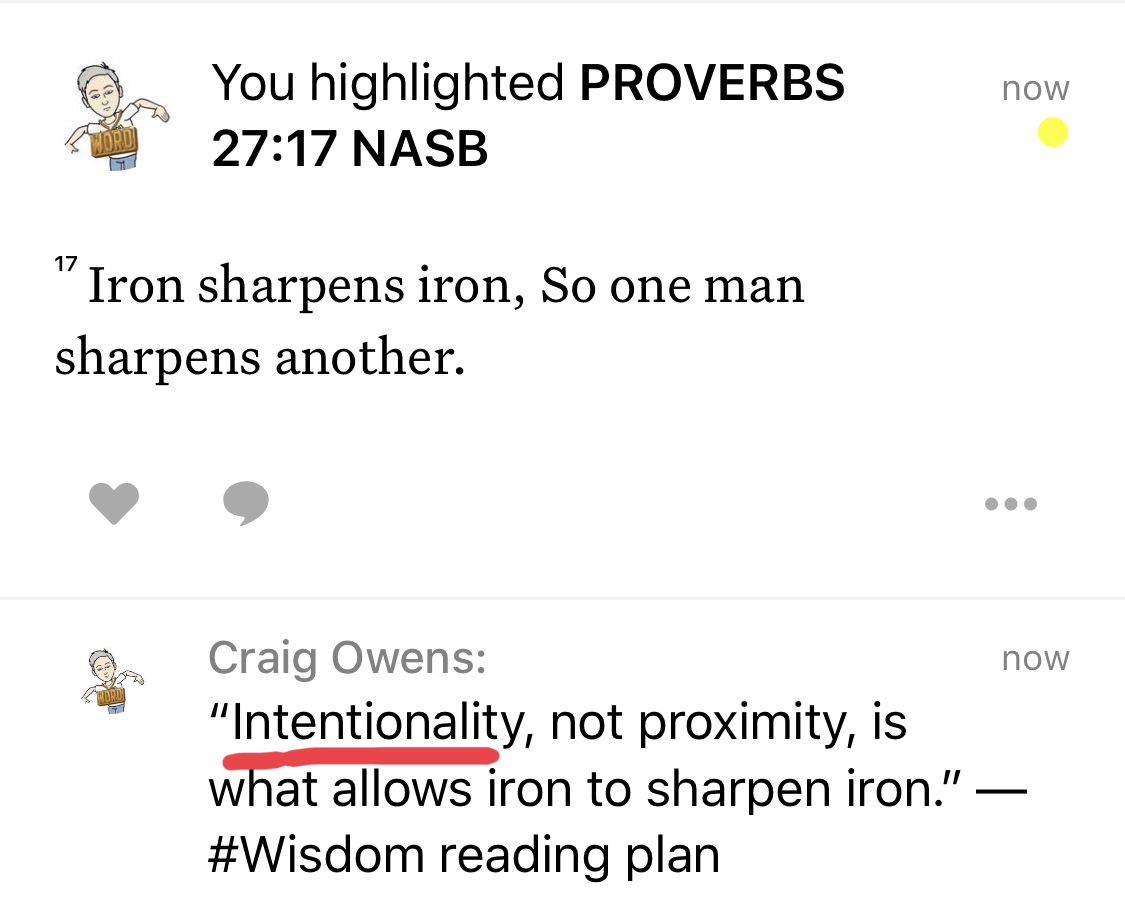
But King Solomon wrote, “As iron sharpens iron, so one man sharpens another” (Proverbs 27:17). The iron of my colleagues definitely sharpened me yesterday.

I also like what John Maxwell said, “Some of my best thinking has been done by others.” In other words, these really smart guys have thought about some things in ways I haven’t; they’ve been exposed to some great thinkers that I haven’t; they’ve experienced some things that I haven’t. But spending the day with them was like getting that education they received, having those conversations with great thinkers they had, and experiencing those things they experienced.

Did I agree with everything that was shared? No.

Was I challenged to think differently? Yes.

F. Scott Fitzgerald wrote, “The truest test of a first-rate mind is the ability to hold two contradictory ideas at the same time, and still retain the ability to function.”

If you really want to sharpen your thinking, get around some people smarter than you. Spend time with people who see things differently than you. But most of all, make sure these folks are one in purpose with you. All of the guys in this Lab shared the same passion to see God glorified and people drawn into a deeper relationship with Jesus. That’s what made yesterday so rewarding for me.

Do you have some “iron” friends in your life that are sharpening your thinking?


Anti-Sudoku Theology

I really enjoy Sudoku. It’s a challenging game of logic, and I’m (for the most part) a logical guy. I like knowing exactly where the digits one through nine are supposed to go, using logical deduction and inference to fill in all of the squares.

If I had my choice, all of life would be this logical. Simple. Neat. Well-defined. Clear. Easy. But, much to my dismay, it’s not.

If I’m following the example and teaching of Jesus, life with Him is anything but logical. Think about some of the paradoxes Jesus Christ taught and lived—

  • To advance, be humbled.
  • To have more, give away more.
  • To possess everything, desire nothing.
  • To connect with people (social), spend time alone with God (solitude).
  • To bring people in, go out.
  • To be a leader, be a servant.
  • To fill up with God, empty yourself of yourself.
  • To come first, come last.
  • To gain wisdom, become foolish.
  • To gain strength, become weak.
  • To live, die.

A.W. Tozer wrote about a godly man: “He has accepted God’s estimate of his own life. He knows he is as weak and helpless as God has declared him to be, but paradoxically, he knows at the same time that he is in the sight of God of more importance than angels. In himself, nothing; in God, everything.”

It isn’t logical, but it’s true: God loves me. And the greatest of all paradoxes: when I was the least worthy of God’s love, that’s when Jesus came to die for my sins.

God’s love for me—the greatest of paradoxes—helps me live these paradoxes Jesus taught. And His love will help you, too.

What other biblical paradoxes have you discovered?