Listen to the podcast of this post by clicking on the player below, and you can also subscribe on Apple, Spotify, or Audible.
Christians should always be striving for a win-win in our relationships. If we try to “win” at the expense of other saints, we all end up losing. So it boils down to this: It’s either a win-win or it’s a lose-lose—there are no other options in God’s Kingdom.
If you would like to watch the full sermon that this clip came from, you can find it here.
You may also be interested in these related posts:
The word gospel simply means the good news about the salvation that comes only through Jesus.
Paul loves this word!
Interestingly, although we refer to the first four books of the New Testament as “The Gospels,” the word itself barely appears:
Matthew—4 times
Mark—8 times
Luke—0 times
John—0 times
And even though these four opening books are the Gospels about Jesus, He Himself only uses the word nine times, with the other three times attributed to someone else mentioning what Jesus was doing.
Peter only uses this word twice (Acts 15:7; 1 Peter 4:17). And John uses it just once (Revelation 14:6).
Paul, however, uses this word 64 times!
It becomes such a part of who he is and how he thinks, that he calls it “my gospel” twice (Romans 2:16, 16:25) and “our gospel” three times (2 Corinthians 4:3; Colossians 1:23; 2 Thessalonians 2:14).
For Paul and for us this Good News is—
God’s promises fulfilled
salvation power
the fullness of God’s blessing
the opening of mysteries
the guide for godly living
glorious light
the expression of God’s grace
the standard of all truth
a key part of the Christian’s spiritual armor
the empowerment for ministry
the anchor of unshakable hope
the means by which we experience Christ’s glory
the only door to life and immortality
For those of us who have been called to preach this Gospel, these thoughts should both humble and empower.
For those of us who have been saved by believing this Gospel, these thoughts should cause us to desire to know more, and more, and more about our Savior.
Listen to the podcast of this post by clicking on the player below, and you can also subscribe on Apple, Spotify, or Audible.
Far too many leaders spend more time making sure things look good on the outside than they do addressing whether things are good on the inside. Of course, I’m talking about issues like character, and humility, and servant-mindedness.
Greg and I addresses this on a recent episode of our leadership podcast The Craig and Greg Show.
Listen to the podcast of this post by clicking on the player below, and you can also subscribe on Apple, Spotify, or Audible.
Have you ever heard this little saying: “To live above with saints we love, oh, that will be glory. But to live below with saints we know, well, that’s a different story”? I’ve found that it’s sometimes true!
We love Psalm 133:1-3 when the saints are all together. What a great “selling point” to invite someone to be a part of the Christian community! But Psalm 41:7-9 is kind of embarrassing as David talks about former friends who have hurt him deeply.
But being bitten by a fellow sheep is a reality we all have experienced, and, sadly, we will probably have to deal with again in the future. There is a natural way we tend to react when we’ve been bitten, but there is also a supernatural response that the Bible consistently calls us to. This is the God-glorifying way we all need to strive for.
In Acts 23, Paul is standing before the Sanhedrin. He opens his remarks by simply saying he has a clear conscience before God, and the high priest immediately orders that Paul be smacked on the mouth! That seems like a bit of an over-reaction on the part of the high priest, but maybe it was a bit of show of force to let Paul know who was really in charge. Paul responded with an immediate—and natural—reaction when he says, “God will slap you!”
Paul is an old man by this time. He’s been through shipwrecks, beatings, imprisonments, gone without food, traveled more miles than he can count, and preached more sermons than he can remember. His body was giving out on him, and his eyesight was especially weak. Clearly, Paul didn’t realize to whom we was addressing his remarks. But when he became aware, he immediately owned up to his mistake. Paul offered no excuses or justifications, just a quick, simple, sincere apology.
When you have been bitten (slapped) by another sheep, you should ask:
Could I have provoked them by something I said or did?
Could I have hurt them by something I didn’t say or do?
David prayed a great prayer in Psalm 139:23. But this prayer is only effective if we are willing to accept that we may have been the agitator that led to the bite. In the last words that Job speaks in the Book of Job, he is very introspective. Check out all of the “If I have” statements throughout Job 31.
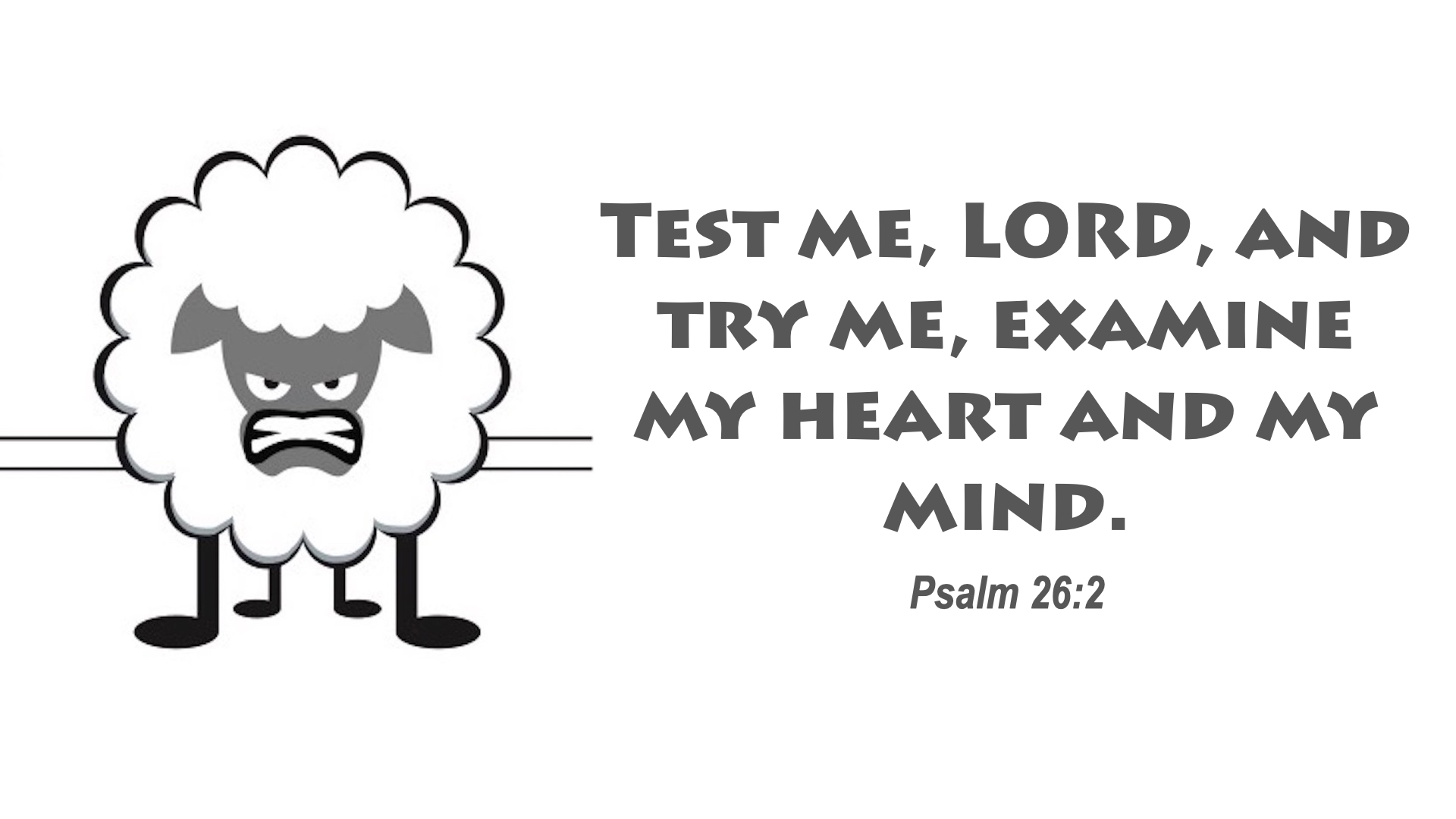
In Psalm 26:2, David invites the Holy Spirit to check him three times!
test me = scrutinize me
try me = assay me
examine me = refine me in the fire
When we are bitten, we should be open to the possiblity that God is using this bite to get my attention—to make me aware of a fault in my life or something that’s been in a blind spot.
So we should consider the following:
Has this kind of bite happened more than once? From different sheep?
Has a spiritually wise person attempted to address this with me before?
Do I ever admit that I’m at fault, or is it always the other person’s fault?
Do I find myself making a list of why they should apologize to me?
When was the last time I apologized to someone else?
If the Holy Spirit reveals something in us, He will also empower us to make the change and make amends. The natural response is to place all the blame on others. The supernatural response to pray Psalm 26:2 before responding.
If we react only the natural way, it is a lose-lose for us and for the whole pasture. But if we learn to respond in a supernatural way, it becomes a win-win for everyone. Listen to the wise words of King Solomon—
He who heeds instruction and correction is not only himself in the way of life but also is a way of life for others. And he who neglects or refuses reproof not only himself goes astray but also causes to err and is a path toward ruin for others. (Proverbs 10:17 AMPC)
Let’s all strive for the supernatural response that is a win-win for the whole Kingdom of God!
Please follow along with all of the messages in this series by clicking here.
P.S. If you are a pastor, you may want to check out my book When Sheep Bite.
You and I will learn lessons in the hard times that we could learn no other way. Then God will use those lessons so we can help minister to others in their hard times. Check out my sermon about interceding for other saints.
ICR’s Dr. Randy Guliuzza says, “Convergent evolution is the fabricated conjecture evolutionists invoke to explain very similar characteristics between creatures that could not have been inherited from a common ancestor and that evolutionists will never accept as having been produced by an intelligently designed internal programming that is specified for common purposes.” This particular article is about bats which have always had the ability to fly. Not one fossil record shows any flightless bats because God created them as flying mammals.
In the early 1900s, Albert Norris was a missionary in India, observing firsthand the spiritual and physical hardships the people faced there. In an article in the Pentecostal Evangel, Norris wrote, “A Christianity that coldly sits down, and goes on its routine of formal work, and allows its fellowmen to starve, or to be obliged to go through all the hard sufferings and exposure connected with famine, without effort to help them, might as well quit its preaching.”
In answering a question about using AI to write a sermon, John Piper answers with an emphatic “no.” I agree! One of the reasons Piper shares: “One of the qualifications for being an elder-pastor-preacher in the Bible is the gift or the ability to teach, didaktikos (1 Timothy 3:2). That means you must have the ability, the gift, to read a passage of Scripture, understand the reality it deals with, feel the emotions it is meant to elicit, be able to explain it to others clearly, illustrate and apply it for their edification. That’s a gift you must have. It’s your number-one job. If you don’t have it, you should not be a pastor.”
“You don’t try to forget the mistake, but you don’t dwell on it. Don’t let it have any of your energy, or any of your time, or any of your space.” —Johnny Cash








 Craig T. Owens