Takin’ Him To The Samaritans

Listen to the podcast of this post by clicking on the player below, and you can also subscribe on AppleSpotify, or Audible. 

Jesus sent us to all nations—to all the streets in all the world (Luke 24:47-49; Acts 1:8). We are to begin in Jerusalem and move outward. As we have seen, Jerusalem is like out Main Street, where there are more similarities than differences between us and the people to whom we are taking the Good News of Jesus. Judea is our Lombard Street & Rodeo Drive, where we are starting to see more differences. 

Then we move to Samaria where there are now way more differences than similarities. But still, let’s never forget that Jesus sent us and the Holy Spirit empowers us to be effective in our witness on every street—even those with whom we have very little in common. 

Jesus literally traveled to Samaria in John 4.

Jesus was baptizing in the Judean countryside (John 3:22) and now He is heading back to Galilee. “The shortest route from Judea in the south to Galilee in the north went through Samaria. The journey took three days if one wanted to travel the direct route. The Jews often avoided Samaria by going around it along the Jordan River. The hatred between the Jews and Samaritans went back to the days of the exile” (Dr. Henry Halley). 

There were wide differences between Jesus and this woman of Sychar:

  1. Cultural differences—The Jews considered the Samaritans to be no longer “pure” Jews, but half-breeds and traitors (vv. 5-9). 
  1. Personal differences—She was female, Jesus was male; she was a divorcée, Jesus was single (vv. 9, 16-18). 
  1. Religious differences—The Samaritans only recognized the Pentateuch; the Jews recognized the entire Old Testament Scripture. And the Samaritans saw Mt. Gerizim as the center of worship and the place the Messiah would reign; the Jews believed Jerusalem to be the center of worship (vv. 19-20). 

Our first task is to find common ground with whoever we can. Jesus used the word “whoever” three times in John 3:16, 18, 36, saying that whoever believed in Him would have eternal life. We need to have this same mindset. It’s not His desire that any should perish—not even the Samaritans!—but that all should come to know Him as Savior. 

In his book Winning With People, John Maxwell presents The 101% Principle: Find the 1% we can agree upon and give that 100% of your effort. 

Jesus found the 1% and gave 100% to it. For He and this Samaritan woman their common connection was water and worship (John 4:9-15, 21-26). Jesus used both of those things to open a conversation about eternal matters. 

Who are the Samaritans in my life? They are people…

  • …I have very little in common with 
  • …I go out of my way to avoid talking to 
  • …I think are never going to “get it” 
  • …who make me angry, defensive, or combative 

But they are also people…

  • …for whom Jesus died
  • …who are dearly loved by our Heavenly Father 
  • …who need to hear the Gospel 
  • …to whom I have been sent 

Our prayer should be this: 

Holy Spirit, help me to notice the people to whom I have been blind or whom I have been avoiding. Help me to find the 1% on which we can agree, and then empower me to give 100% of my effort to that 1%. I want my heart to beat with the heart of my Savior: Whoever believes on Him will not perish but will have eternal life.

If you’ve missed any of the others messages in our Takin’ Him to the Streets series, you can find them all by clicking here. 

►► Would you please prayerfully consider supporting this ministry? My Patreon supporters get behind-the-scenes access to exclusive materials. ◀︎◀︎

Links & Quotes

Shepherd leaders do know the voice of their sheep, and the sheep know the voice of their shepherd. Leaders, this is the value of regularly being around all the people on your team. Check out this full conversation Greg and I had on our leadership podcast. This idea is central to my book Shepherd Leadership.

I have lots of new content every week, which you can check out on my YouTube channel.

Alice Reynolds Flower (1890-1991), the wife of [Assembly of God] pioneer J. Roswell Flower, is a shining example of motherhood. Affectionately known as ‘Mother Flower,’ she preached, taught Sunday School, led prayer meetings, wrote articles, penned poetry, authored books, and lived a godly example in front of her six children and everyone she came in contact with. As Mother’s Day approaches, it is good to consider an article that Mother Flower wrote for the Pentecostal Evangel in May 1952.” Check out Alice Flowers’ article here.

Kenneth Blanchard discusses when it is and isn’t a good time for a leader to be a micromanager. He concludes this insightful post by saying, “The best leaders know how to continually adjust their leadership style to fit each situation, helping to develop individuals who will ultimately achieve each goal and perform well on each task with little direction or support.”

“The pre-Flood world had some truly massive dinosaurs, and the largest of them were in the group Sauropodomorpha. Within this group were titanosaurs, which include the gigantic Argentinosaurus that is estimated to have weighed over 100 tons.” Read more about titanosaurs here.

What is it about morality that points humans higher and higher to find the Source? J. Warner Wallace, in this video based on his book God’s Crime Scene, makes the case that objective, transcendent morality is good proof for God. This reminds me of C.S. Lewis’ similar argument: “My argument against God was that the universe seemed so cruel and unjust. But how had I got this idea of just and unjust? A man does not call a line crooked unless he has some idea of a straight line. What was I comparing this universe with when I called it unjust? If the whole show was bad and senseless from A to Z, so to speak, why did I, who was supposed to be part of the show, find myself in such a violent reaction against it?”

Pastors, listen to this call to revival from the pen of Jonathan Edwards. Let us seek in prayer for a revival in our day! “The Scripture gives us great reason to think, that when once there comes to appear much of a spirit of prayer in the church of God for this mercy, then it will soon be accomplished…Spiritual waters and rivers are explained by the apostle John, to be the Holy Spirit…It is now a time of scarcity of these spiritual waters; there are, as it were, none. If God’s people, in this time of great drought, were but made sensitive of this calamity, and their own emptiness and necessity, and brought earnestly to thirst and cry for needed supplies, God would, doubtless, soon fulfill this blessed promise.”

The God Who Is Our Salvation

Selah means to pause and carefully consider. 

“The God who is our salvation” is on each side of this sacred pause. What can we consider from this? 

  • God is my salvation
  • God is for me
  • God is my daily provision
  • God is my light and my life
  • God is my escape from death
  • God is worthy of all my worship

Let’s take time to slow down and truly savor the inspired thoughts when the Holy Spirit moved the biblical author to pause. There are powerful, encouraging, life-changing truths just waiting to burst into our heart and mind!

I shared more about this Selah pause in this message and this message. You may also be interested in our whole series looking at the all the Selahs in the Bible.

Responding To The Invitations

Listen to the podcast of this post by clicking on the player below, and you can also subscribe on AppleSpotify, or Audible.

The apostle Paul shows us how simply sharing the good news about Jesus opened a door for him to speak to a very influential group in Athens. I experienced something similar that I think will be helpful for you to hear. 

The Scripture I reference in this video is Acts 17:16-34. 

You can watch the full sermon this clip came from by clicking here.

►► Would you please prayerfully consider supporting this ministry? My Patreon supporters get behind-the-scenes access to exclusive materials. ◀︎◀︎

My Newest Book Is Available Now

When Sheep Bite is available for purchase now.

This is a book I wish I didn’t have to write, but far too many pastors are leaving their ministries too early because of the attacks they have had to endure. When Sheep Bite is help for hurting shepherds.

One pastor has called this book “a must-read for every pastor and ministry leader,” and another pastor said, “This is more than a good book. This is the difference between finishing your race and dropping out.”

Check out this book review by theologian T.M. Moore.

When Sheep Bite is presented in three sections:

  1. Cultivating God’s heart toward the sheep
  2. A shepherd’s godly response to attacks
  3. Finishing well

Get your print copy today!

Here is a recent video about When Sheep Bite. You can also check out the whole playlist of videos related to this helpful book.

Jesus The Gentleman

Listen to the podcast of this post by clicking on the player below, and you can also subscribe on AppleSpotify, or Audible. 

Have you every thought of Jesus as a gentleman? 

Consider this question He asked of a Samaritan woman, “Will you give Me a drink?” (John 4:7). 

As a Man, Jesus could have demanded to be served, but instead He asked her if she was willing to serve Him. He gave her dignity. 

Jesus was tired and thirsty (v. 6), so He gave her an opportunity to be a blessing to Him. When Samaritans were so often overlooked or avoided or even derided by Jews, Jesus gave her a chance to help someone truly in need. 

Jesus offered her living water. She was used to an angry look or a striking hand, not an offer of a blessing. He said, “I would like to bless you with living water, if you will just ask Me for it” (v. 10). 

Once again, Jesus affirmed her dignity by giving her the option to take His blessing—it was right there for the asking. He didn’t force anything upon her, but allowed her to choose. 

Jesus didn’t talk down to her. He didn’t demean her as a woman, a Samaritan, or a divorcée. He didn’t scold her for her religious beliefs. He treated her with love as a person of value and great worth. 

Jesus is love. 

Jesus is gentle. 

Jesus wants to show us His favor. 

And Jesus wants us to show His favor to others. 

Are you treating others in this gentle, Christ-honoring way? 

It’s an important question for you to ask and honestly listen to the answer from the Holy Spirit. Let’s be the kind of gentlemen and gentlewomen that represent Jesus well. 

►► Would you please prayerfully consider supporting this ministry? My Patreon supporters get behind-the-scenes access to exclusive materials. ◀︎◀︎

Please Don’t Misunderstand Me

Listen to the podcast of this post by clicking on the player below, and you can also subscribe on AppleSpotify, or Audible. 

I want to make sure there are no misunderstandings on this, so please stay with me! I realize that the title of my newest book—When Sheep Bite—may bring a picture to your mind that I never intended.

Check out this episode of The Podcast.

Here are some helpful resources from this episode:

If you would like to watch the full interview I did on the Converge Coaching podcast, check that out here.

Order your copy of When Sheep Bite here!

Here are a bunch of ways to get in touch with me and follow along with other projects on which I am involved.

►► Would you please prayerfully consider supporting this ministry? My Patreon supporters get behind-the-scenes access to exclusive materials. ◀︎◀︎

A Godly Woman’s Superpower

Listen to the podcast of this post by clicking on the player below, and you can also subscribe on AppleSpotify, or Audible.

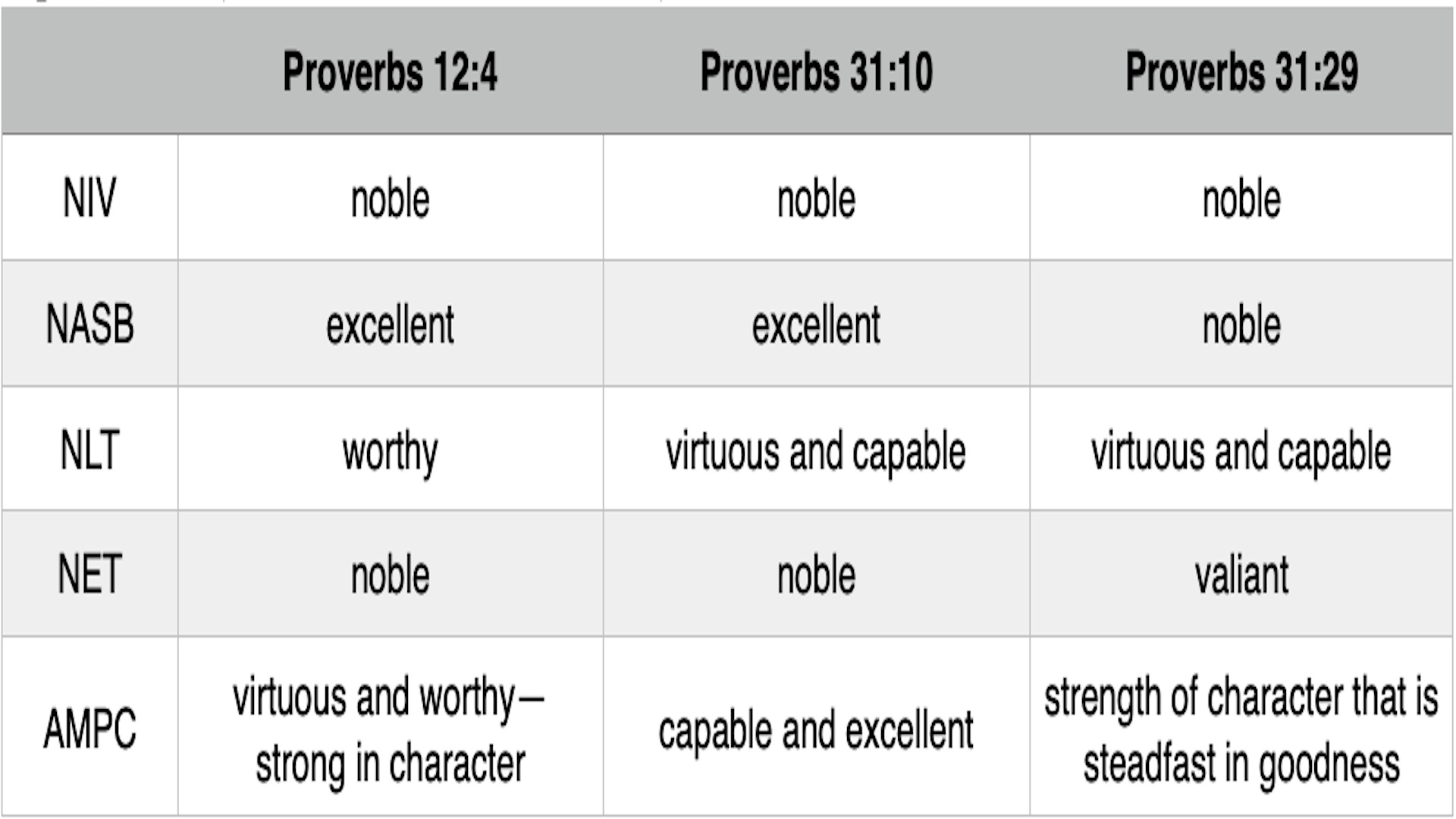
Mother’s Day messages seem to set a lofty expectation for women. When a pastor flips to Proverbs 31 and begins to read the description of the noble wife, I’m afraid many women—both moms and not-yet-moms—wonder how they could measure up to this list! The proverb itself really starts out with a question, “Who could find such a woman?!” (Proverbs 31:10).  

The Hebrew word for noble is used five times in Proverbs. Three of those are for this kind of superwoman (Proverbs 12:4, 31:10, 31:29).

This same word is also used twice for men in Proverbs—A good man leaves an inheritance to his children’s children (13:22); do not spend your strength on women, your vigor on those who ruin kings (31:3). 

(You can read all of the verses I’ve mentioned in this post by clicking here.)

A woman’s nobility and virtue either unleashes strength OR her vices deplete strength and bring ruin. In the language of Proverbs 31:3, she is either a king-maker or a king-breaker. 

This picture of empowerment is seen in the very first couple (Genesis 2:18-24). In the King James Version language, the word for helper is help meet. This means that Eve is the key that unlocks Adam’s potential. The godly woman makes possible what the godly man cannot do on his own. 

For a negative example of this, look at how Delilah sapped Samson of his strength and potential (Judges 16:6, 16, 19). On the flip side, we see a positive example in Ruth who unleashed the king-making power of her husband Boaz (Ruth 3:11, 4:11). 

As a kid, I always suspected my Mom had superpowers. I remember digging through the hair on the back of her head to find “the eyes” she said she had in the back of her head! She could kiss my boo-boo and instantly I was better, and she could help me understand the things that perplexed me the most. 

As I got older, I realized that my Mom actually did have superpowers:

  • She faithfully loved her God—Proverbs 31:30  
  • She diligently served her husband—31:11-12, 23 
  • She consistently cared for her children—31:27-28 

Ladies, that is the superpower that you have—you complete us, you elevate us, you unlock our potential! This brings both elevation for your family and honor for yourself (see Proverbs 31:29-31, and notice the phrase “city gate” in vv. 23 & 31 which symbolizes a leadership position). 

Women who ignore their God-given superpower of nobility unleash the vicious cycle of king-breakers. 

Women who use their God-given superpower of nobility unlock a virtuous cycle of king-makers. 

Ladies, be encouraged today that all that is required for this Proverbs 31 list to be an accurate description of you is faithfully loving your God and faithfully serving your family in the consistent, little things day after day after day. God sees this, He is pleased by it, and He is rewarding it! 

Guys, you have a part to play in this too. What you do with the potential that your mother and your wife have unlocked for you also plays a vital role in your family and in your community. I talked about this on Father’s Day, which you can check out here.

►► Would you please prayerfully consider supporting this ministry? My Patreon supporters get behind-the-scenes access to exclusive materials. ◀︎◀︎

Links & Quotes

Christians do a disservice to the Gospel when we’re known more for what we’re against than what we’re for. Check out this full message hereI have lots of new content every week, which you can check out on my YouTube channel.

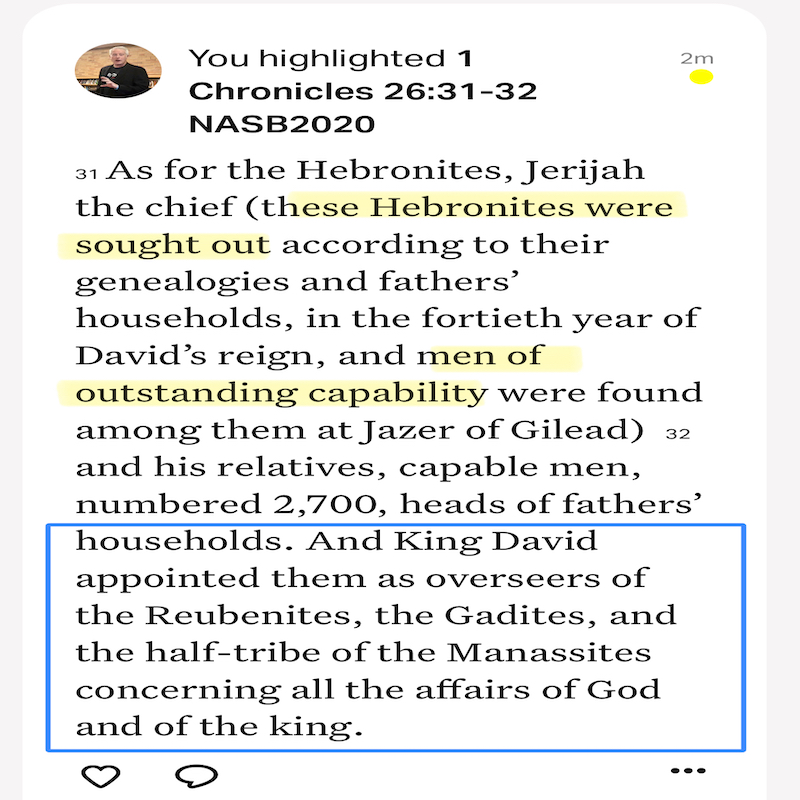
The Hebronites faithfully served God and King David without any fanfare or recognition. God shined His light on these “men of outstanding capability” so that they were finally recognized publicly. Note that they didn’t try to promote themselves. They faithfully served and God promoted these humble men in His timing.

I always appreciate the straightforward leadership insights that Ken Blanchard shares. He wrote, “Leadership is not something you do to people, but something you do with people.” And in this post he discusses some strategies when one of your direct reports is struggling.

“If I find 10,000 ways something won’t work, I haven’t failed.” —Thomas Edison

“We are a Christian people, according to one another the equal right of religious freedom, and acknowledging with reverence the duty of obedience to the will of God.” —1931 Supreme Court ruling

The Holy Spirit reminds us of God’s Word. But in order for Him to remind us, we have to study it first! Check out this full message.

“Your real, new self…will not come as long as you are looking for it. It will come when you are looking for God.” —C.S. Lewis, in Mere Christianity

“Just because they say it’s impossible doesn’t mean you can’t do it.” —Roger Bannister, who broke the “impossible” barrier of running less than a 4-minute mile on May 6, 1954

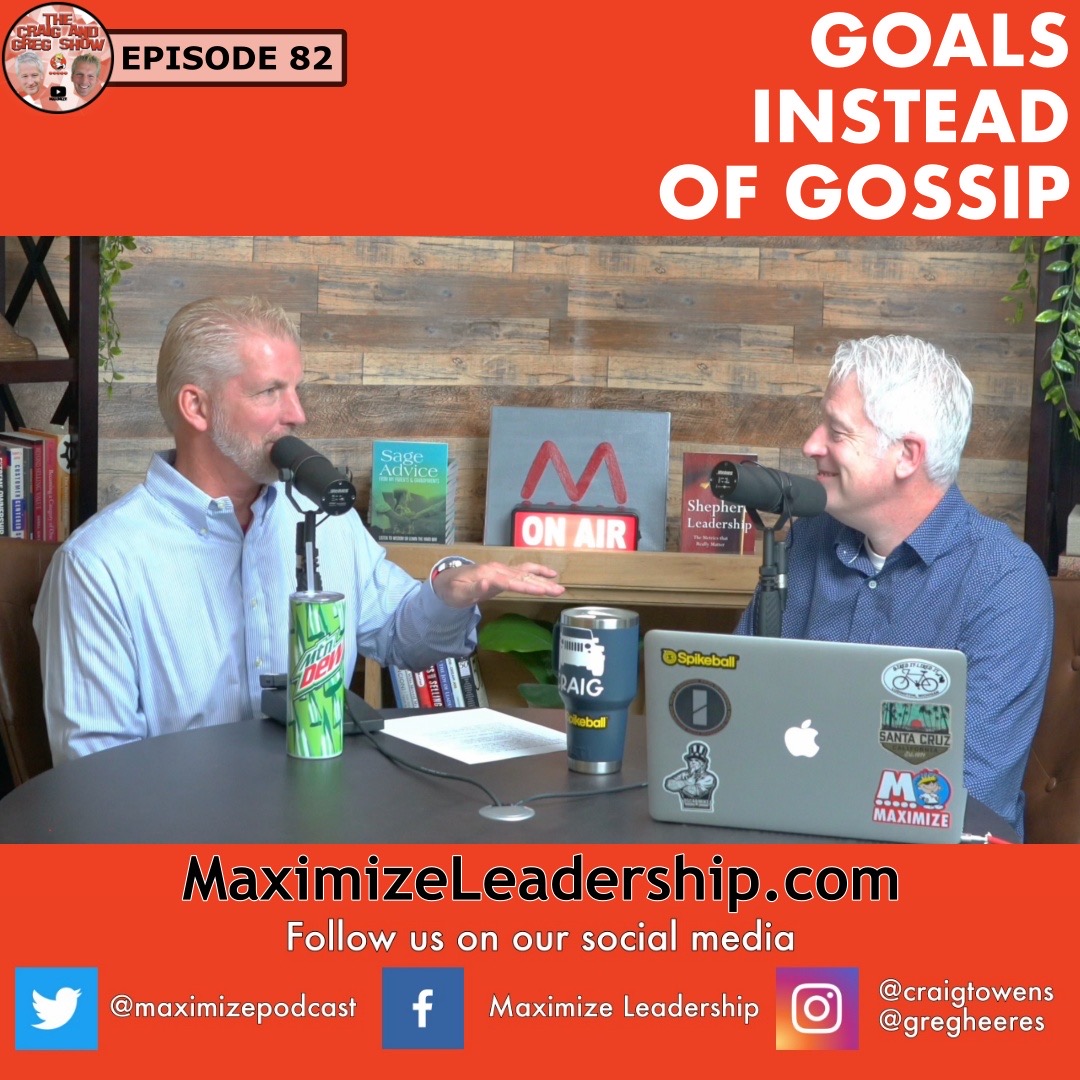
The Craig And Greg Show: Goals Instead Of Gossip

Listen to the audio-only version of this podcast by clicking on the player below, or scroll down to watch the video.

When you are in a leadership role it is unavoidable that you will occasionally have to talk about people. Perhaps it’s gathering more information or discussing an incident with a fellow leader. However, we have to be very careful that these discussions don’t cross the line into gossip. Gossip is toxic for your organization, and left unchecked can lead to disastrous results. Check out this episode where Greg and I discuss how to make your conversations about goals instead of gossip.

  • [0:31] Leaders have to have lots of conversations on different levels—how do they do this without gossiping about their teammates? 
  • [1:32] Leaders need to have a goal for each of their conversations.
  • [3:39] What holds leaders back from having the productive (but difficult) conversations?
  • [6:02] Leaders need to be careful of the diabolic nature of gossip.
  • [8:58] We need to try to make all of our conversations constructive for us, our teammates, and the entire organization.
  • [11:01] Productive, healthy conversations must become a part of your organization’s culture.
  • [13:09] Do your teammates totally trust that you, as their leader, have their best in mind?
  • [16:51] Leaders need to prioritize transparency at all levels of the organization.
  • [18:36] Leaders can empower their teammates to make healthy changes.
  • [22:33] With the privilege of leadership come responsibility. Greg and I can help you raise your leadership impact through our coaching services.

Check out this episode and subscribe on YouTube so you can watch all of the upcoming episodes. You can also listen to our podcast on Spotify and Apple.