Listen to the podcast of this post by clicking on the player below, and you can also subscribe on Apple, Spotify, or Audible.
In my book Shepherd Leadership, I take two chapters to dive deep into the healthy tension that is helpful for leaders. This is an important tension to maintain our effectiveness as leaders.
As I said in this interview, every leader should take the proactive steps to make sure that our healthy leadership confidence doesn’t cross the line and become unhealthy leadership hubris. Keep healthy friends around you, enlist the help of a wise mentor, pray that searching prayer from Psalm 139, and pick up a copy of Shepherd Leadership.
I have a special offer just for pastors (and for those who love their pastor). For just $12 I will send you an autographed copy of my book and a download link to get the audiobook of Shepherd Leadership free of charge. All you need to do is complete this form and I’ll have the materials right out to you.
Listen to the podcast of this post by clicking on the player below, and you can also subscribe on Apple, Spotify, or Audible.
Being the firstborn, I didn’t have a big brother, but I took being the big brother to my little sister very seriously! Like when young men would come to pick her up for a date, I would meet them on the front porch and say, “I hope you have a really nice evening. Just so you know, I will be home all evening waiting by the phone. You’d better pray that my little sister doesn’t have to call me!” Hopefully, that let my sister know I was ready to protect her whenever she may need it.
Whenever we go into any situation for the first time, there is always a natural fear of the unknown. What’s going to happen? How do I behave? What do I say? How will others treat me? How will I know who to trust? Or even, how will I know what to pray for?
Those unknowns cause fear, and fear prevents intimacy. The Bible says, “There is no fear in love” (1 John 4:18). Where there is love, fear has to leave. But when there is fear, love is pushed aside.
We learned that we can come to God in prayer as a Father—we can bring Him all our fears and concerns and problems—but did you know that we can also come to God in prayer as coming to a Brother?
Jesus loves the fact that we can come to our Abba Father just as He did, which is why He taught us to begin our prayers with, “Our Father in heaven.”
How wonderful it is to have a “big brother” to show us the ropes, to walk with us, to give us his counsel! One that says, “I’ve already been to that high school … I know that employer … I have experience with that kind of relationship … I’ve solved that problem … I’ve tasted that pain.…” That’s exactly what Jesus does for us. He is our perfect Big Brother!
Jesus knows everything we will experience in life. There might be unknown things that we walk into, but they are never unknown to Him. And more importantly, they are never unexperienced by Him. Check out these assuring words from the Book of Hebrews—
Both the One who makes people holy and those who are made holy are of the same family. So Jesus is not ashamed to call them brothers and sisters. … For this reason He had to be made like them,fully human in every way, in order that He might become a merciful and faithful high priest in service to God, and that He might make atonement for the sins of the people. Because He Himself suffered when He was tempted, He is able to help those who are being tempted. (2:11, 17-18)
For we do not have a high priest who is unable to empathize with our weaknesses, but we have one who has been tempted in every way, just as we are—yet He did not sin. Let us then approach God’s throne of grace with confidence, so that we may receive mercy and find grace to help us in our time of need. (4:15-16)
Jesus has been there, done that, and has the scars to prove that He is victorious!
We never have to be at a loss of what to say (John 12:49-50)
We never have to be at a loss of what path to take (John 14:6)
We never have to be at a loss of what prayer to pray (John 16:23)
Charles Spurgeon said, “The Lord Jesus Christ is always ready to take the most imperfect prayer and perfect it for us. If our prayers had to go up to heaven as they are, they would never succeed; but they find a Friend on the way, and therefore they prosper.”
Solomon wrote, “Trust in the Lord with all your heart; do not depend on your own understanding.Seek His will in all you do, and He will show you which path to take (Proverbs 3:5-6).
“We tend to crave God’s explicit direction for the momentous choices of life—marriage, study, career, transition, promotion, change—but sail through a thousand daily choices independent of consultation with Him. Functionally, we act as if we only need God’s help for big things because we can handle the small things without Him. The error in this dichotomy of dependence (thinking we only need God’s help for big decisions) is twofold. First, big decisions are not divorced from small decisions; they are simply the crowning act, the summary of a legion of choices. Second, big decisions are not more important than small decisions. It is the small, simple, silent, serial choices of daily living that make one wise. When we acknowledge the Lord in all the minutia, our course is chosen and our path is set, and we do not stand bewildered at the critical crossroads of life.”
Walking with Jesus as our Brother keeps us free from fear. His perfect love opens our hearts to have intimate conversation with our Heavenly Father. You can trust our Brother to help you with every single decision at every single moment. Let’s learn to lean on Him more!
When Jesus says, “I need you,” will you be able to say, “I’m ready for You”? Here is a great example of a man who stayed ready year after year for that precise moment when Jesus said, “It’s time.” Please subscribe to my YouTube channel.
Pastors, I was challenged by the insight from T.M. Moore, and I hope you will take a couple of minutes to read the full post and even subscribe to his regular emails. “John Calvin explained that one of the marks of a true church is that the Word of God is faithfully proclaimed and heard. He did not consider a church to be fulfilling its mission simply by sound preaching. Sound preaching had to be coupled with sound hearing and obedience, for only as believers do the Word to they receive it as God intends.
“In this, Calvin and Columbanus are in agreement: ‘While we preach often we improve slowly; often are we offended, seldom patient, often conquered, seldom conquerors, often led astray, seldom wise. Then what will help us, like weak and unskilled fighters whose weapons turn and wound them, while it is no credit to hear these things, but to accomplish them? For the law does not make holy by hearing, but doubtless by performance; each should honour the Lord, not simply by words and bodily toil, but by ripeness of character and purity of heart’ (Sermon II).”
[1:47] What are some reasons people don’t set goals?
[3:10] The trap of comfort zones.
[5:14] Are you afraid of achievement?
[5:57] The balance of internal and external discipline.
[9:21] We would love to help you stretch to the next level!
[10:30] Why do people set goals?
[13:42] Why are goals hard to attain?
[14:31] Time is not manageable.
[15:30] Self-awareness and clarity are tools to help set goals.
[17:48] Be a goal-influencer by supporting others’ goals.
[19:20] Take time to celebrate reaching goals.
[22:40] Sharing goals with others lets them know what’s important to you.
[23:31] Celebrating steps toward a goal helps maintain motivation.
[25:00] I love this quote from Andrew Wood on incremental steps.
Check out this episode and subscribe on YouTube so you can watch all of the upcoming episodes. You can also listen to our podcast on Spotify and Apple.
Listen to the podcast of this post by clicking on the player below, and you can also subscribe on Apple, Spotify, or Audible.
Are you a pastor who is feeling discouraged? Or do you know a pastor who has become frustrated by what isn’t happening in their church? If so, please read on because I have something special for you.
When I was interviewed on the 200churches podcast with Jeff Keady, I tried to speak an encouraging word to my fellow pastors, especially those who were discouraged to the point of wanting to throw in the towel. If that’s you, I hope that you will take two minutes to listen to this short clip (click the audio link above).
I’ve never seen the actual research, but I’ve heard the story enough to believe that it’s probably true that more pastors write their letters of resignation on Monday morning than on any other day.
That’s understandable.
All week, pastors prepare to deliver a message on Sunday, and then they pour out their hearts as they minister to those who have come to church. But when they look around for those who didn’t come to church, or when they see only apathy in those who did come to church, or (perhaps worst of all) when all they hear are complaints, it’s understandable how frustration and discouragement can creep in and even overwhelm.
So back in their office on Monday morning, facing the prospect of another week that seems to be shaping up to feel unsuccessful again, many pastors choose to resign.
My heart goes out to these pastors. In fact, I had these very pastors in mind as I wrote my book Shepherd Leadership.
As we are at the start of a new year, I would like to make a special offer for pastors. For just $12 I will send you an autographed copy of my book and a download link to get the audiobook of Shepherd Leadership free of charge.
All you need to do is complete this form and I’ll have the materials right out to you. I’m praying for you, my friend, that you will allow God to use the message in this book to encourage you to persevere and thrive despite the challenges you are facing.
Listen to the podcast of this post by clicking on the player below, and you can also subscribe on Apple, Spotify, or Audible.
I enjoy reading devotional books that are based on passages of Scripture, but I get quite frustrated when there is more devotional thought than there is Scripture. This is decidedly not the case in Dick Brogden’s devotional book Proverbs: Amplified And Applied.
Full disclosure: Dick Brogden is my cousin, so I may be just slightly biased on this book. But I don’t think my bias in any way contradicts my statement about the volume of Scripture contained in this powerfully insightful devotional work.
Dick has taken the Book of Proverbs and gone deep on every single verse. Each note is a treasure trove of insights, cross-references to other biblical concepts, and action steps that can immediately become a prayer request or a daily goal.
Let me give you an example. Provers 2:7 says, “He holds success in store for the upright, He is a shield to those whose walk is blameless.” Dick’s amplification and application for this verse says—
“Wisdom is a supply and a defense. Wisdom gained now provides in the present and protects in the future. God in His benevolence stockpiles wisdom for us. He gives neither Spirit nor wisdom by measure. He delights to flood, saturate, fill, overwhelm, and lavish the spirit of wisdom, counsel, discernment, and understanding upon us. When we walk in the light, in integrity, it is as if we have a library card that allows us free checkout of heaven’s daily living manuals. Our integrity is what gives us access to all the stored-up wisdom of God. Integrity also shields us from the attacks of folly. The grandest folly comes wrapped in deceptive intelligence. The devil is able (cunning angel of light that he is) to make foolish things seem wise. We are able to see through his disguises and be shielded from his traps when we have a legacy of continually checking out, reading, and applying God’s insight. It is the familiarity with the feel of the true that helps us recognize the false.”
I’m reading through the Book of Proverbs very slowly this year, allowing Dick’s commentary to help me let these principles sink in deep. For those who love the wisdom of Proverbs, I would greatly encourage you to get a copy of Dick’s book for yourself.
Listen to the podcast of this post by clicking on the player below, and you can also subscribe on Apple, Spotify, or Audible.
Jesus told us numerous times that we can come to God as our Father.
Have you ever played a word association game? For instance, if I said “winter” you might say “shoveling” (or kids might say “sledding”). If I said “summer” you might say “vacation.” But I think the word “father” may bring up a lot of very different feelings or images. Some may have fond memories of the word “father” while others may think:
playful but not a good provider
disciplinarian
hard to please
absent
unavailable
Even if our human fathers were good, they were still flawed. Jesus said this about us, “If you parents, that even know how to give good things to your kids are evil, how much more amazing is the goodness and love of God” (Matthew 7:11). But Jesus had something entirely different in mind for us when He told us we could come to God as our Father. And, sadly, it’s a level of intimacy that many have never known.
All of us could only experience limited intimacy with our earthly fathers, but with our Heavenly Father we can have unlimited and unimaginable intimacy!
When Jesus was teaching us to pray in Matthew 6:6-9, there are two thoughts that stand out to me about coming to God as our Father. First, Jesus tells us that we don’t have to use any special language. When He said some people babble in prayer, Jesus was saying they were using a language that was unnatural to them—they weren’t being themselves.
Our Heavenly Father wants us to come to Him as children: full of innocence, and wonder, and expectation, and imagination!
Second, I notice that three times Jesus calls God “your Father,” but when He begins His model prayer He says, “Our Father.” Think of that: Jesus is saying we can approach God the same way He approached His Father!
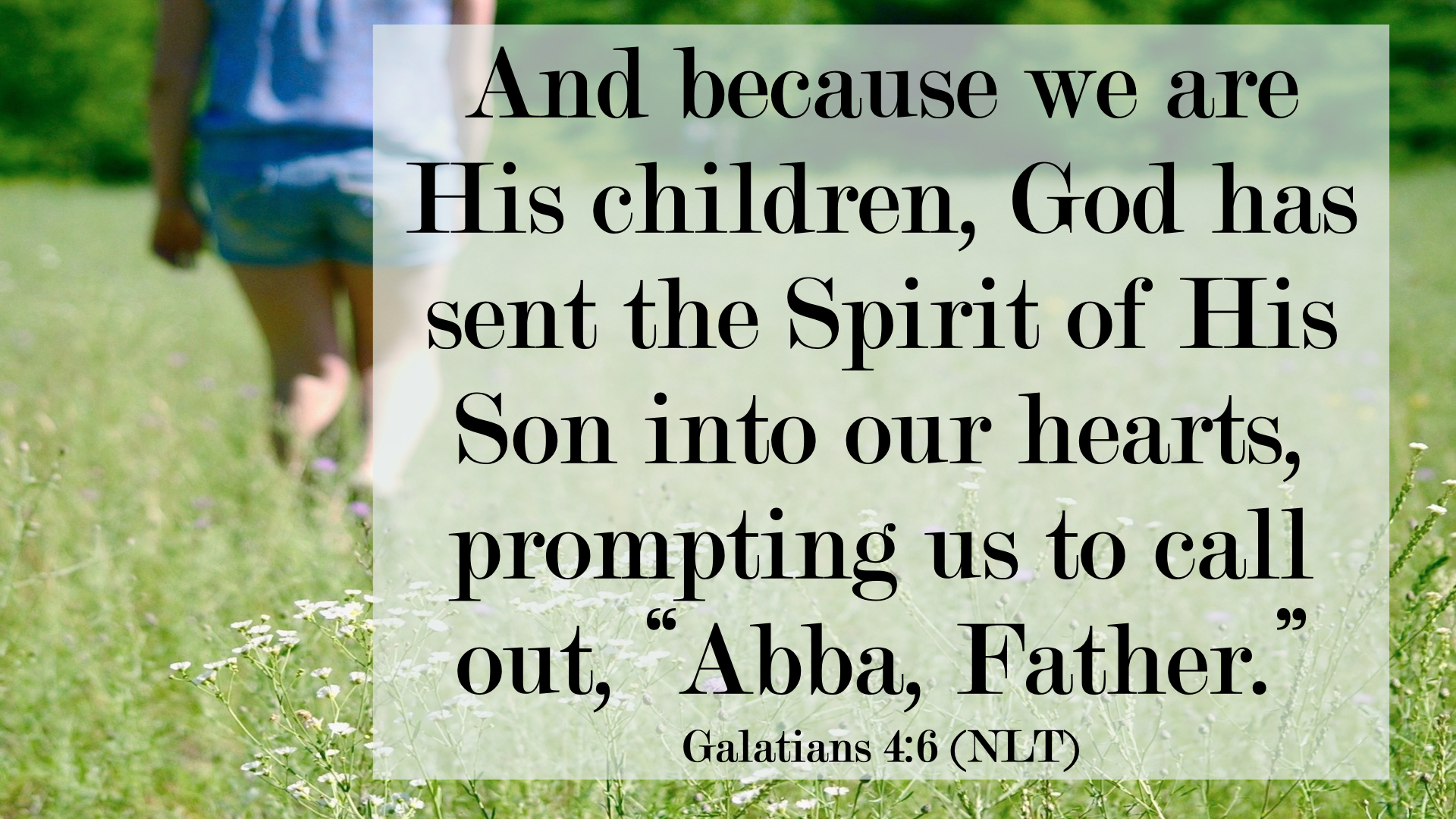
In His intense prayer time just before His crucifixion, Jesus used the phrase “Abba Father” to express His intimacy. This phrase is used two other times in the New Testament. Both of these times it’s telling us that we can approach our Heavenly Father the same way Jesus did (see Mark 14:36; Galatians 4:6; Romans 8:15).
The Romans understood the weight that was associated with the practice of adoption. They knew that a father chose that child to be a part of his family, giving that child full acceptance into the family. Marvin Vincent noted,
“We have but a faint conception of the force with which such an illustration would speak to one familiar with the Roman practice; how it would serve to impress upon him the assurance that the adopted son of God becomes, in a peculiar and intimate sense, one with the heavenly Father.”
In writing to the Romans, Paul reminds them that for those who are in Christ Jesus, there is no condemnation—nothing holding them back from God’s presence. He also said that God has fully adopted us into His family, and that the Holy Spirit was now in us, encouraging us to call God “Abba Father” just as Jesus did (Romans 8:1, 14-16).
Check out these two final thoughts from Jesus: He encourages us to approach God as innocent children, and He praises Our Father for then intimately confiding in His children—
“Truly I tell you, unless you change and become like little children, you will never enter the kingdom of heaven. … I praise You, Father, Lord of heaven and earth, because You have hidden these things from the wise and learned, and revealed them to little children.” (Matthew 18:3, 11:25)
No matter what your relationship was with your earthly father, Jesus encourages us to approach our Heavenly Father in innocence, wonder, expectation, imagination, and intimacy. This is what God desires in His relationship with you!
God made you uniquely YOU on purpose. So you can ask Him to show you why He put you together as He did—with all of the gifts that make you YOU. Please subscribe to my YouTube channel.
“It is best not to be too dogmatic about the events surrounding [Christ’s] second coming. But if language is a vehicle of thought at all, it certainly takes a good deal of explaining and interpreting to make anything else out of Jesus’ words than that He Himself looked forward to His coming again as a definite historical event in which He will personally and literally appear to gather to Himself and to eternal glory those who have been redeemed by His blood.
“And it is best not to cloud the hope of His coming with too detailed a theory as to what is going to happen when He comes. Some people may be disappointed if Jesus does not follow the schedule they have mapped out for Him.”
“The future doesn’t belong to the fainthearted; it belongs to the brave.” —Ronald Reagan
“We are not called to punish the people for whom Jesus was already punished.” —Kevin Berry
Daniel B. Wallace, a New Testament professor at Dallas Theological Seminary, wrote, “If you could stack up all handwritten manuscripts of the New Testament—Greek, Syriac, Latin, Coptic, all languages—how tall would the stack be? … I have said in many lectures that it would be the equivalent of c. 4 & 1/2 Empire State Buildings stacked on top of each other. How did I come up with that number?” Check out his post to read how he calculated this astounding number. This is just another link in the chain of evidence for the historicity of the Bible.
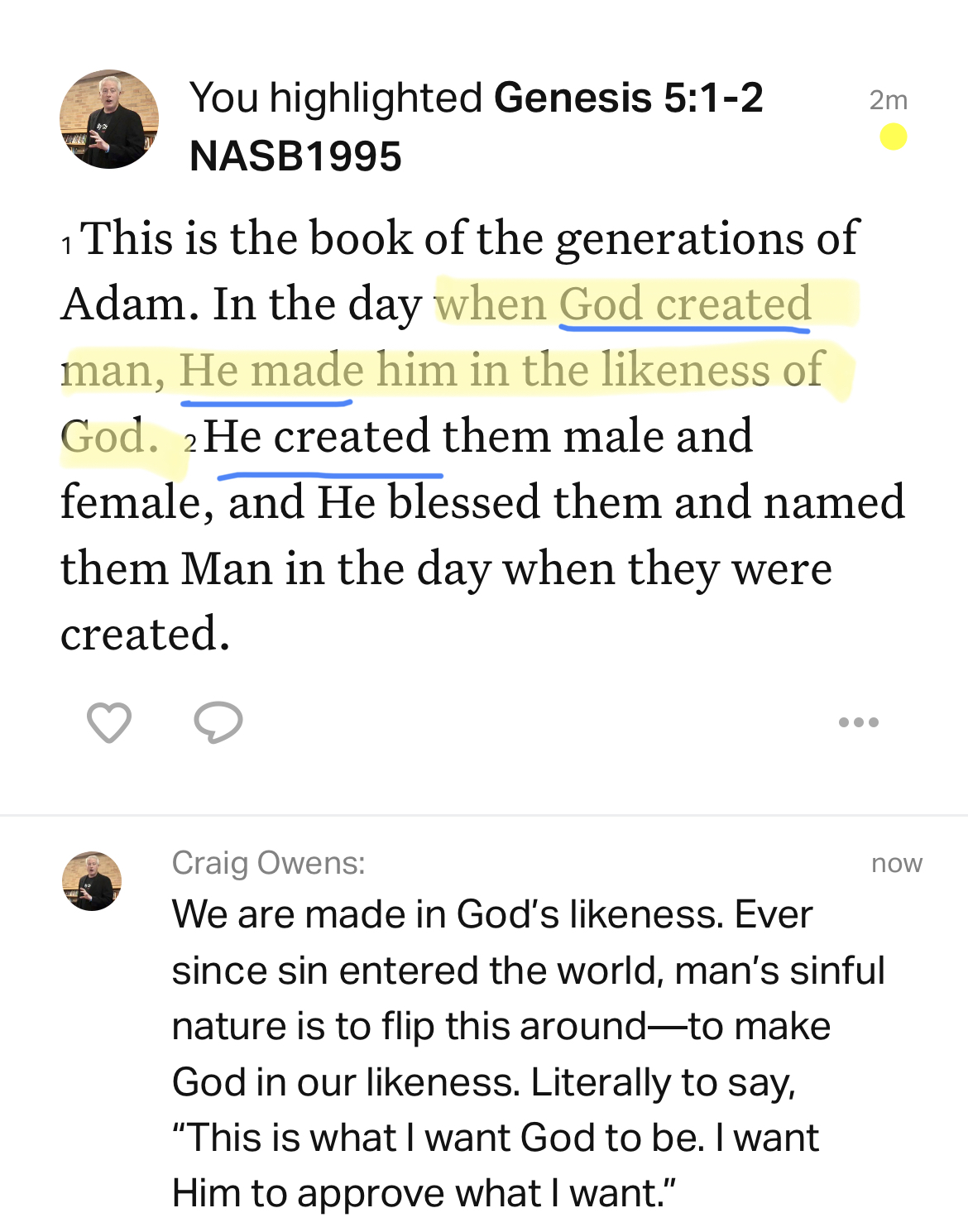
I shared this commentary on YouVersion this week: We are made in God’s likeness. Ever since sin entered the world, man’s sinful nature is to flip this around—to make God in our likeness. Literally to say, “This is what I want God to be. I want Him to approve what I want.”
“Pure humor is the most difficult of all of comedy. Late night humor is funny because it is mean. It is relatively easy to be crude, cynical, and sarcastic. It comes naturally to our fallen natures to criticize, tease, mock, and scoff. It’s much harder to make people laugh by lifting others up.” —Dick Brogden, in his book Proverbs: Amplified and Applied, commenting on Proverbs 1:22
The dictionary defines the word “intimate” with these phrases:
associated in close personal relations
characterized by warm friendship
closely personal
These words perfectly describe the relationship God wants to have with His children through prayer. Pete Briscoe said, “Prayer is an intimate conversation with the One who passionately loves you and lives in you.”
The One who loves you so passionately desires to walk with you and share intimate knowledge with you. Prayer is not something formal, cold, or mechanical, but it is vibrant, warm, engaging, and life-changing.
I invite you to join us for our prayer series called Intimate Conversation beginning this Sunday. We would love to have you join us in person, but if you are unable to do that, we will make all of the messages available on Facebook and YouTube. If you’ve missed any of the messages, you will be able to find them all here:
Listen to the podcast of this post by clicking on the player below, and you can also subscribe on Apple, Spotify, or Audible.
Plato said, “Arguments, like men, are often pretenders.” This is both true and a logical syllogism. It is true because men often pretend, and they design their arguments to support their pretenses.
One of my favorite classes in college was “Introduction to Logic.” In fact, it is one of my few college textbooks that is still in my personal library today. It always struck me that God created logic. That means He is infinitely logical.
So we can restate Plato’s quote like this, “God’s arguments, like God Himself, are always authentic, logical, and valid.”
In my Bible study time, I often highlight the words that denote premisses and conclusions. In just Ezekiel 36 alone I find:
therefore (6x)
because (2x)
then (6x)
for (1x)
so that (1x)
We can argue against God’s logic, and we can even try to invalidate His arguments. But to do so makes me illogical. God not only gives the premisses and the conclusion, but He makes them both logical and valid. God told Jeremiah, “I am watching to see that My word is fulfilled” (Jeremiah 1:12).
So any of my attempts to redefine or re-order or invalidate what God has logically presented ultimately brings disorder, collapse, and frustration. It is far better for me to simply follow the premisses and trust God to bring about His promised—and logical—conclusion.
I encourage you to look for these logic statements as you read the Bible yourself. Here is a Bible study from Proverbs 2 that can help get you started.



 In my book Shepherd Leadership, I take two chapters to dive deep into the healthy tension that is helpful for leaders. This is an important tension to maintain our effectiveness as leaders.






 Craig T. Owens
Proverbs: Amplified And Applied (book review)
January 10, 2023 — Craig T. OwensListen to the podcast of this post by clicking on the player below, and you can also subscribe on Apple, Spotify, or Audible.
Full disclosure: Dick Brogden is my cousin, so I may be just slightly biased on this book. But I don’t think my bias in any way contradicts my statement about the volume of Scripture contained in this powerfully insightful devotional work.
Dick has taken the Book of Proverbs and gone deep on every single verse. Each note is a treasure trove of insights, cross-references to other biblical concepts, and action steps that can immediately become a prayer request or a daily goal.
Let me give you an example. Provers 2:7 says, “He holds success in store for the upright, He is a shield to those whose walk is blameless.” Dick’s amplification and application for this verse says—
“Wisdom is a supply and a defense. Wisdom gained now provides in the present and protects in the future. God in His benevolence stockpiles wisdom for us. He gives neither Spirit nor wisdom by measure. He delights to flood, saturate, fill, overwhelm, and lavish the spirit of wisdom, counsel, discernment, and understanding upon us. When we walk in the light, in integrity, it is as if we have a library card that allows us free checkout of heaven’s daily living manuals. Our integrity is what gives us access to all the stored-up wisdom of God. Integrity also shields us from the attacks of folly. The grandest folly comes wrapped in deceptive intelligence. The devil is able (cunning angel of light that he is) to make foolish things seem wise. We are able to see through his disguises and be shielded from his traps when we have a legacy of continually checking out, reading, and applying God’s insight. It is the familiarity with the feel of the true that helps us recognize the false.”
I’m reading through the Book of Proverbs very slowly this year, allowing Dick’s commentary to help me let these principles sink in deep. For those who love the wisdom of Proverbs, I would greatly encourage you to get a copy of Dick’s book for yourself.
►► Would you please prayerfully consider supporting this ministry? My Patreon supporters get behind-the-scenes access to exclusive materials. ◀︎◀︎
Share this: