Saturday In The Psalms—Childlike Not Childish

Lord, my heart is not haughty… (Psalm 131:1).

This psalm is only three verses long, but they are three verses of immense trust in God. Truly these verses reveal extraordinary childlike dependence on God.

My heart is not haughty—I am subduing my pride.

My eyes are not lofty—I’m not looking for great things for myself.

I do not concern myself with great matters—I stay away from burdens I don’t need to carry.

I have no interest in things too profound for me—I don’t spend time on the “what ifs,” but I quietly trust God to provide for me.

I have calmed and quieted my soul—if my emotions start running too far ahead, I remind myself that God knows best what I need.

Childlike not childish!

Childlike is lovingly dependent. Childish is selfishly independent.

Childlike is trusting someone wiser. Childish is believing I know best.

John Maxwell said, “The Christian leader is mature enough to not act childish, yet remains trusting enough to stay childlike.”

Think of it this way: a “weaned child” (v. 2) is able to eat more grown-up food than an infant, but it is still dependent on a loving parent to provide that food—food that is best. It’s not necessarily food I want, but it is food I need.

David implores us to adopt this childlike dependence on God, and give up our childish independence apart from God. This attitude, David says, starts in a humbled heart.

Holy Spirit, work in my heart today. Drive out any childish selfishness for what I want, and create in me a childlike trust in my God Who gives me all that I need. Amen.


Thursdays With Oswald—Don’t Argue!

Oswald ChambersThis is a weekly series with things I’m reading and pondering from Oswald Chambers. You can read the original seed thought here, or type “Thursdays With Oswald” in the search box to read more entries.

Don’t Argue!

     The reason Paul tells Timothy not to argue [1 Timothy 4:7], and the reason he tells me not to argue, and the reason he tells you not to argue, is that we argue from our own point of view. We argue not for the truth’s sake, we argue to prove we are right. God grant that we may learn to take heed lest we get switched off on arguing. … 

     “Oh, the unmitigated curse of controversy! Oh, the detestable passions that corrections and contradictions kindle up to fury in the proud heart of man! Eschew controversy, my brethren, as you would eschew the entrance to hell itself. Let them have it their way; let them talk; let them write; let them correct to you; let them traduce you; let them judge and condemn you; let them slay you. Rather let the truth of God suffer itself, than that love suffer. You have not enough of the divine nature in you to be a controversialist.” —Dr. Alexander Whyte … 

     For example… “sanctification” is not a man’s term; it is God’s: “the baptism with the Holy Ghost” is not man’s conception, it is God’s, and when a soul begins to argue on these matters, remember, worker for God, it is the Holy Spirit they are arguing with, the Word of God they are haggling about. God grant we may not hinder those who are battling their way slowly into the light. …  

     “Heal me of this lust of mine of always vindicating myself.” —Augustine … 

     If we are living rightly with God, living holy lives in secret and in public, God puts a wall of fire round about us.

From Workmen Of God

How true it is that we argue not because we’re standing up for the truth, but because we want to prove that we are right! This is a tactic of the devil which keeps us focused on less important matters.

Our only line of defense needs to be something Oswald Chambers said earlier: “the Word of God, the Word of God, the Word of God, first second and last.” If we stick to the Word, people who want to argue aren’t arguing with us, but with God. That is an argument in which we never have to participate!

Resurrected From The Dead?! Really?

It is the foundational claim of Christianity: Christ died on a Cross and was raised back to life. It is also the claim many skeptics of Christianity find so difficult to process.

I am going to present a 5-part series of messages on this topic—“I can know Jesus is A.L.I.V.E. because of…” and then I’m going to give evidence for each of the five letters of “ALIVE.”

These messages are specifically designed for those skeptical of the claims of Christianity. The evidence won’t be a bunch of “churchy” platitudes, but court-room-level evidence that will attempt to make the case for what Christians believe about the death and resurrection of Jesus.

If you fall into that skeptical group, I would be honored to have you join me either in person at our church or on Facebook Live at 10:30am for the next five Sundays (March 18-April 15). I’m excited to present this evidence and I am looking forward to interacting with you!

If you missed any of the messages in this series, please check them out here. I can know that Jesus is alive because of…

8 Quotes From “Workmen Of God”

Although written over 100 years ago, Workmen Of God is still a treasure-trove for anyone in pastoral ministry today. I have shared longer passages from this book in my weekly series called “Thursdays With Oswald,” but here are a few other gems from this book. You can read my full book review of Workmen Of God by clicking here.

“We must keep ourselves in touch, not with theories, but with people, and never get out of touch with human beings, if we are going to use the Word of God amongst them, and if the Holy Spirit is to apply the Word of God through us as workmen meeting not to be ashamed.”

“Men’s minds will always assent that Jesus Christ is right—why? Because Jesus Christ is Incarnate Reason. There is something in Jesus Christ that appeals to every man, no matter what condition he is in. If once Jesus Christ is brought into contact with the man, let that man seem to us dead and indifferent, destitute of anything like goodness—let him come in contact with Jesus Christ by the Holy Spirit, and you will instantly see that he can grasp something about Him in a way we cannot understand unless we know the Holy Spirit.”

“Unless your religion will go to the lowest and the worst and the most desperate case you know of, your religion is of no use.”

“Intercessory prayer for a backslider is a most instructive but most trying work for God, it will teach the worker that prayer is not only making petitions, but that prayer is breathing and atmosphere.”

“When the message you have to deliver, brother preacher, strikes straight home, don’t water it down just a little. Go straight for God if you come from Him. Neither for fear nor favor alter the message.”

“Love for men as men will never stand the strain. In order to catch men for the Lord Jesus Christ, you must love Jesus Christ absolutely, beyond all others. You must have a consuming passion of love, then He will flow through you in a passion of love and yearning and draw all men to Himself.”

“We need to live steadfastly in the presence of God so that when we are praised we don’t arouse the spirit of envy, the spirit that makes a man want to do something, not because he loves God, but because he wants to emulate us. … God grant we may see that the great need of every worker is a first-hand acquaintance with Jesus Christ which puts to death the spirit of ambition.”

“You cannot have holiness without a chaste physical life. Oh, the sapping power of God because of unchaste men and women who preached His Gospel.”

Workmen Of God (book review)

Oswald Chambers constantly tried to follow what Paul spoke to Timothy, “And these things you have heard me say in the presence of many witnesses entrust to reliable men who will also be qualified to teach others” (2 Timothy 2:2). In Workmen Of God, we have a collection of lectures Chambers is giving to those “reliable men” and women who were either already working in pastoral ministry or preparing to do so.

It’s amazing how Chambers could so effectively and specifically apply biblical principles to the audiences he addressed. For instance, some might think that those pastoring a local church and those ministering as a missionary would receive roughly the same sort of training. But a collection of Chambers’ lectures to those in missionary work (in his book So Send I You) has completely different ministry principles from the lectures he delivers to pastors in this book.

But in both books, we are privileged to read what Chambers’ friend and coworker Mary Hooker called “a wealth of spiritual vitamins.” She went on to say, “And now this latest book [Workmen Of God] goes forth, at a time when soul-sickness is more than ever rampant. The messages are full of spiritual discernment and diagnosis.”

If Chambers’ time was a time of rampant “soul-sickness,” how much more so do we need his insight today!

Indeed, Chambers talks to pastors about their work among those entrenched in their unbelief, those who are skeptical, those who are backslidden, those who are hypocrites, and those who have sick souls. He also challenges pastors on how to minister to themselves so that they are prepared to minister to any soul in which God brings them in contact.

Although written over 100 years ago, this book is still a treasure-trove for anyone in pastoral ministry today!

How Should Christians Handle Objections?

It’s no secret that when a Christian says, “This is what I believe,” or “This is what the Bible says,” or even something as simple as, “I believe in God,” that there will be people who disagree. Sometimes their disagreement may even become an outright attack.

How are Christians to respond?

Here are five ways I’ve found to be effective and Christ-honoring—

1. Don’t argue. Arguments tend to create an “I don’t want to lose” feeling in the other person, which makes them unable to truly hear what you’re saying. Solomon wrote, “Do not answer a fool according to his folly, or you will be like him yourself” (Proverbs 26:4).

2. Ask questions. Jesus was a master at this. Look through the Gospels and you will see Jesus asking questions to clarify others’ positions. Questions stimulate further conversation, while statements tend to shut down the conversation. Questions develop a relationship, while definitive statements make you seem superior to the other person.

3. Don’t argue. Yes, this is good enough to repeat! Paul’s advice to Timothy was, “Do not waste time arguing over godless ideas and old wives’ tales” (1 Timothy 4:7).

4. Pray for mercy. Remember that if you are really speaking truths from the Bible, the person arguing against those truths is arguing with God, not with you.

5. Pray for light. Paul said that the “god of this age” has blinded people (see 2 Corinthians 4:2-4), so we should pray that the Holy Spirit would grant them light to see the truth.

“Oh, the unmitigated curse of controversy! Oh, the detestable passions that corrections and contradictions kindle up to fury in the proud heart of man! Eschew controversy, my brethren, as you would eschew the entrance to hell itself. Let them have it their way; let them talk; let them write; let them correct to you; let them traduce you; let them judge and condemn you; let them slay you. Rather let the truth of God suffer itself, than that love suffer. You have not enough of the divine nature in you to be a controversialist.” —Dr. Alexander Whyte

Let’s be passionate for people, not passionate to win an argument!

I go into more detail in this video…

Saturday In The Psalms—Creation Recognizes Its Creator

The sea saw it and fled; Jordan turned back, the mountains skipped like rams … rocks turned into a pool of water… (Psalm 114:3, 4, 8).

What would cause a sea to shrink?

Or a river to stop flowing? Or mountains and hills to quake in fear?

What could turn flint rocks into puddles?

God’s presence!

Creation recognizes its Creator!

Do we?

Waters and mountains and rocks cannot think or feel or appreciate majesty and beauty—but they can and do recognize their majestic Creator and bow in His presence.

How much more so we who can think and feel and appreciatehow much more so should we bow before our Majesty, the Creator of all!

Jesus may have had this Psalm 114 in mind when He said that rocks would cry out in praise if we humans did not [Luke 19:37-40]. I, for one, am not going to let rocks or waters praise on my behalf!

Thursdays With Oswald—Passion For Souls

Oswald ChambersThis is a weekly series with things I’m reading and pondering from Oswald Chambers. You can read the original seed thought here, or type “Thursdays With Oswald” in the search box to read more entries.

Passion For Souls

     You hear people say that Paul showed his wonderful breath of mind, his culture and generosity, his gentleness and patience, by becoming all things to all men [1 Corinthians 9:22]. He did nothing of the sort; he said, “I am become all things to all men” for one purpose only—“that I may by all means save some.” He did not say, “I became all things to all men that I might show what a wonderful being I am.” There is no thought of himself in the whole matter.

     The phrase “a passion for souls” is a dangerous one; a passion for souls may be either a diseased lust or a Divine life. Let me give you a specimen of it as a diseased lust—“Woe to you, teachers of the law and Pharisees, you hypocrites! You travel over land and sea to win a single convert, and when he becomes one, you make him twice as much a son of hell as you are” (Matthew 23:15). … 

     But have we got clearly in our minds what the passion for souls as a Divine life is? Read James 5:19-20: “My brothers, if one of you should wander from the truth and someone should bring him back, remember this: Whoever turns a sinner from the error of his way will save him from death and cover over a multitude of sins.” … 

     God grant we may understand that the passion for souls is not a placid, scientifically worked-out thing, it compresses all the energy of heart and brain and body in one consuming drive, day and night from the beginning of life to the end—a consuming, fiery, living passion. … 

     God grant we may understand that the mainspring of our passion for souls must be a personal, passionate devotion to the Lord Jesus Christ. 

From Workmen Of God

The root of our passion really does make a difference in our Christian activity. Is my passion to make converts so that people can say, “Look what a good guy he is”? Or is my passion to save a soul from death so that people can say, “Look what a great God He is”?

Fellow Christian, I pray our passion is always the latter.

Leave Every Place Better

Peter spent 3+ years with Jesus, and when he was asked to sum up Christ’s ministry he simply said, “He went around doing good and healing all who were under the power of the devil” (Acts 10:38).

What if His followers lived that way?

What if we made it our goal to leave every place better than we found it?

What if it was said of Christians, “I can tell they’ve been here because they did good while they were here”?

Check out this 3-minute clip…

My challenge to you:

Leave every place better than you found it

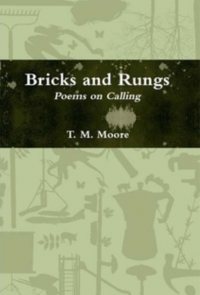
Bricks And Rungs (book review)

T.M. Moore is a first-rate theologian, so everything he writes is well-grounded in Scripture. However, when most people think of “theology,” they think of a lifeless treatise that is boring to read, or perhaps difficult to grasp. But T.M. totally shakes things up in Bricks And Rungs with rock-solid theology presented in beautiful poetic verse.

Bricks And Rungs is all about finding our purpose or calling in life. T.M. says—

“Most people have a sense of being here for some reason. They must become something, achieve something, or come to know something which they consider to be unique to them. Something is out there for them, beckoning them, drawing and wooing them beyond themselves to realize more of something, however that is envisioned or whatever it may be.

“Calling is experienced as a summons from without, a beckoning which resonates with something within, something deeply personal, leading us to aspire to more than what we know or are or have at present. …

“Everyone has a sense of calling. Christians know this to be a summons from God, a command which their lives are intended to fulfill by knowing God and serving Him. The Christian knows that each human being is called to know God and, knowing Him, to serve Him gladly and fruitfully. Calling thus involves our need to be blessed and to be a blessing to others.”

Some of these poems are autobiographical to T.M. Moore, some are reflections on Scripture, and some are musings about how each of us discovers our own calling. But all of these poems will open a window in your soul to hear God’s voice speaking to you about your own unique calling.

Take some time to linger over these insightful words.