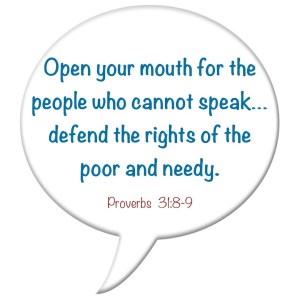
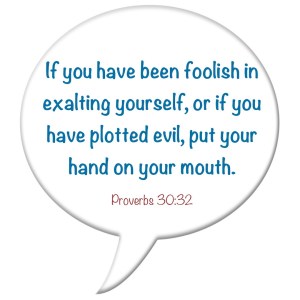
Let no foul or polluting language, nor evil word nor unwholesome or worthless talk ever come out of your mouth, but only such speech as is good and beneficial to the spiritual progress of others, as is fitting to the need and the occasion, that it may be a blessing and give grace to those who hear it. (Ephesians 4:29 AMPC)
Don’t use…
❌ foul words
❌ polluted words
❌ evil words
❌ unwholesome words
❌ worthless words
Do use…
✅ good words
✅ beneficial words
✅ encouraging words
✅ helpful words
✅ graceful words
Let’s put Ephesians 4:29 in practice with every conversation—both in-person and online.
I believe that one of the main reasons His words had such authority and power to capture people’s attention was because He was so immersed in Scripture. As Jesus cleared the temple, He quoted from two Old Testament prophets. As He told a parable to the crowd in the temple—a parable that the religious leaders knew “He had spoken…against them”—He made a passage from Psalm 118 the foundational piece of His story.
The words of Jesus are…
Scriptural
authoritative
loving
unswervingly truthful
practical
challenging
unconventional (according to human standards)
God-glorifying
paradigm challenging
life changing
I want others to say of me what Charles Spurgeon said of John Bunyan, “Why, this man is a living Bible! Prick him anywhere—his blood is Bibline, the very essence of the Bible flows from him. He cannot speak without quoting a text, for his very soul is full of the Word of God.”
Wouldn’t you want that said of your life too? I sure would!
Our first step is to read the Word of God. Next, we need to allow the God of the Word to transform our minds. And then we can rely on the Holy Spirit to help us apply the Bible to everything we say and do.
Heavenly Father, I pray that people may hear the words of Jesus in all the words I speak. Holy Spirit, bring all of the Word I have read back to my mind (John 14:26; Mark 13:11) so that it is not my words that I am speaking but Yours. In the name of Jesus I ask this. Amen!
Listen to the podcast of this post by clicking on the player below, and you can also subscribe on Apple, Spotify, or Audible.
It is important for leaders to use the right words to encourage their teammates. The most memorable, motivating, and beautiful word a leader can use is their teammates’ names.
One of the things that contributes to “quiet quitting” is a lack of passion. But when the leader has conveyed a compelling vision for all that the organization is doing, that vision fuels the passion to work excellently. Vision can change a “have to” attitude into a “get to” attitude. Check out the full conversation Greg and I had about quiet quitting on the Craig And Greg Show. I have lots of new content every week, which you can check out on my YouTube channel.
“One important key to success is self-confidence. An important key to self-confidence is preparation.” —Arthur Ashe
“Strange as it may seem, the first rule of gracious speech is sincere listening: ‘So then, my beloved brethren, let every man be swift to hear, slow to speak, slow to wrath’ (James 1:19). Being an attentive and sincere listener is like cutting a swath through the jungle. It creates a path along which conversations can develop and people can journey together.” —T.M. Moore
J. Warner Wallace discusses how scientists who were Christians used their biblical worldview to drive their scientific pursuits. As a result, Christian scientists have been awarded more Nobel Prizes than any other group of scientific contributors!
“The devil will not stand by quietly and watch his realm decline and erode. He counterattacks with rage; his onslaught is fierce. One of the tricks he uses is to preoccupy Christian workers with issues that are detrimental to a healthy relationship with Christ. The scenario is all too familiar: a Christian worker gets busy in the ministry and work takes priority over relationship with God. He no longer has the time to sit at Jesus’ feet in quiet solitude and listen to God’s Word. Spiritual emptiness comes unnoticed and with it vulnerability to satan’s sifting (Luke 22:31-34); dishonest handling of monies or power or an illicit relationship is justified, and whoa! immorality has lured and sent such a Christian worker tumbling. He commits what he has preached against. Sin is dangerous. Sin is destructive. Its price is very costly—separation from God, irreversible stigma, damage to family relations, loss of ministry, loss of reputation, a black mark on God’s work, and the list goes on.” —Sobhi Malek
Our Creator gave us an amazing gift of the human brain! I love the fascinating new discoveries that scientists are continuing to make. Like this one: “To be spatially capable creatures, humans need their brains to tell them 1) where things are in relation to themselves and 2) where everything is in relation to everything else—the so-called allocentric map of space. To navigate an environment, the brain seems to generate a mental representation of its surroundings. This is often called a cognitive map.” Read more about our cognitive map here.
I hope you have had a chance to see the movie “Sound of Freedom.” Thankfully, this has gotten a lot of people talking about how to eliminate sex trafficking. Fight The New Drug has an excellent post on how you can spot and report human trafficking, and you should also check out Operation Underground Railroad, which was founded by Tim Ballard (whom Jim Caviezel portrays in the movie).
“It will be a comfort to me all my life to know that the scientist and the materialist have not the last word, that Darwin and Spencer, undermining ancestral beliefs, stand themselves on a foundation of sand.” —C.S. Lewis
Listen to the audio-only version of this podcast by clicking on the player below, or scroll down to watch the video.
Words are incredibly powerful! With our tongues, we can elevate others to amazing heights, or tear them down completely. In this episode, Greg and I discuss how, as leaders, it is critical that we are mindful of our everyday words so that we ensure we are taking our team in the right direction.
[0:20] Sometimes leaders can forget how powerful their words can be.
[1:00] Words need to be used strategically and carefully.
[2:05] “Words of affirmation” is one of the love languages, but everyone needs to hear words that affirm and encourage them.
[3:40] Some of the most meaningful words are our apologies and requests for forgiveness. When we do this well, it opens up the door for deeper communication.
[6:00] Leaders should be able to see a visible and immediate difference in their teammates when they are speaking the correct words to them. If not, we need to quickly adjust our words.
[6:50] People don’t care how much their leader knows (or says) until they know how much their leader cares about them.
[8:25] Negative words can sour relationships.
[9:08] Leaders need to pay close attention to what words work best with each teammate.
[10:15] What is the difference between efficient communication and effective communication?
[12:40] We share some insights from two noteworthy books: Leadership Jazz by Max DePree and Ten Powerful Phrases for Positive People by Rich DeVos.
[15:00] One of the most beautiful words anyone will ever hear a leader speak is their teammate’s name.
[19:02] Handwritten notes go the extra mile, but we need to slow down to think about who needs to hear an affirming word from us.
[21:20] Greg shares a memorable quote about the long-term results of our words.
[22:07] A good coach can give you more impactful insights than someone close to you.
Check out this episode and subscribe on YouTube so you can watch all of the upcoming episodes. You can also listen to our podcast on Spotify and Apple.
Listen to the podcast of this post by clicking on the player below, and you can also subscribe on Apple, Spotify, or Audible.
We’ve just looked at two back-to-back bold statements of Jesus. To the Sanhedrin, He said, “I am the I AM,”and to Pontius Pilate, He said, “I am a king.” Christ’s third bold claim essentially amounts to, “And I don’t have to prove either of these to you; I don’t have to argue with you about it.”
After He was arrested, there was a back-and-forth shuttling of Jesus from the Sanhedrin to Pilate, then from Pilate to King Herod, and then back to Pilate again. Pilate told the Sanhedrin, “I find no basis for a charge against Him.” But the Sanhedrin countered, “But He is stirring up trouble all the way from Galilee to here in Jerusalem!” (see Luke 22:67-23:11).
Pilate was looking for “an out”—a way he could safely discharge or punish Jesus that would keep both the Sanhedrin and his Roman superiors happy. So when Pilate heard that Jesus was from Galilee, he was more than happy to pass this “hot potato” to King Herod. When Jesus was hauled before Herod, we read that he was greatly pleased to see Jesus.
Why was that? To answer that question, we need to understand who Herod was. His name is Herod Antipas, and he was the son of Herod the Great. Herod the Great was king when Jesus was born, and he was the one who attempted to kill Jesus.
Herod Antipas was infamous for having seduced his sister-in-law Herodias, whom he married after divorcing his wife. Shortly after this, Herod arrested John the Baptist for calling out this marriage as sinful. Herodias especially was embarrassed by this and wanted John killed, but Herod feared the backlash from the people if he did this. Eventually Herodias got her way and Herod was forced to have John beheaded (Matthew 14:5; Mark 6:17-28).
When news about Jesus began to reach his ears, Herod thought that Jesus was John reincarnated and he wanted to see him (Luke 9:9). So now when Jesus is brought before him, Herod is looking for a magic trick—Jesus remains silent. Then the religious leaders resume their accusations against Jesus, and still He remains silent. Then Herod and his soldiers began mocking and ridiculing Jesus, and amazingly, He still doesn’t say a word.
Jesus knew the Scriptures that make it clear that there is nothing to be gained by bantering with fools. For instance, Solomon wrote,
Do not answer a fool according to his folly, or you yourself will be just like him. … Don’t waste your breath on fools, for they will despise the wisest advice. (Proverbs 26:4, 23:9).
So here is the next bold claim from Jesus: {Eloquent silence.}
Even in the face of accusation, ridicule, and mocking, Jesus refused to engage in meaningless arguing with Herod or the Sanhedrin’s false witnesses. His silence was so eloquent that it got the attention of Governor Pilate:
“Then Pilate asked [Jesus], ‘Don’t You hear the testimony they are bringing against You?’ But Jesus made no reply, not even to a single charge—to the great amazement of the governor.” (Matthew 27:13-14)
Let’s learn from Jesus: Sometimes the best thing to say is NO thing!
Peter pointed Christians to this example of Jesus when he wrote—
To this you were called, because Christ suffered for you, leaving you an example, that you should follow in His steps. “He committed no sin, and no deceit was found in His mouth.” When they hurled their insults at Him, He did not retaliate; when He suffered, He made no threats. Instead, He entrusted Himself to Him who judges justly. (1 Peter 2:21-23)
Jesus called us to let our good deeds shine brightly to bring glory to God. Fools will ridicule and mock and accuse us, just as the religious crowd did to Jesus. Let’s not let our bantering with fools put out the light of our testimony.
When I was a little kid in Sunday School, we used to sing a song called This Little Light Of Mine. We would hold up our pointer finger like a candle as we sang.But holding up our pointer finger across our lips is also a way to let our light shine too. Your silence in the face of foolish ridicule will speak so eloquently!
Let’s learn this lesson from Jesus. Instead of bantering with fools, entrust yourself to the perfect Judge who is perfectly keeping track of every word. He is the One who can add eloquence to your silence as you shine brightly for Him.
This is a weekly series with things I’m reading and pondering from Charles Spurgeon. You can read the original seed thought here, or type “Thursdays With Spurgeon” in the search box to read more entries.
Listen to the podcast of this post by clicking on the player below, and you can also subscribe on Apple, Spotify, or Audible.
Our Tricky Tongues
I said, “I will guard my ways, lest I sin with my tongue; I will restrain my mouth with a muzzle, while the wicked are before me.” I was mute with silence, I held my peace even from good; and my sorrow was stirred up. My heart was hot within me; while I was musing, the fire burned…. (Psalm 39:1-3)
Tongue sins are great sins; like sparks of fire ill words spread and do great damage. ‘I will guard my ways, lest I sin with my tongue’ (v. 1). If believers utter hard words of God in times of depression, the ungodly will take them up and use them as a justification for their sinful courses. If parents’ own children rail at them, no wonder if their enemies’ mouths are full of abuse.
Our tongue always wants watching, for it is fidgety as an ill-broken horse, but especially must we hold it in when the sharp cuts of the Lord’s rod excite it to rebel.
David was not quite so wise as our translation would make him; if he had resolved to be very guarded in his speech, it would have been altogether commendable. When he went so far as to condemn himself to entire silence, ‘even from good,’ there must have been at least a little sullenness in his soul.
Oh, how often our tongues trip us up! More times than we would like to admit, our tongues completely undo the good example we have previously shown. James spends almost an entire chapter talking about the fire our tongues can kindle, concluding that our tongues are “a restless evil, full of deadly poison” (James 3:1-18)!
Part of David’s solution was to notice who was around him so that his words would not add fuel to their skepticism about God. But notice that he went too far because he didn’t speak out the good that he should have spoken.
Clearly, there is a time to speak and a time to be silent. David’s son Solomon talked about the wisdom of speaking the appropriate words at the appropriate time (see especially Proverbs 10).
In Mere Christianity, C.S. Lewis talks about a valuable discipline: A personal review of our words and actions at the end of the day. After all, it’s hard to correct something of which we are unaware. Here’s what Lewis wrote—
“When I come to my evening prayers and try to reckon up the sins of the day, nine times out of ten the most obvious one is some sin against charity; I have sulked or snapped or sneered or snubbed or stormed. And the excuse that immediately springs to mind is that the provocation was so sudden or unexpected. I was caught off my guard, I had not time to collect myself…. Surely what a man does when he is taken off guard is the best evidence of what sort of man he is. Surely what pops out before the man has time to put on a disguise is the truth. If there are rats in the cellar you are most likely to see them if you go in very suddenly. But the suddenness did not create the rats; it only prevents them from hiding. In the same way the suddenness of the provocation does not make me an ill-tempered man: it only shows what an ill-tempered man I am.”
We would do well to pause and ask the Holy Spirit to show us the rats in our cellar—evil words spoken that shouldn’t have been uttered, and helpful words left unspoken at the moment they should have been said. If we will humbly listen, the Holy Spirit will help us mature in this vital area of taming our tricky tongues.
Jesus said we are hypocrites when we give, pray, or fast only outwardly. He called our prayers “pagan” when we try to pray unnaturally. Jesus desires for our giving, praying, and fasting to be natural parts of who we are.This is a short clip of a full-length teaching called “Keepin’ it real” that I shared exclusively with my Patreon supporters. If you would like to sponsor me too for just $5/month, check out the details here.
“Nothing is impossible, the word itself says ‘I’m possible’!” —Audrey Hepburn
“Astronomers are thrilled by the extraordinary images provided by the new James Webb Space Telescope (JWST)—but some of the data already contradict Big Bang expectations. … Creationists have long noted that the Big Bang suffers from the mature distant galaxy problem. Big Bang theorists assume that light from the most distant galaxies took more than 13 billion years to reach Earth. By Big Bang reckoning, we should be seeing these very distant galaxies, not as they are today, but as they were more than 13 billion years ago. Hence, these galaxies should look ‘unevolved’ and ‘immature.’ Yet this expectation is routinely contradicted, and preliminary data from Webb continues the trend.” Check out more from this ICR article.
“Our leadership will always be second to our followership of Jesus.” —Pastor Ben Stoffel
Have you ever been cursed out? Here’s how Jesus wants Christians to respond. It’s pretty easy to say something nice to someone who has done something nice for you. But Jesus tells us to say nice things to people regardlessof how they have treated us.
“The battles that count aren’t the ones for gold medals. The struggles within yourself—that’s where it’s at.” —Jesse Owens
“Your walk walks, and your talk talks, but your walk talks more than your talk talks.” —Anonymous
Listen to the podcast of this post by clicking on the player below, and you can also subscribe on Apple, Spotify, or Audible.
I once knew a businessman who was one of the most silver-tongued talkers I have ever met! He could persuade just about anyone to join him in one of his “can’t miss” business ventures.
And even after they did miss (which was all of them that I was aware of) he could still convince many of his backers to continue. I never knew him to fulfill what he had promised.
Eventually, this caught up with him. And so did the law, and he ended up serving a prison term.
It has always been intriguing to me how much value we put on the words of leaders. It seems as if they can “talk a good game,” we feel a need to exalt them to a higher level. It’s not the one who gets things done, or the one who has the best ideas, or the one who can bring increased efficiency or effectiveness, but the one who can talk the most convincingly.
I think about in my own profession as a pastor. Churches will select a pastor based on how he sounds from the platform. And yet the sermon is only a tiny fraction of a pastor’s work each week.
The danger comes when the leader thinks that his highest value to the organization is the words he speaks. Inevitably, then, he will put more effort into what he says than into what he does. He will spend a lot of time figuring out the right words to say, and how to move people’s hearts.
The apostle Paul told the Christians at Corinth, “My speech and my preaching were not with persuasive words of human wisdom” (1 Corinthians 2:4). And he told the Christians at Thessalonica, “For you remember what we taught you by the authority of the Lord Jesus” (1 Thessalonians 4:2), not Paul’s own authority.
I don’t want people to be impressed with me. I don’t want my authority to come from my vocabulary. I simply want to be known for speaking the Word of God, and then living a life that matches the Word of God.
As King Solomon said, “A truly wise person usesfew words” (Proverbs 17:27). The wisest words are not mine but God’s. Then “your faith [is] not in the wisdom of men but in the power of God” (1 Corinthians 2:5).
Words do have their place. But let’s always make sure that that place isn’t in place of God’s Word.