8 Must-Have Bible Study Tools

Bonhoeffer - study the BibleIt’s been said that if the only tool a man has in his toolbox is a hammer, he tends to see every problem as a nail. In other words, we try to force every project to be handled in the exactly same way.

Sadly, for many Christians, the same is true with our knowledge of the Bible. If we have limited tools, we try to make every situation look like something we can fix with that smaller toolbox. It’s not enough for us to know only a couple of verses or a few biblical principles, and then try to use those tools to handle all of life’s situations. So let me share some basic tools that will help you expand your biblical toolbox.

Time and cultureThink about how much your culture has changed just in the 70-80 years since your grandparents were born. Think about how wardrobes have changed, and technology, and manners and customs. The earliest book of the Bible was written about 1400 BC, and the most recent book was written about 100 AD. To better understand the things I read in the Bible, here are some tools I like to use:

LanguageEven the English language has changed a lot since William Shakespeare penned his famous plays. But consider that the Bible was written in languages that are even older (not to mention they’re languages other than English!). To really get the full meaning of a passage, here are some tools I use:

Chain of pearls—The Bible is not a collection of isolated, independent stories or concepts, but it is a beautiful string of pearls. Every part connects to the rest of the Scripture. So some resources I use to help me discover how the pearls are strung together include:

What did I miss? What are your favorite Bible study tools? In the comments, please share books, commentaries, or online resources that you use to maximize your study of God’s Word.

This Sunday I’ll be sharing some different styles of Bible studies we can all do. If you live in the Cedar Springs area, please come join a really great group of people at Calvary Assembly of God. Otherwise, watch us on Periscope.


4 Reasons To Study Your Bible

Commitment to readYou probably hear Christians say quite frequently, “You should read your Bible.” But one thing you may not hear as often is why you should read your Bible. There are probably many more reasons, but here are four reasons why I believe reading your Bible should be a daily part of your life.

(1) To help spot errors.

When the devil tempted Jesus, it is noteworthy that Jesus didn’t try to use logic, or persuasion, or even willpower. Every temptation was blocked by Jesus saying, “It is written” as He quoted Scripture.

In the second temptation, the devil tried the same tactic. He, too, quoted a couple of verses from the Psalms, but he took them out of their context. So notice Christ’s reply, “It is also written” (Matthew 4:7). The best way to spot error is to know the full counsel of God’s Word. This tactic the devil tried with Jesus wasn’t something new, but it was something he used on the very first humans: “Did God really say…” (Genesis 3:1), and he will try it again on you!

(2) To clarify your emotions.

Most of us allow our emotions to control our actions. Or sometimes we wrestle with, “My heart says one thing, but my head says something else!” In this tug-of-war, we allow our emotions to determine our beliefs, and then our beliefs determine our actions. This is not only dangerous, but it is contrary to what the Bible teaches.

The healthy way to respond is by fully knowing what we believe, and then acting according to our beliefs. Our proper emotional response will then follow those actions.

Look at the example of Jesus in John 2:13-16. He was ticked off at how people were misusing His Father’s house, and He did some serious house cleaning! Just reading those four verses, you may get the idea that Christ’s emotions carried Him away. But check out verse 17, in which we see He was acting in accordance to His beliefs, which were fully grounded in Scripture.

(3) To know prophesy.

All of the Scriptures point to Jesus, so all of the Scriptures are illuminated by Christ (Luke 24:27, 45). If you want to know what is happening in our world, turn to the pages of Scripture and see how Jesus is revealed. This will help you put even current events into perspective.

(4) To give sound answers.

When people need help, I want to be able to give them real answers. Not my opinion, but truth that they can apply. The Apostle Peter told us to always be prepared to give people an answer that is based on our knowledge of Jesus (1 Peter 3:15).

“Beware of saying, ‘I haven’t time to read the Bible, or to pray’; say rather, ‘I haven’t disciplined myself to do these things.’” —Oswald Chambers

Can I challenge you to do something I challenged my whole church to do … Make a commitment to read the Bible every day for the next seven days. See what happens as God meets with you, and reveals Himself and His wisdom to you, every day.

We’ll be learning some Bible study strategies next Sunday, and I invite you to join us.

Asyougo

Listen to the podcast of this post by clicking on the player below, and you can also subscribe on AppleSpotify, or Audible.

A little habit started for me as a kid. I’d put things on the bottom steps of the stairway, so I’d be sure to see them and grab them as I went upstairs to my bedroom. After a while, everyone in our family had his or her own “step.” I called these asyougos: as you go upstairs, please take these with you. The principle was pretty simple, as I would naturally see these things going about my regular route.

Jesus had a similar idea for His followers: Go into all the world and preach the Good News to all creation (Mark 16:15). The verb tense and definition of the word go literally means that Jesus said, “Asyougo into all the world, preach the Good News.

In fact, this is exactly how Jesus lived His life. As He went about His normal life, His life intersected with people who needed Good News (check out Mark 10:17, 46; Luke 8:4, 42; 17:11; and John 9:1 as examples).

Peter summed up all of Christ’s life like this: God anointed Jesus of Nazareth with the Holy Spirit and power, and how He went around doing good and healing all who were under the power of the devil, because God was with Him (Acts 10:38).

Jesus lived an asyougo lifestyle, He called us to do the same, and He empowered us to live our asyougo lifestyle with the same power He had (Matthew 28:18-19; Acts 1:8).

Here’s the big idea—We don’t need to go anywhere special to find people who need Good News…

  • asyougo to school, you will attend class with them
  • asyougo to work, you will work alongside them
  • asyougo to the grocery store, you will interact with them
  • asyougo to do yard work, you will talk over the backyard fence with them
  • asyougo out to eat, you will sit next to them

People who need the life-changing, disease-healing, sin-forgiving power of Jesus are all around you. ASYOUGO share the Good News of Jesus Christ with them!

►► Would you please prayerfully consider supporting this ministry? My Patreon supporters get behind-the-scenes access to exclusive materials. ◀︎◀︎

4 Thoughts To Help Prayer Become A Daily Habit

ImportunityI have shared several strategies about prayer throughout this series (you can read them here, here, here, and here). One danger in putting these steps into practice in our life is what I would call one-and-done. We do it once and think we’ve done all we need to do.

Scientists tell us at a minimum it takes 21 days in a row to make a habit. Jesus went even farther than that in talking about prayer in Matthew 7:7. When we look at the three aspects of the verbs ask, seek, and knock in this verse, it would be better stated like this—

You need to keep on asking, and keep on seeking, and keep on knocking. This is not good advice or a helpful suggestion, but it is vital for your spiritual life. So after you have asked, sought, and knocked, then do it again, and again, and AGAIN.

Matthew Henry said it this way: “Here is a precept in three words to the same purport, Ask, Seek, Knock; that is, in one word, ‘Pray; pray often; pray with sincerity and seriousness; pray, and pray again; make conscience of prayer, and be constant in it; make a business of prayer, and be earnest in it.’”

In the English language the dictionary has a word for this: importunity. This means being urgent and persistent, sometimes annoyingly so!

I believe importunity requires these four characteristics:

  1. Trust. Remember Jesus taught us to begin our prayer with, “Our Father.” We have to come to Him again and again and again trusting that He loves us, that He alone is the Source of our help, and that He wants to help us. We also have to trust that our Father wants to give us the very best (Matthew 6:8, 7:7-11).
  2. Perseverance. I love the story of the persistent widow in Luke 18:1-5. This determined lady kept coming back again and again. Henry Ward Beecher said, “The difference between perseverance and obstinacy is, that one often comes from a strong will, and the other from a strong won’t.”
  3. Creativity. One of my favorite New Testament stories is about a mother who is not only as persistent as the widow in Luke 18, but she is creative in her prayer as well (Mark 7:24-30). This lady bantered with Jesus in a way that I believe caused Christ to throw back His head and laugh! This is not bargaining with God, as Oswald Chambers wrote, “Repetition in intercessory importunity is not bargaining, but the joyous insistence of prayer.”
  4. Action. Paul was looking for an open door to preach the Gospel, but he didn’t sit still while he waited for God to say “yes” (Acts 16:6-10).

Keep these in mind as you make importunity a key part of your prayer life. And check out the full video of my message on importunity in prayer.

Confession: I Struggle With Being An Atheist

ITLWYou see, I love my day to be highly organized. I like to get to all my meetings on time, and then have them run smoothly and efficiently. I like to setup my To Do list, and then methodically check off each item as I go through my day. I like to be in charge of my day.

I am an atheist.

I’m the one calling the shots. I set my agenda. I determine my day. I decide who to see and what project to accept.

There was a guy that Jesus talked about who did the exact same thing. This guy thought to himself and talked to himself all about his plans. Seriously, in just three verses he says me/I/my a dozen times (Luke 12:17-19)!

But God said, “You fool!” The word for fool means without mind. He didn’t mind his mind. He thought the thoughts he wanted to think, without ever consulting anyone else. Not even God.

Jesus made prayer a priority every day (Mark 1:35). What do you think He prayed? Do you think He said, “Here’s what I’m going to do today, and I want You to bless it, Father”? No way!

When Jesus taught us to pray He said, Your kingdom come, Your will be done” (Matthew 6:9-13). Not only did Jesus pray this way, He lived this way too. He didn’t do a single thing unless His Father directed Him to do it (John 6:38), and He didn’t say a single word unless His Father directed Him to say it (John 12:49).

The problem is not going into my prayer closet to meet with God in the morning, the problem is thinking I can leave God in the closet as I go about my day! That is atheism!

The Apostle James gave us this sound counsel: Instead of making my plans all on my own, I should say, “If the Lord wills, this is what I will do today” (James 4:13-17). And wise King Solomon said I shouldn’t lean on my own thoughts when planning my days, but lean onto God, and then watch to see how He will direct my life in the right way (Proverbs 3:5-6).

I’ve begun writing I.T.L.W. on the top of my daily calendar. It’s my reminder to say, “If The Lord Wills” this is what I will do today. And if something else comes up, I quickly acknowledge that God is directing my path where He needs me to go.

Your Kingdom come means my kingdom has to go. Your will be done means my agenda takes a distant second.

If you’re feeling stressed about your schedule, that should be your reminder to pray: “God, what do you want to have done here.” Silence the atheistic thoughts that sound like, “I have to get my list done.” Stop and pray right there on the spot.

Here’s the full video of my message on this topic—

We will be continuing our series called Practical Prayer this Sunday. If you don’t have a home church in Cedar Springs, please come be our guest. Or you can tune into our live broadcast via Periscope.

The Power Of Confession

God restoresGod wants to meet with us. He loves hearing our voice and talking to us. We can come into His presence at anytime, with anything and everything that’s on our heart, and know for sure that He is waiting to hear from us.

But there is one thing that can short-circuit this intimate relationship. And if we don’t deal with this one thing quickly, it could lead to disastrous results.

This one thing is unconfessed sin.

Adam and Eve sinned, and started a downward slide that we continue in today. First, they tried to cover up their sin (Genesis 3:7). Think about this for a moment. They made clothes out of fig leaves. What happens to leaves when are detached from their vine? Yep, they die and shrivel up!

Next, they tried to hide from God (Genesis 3:8-10). Really? You can hide from God?! That’s sort of like a toddler covering her eyes and thinking since she can’t see daddy, he can’t see her either.

Then they made excuses for their sin (Genesis 3:11-13). Of course, they said, we would have never sinned on our own. She made me do it! The devil made me do it!

None of this worked. Instead it kept them in fear of God’s presence!! 

A beautiful prayer of confession of his sin is David’s prayer in Psalm 51. Notice this:

  • He was assured of God’s unfailing love and His great compassion (v. 1).
  • He confessed his sin without excuse. Five times in verses 1-3 he says my transgression, my sin, my iniquity.
  • He let God restore him (vv. 7-12)

It works so much better when God does the restoring! Instead of the fig leaves which were dying, God Himself made clothes for Adam and Eve (Genesis 3:21). This was a foreshadowing of the of way God will clothe all men and women who confess their sin, and place their faith in Christ’s work on Calvary (Ephesians 5:26-27).

Don’t let unconfessed sin keep you from God’s presence! Quickly confess your sin, and let God clothe you in the righteousness of Jesus.

We’ll be continuing our look at Practical Prayer this Sunday, and I hope you can join me. If you cannot join us in person, check out our live broadcast on Periscope.

4 Practical Prayer Tips From Jesus

Listen to the podcast of this post by clicking on the player below, and you can also subscribe on AppleSpotify, or Audible.

One of the best ways to learn how to pray is not to read about prayer. It’s not even to listen to other people pray. The best way to learn how to pray is … to pray! 

Can you imagine a baby thinking to herself, “I’m not going to start talking until I’ve got the English language nearly mastered. I need to brush up on my vocabulary and have a few tongue-twisters handy, and then I’ll start talking”? Of course not!

Babies learn to talk by talking! Well, perhaps they learn by babbling first. But ask any parent, and they will tell you that those first da-da, ma-ma, ba-ba sounds are like music in their ears!

It’s the same way with our Heavenly Father. He’s not waiting for you to be a prayer expert (whatever that is!) before you start talking with Him. Even if your attempt at praying sounds like a baby’s babbling to you, those attempts are sweet sounds to our loving Heavenly Father.

One verse about Jesus gives us four practical prayer tips to help us practice praying—

Very early in the morning, while it was still dark, Jesus got up, left the house and went off to a solitary place, where He prayed. (Mark 1:35)

Check out these four prayer tips:

1. early in the morning. This speaks to me of priority. I want to talk with God before I talk with anyone else—before I make my plans for the day, or even before I have any major decisions to make.

Practical application: I need to go to bed on time.

2. Jesus got up. This was a physical change of position to make sure He was alert.

Practical application: Don’t try to pray laying in bed, but find a posture where I am most alert; maybe even go for a walk while I pray.

3. left the house [and] went to a solitary place. He left the familiar and left any distractions behind. Some translations of Matthew 6:6 say we should go into our prayer closet.

Practical application: Find a place that’s just for prayer, then eliminate the distractions (like turning off my phone).

4. He prayed. This Greek word is used 87 times in the New Testament and it means … PRAY. There’s nothing wrong with reading the Bible, or listening to worship music, but I shouldn’t allow these activities to substitute for prayer.

Practical application: My mind can wander when I’m praying unless I’m intentional about staying focused. So I keep a list of things I want to pray about, and I keep a blank piece of paper ready for things that come to my mind. Both of these things keep my mind from wandering away from prayer.

How about you: Can you make prayer a priority? Can you find a place and posture that will help you pray? What can you do to stay focused while you’re praying?

Remember: the best way to learn how to pray is to pray. Get started today! Your Father is waiting to hear your sweet voice!

You may also be interested in my post Continually learning to pray.

I’ll be continuing our series on Practical Prayer this Sunday. If you don’t have a home church in Cedar Springs, I’d love to have you join us. Otherwise, you can tune in to our live broadcast via Periscope.

►► Would you please prayerfully consider supporting this ministry? My Patreon supporters get behind-the-scenes access to exclusive materials. ◀︎◀︎

Year-End Review (2015 edition)

Theme for 2016The last Sunday of each year I take some time with our church family to look back to review what we’ve learned. Then we look forward to a theme God is impressing on us for the new year. Check it out here—

Peace On Earth! Really?

Craig T. OwensFor some people, “peace on earth” is just a wish. Perhaps all of this talk of peace and goodwill during the buildup to Christmas is doing just the opposite, and you’re feeling a bit stressed out.

How do you think Joseph felt on the night of his first son’s birth? Do you think he was peaceful, or do you think things weren’t going as he had planned, and his stress level was through the roof? We can learn a very valuable lesson from his life.

Please gather your family and friends around to watch this short 10-minute video before you begin your Christmas celebration. This encouraging word may be just what you need to have a peaceful and joyous Christmas.

(If you have any trouble with the above video, here’s another link to try.)

I encourage you to read the Scriptures I mention in this video. They are:

And the quote from Max Lucado I shared:

“You’ve stood where Joseph stood. Caught between what God says and what makes sense. You’ve done what He told you to do only to wonder if it was Him speaking in the first place. You stared into a sky blackened with doubt. And you’ve asked what Joseph asked. You’ve asked if you’re still on the right road. You’ve asked if you were supposed to turn left when you turned right. And you’ve asked if there is a plan behind the scheme. Things haven’t turned out like you thought they would. Each of us knows what it’s like to search the night for light. Not outside a stable, but perhaps outside an emergency room. On the gravel of a roadside. On the manicured grass of the cemetery. We’ve asked our questions. We’ve questioned God’s plan. And we’ve wondered why God does what He does. The Bethlehem sky is not the first to hear the pleading of a confused pilgrim. If you are asking what Joseph asked, let me urge you to do what Joseph did. Obey.”

Merry Christmas!

O Holy Night & O Holy Day

O Holy NightIn 1847 an unnamed parish priest sent an unusual request to Placide Cappeau, the commissioner of wines in a small French town: “You are well known for your poems. Would you consider writing a poem for our Christmas mass?” Cappeau was both intrigued and honored, and he soon penned an essay called Cantique de Noel.

Cappeau felt that his poem was more worthy of a song, than just merely a poem, so he turned to his friend Adolphe Adams. Adams was a classically trained musician, but he was also a Jew. Adams said to Cappeau, “You’re asking me to write a melody for a poem that celebrates a Man I do not view as the Son of God, and a poem that celebrates a day I do not celebrate?” But because his friend Cappeau had requested it, he gave it his best effort. Three weeks later, Cantique de Noel was first heard at the Christmas Eve midnight mass.

Cantique de Noel quickly became popular throughout France. But when it was discovered that the lyricist Cappeau had left the church to become a socialist and that the musical composer Adams was a Jew, the Catholic Church banned the song from being sung in any of its churches. Still, the song grew in popularity.

During the build-up to the American Civil War, an abolitionist named John Dwight was especially moved by a line in Cantique de Noel: “Chains shall He break, for the slave is our brother, and in His name all oppression shall cease.” Dwight published his version of Cantique de Noel in his abolitionist magazine with the new title O Holy Night. The song quickly caught on in America.

The opening words of O Holy Night speak to our hearts today, as much as they did to those present at the First Advent—long lay the world in sin and error pining, till He appeared and the soul felt its worth. To pine for something means to long painfully for something just out of our reach. It’s what the psalmist in ancient Israel captured too when he wrote, My soul yearns, even faints, for the courts of the Lord; my heart and my flesh cry out for the living God (Psalm 84:2). There is a longing in all of us to know the Lord!

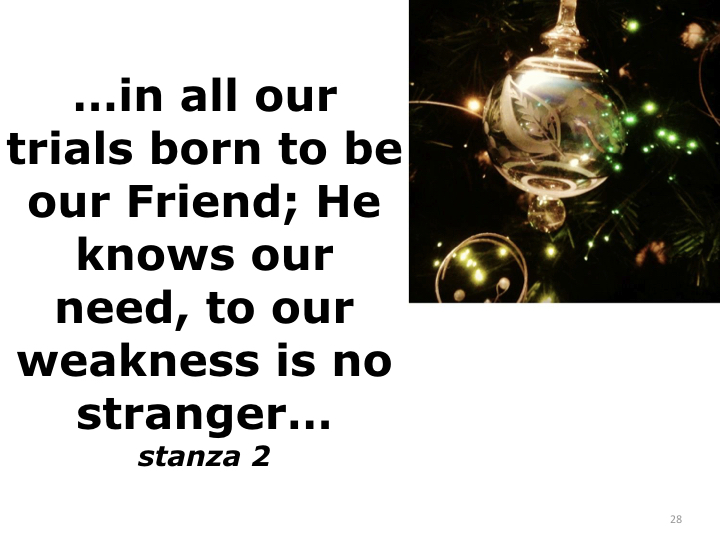
That’s why Christ’s First Advent is such a blessed, joyous event! In the second stanza we sing—In all our trials born to be our Friend; He knows our need, to our weakness is no stranger. Indeed the writer of Hebrews tells us why Jesus was born as a human (Hebrews 2:14-18), and why we can approach Him confidently (4:15-16).

Christ’s Incarnation allows us to put our faith in Him. When we do, we experience the Atonement. I like to remember this word by saying it at-onement. In other words, the Heavenly Father now sees me at-onement with His Son—when He looks at me, He sees Jesus. That’s why God forgets our forgiven sins (Hebrews 8:12)!

Then the third stanza of O Holy Night begins to tell us how we live out the at-onement every day by loving one another, enjoying His peace, living free and helping others get free too, singing joyfully to God day after night after day after night!

The First Advent was a holy night because Christ’s Atonement it makes us holy. So now all our nights are O holy nights, and all our days are O holy days, and all our work is O holy work, and all our relationships are O holy relationships!

Christ’s First Advent changes EVERYTHING for those who put their faith in Him. Is that you? Are you living in Christ’s at-onement? If not, you can be today by simply asking Him to come into your life.

You can check out some of the other Christmas carols we have looked at here. And check out the video of this message too—

If you have missed any of the messages in our series The Carols Of Christmas, you can find the full list by clicking here.