


 The beauty, inter-depdence and resiliency that our Creator masterfully designed into His creation is breathtaking! As I watched this video, I couldn’t help but imagining God’s smile as scientists learn what He knew all along!
The beauty, inter-depdence and resiliency that our Creator masterfully designed into His creation is breathtaking! As I watched this video, I couldn’t help but imagining God’s smile as scientists learn what He knew all along!
Imagine you are taking a nice autumn color tour. As you are enjoying the beautiful fall colors, you come upon a quaint town, where the speed limit through town drops to 25 mph.
As you make your way through town, enjoying the scenery, you suddenly become aware of the flashing lights of a police car behind you. Quickly glancing down at your speedometer, you notice that you are traveling at 35 mph!
 The officer approaches your car, asks for your license and registration and returns to his car. At this point, there are two things that could happen.
Since you did break the law, the officer might return to your car with a traffic ticket, indicating that you were driving 10 mph over the speed limit. You may have all kinds of excuses, and even a spotless driving record, but the truth of the matter is you broke the traffic laws of that city. The ticket you received is, in fact, justice.
Now imagine the officer returns to your car and says, “You have a pretty good driving record, and I believe that you were enjoying the fall scenery, so I’m going to let you off with a warning this time.” Even though you broke the law, this police officer extended mercy to you by not giving you the penalty you deserved.
Have you ever experienced this kind of justice or mercy? Most of us probably have.
But here’s something you have probably never experienced. Imagine you are driving through the same quaint town, admiring the beauty, when you see those flashing lights in your rearview mirror. Quickly glancing down at your speedometer you see that you are traveling under the speed limit. You double-check that your seatbelt is fastened and you are obeying all of the traffic laws.
When the officer approaches your car, he says, “Do you know why I pulled you over? I pulled you over because you are following all of the traffic laws and I wanted to give you a $50 gift certificate to one of the best restaurants we have in town.”
If this ever happened to you, this would be the definition of grace: getting a blessing you didn’t deserve to receive!
Christians certainly understand justice averted, when the penalty for our sins fell on Jesus instead of on us. Christians also understand mercy, when we don’t have to pay for the sins we have committed. But have you ever stopped to consider the amazing grace God continues to pour over your life?
John describes it like this: For out of Christ’s fullness we have all received—all had a share and we were all supplied with—one grace after another and spiritual blessing upon spiritual blessing and even favor upon favor and gift heaped upon gift (John 1:16 AMP).
All of us have blessing upon blessing, favor upon favor, gift upon gift heaped onto our lives. The Apostle Paul then asks, “What am I going to do with all of this grace I’ve received?”
His answer: I’m going to make sure I pass it along to others! (see Ephesians 3:1-9)
Gordon MacDonald wrote, “The world can do almost anything as well as or better than the church. You need not be a Christian to build houses, feed the hungry, or heal the sick. There is only one thing the world cannot do. It cannot offer grace.”
So here’s my question to you: how are you handling the grace God has lavished on you? Are you even aware of His grace gifts? Are you hoarding them for yourself?
Or are you making sure that those around you are recipients of the overflow of grace from your life? In other words, are you demonstrating what the world can never show?
Christian, make sure the world sees your grace-filled life in action! This is what brings glory to God and draws others to their own personal relationship with Jesus Christ.
Please check out this video…
 Some of the greatest discoveries and revelations came about because people were curious. They refused to just go along with what they had always been told, what they grew up believing, or what the conventional wisdom told them was impossible.
Archimedes had his “Eureka!” moment because he refused to believe that it was impossible to measure the volume of an irregularly-shaped object.
Isaac Newton formulated the laws of gravitation because he curiously wondered about why apples fell perpendicular and at the same velocity.
The Apostle Peter saw a vision from God with animals, but didn’t stop there. His openness helped him realize that God didn’t have “favorites.”
Far too many people live their lives cursed with low expectations. They say, “That’s all there is.” and they put a period on it.
God wants us to soar above those low expectations! He tells us things like:
 But we are trapped in the curse of low expectations when we put a period on things, when we refuse to learn more, see more, hear more.
For example, Paul uses the word “mystery” multiple times in his letter to the Ephesians. He explains that a mystery is something hidden from those who have it all figured out (the “period” people), but is revealed to those who will ask God (the “question mark” people). Only the “question mark” people get to see the “exclamation points” God has for them. Things like…
Don’t stop with “.” but go on to “?” and experience “!”
With great expectation, read God’s Word, approach His throne, dig into His riches, wrestle with the difficult things, learn more of God’s purpose for your life. He wants to give you so much more “!”
 I have blogged quite a bit about the tendency of our culture to be pragmatic. That is, people determine the rightness or wrongness of something based on how it feels to them. If it feels good, or if they get something positive out of it, then it must be good; but if it feels bad, or if they don’t get anything out of it, then it must be something they need to abandon.
True love is never pragmatic. Although culture tells us it is:
“We dress ‘love’ in the fantasy of evening gowns and tuxedos, with silver and candelabras. But most of the time…love comes dressed in overalls—it is practical, down-to-earth, everyday hard work. It is really thinking of the other person and doing what the other person needs and being what the other person needs when he or she needs you to be there.” —Dr. Richard Dobbins
 In writing to the church at Ephesus, Paul told them he became their servant—literally this means their waiter. But not so he could get something out of it. Instead it was a love completely focused on them…
Speaking to the Ephesian leaders as he was traveling to Jerusalem, he said…I served the Lord with great humility and with tears (Acts 20:19)
Dear Christian, is this the kind of love you demonstrate? Do you share God’s grace with the hurting? Do you walk alongside those who are limping or about to give up? Do you stand through the storms with those on the battlefield?
You can help end the human trafficking that is ruled by the pornography industry by one simple action …
 There’s an interesting story recorded in Acts. Seven sons of a priest named Sceva attempt to cast out a demon by saying, “In the name of Jesus whom Paul preaches, come out!” To which the demon replies, “Jesus I know and Paul I know, but who are you?”
Not only was the demon not exorcised, but the seven men came running out of the house bloodied and naked from the beating they received!
Think about it: If you spoke to the devil and said, “Get away from me!” would he be afraid of you? The simple answer is “No!” Why? Because you have no power in yourself.
It’s not about who you are, it’s about Whose you are.
 Jesus talked about our place in Him in John 14:20. Notice the word “in” in this verse:
Here are the two life-changing words for any Christian to remember…
The devil wants to get you second-guessing your identity. He wants you to be uncertain if you are worthy of coming into God’s presence. He wants you doubting if you are truly forgiven and worthy of God’s attention. He wants you unsure if you can stand up against him in a spiritual fight.
This uncertainty and doubt is erased by faith in this: I am IN CHRIST!
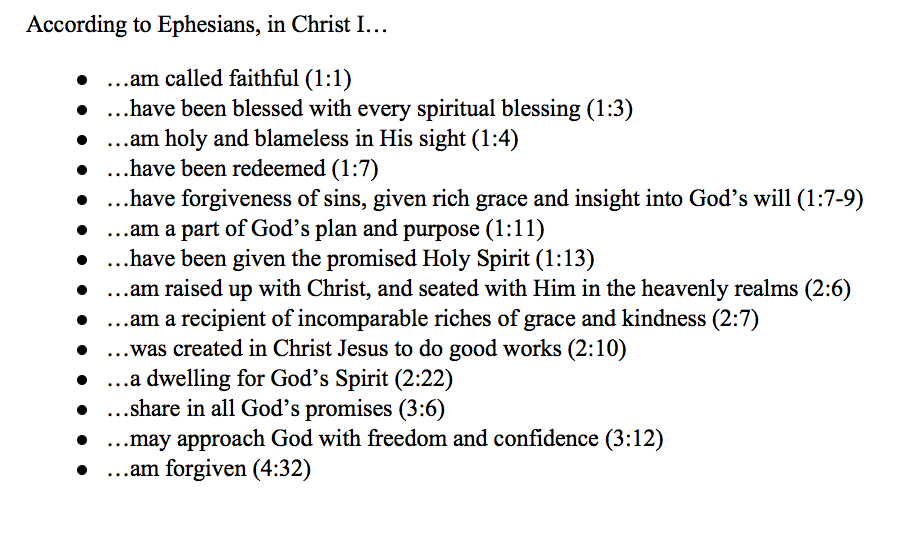 Please print out this list from Ephesians of all the “in Christ” statements Paul shares with us. (You may download a PDF version by clicking here → in-christ-i-am)
Keep this list handy, and the next time satan whispers doubts in your ear like, “Jesus I know and Paul I know, but who are you?” say—
“It’s not who I am, but Whose I am! I am Christ’s. I am in Him and He is in me. I have been forgiven. I am a part of His family. I have a purpose. I am holy and blameless. I am the recipient of all God’s blessings. And you can never defeat me because I AM IN CHRIST!”
If you don’t have a home church, join us next week as we continue our series in the book of Ephesians called Sit Walk Stand.
 Have you ever noticed that nowhere in the New Testament do we see an “order of service” for a church congregation? It’s simply not there.
Neither is there a list of acceptable songs, or the design of a church building, or how or when Communion is served, or even what clothing the pastor is supposed to wear. Yet we modern-day Christians seem to spend a lot of time not only arguing about these non-essentials, but even (gasp!) evaluating the “churchness” of a church based on these things.
It’s understandable, then, when someone says, “I enjoy being a Christian, but I really don’t like going to church.” Or even insisting that they can be a Christian without attending a church.
But here’s where those statements miss the mark: “Church” was never intended to be merely a group of people who met at a designated address once a week.
The Church that Jesus described—and the Church the apostles were a part of—was a living organism. It was fellow followers of Jesus Christ interacting with each other as they worshiped the Lord.
The Apostle Peter describes a gathering of Christians in just one verse. In this verse he gives five descriptors of how Church should be done. To stress the point that every gathering of Christians is unique, three of Peter’s five descriptors are found nowhere else in Scripture.
One translation has this as “one mind.” Paul has a similar thought in 1 Corinthians 14:20. The bottom line—get on the same page working toward the same goal. What’s that goal? Pointing people to Jesus!
2. Be sympathetic (the next unique word)
A definition we may better understand is “empathy.” This world literally means to “vibrate with others.” Be on in tune with what they’re going through that you can feel it just like it was happening to you.
3. Love as brothers
This is the Greek word philadelphos, which means to treat other Christians like they’re from the same womb as you.
4. Be compassionate
That is: be strong enough to step into other people’s stuff. Keep on increasing your capacity to carry a bigger load for someone else (Galatians 6:2).
5. Be humble (the last unique word)
The King James Version translates this “courteous.” Not just being strong enough to help, but gentle enough that your help will be accepted.
Let me repeat: The Church is not a physical address where we gather once per week. YOU are the temple of God’s presence, which is why Jesus said if just two of His followers get together, He is right there with them. That’s right—two Christians can have “church” wherever they happen to meet!
Don’t just go to church, BE the church. Don’t miss an opportunity to encourage, pray with, instruct, or learn from another Christ-follower whenever and wherever you happen to meet.
If you’ve missed any messages in this series, you may find the complete list by clicking here.
 Time after time Peter calls Christians to live a counter-cultural lifestyle. The most countercultural example we have ever seen is Jesus Christ.
Peter shows us how Jesus—in the most excruciating situation possible—lived. Heading into the torture of crucifixion…
Peter then tells Christian wives and husbands they are to behave in the same way as Jesus. Wow!
More specifically Peter challenges Christlike wives to be:
Likewise Peter challenges Christlike husbands to be:
Here are two questions I think Christian wives and husbands need to seriously consider: Are you thinking about your role as a husband or wife in biblical terms or cultural terms? If you are thinking in cultural terms, are you willing to try it God’s way?
Our Christian marriages should be “alien” to the way the world operates; they should be counter-cultural. That kind of marriage is what points people to a relationship with Jesus!
If you’ve missed any messages in this series, you may find the complete list by clicking here.
 The Apostle Peter uses an appropriate term for Christians living on Earth: “Aliens and strangers.” This means that those who call Jesus their Lord are to live a counter-cultural lifestyle. Not a lifestyle that changes with the popular culture, but one that stays true to God’s Word.
There probably has never been a more controversial subject in any day or culture than marriage and the relationship between the sexes. Why are these terms “controversial”? I suspect it is because we are naturally bent toward being pragmatic people.
In pragmatism, the outcome determines meaning. If I find something easy to do, convenient for me, and I seem to get applause from those around me, then what I did must be right. However, if it’s challenging to stick with something, and seemingly only a few people approve of how I do it, then it must be wrong. That is letting culture determine morality, instead of letting God determine it.
As Peter begins to address the topic of marriage, and the interaction between spouses, he uses two similar phrases—“Wives, in the same way … Husbands, in the same way (vv. 1, 7).”
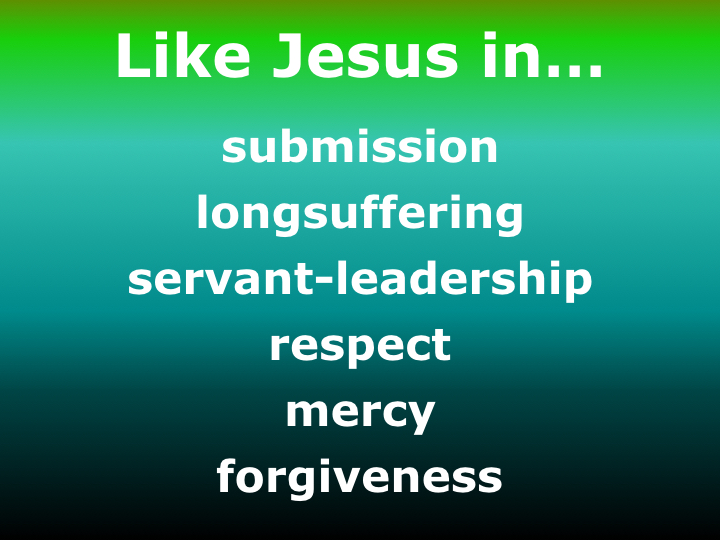
In the same way as what? Actually, if you look at the five verses that come before this you will see that it’s not what but Whom. Those verses are talking about our example in Jesus. Peter points out that Jesus showed:
Pragmatism looks at God’s design and says, “Yes, I understand that, but….” Pragmatism tries to find an “out” or a “loophole” that let’s someone change a definition or skip out on doing something God’s way.
If anyone ever had the authority to say, “Yes, Father, I know what You want Me to do, but look how they’re treating Me” it was Jesus.
A wife with a difficult husband may want to say, “Yes, I know I’m supposed to submit to my husband, but….” A husband with a nagging wife may say, “Yes, I know I’m supposed to treat my wife with consideration and respect, but….”
But Peter says, “Wives and husbands, exhibit the same submission, longsuffering, servant-leadership, respectful behavior, mercy and forgiveness toward your spouse as Jesus exhibited toward you!”
So the question we need to ask is: Am I thinking about marriage—a husband’s role, a wife’s role—in counter-cultural biblical terms or in popular cultural terms?
If I find I am thinking culture’s thoughts, am I willing to try God’s way?
Join me next Sunday as we look at this passage again, and see how a wife and husband can love and serve each other in a God-honoring, counter-cultural way. If you’ve missed any messages in this series, you may find the complete list by clicking here.
 “Do you have a loved one who’s lost their way in life? Whatever you do, don’t give up on them. Take a lesson from the Judean date palm tree. You never know when a seed may take root and bloom.
“In the mid-1960s, an archaeological dig in Israel revealed a cache of date palm seeds nearly 2,000 years old. Having lain dormant for two millennia in such an arid climate, most experts logically assumed the seeds were dead and, other than their historic value, useless. But then faculty at a Jerusalem university were given a few of the seeds to conduct scientific experiments. To everyone’s surprise, the seeds germinated soon after being planted. In fact, within a few years, the date palm tree they produced was thriving and stood nearly eight feet tall.
“It’s a powerful reminder for families with a loved one who’s gone astray. When someone’s life seems barren and directionless, it can feel as if their circumstances will never improve. But our lives are often like that desert seed that blossomed into a beautiful tree against all expectations. Even when it seems like nothing is happening, you never know what potential God may already be stirring inside someone’s heart.” —Jim Daly


 Craig T. Owens