20 More Useful Maxims

Useful MaximsFor anyone who would like to get your message to “stick” with others—like parents, pastors, teachers, coaches, mentors—I highly recommend Useful Maxims by Brian Ridolfi. You can read my book review to get more background info on this innovative book.

I previously shared 20 useful maxims from Brian’s book, and now here is my next set of 20…

  1. Strong men do not always lift weak men, but weak men always bring down strong men. The lowest common denominator dominates.
  2. You cannot force someone to be tolerant without being intolerant toward their intolerance.
  3. Offending the truth for the sake of the offended is most offensive.
  4. Just fitting in fits in with just giving in.
  5. Prayer is a slayer. To not pray is to become prey.
  6. People aligned with good are maligned by evil.
  7. There is little success when little is involved.
  8. Better to make the last move than to make the first one.
  9. Smart men run from danger; wise men avoid it altogether. Better to prevent than to lament.
  10. Your life becomes a job whenever a job becomes your life.
  11. Those with no time to spare have no time to care.
  12. Wisdom becomes foolishness when foolishness becomes wisdom.
  13. A Christian without a Bible is like a knight without a sword.
  14. Relativists believe in relativism until they or their loved ones are victims.
  15. Vinegar is not bitter to those who have not tasted honey.
  16. Questions cannot be answered if answers cannot be questioned.
  17. Sound wisdom sounds odd in a world deaf to God.
  18. Bad entertainment entertains bad behavior.
  19. Good guys look bad when bad guys look good.
  20. To help the helpers is to help the helpless.

To read some of the other quotes from Useful Maxims that I am sharing, be sure to follow me on Twitter and on Tumblr.

The Power To Overcome Sexual Temptation

Focus On The Family“It’s not easy to overcome recurring sexual temptation. That’s because sexual sin is, at the most basic level, an illegitimate way of fulfilling a deep and legitimate human need: the need for love and intimacy.” —Focus On The Family

John Piper“Here is the secret of the power of faith to break the enslaving force of sinful attractions. If the heart is satisfied with all that God is for us in Jesus, the power of sin to lure us away from the wisdom of Christ is broken.” —John Piper

10 Quotes From C.S. Lewis

C.S. Lewis(When is it ever not a good day to share C.S. Lewis quotes?!)

“There is either a warning or an encouragement here for every one of us. If you are a nice person—if virtue comes easily to you—beware! Much is expected from those to whom much is given. If you mistake for your own merits what are really God’s gifts to you through nature, and if you are contented with simply being nice, you are still a rebel: and all those gifts will only make your fall more terrible, your corruption more complicated, your bad example more disastrous. The devil was an archangel once; his natural gifts were as far above yours as yours are above those of a chimpanzee.” —C.S. Lewis 

“The monstrosity of sexual intercourse outside marriage is that those who indulge in it are trying to isolate one kind of union (the sexual) from all the other kinds of union which were intended to go along with it and make up the total union. …You must not isolate that pleasure and try to get it by itself, any more than you ought to try to get the pleasures of taste without swallowing and digesting, by chewing things and spitting them out again.” —C.S. Lewis

“On the contrary, those who are seriously attempting chastity are more conscious, and soon know a great deal more about their own sexuality than anyone else. They come to know their desires as Wellington knew Napoleon, or as Sherlock Holmes knew Moriarty; as a rat-catcher knows rats or a plumber knows about leaky pipes. Virtue—even attempted virtue—brings light; indulgence brings fog.” —C.S. Lewis

“For there are two things inside me, competing with the human self which I must try to become. They are the Animal self, and the Diabolical self. The Diabolical self is the worse of the two. That is why a cold, self-righteous prig who goes regularly to church may be far nearer to hell than a prostitute. But, of  course, it is better to be neither.” —C.S. Lewis

 “A great deal of our anxiety to make excuses comes from not really believing in it, from thinking that God will not take us to Himself again unless he is satisfied that some sort of case can be made out in our favor. But that would not be forgiveness at all. Real forgiveness means looking steadily at the sin, the sin that is left over without any excuse, after all allowances have been made, and seeing it in all its horror, dirt, meanness, and malice, and nevertheless being wholly reconciled to the man who has done it. That, and only that, is forgiveness, and that we can always have from God if we ask for it.” —C.S. Lewis 

“To be a Christian means to forgive the inexcusable, because God has forgiven the inexcusable in you.” —C.S. Lewis

“The human lives in time but our enemy destines them to eternity. He therefore, I believe, wants them to attend chiefly to two things, to eternity itself, and to that point of time which they call the Present. For the Present is the point at which time touches eternity. Of the present moment, and of it only, humans have an experience analogous to the experience which our Enemy has of reality as a whole; in it alone freedom and actuality are offered them. He would therefore have them continually concerned either with eternity (which means being concerned with Him) or with the Present—either meditating on their eternal union with, or separation from, Himself, or else obeying the present voice of conscience, bearing the present cross, receiving the present grace, giving thanks for the present pleasure.” —C.S. Lewis

“War creates no absolutely new situation; it simply aggravates the permanent human situation so that we can no longer ignore it.” —C.S. Lewis

“The rescue of drowning men is, then, a duty worth dying for, but not worth living for.” —C.S. Lewis

“Christianity does not simply replace our natural life and substitute a new one; it is rather a new organization which exploits, to its own supernatural ends, these natural materials.” —C.S. Lewis

Thursdays With Oswald—The New Life In Me

Oswald ChambersThis is a weekly series with things I’m reading and pondering from Oswald Chambers. You can read the original seed thought here, or type “Thursdays With Oswald” in the search box to read more entries.

The New Life In Me

     Oswald Chambers points out several things which affirms that one has experienced the new birth of salvation.

     “If Christ is formed in us, the great characteristic is that we know Him and perceive Him for ourselves. We do not need anyone to tell us about Him now, He is our Lord and Master.” 

     “Where do we go in a crisis? If we are born from above and Jesus Christ is Lord and Master, we will go direct as a homing pigeon to Him.” 

     “When Christ is formed in us, we are a satisfaction to our Lord and Master wherever He places us. The point of importance is to know that we are just exactly where He has engineered our circumstances. There is no ‘foreign field’ to our Lord.” 

     “Another evidence of new birth is that we see the rule of God. We no longer see the haphazard of chance for fate, but by the experience of new birth we are in able to see the rule of God everywhere. … We all see the common occurrences of our daily life, but who amongst us can perceive the arm of the Lord behind them? The saint recognizes in all the ordinary circumstances of his life the hand of God and the rule of God, and Jesus says we cannot do that unless we are born from above. … Nothing happens by chance to a saint, no matter how haphazard it seems. It is the order of God.” 

     “Do we seek to stop sinning, or have we stopped sinning? We are always inclined to make theoretical what God makes practical. Learned divines and others talk about the sin question, and make it a doctrinal matter of dispute. In the Bible it is never, Should a Christian sin? The Bible puts it emphatically: A Christian must not sin. … 

     “When we are born into the new realm the life of God is born in us, and the life of God in us cannot sin (1 John 3:9). That does not mean that we cannot sin; it means that if we obey the life of God in us, we need not sin. God never takes away our power to disobey; if He did, our obedience would be of no value, for we should cease to be morally responsible. By regeneration God puts in us the power not to sin.” 

From The Psychology Of Redemption

As you read through this list, what do you think? Are you trying to be a Christian, or are you letting this new birth simply do its work in you?

Life Or Death?

Life or deathSince Jesus predicted His death on a Cross, and His resurrection from the dead three days later, and since that really happened(!), I think that it would be wise to consider the other words Jesus said!

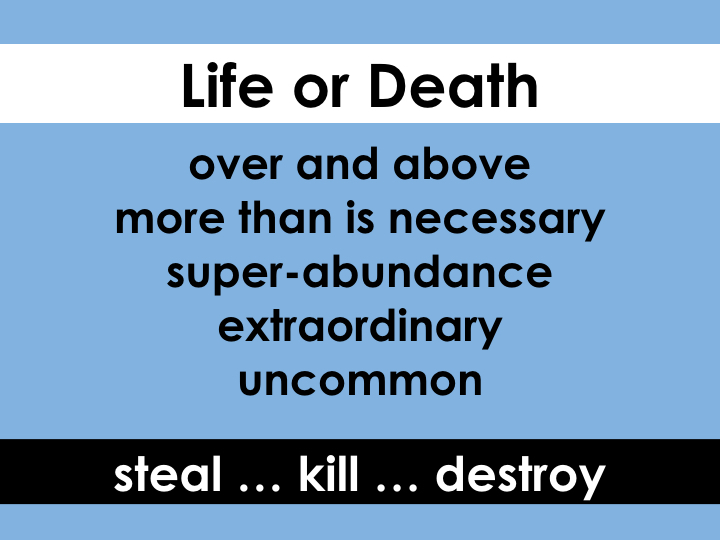
Here’s an important one—The thief cometh not, but for to steal, and to kill, and to destroy: I am come that they might have life, and that they might have it more abundantly (John 10:10).

It’s a pretty clear distinction: One way brings death and the other way brings life. But not just any kind of life.

The Greeks had three words for “life”—

  1. Bios from which we get our word biology. We can see when something is alive because of its biological growth.
  2. Psuche from which we get our word psychology. Plants might be biologically alive, but they don’t have the psychological life of a human.
  3. Zoe. This is the word Jesus used in John 10:10. It’s the word that means “life force” or better stated it’s God’s life.

God is a Triune God: Father, Son, and Spirit. When God created humans, we were created in His “trinity” image—Let Us make man in Our image (Genesis 1:26). Adam was created with bios, psuche, and zoe life. God told Adam and Eve that if they sinned, they would die (Genesis 2:17). When they did eat that forbidden fruit, they remained biologically and psychologically alive, but the zoe life force was cut off.

Jesus came to restore that! He came to bring us back to the state God originally intended for us, which meant He had to go to the Cross to become our sin, so that we could be forgiven and brought back to life.

Placing your faith in Jesus Christ’s work on the Cross means a complete about-face. The devil wants to steal from you, kill you, and destroy your soul for eternity. But Jesus came that you could have zoe in a way that was above-and-beyond, super-abundant, extraordinary and uncommon!

To get this life, Jesus asks us to do something that He did—If anyone would come after Me, he must deny himself and take up his cross and follow Me (Matthew 16:24).

Jesus isn’t calling for our hands and feet to be nailed to a wooden Cross. But He is calling for our selfish thoughts to be crucified (Matthew 16:23), and for us to give no more attention to our old sinful life.

I think this passage in Romans captures that thought so well—

Could it be any clearer? Our old way of life was nailed to the Cross with Christ, a decisive end to that sin-miserable life—no longer at sin’s every beck and call! What we believe is this: If we get included in Christ’s sin-conquering death, we also get included in His life-saving resurrection. We know that when Jesus was raised from the dead it was a signal of the end of death-as-the-end. Never again will death have the last word. When Jesus died, He took sin down with Him, but alive He brings God down to us. From now on, think of it this way: Sin speaks a dead language that means nothing to you; God speaks your mother tongue, and you hang on every word. You are dead to sin and alive to God. That’s what Jesus did. That means you must not give sin a vote in the way you conduct your lives. Don’t give it the time of day. Don’t even run little errands that are connected with that old way of life. Throw yourselves wholeheartedly and full-time—remember, you’ve been raised from the dead!—into God’s way of doing things. Sin can’t tell you how to live. After all, you’re not living under that old tyranny any longer. You’re living in the freedom of God. (Romans 6:6-14)

The choice is yours: the rip-off, destruction, and death the devil offers OR the abundant, overflowing, extraordinary, more-than-is-needed, zoe life that Jesus offers.

Life or death. Your choice.

The Emblem Of Suffering And Shame

Listen to the podcast of this post by clicking on the player below, and you can also subscribe on AppleSpotify, or Audible.

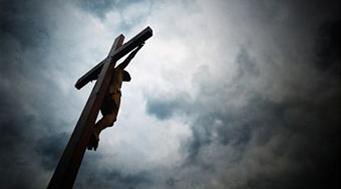
Tomorrow we celebrate Good Friday—the day Jesus died a horrific death on Calvary for my sins and your sins. The apostle Paul said Christ’s crucifixion was a stumbling block to many, because it was unimaginable that anyone—especially the perfect Son of God—could be subject to the torturous death reserved for the worst of offenders. But when Jesus became sin for us, that’s just what He was in that moment: the worst of offenders in Holy God’s eyes.

Christ on the Cross    “In the ancient world crucifixion was seen as a particularly disgraceful and grievous form of execution. Assyrian battle reliefs depict a precursor to crucifixion—impaling victims on poles outside the walls of conquered cities. The Persians made wide spread use of crucifixion, although sometimes the crucifixion took place only after the victim had been executed by other means (Herodotus, Histories, 3.125.2-3). There are also reports that crucifixion was used by peoples as varied as the Assyrians, Scythians, Celts, Germans, Britons and inhabitants of India, although the reliability of some of these accounts is questionable. Common to most of these cultures was the perspective that crucifixion was a form of execution reserved for the worst offenders, as well as for slaves.

     “The practice of crucifixion became widespread under Alexander the Great (356-323 B.C.). It became the common form of execution for traitors, defeated armies and rebellious slaves. Later, under the Roman Empire, only non-citizens, lower-class Romans and violent offenders could be crucified. The only possible exceptions were in cases of high treason or desertion during wartime. Slaves were particularly vulnerable to the imposition of crucifixion. Latin literature reflects the dread slaves felt at the prospect of this fate. It was officially accepted as the most painful and disgraceful form of capital punishment, more so than decapitation, being thrown to wild animals or even being burned alive. For these reasons this heinous penalty was often imposed upon foreigners who were seen as threats to Roman rule.

     “There are also accounts of crucifixion being practiced among Jews. Josephus wrote that the Sadducees and high priest Alexander Janneus (in the office from 103 to 76 B.C.) committed the following atrocity against his enemies, the Pharisees: ‘While dining in a conspicuous place with his concubines, he commanded that about 800 of them be crucified, and while they were still alive before their eyes he had the throats of their children and wives cut’ (Josephus, Antiquities, 13.14.2).

     “Victims were often scourged or otherwise tortured prior to crucifixion. Crucifixions were carried out on either a single vertical stake or on a vertical stake with a crossbeam near or on its top. Sometimes blocks were attached to the stake as a seat, footrest or both. Depending upon the presence of these blocks, the victim might linger, alive, for up to three days. The blocks allowed a victim to rest some of his weight, increasing the chance of breathing and proper circulation. Without the blocks a victim’s weight would rest totally upon his arms, which were attached to the crosspiece by ropes, nails or both. This would prohibit breathing and circulation and lead to both brain and heart failure. To end the torture, a victim’s legs could be broken, after which death would quickly follow. Oftentimes the charge against the guilty party would be written out and nailed to the cross above his head. As a deterrent to would-be rebels and criminals, crucifixions were usually carried out in highly visible locations.

     “During Jesus’ lifetime crucifixion was used by the Romans to exercise and gruesomely display their authority over others. This torturous execution was viewed by the Jews as a cursed form of death. Deuteronomy 21:23 states that ‘anyone who is hung on a tree is under God’s curse.’ Documents discovered at Qumran reveal that many Jews of Jesus’ time applied this text to Roman crucifixion. This perspective of crucifixion demonstrates why the apostle Paul wrote that the Cross of Christ was ‘a stumbling block to Jews and foolishness to Gentiles’ (1 Corinthians 1:23). Who would have imagined that the Holy One of God would voluntarily take upon Himself the curse that should have been ours? This emblem of shame has thus become the symbol of our salvation.” —Archaeological Study Bible, “Crucifixion” (page 1757)

As you remember what Jesus did for you on the Cross atop of Golgotha, may you be overwhelmed by the love which held Him fast to such a horrific instrument of death. He endured the suffering and shame of the Cross because He loves you and wants you to be with Him forever.

May we cherish that old rugged Cross and the Savior who suffered and died for us. As we place our faith in His death and resurrection three days later, may we be able to live each day in celebration of the victory Jesus won over hell, death, and the grave!

►► Would you please prayerfully consider supporting this ministry? My Patreon supporters get behind-the-scenes access to exclusive materials. ◀︎◀︎

11 More Quotes From “#struggles”

#strugglesCraig Groeschel nailed the tension between technology and relationships in his timely book #struggles. He doesn’t advocate getting rid of technology, but he does make a great case for not allowing technology to diminish our flesh-and-blood relationships. You can read my review of #struggles by clicking here. Below are some more quotes that caught my eye from this book.

“The highest percentage of consumers of pornography our children aged twelve to seventeen.”

“We have access to many opportunities online that—without accountability—can turn technological blessings into curses.”

“Over time and with repeated use, technology is eroding both our moral beliefs and our commitment to acting on what we believe. According to one study, ‘Roughly two-thirds (67 percent) of young adult men and one-half (49 percent) of young adult women now believe that viewing pornography is acceptable.’ … Times have changed. But that doesn’t mean morality should.” 

“If you want to live in a way that honors our Savior—if you want to follow Jesus in a sin-saturated, selfie-centered world—then you will have to be different. … Our convictions must be guided by God’s timeless principles, not by the ever-eroding popular opinion on whatever happens to be acceptable now.”

“Most people I know you don’t plan to ruin their lives. I don’t know anyone who thinks, ‘If I can connect with an old boyfriend on Facebook, I can totally wreck my life. I can almost guarantee an ugly divorce full of expensive lawyers helping us fight over custody rights for the kids. I can devastate my husband and drop a nuclear bomb of pain into my kids’ lives. And I can spend the next years of my life trying to forgive myself, rebuild my life, and regain my name.’ No one plans like that, but these things happen every day. Same with pornography. I don’t know a single man who wanted to crush the wife he loves when she discovered his ‘little secret.’ But one glance followed by another click often leads to an addiction that seems impossible to overcome.”

“When you think about it, no one stumbles into righteousness. People fall into sin and every day. But no one just falls into holiness. It requires making deliberate, prayerful choices and walking an intentional path.”

“Here’s what many people miss: when we misuse technology, we’re robbing ourselves of the peace we so desperately crave, because even the momentary escape is followed by waves of intense guilt. We want to numb the pain, but on the other side of our binge, the pain is still there, only worse. We love the momentary distraction, but then reality screams at us and our responsibilities pile up. We love the thrill of the lust, but the fear of getting caught haunts us and robs us of sleep and peace. Like a person dying of thirst who gulps salt water, that which is supposed to satisfy only intensifies our need. So life goes on as usual. More stress. More anxiety. More worries. And less peace.”

“Now is a great time to be brutally honest. Are you addicted to something online? Looking lustfully? Spending uncontrollably? Surfing endlessly? Playing continually? Gambling consistently? Scrolling incessantly?”

“If you are checking multiple times a day to see what people are saying about you, let’s call that what it is: idolatry. If your identity comes more from who follows you, who Likes you, what they say and what they think about you rather than who God says you are, it’s time to take this issue to God.”

“When our minds are idle, we’re not thinking about anything meaningful, and when we’re not intentionally living, it can be so easy to shift into neutral. When we don’t have a specific destination in mind, any road will do. And if our time and our resources aren’t precious, if we’re not doing anything important, it can be so easy to just pick up our phone, unlock the screen, and wonder aimlessly through cyberspace, wasting our time and our thoughts.”

“Maybe it’s time to power down and take a cyber Sabbath. Maybe it’s time to remember what life is like without your phone, tablet, or laptop. Maybe it’s time for your soul to rest.”

You can check out the other quotes I shared from #struggles by clicking here.

The Power Of Confession

God restoresGod wants to meet with us. He loves hearing our voice and talking to us. We can come into His presence at anytime, with anything and everything that’s on our heart, and know for sure that He is waiting to hear from us.

But there is one thing that can short-circuit this intimate relationship. And if we don’t deal with this one thing quickly, it could lead to disastrous results.

This one thing is unconfessed sin.

Adam and Eve sinned, and started a downward slide that we continue in today. First, they tried to cover up their sin (Genesis 3:7). Think about this for a moment. They made clothes out of fig leaves. What happens to leaves when are detached from their vine? Yep, they die and shrivel up!

Next, they tried to hide from God (Genesis 3:8-10). Really? You can hide from God?! That’s sort of like a toddler covering her eyes and thinking since she can’t see daddy, he can’t see her either.

Then they made excuses for their sin (Genesis 3:11-13). Of course, they said, we would have never sinned on our own. She made me do it! The devil made me do it!

None of this worked. Instead it kept them in fear of God’s presence!! 

A beautiful prayer of confession of his sin is David’s prayer in Psalm 51. Notice this:

  • He was assured of God’s unfailing love and His great compassion (v. 1).
  • He confessed his sin without excuse. Five times in verses 1-3 he says my transgression, my sin, my iniquity.
  • He let God restore him (vv. 7-12)

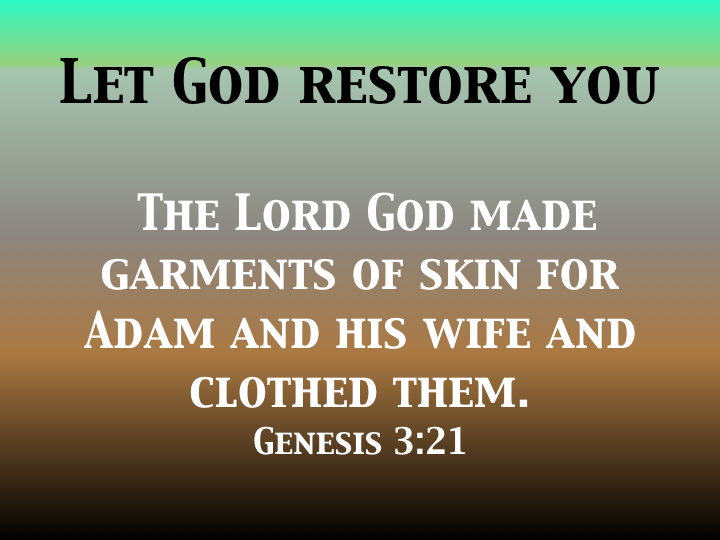
It works so much better when God does the restoring! Instead of the fig leaves which were dying, God Himself made clothes for Adam and Eve (Genesis 3:21). This was a foreshadowing of the of way God will clothe all men and women who confess their sin, and place their faith in Christ’s work on Calvary (Ephesians 5:26-27).

Don’t let unconfessed sin keep you from God’s presence! Quickly confess your sin, and let God clothe you in the righteousness of Jesus.

We’ll be continuing our look at Practical Prayer this Sunday, and I hope you can join me. If you cannot join us in person, check out our live broadcast on Periscope.

Links & Quotes

link quote

“Although circumstances may bring us into the place of death, that need not spell disaster—for if we trust in the Lord and wait patiently, that simply provides the occasion for the display of His almighty power.” —L.B. Cowman

“Notice the singular ‘commandment’—‘This is His commandment, that we believe in the name of His Son Jesus Christ, and love one another, just as He commanded us’ [1 John 3:23]. These two things are so closely connected for John he calls them one commandment: believe Jesus and love others. That is your purpose. That is the sum of the Christian life. Trusting Jesus, loving people.” —John Piper

“We make progress in overcoming our sin when we have hope that our failures will be forgiven. If you don’t have hope that God will forgive your failures, when you start fighting sin, you give up.” —John Piper

“Impatient believers are offended when they see God working miracles all around them but not in their lives. They’re offended at what they believe is God’s slowness to answer them, and over time they feel neglected and imprisoned. Hebrews tells us such impatience is a form of spiritual laziness: ‘Be not slothful, but followers of them who through faith and patience inherit the promises’ (Hebrews 6:12). We are instructed to follow Abraham’s example: ‘After he had patiently endured, he obtained the promise’ (6:15).” —David Wilkerson

Tim Dilena has some amazing insights for every married couple in this video.

Links & Quotes

link quote

“Ah, what a thing is prayer! The simplest form of speech—such as even a child could utter—yet the highest and divinest of all utterances; such as the Holy Spirit alone can enable us to give fourth.” —Horatius Bonar

“When God feels distant, remember the Christmas story. When you feel alone, unloved, or unlovable, remember that God loves you. And He travelled a great distance to be close to you. Why? Because He loves to be with the ones He loves!” —Max Lucado

“Do you ever take a moment to pray but feel like you stumble out of the gate? Do you have trouble finding the words when it comes time to bow your head? Remember, the One who hears your prayers is your Daddy. You don’t need to wow him with eloquence. Jesus downplayed the importance of words in prayers. We tend to do the opposite. The more words the better. The better words the better. … Just as a happy child cannot mis-hug, the sincere heart cannot mis-pray.” —Max Lucado

J.Warner Wallace answers a good question: Why doesn’t the birth record of Jesus appear in every Gospel?

Dan Reiland has some good words for those in leadership positions in ministry.

Far too many school administrators and teachers think they are limited by the so-called “separation of church and state.” Here’s a post from Eric Buehrer you should share with any of your friends who work in the public school system.

John Stonestreet says, “Remember when people laughed about ‘death panels’?” Check out Who decides to end a life?

Frank Turek asks, “How do we fix a world filled with murder, rape, betrayal, adultery, fraud, theft, sexual exploitation, pornography, bullying, abortion, terrorism, cheating, lying, child abuse, racism, assault, drugs, robbery, and countless other evils?” He says we may not like the answer.