Links & Quotes

link quote

Some good reading from today…

Hobby Lobby: Good News, Bad News & A Warning.

In related news: Liberals’ Top 3 Absurd Hobby Lobby Claims.

And a scary news item: Obama White House seeking ways to circumvent the Hobby Lobby SCOTUS ruling.

Perhaps even scarier is this [VIDEO]: President Obama unapologetic about trying to bypass Congress.

Hamas (which is supported by the Obama State Department) murdered three Israeli teenagers.

All of this re-reminds me: The world needs Jesus. John Piper says, “Your life is too small if it is not connected to this great challenge. Not all Christians are missionaries. But all care about the mission. All are connected. And want to be connected. No Christian should go for months and never think about this greatest of all enterprises.” Read more in his post The Greatest Challenge In The World.

“Success is not final; failure is not final: it is the courage to continue that counts.” —Winston Churchill 

“No scripture is exhausted by a single explanation. The flowers of God’s garden bloom, not only double, but seven-fold: they are continually pouring forth fresh fragrance.” —Charles Spurgeon

“Human knowledge must be understood in order to be loved; but Divine knowledge must be loved to be understood.” —Blaise Pascal


13 Quotes From “The Solomon Seduction”

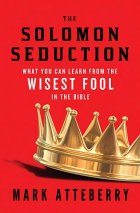
Solomon SeductionThe Solomon Seduction is a biography on King Solomon, a Bible study, a book for men to overcome temptation, a leadership book, and a great discussion starter for a men’s group. In other words, there are lots of reasons for guys to read this book! You can read my full book review by clicking here, and below are some of the quotes I highlighted from this book.

“Moderation can be a great thing. But the idea that anything is okay as long as it’s done in moderation has given rise to some of the wackiest notions known to man. … One of the big problems with using moderation as a justification for whatever you want to do is that it’s almost impossible to take just a bite when you’re really hungry.” 

“Are you just a guy who goes to church, or are you serious about growing spiritually and acquiring discernment? satan’s chances of seducing you will rise or fall on your answers to these questions.”

“Solomon is the perfect example of the fact that you can have your cranium crammed full of discernment and still end up embarrassing yourself. Keep in mind, he not only knew the book of Proverbs, he wrote the vast majority of it! And then ended up doing many of the very things he himself said were foolish!” 

“All of satan’s various attempts at seducing believers must include an attempt to undermine Scripture.”

“What we have here is a case not of ignorance or confusion or misinterpretation, but of satan subtly and artfully manipulating Solomon’s thinking to the point where he felt the commands of God seemed out of touch with his real-world experience.”

“satan doesn’t try to get you to forsake your good priorities. He just encourages you to mix in a few lesser priorities that will compete with those good priorities.”

“Mark it down. When the word I starts replacing the word we in your speech, something ugly is happening in your heart. Your ego is swelling.” 

“Big-ego people almost never back up and take another look at their actions. Why should they? They’re convinced that everything they do is right. It never occurs to them that they might be on the wrong track. They’re so infatuated with themselves that they can see nothing but that beautiful image in the mirror.”

‘What’s the big deal?’ If ever a question spoke to the attitude of our generation towards sin, that one does. We shrug off sin as though it’s just a little harmless fun. You know, boys will be boys. Everybody sows some wild oats, right? Or, if we don’t play the what’s-the-big-deal card, we claim that the sin we are indulging in is actually necessary.” 

“Instead of repenting, instead of exterminating, illuminating, or correcting their bad behavior, [sin managers] try to manage it. They believe that if they can keep the behavior from getting out of hand, keep people from being hurt or offended, keep the status quo from being upset, keep the ugliness under wraps and out of sight, they can hang on to their sin and everything will be fine. … This is typical of sin managers. Instead of seeing sin as the problem, they see the awkwardness the sin creates as the problem and believe, therefore, that if they can find an answer for the awkwardness, they will have solved the problem.”

“In the category of cold, hard truths, this is a doozy: God doesn’t share the throne of your heart with anybody or anything. You either give it to Him wholly and completely, or He vacates it. You can tell yourself that God comes first and that the sin you’re harboring is just a little something you need to work on, but if you choose a lifestyle of sin management over repentance, you’ve pledged your allegiance to your sin, not to God.”

“Repentance is not what saves us; grace is. But repentance is a response to grace that makes what we are after having received grace different from what we were before. … Repentance concerns itself with how things are while sin management only worries about how things look. Think of a messy closet. Repentance cleans out the closet. Sin management straightens up the closet. Repentance throws away the junk. Sin management rearranges the junk. Repentance gives you a better closet. Sin management only gives you a better-looking closet.”

“When we see Solomon at the height of his idolatrous lifestyle, marrying and buying and indulging like an out-of-control sailor on a weekend pass, what does he say over and over again? ‘I said to myself…’ (Ecclesiastes 1:16, 2:1, 2:15, 3:17, 7:23). Solomon was talking to himself about a lot of things he should have been discussing with God. Who can argue that the reason why he was seduced and eventually reduced to an object of scorn and pity was because he excluded God from so many areas of his life?” 


Links & Quotes

link quote

Some good reading from today…

“Married women are notably safer than their unmarried peers, and girls raised in a home with their married father are markedly less likely to be abused or assaulted than children living without their own father.” See what else Eric Metaxas shares in Men Who Serve And Protect.

“A rejection, or in Scripture’s strong language, a crucifixion of the natural self is the passport to everlasting life. Nothing that has not died will be resurrected.” —C.S. Lewis

“If Bible Christianity is to survive the present world upheaval, we shall need to recapture the spirit of worship. We shall need to have a fresh revelation of the greatness of God and the beauty of Jesus. We shall need to put away our phobias and our prejudices against the deeper life and seek again to be filled with the Holy Spirit.” —A.W. Tozer

The state of California is going to pay abortion providers more money to kill babies. Guess where the funds are coming from? Yep, those doctors who are trying to save lives will be paid less! Bishop Jaime Soto speaks out.

Planned Parenthood wrote an open letter saying the word abortion is not mentioned in Scripture, so that somehow makes it okay to kill innocent lives. Pastor Garrett Kell has a wonderful, biblical response.

In a Family Talk interview with Ryan Dobson, here are some great quotes from Nick Vujicic: “Fear will disable you more than your physical limitations. … When we give God our broken pieces, he can turn our broken pieces into something beautiful. … You’re not important because of how many people know you; you’re important because you’re a child of God. … Don’t be a bystander, be on stand by. I will not allow a bully to bully others. I will not laugh at his jokes, I will not remain silent. I will stand up and say ‘Enough is enough.’”

“Our resources are the Christlikeness we win while immersed in battle. They are the lessons, the faith, the character we gain from warfare with the enemy.” —David Wilkerson

Defeating satan

Spiritual warfare.1The Bible tells us that satan is a formidable foe. He steals, he kills, he destroys. When he speaks, lies are all that come out of his mouth. He slanders, he deceives, he coaxes, he bullies; he does whatever he can to trip up as many people as he can.

Remember this: “The prince of this world now stands condemned” (John 16:11). He wants to take as many victims down with him as he can! Look what the Bible says about his powers—

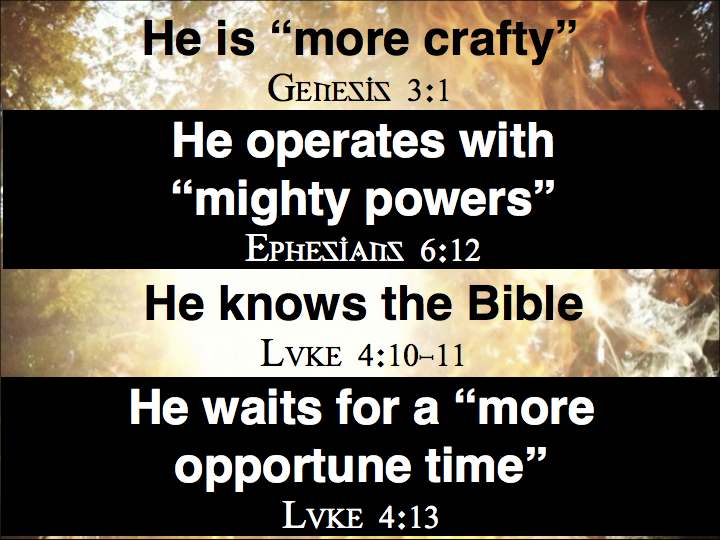
  • He is more crafty (Genesis 3:1). This means he is extremely subtle. He seldom throws a huge blatant sin right in your face, but he whispers subtle suggestions.
  • He operates with mighty powers (Ephesians 6:12). He knows how to match strength for strength.
  • He knows the Bible (Luke 4:9-11). The difference is he only knows the words, but the scriptural text is not illuminated by the Holy Spirit to him.
  • He waits for the most opportune time (Luke 4:13) to pounce.

But “…that satan might outwit us… we are not unaware of his schemes” (2 Corinthians 2:11). What are his schemes?

  • Pride—“You can do it yourself.” This was his original downfall, and now he will use it on you.
  • Second-guessing—“Did God really say…?” (Genesis 3:1). He will try to make you think that God’s Word is out-of-date or irrelevant to you.
  • Condemning. Notice that satan wasn’t around when God showed up in the Garden of Eden. Instead he leaves you feeling like you’re unacceptable to God and that you need to hide from Him.

The way we overcome satan is the same way Jesus did it: Jesus quoted Scripture to refute each of satan’s temptations (see Luke 4:1-13). We are victorious in the exact same manner!

Now have come the salvation and the power and the kingdom of our God, and the authority of his Messiah. For the accuser of our brothers and sisters, who accuses them before our God day and night, has been hurled down. They triumphed over him by the blood of the Lamb and by the word of their testimony(Revelation 12:10-11).

Don’t try to go toe-to-toe with the devil because he is too strong for you to handle on your own! But with God’s Word as your weapon and the Holy Spirit as your Counselor, you can hurl him down every time!

3 Steps To Better Bible Studies

Inspired WordThe Bible is God’s inspired Word—literally, that means it is “God-breathed” (2 Timothy 3:16-17). If the Holy Spirit inspired the Word to the biblical writers, He can best illuminate the same Word to you as you read and study it.

This is how Jesus said the Holy Spirit would help us handle God’s Word:

Teach (John 14:26a). This word means to teach by holding a discourse with someone (or in this case, with Someone). Reading the Bible is meant to be a dialogue, not a monologue.

Remind (John 14:26b). The Holy Spirit is actively involved in us recalling and applying the Word to the situations in which we find ourselves. The Bible tells us to study to be prepared (1 Peter 3:15) and to handle God’s Word like a good worker (2 Timothy 2:15). We are also told not to pre-plan what to say if we are put on the spot, but that words would be given us (Matthew 10:19) as the Holy Spirit recalls to our memory which we have studied.

Convict (John 16:8). This word means both to refute and to confute. Confute simply means proving something is wrong. Refute means to show us we’ve reached a false or illogical conclusion, perhaps a conclusion we reached without giving it very much thought.

Guide (John 16:13). We get a good idea of the meaning of this word from the negative use of the same word—Can a blind man lead [the same word for “guide” in John 16:13] a blind man? Will they not both fall in a pit? (Luke 6:39). We can trust the Holy Spirit to lead us to the truth in the Scriptures that we can apply to our lives.

Quite simply better Bible studies come from:

  1. Praying for the Holy Spirit to illuminate Scripture to you as your read it.
  2. Reading the Bible.
  3. Obeying what the Holy Spirit illuminates to your heart and mind.

Try it and see what happens. I think you’ll like the results!

Links & Quotes

link quote

Some good reading from today…

“We were made not primarily that we may love God (though we were made for that too) but that God may love us, that we may become objects in which the Divine love may rest ‘well pleased.’ To ask that God’s love should be content with us as we are is to ask that God should cease to be God: because He is what He is, His love must, in the nature of things, be impeded and repelled, by certain stains in our present character, and because He already loves us He must labour to make us lovable.” —C.S. Lewis

“Our old history ends with the Cross; our new history begins with the resurrection.” —Watchman Nee

Chick-Fil-A closed for a very honorable reason.

A bit scary: Muslims’ attitude toward non-Muslims.

“It’s easy, and perhaps comforting, to think of all the things the church is doing to try to change the world. But the real question is, what are you doing? Sure, you go to church and try to live a good life. But how intentional are you when it comes to actually impacting the lives of the lost people you rub shoulders with every day?” —Mark Atteberry

“Whatever the currents of public opinion and governmental action, God’s message is constant and glorious. Whether it is a crime to defy Scripture or to defend it, the Church must preach it—both in season and out of season. This is her calling.” —Kairos Journal

Blessing Your Descendants

Sunrise on Mt. SinaiParents want to give their children the best they can give. But that doesn’t come through education, or possessions, or even the loving attention of devoted parents.

King Abijah started out well. When King Jeroboam came from the north to attack him with an army double the size of Abijah’s army, Abijah delivered an impassioned speech to his men. He reminded them that the northern tribes of Israel were in rebellion against God, but that he and the southern tribes of Judah still had God’s favor.

In the middle of his speech, some men of Israel launched a surprise attack from behind, and the men of Judah cried out to God for help. With the Lord’s help, Judah routed the Israelite army. The Bible says, “The men of Judah were victorious because they relied on the Lord, the God of their fathers” (see 2 Chronicles 13, emphasis added).

But something happened to Abijah. The scriptural account says that he became sinful and wasn’t fully devoted to God “as the heart of David his forefather had been” (1 Kings 15:3).

Did this happen because he thought his speech and his strategy won the day? Maybe his speech was just for show and he didn’t really believe what he was saying. Did his grandmother lead him astray by her idol worship? Perhaps Abijah’s 14 wives were his downfall.

In any case, Abijah sinned and God’s righteous judgment was going to fall on him and his people. Then the Bible says,

Nevertheless, for David’s sake the Lord his God gave him a lamp in Jerusalem by raising up a son to succeed him and by making Jerusalem strong. (1 Kings 15:4, emphasis added).

Although Abijah sinned, God looked back to his great-grandfather in order to bless Jerusalem. Wow!

I pray that my life can be so devoted to God that His blessing can extend to my descendants. I know they have to choose for themselves that they will follow God, but I want my life to be a help and not a hindrance. So help me God!

Koinonia

All inIn 2007, Dave Kinnaman & Gabe Lyons published a book called unChristian. In it they reported the cultural view of Christians: haters, judgmental, hypocritical, too involved in politics, out of touch, insensitive, boring.

Do any of these words fit Jesus? No, I’ve never heard anyone—whether in the Bible or in the history of that day—call Jesus a hypocrite, or boring, or a hater. Do any of these words fit the apostles who began to spread the message of Jesus Christ after His ascension? No! Again, I’ve never read anywhere where the early Christians were called judgmental, or too political, or out of touch.

But if these labels are thrown at Christians today—Do not be surprised, my brothers, if the world hates you (1 John 3:13)—the Bible tells us how to reverse them: By living counter culture, by living according to God’s Word. In a word, by living in koinonia.

This is a Greek word that isn’t used in the Gospels, but shows up just after the first Church is born on the day of Pentecost. It’s a word and a concept that simply won’t work in a pragmatic culture, but works powerfully in a biblical counter culture. The word is usually translated fellowship in English.

Koinonia is how the Trinity operates (see 2 Corinthians 13:14). All three Persons of the Godhead are mentioned in fellowship with each other. There is no rivalry in the Trinity, but if any part of it is diminished, so is its total effectiveness and glory.

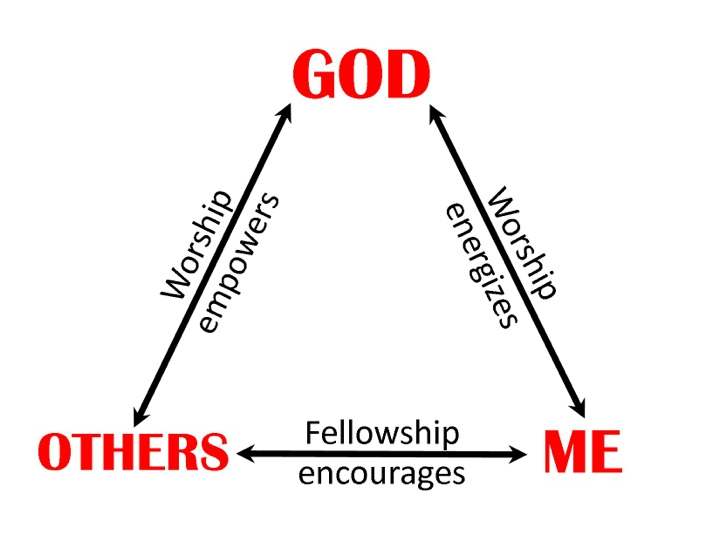
trinity of koinoniaChristians are called to be part of a trinity of koinonia as well.

  • When I worship God, I am energized to be in fellowship with others.
  • My fellowship with others that flows from my love for God empowers them to worship God for themselves.
  • The overflow of that relationship with God encourages others to be in fellowship with me.
  • And that fellowship energizes me to worship God even more deeply, which encourages my fellowship with others, which empowers them for deeper worship… and on and on and on it goes!

Koinonia is an ALL IN relationship. It’s not something I can dabble in, or be involved with occasionally. I’m either in koinonia, or I’m not.

To see a great example, look at the Christians the very first time the word koinonia is used in Scripture. Acts 2:42-47 shows us how the Christians were not only all in (the Bible uses the word devoted), but how others in the community responded: they were in awe and viewed the Christians with favor. And as a result, lives were being changed every single day.

Yes! That’s what I want to be a part of! How about you?

11 Quotes From “Holy Fire”

Holy FireHoly Fire by R.T. Kendall is an excellent book for dyed-in-the-wool Pentecostals, and for those who believed the operational gifts of the Holy Spirit have ceased. You can read my book review by clicking here. Below are a few quotes I highlighted in this book.

“So if you feel threatened by the Holy Spirit, is it because you are happily in your comfort zone? Are you afraid of what the Holy Spirit might do to you? What He would require of you? What He might ask you to do? Do you think you will lose something if you make yourself vulnerable and totally open to Him? Are you afraid He will embarrass you? Do you think you will lose your identity? Do you think you might have to change?”

“The canon of Holy Scripture is closed. It is final. Absolute. Incontrovertible. It is God’s complete and final revelation. No word that will come in the future will be equal to the Bible in level of inspiration. This means that any leading, prophetic word, word of knowledge, or vision one may have today must cohere with Holy Scripture. If it doesn’t, it must be rejected.”

“The Holy Spirit is our best and only reliable Teacher. In fact, He is the only Teacher who matters. Whatever teaching you hear or read (including this book)—whoever the preacher or teacher, if the Spirit does not apply it and witness it to your heart (which He is most capable of doing), you should learn to hold that teaching in abeyance—if not dismiss it.” 

“The Spirit ‘guides’ us into truth—showing what is there but what cannot be seen without Him opening our eyes. It is humbling for prideful people to admit to the need of the Holy Spirit. The cost? Our pride being shattered. But once we are broken and enabled to see our stubbornness, the Spirit will show us amazing things—in Scripture.”

“The Holy Spirit leads us to praise the Lord Jesus as He deserves.” 

“Don’t come short of discovering how real God is because some well-meaning person says this kind of relationship with God is not possible today.”

“Unbelief is doubt that degenerates to a conscious act of the will. … But when we consciously decide that God did not say what He did—and we can do it better; or that He is not going to keep His word—or manifest Himself, and then put ourselves above His Word, we cross over a line. This is dangerous stuff.” 

“Do you know the context of Hebrews 13:8? Verses 7 and 9 point to one thing: sound teaching. … Whereas we have a perfect right to apply Hebrews 13:8 against cessationist teaching, the immediate context refers to doctrine. Sound theology. The writer wanted the teaching of Jesus to remain the same yesterday and today and forever. Knowing His Word and His ways.”

“What if God in some cases keeps some skeptics from seeing the miraculous even though it actually takes place? What if miracles are largely for those believers in God’s family who have accepted the stigma of being ‘outside the camp’ (Hebrews 13:13)? After all, why didn’t the resurrected Christ appear to everybody on Easter Sunday? One might choose to argue that this would have been a reasonable thing to do if God truly wanted everybody to believe on His Son. Why did Jesus reveal Himself only to a few? Why didn’t Jesus knock on Pontius Pilate’s door on Easter morning and say, ‘Surprise!’? Why didn’t Jesus go straight from the empty tomb to Herod’s palace and say, ‘Bet you weren’t expecting Me!’ He appeared only to a few—those who were His faithful followers. I also suspect that God sometimes allows just a little bit of doubt when it comes to the objective proof of the miraculous. This keeps us humbled. And sobered.” 

“The Holy Spirit can therefore be quenched by a doctrine that does not allow for Him to show up. … It also seems to me that one of the more serious fallouts of being a cessationist is that it can eliminate any expectancy for God to work powerfully in our hearts and lives. One may become too content with his or her sheer intellectual grasp of the gospel. The consequence is that we don’t even consider—much less expect—that God will manifest His power in our lives.”

“This to me is serious—and a very precarious position to take, namely, ruling out categorically the possibility of God manifesting His glory in signs and wonders today and deleting a great portion of the Bible for today. Consider how much the Bible has to say about God’s power. Healing. Signs and wonders. Revelation of truth by the Holy Spirit. Consider what is left in Holy Scripture when you rule out the miraculous or the gifts of the Holy Spirit.”

Links & Quotes

link quote

Great reading (and watching) today.

[VIDEO] John Maxwell reminds us of the value of delays.

Dr. James Dobson defends his comments at the National Day of Prayer address.

[VIDEO] Dr. Brian Mattson discusses the place of the Apocrypha.

[INFOGRAPHIC] Exercise helps your memory.

“The surprise comes for many people that such a tiny little brain is able to form such a rich memory described as a cognitive map,” says co-author Randolf Menzel. Actually, the surprise for me is that many people refuse to believe this amazing little brain was created by an amazing Creator. See how bees build mental maps to get back home.