Thursdays With Oswald—Heavenly Minded & Earthly Good

This is a weekly series with things I’m reading and pondering from Oswald Chambers. You can read the original seed thought here, or type “Thursdays With Oswald” in the search box to read more entries.

Oswald Chambers

Heavenly Minded & Earthly Good 

     Entire sanctification puts a man’s breast and back as either should be, places his feet on earth and his head in Heaven, and gives him the royal insignia of the saints. 

From Christian Disciplines

Have you ever heard it said of someone, “He’s so heavenly minded that he’s no earthly good”? They are saying that man has ideas which sound spiritual but aren’t very practical.

Isn’t it also true that someone could be “so earthly minded that he’s no heavenly good”? Yes, sadly, many people fall into this category!

Oswald Chambers is saying that those people who allow the Holy Spirit’s total sanctification process in their lives are both heavenly minded and earthly good. Or, as Chambers says in If Ye Will Ask, “Jesus Christ does not make monks and nuns, He makes men and women fit for the world as it is (see John 17:15).”

Christians should be the most practical people on earth, because their feet remain on earth while their mind and hearts remain in Heaven, hearing and applying God’s timeless and practical truths. True Christians should sound and live differently.

20 Quotes From “The Highest Good”

The Highest GoodSome of my most highlighted books are Oswald Chambers’ books, so The Highest Good was no exception. It was difficult to narrow down, but here are 20 of my favorite quotes from this book. (If you would like to read my book review of The Highest Good, click here).

“If I am a child of God, distress will lead me to Him for direction. The distress comes not because I have done wrong, it is part of the inevitable results of not being at home in the world, of being in contact with those who reason and live from a different standpoint.” 

“Spiritual insight is not for the purpose of making us realize we are better than other people, but in order that our responsibility might be added to.”

“God expects us to be intercessors, not dogmatic fault-finders, but vicarious intercessors, until other lives come up to the same standard.” 

“In times of prosperity we are apt to forget God, we imagine it does not matter whether we recognize Him or not. As long as we are comfortably clothed and fed and looked after, our civilization becomes an elaborate means of ignoring God. … But remember God’s blessing may mean God’s blasting. If God is going to bless me, He must condemn and blast out of my being what He cannot bless. ‘Our God is a consuming fire.’ When we ask God to bless, we sometimes pray terrible havoc upon the things that are not of God. God will shake all that can be shaken, and He is doing it just now.”

“God intends our attention to be arrested, He does not arrest it for us. … We are apt to pay more attention to our newspaper than to God’s Book, and spiritual leakage begins because we do not make the effort to lift up our eyes to God.” 

“The majority of us do not enthrone God, we enthrone common-sense. We make our decisions and then ask the real God to bless our god’s decision.”

“When I wish I was somewhere else I am not doing my duty to God where I am.” 

“Let us not be so careful as to how we offend or please human ears, but let us never offend God’s ears.”

“We have not only lost Jesus Christ’s idea of righteousness, but we laugh at the Bible idea of righteousness; our god is the conventional righteousness of the society to which we belong.” 

“It is so absurd to put our Lord as Teacher first, He is not first a Teacher, He is a Savior first. He did not come to give us a new code of morals: He came to enable us to keep a moral code we had not been able to fulfill. … If He is a Teacher only, then He is a most cruel Teacher, for He puts ideals before us that blanch us white to the lips and lead us to a hell of despair. But if He came to do something else as well as teach—if He came to re-make us on the inside and put within us His own disposition of unsullied holiness, then we can understand why He taught like He did.”

“The only way to get out of our smiling complacency about salvation and sanctification is to look at Jesus Christ for two minutes and then read Matthew 5:43-48 and see Who He tells us we are to be like, God Almighty, and every piece of smiling spiritual conceit will be knocked out of us for ever, and the one dominant note of the life will be Jesus Christ first, Jesus Christ second, and Jesus Christ third, and our own whiteness nowhere. Never look to your own whiteness; look to Jesus and get power to live as He wants; look away for one second and all goes wrong.”

“For the past three hundred years men have been pointing out how similar Jesus Christ’s teachings are to other good teachings. We have to remember that Christianity, if it is not a  supernatural miracle, is a sham.”

“The point is that Jesus saw life from God’s standpoint, and we don’t. We won’t accept the responsibility of life as God gives it to us, we only accept responsibility as we wish to take it, and the responsibility we wish to take is to save our own skins, make comfortable positions for ourselves and those we are related to, exert ourselves a little to keep ourselves clean and vigorous and upright; but when it comes to following out what Jesus says, His sayings are nothing but jargon. We name the Name of Christ but we are not based on His one issue of life, and Jesus says, ‘What shall it profit a man, if he shall gain the whole world’—and he can easily do it—‘and lose his own soul.’” 

“It is remarkable how little Jesus directed His speech against carnal and public sins, though He showed plenty of prophetic indignation against the sins of a wholly different class, He preached His grandest sermon to a bad, ignorant woman (John 4:10-14), and one of His most prominent disciples was a publican named Matthew. The one man He ever said He wanted to stay with was another publican called Zaccheus, and some of the most fathomless things He said were in connection with a notoriously bad woman (Luke 7:36-50). … Jesus aroused the conscience of the very worst of them by presenting the highest good.”

“Ask yourself, then, what is it that awakens indignation in your heart? Is it the same kind of thing that awakened indignation in Jesus Christ? The thing that awakens indignation in us is the thing that upsets our present state of comfort and society. The thing that made Jesus Christ blaze was pride that defied God and prevented Him from having His right with human hearts.” 

“If we know that we have received the unmerited favor of God and we do not give unmerited favor to other people, we are damned in that degree.”

“‘If ye then, being evil…’ (Luke 11:13). Jesus Christ is made to teach the opposite of this by modern teachers; they make out that He taught the goodness of human nature. Jesus Christ revealed that men were evil, and that He came that He might plant in them the very nature that was in Himself. He cannot, however, begin to do this until a man recognizes himself as Jesus sees him.” 

“The holiest person is not the one who is not conscious of sin, but the one is more conscious of what sin is. … The purer we are through God’s sovereign grace, the more terribly poignant is our sense of sin. … Sin destroys the capacity of knowing what sin is. … We shall find over and over again that God will send us shuddering to our knees every time we realize what sin is, and instead of increasing hardness in us towards the men and women who are living in sin, the Spirit of God will use it as a means of bringing us to the dust before Him in vicarious intercession that God will save them as He has saved us.”

“‘God is able to make all grace abound toward you.’ Have you been saying, ‘I cannot expect God to do that for me’? Why cannot you? Is God Almighty impoverished by your circumstances? Is His hand shortened that it cannot save? Are your particular circumstances so peculiar, so remote from the circumstances of every son and daughter of Adam, that the Atonement and the grace of God are not sufficient for you? Immediately we ask ourselves these things, we get shaken out of our sulks into a simple trust in God. When we have the simple, childlike trust in God that Jesus exhibited, the overflowing grace of God will have no limits, and we must set no limits to is.” 

“The love of God rakes the very bottom of hell, and from the depths of sin and suffering brings sons and daughters to God.”

Thursdays With Oswald—Smiling Complacency

This is a weekly series with things I’m reading and pondering from Oswald Chambers. You can read the original seed thought here, or type “Thursdays With Oswald” in the search box to read more entries.

Oswald Chambers

Smiling Complacency 

     The only way to get out of our smiling complacency about salvation and sanctification is to look at Jesus Christ for two minutes and then read Matthew 5:43-48 and see Who He tells us we are to be like, God Almighty, and every piece of smiling spiritual conceit will be knocked out of us for ever, and the one dominant note of the life will be Jesus Christ first, Jesus Christ second, Jesus Christ third, and our own whiteness nowhere. Never look to your own whiteness; look to Jesus and get power to live as He wants; look away for one second and it all goes wrong. 

From The Highest Good 

If I compare myself with myself, I look pretty good.

But if I compare myself with the righteous standard of God Almighty, I see who I truly am: a sinner in need of a Savior.

The only way to keep myself from feeling smug about how good I’m doing as a Christian is to keep my eyes on Jesus. I love how Chambers sums it up: Jesus Christ first, Jesus Christ second, Jesus Christ third, and our own whiteness nowhere.

Thursdays With Oswald—Sanctified Specimens

This is a weekly series with things I’m reading and pondering from Oswald Chambers. You can read the original seed thought here, or type “Thursdays With Oswald” in the search box to read more entries.

Sanctified Specimens

     May God save us from the selfish meanness of a sanctified life which says, “I am saved and sanctified, look what a wonderful specimen I am.” If we are saved and sanctified we have lost sight of ourselves absolutely, self is effaced, it is not there. 

     …We are saved and sanctified for God, not to be specimens in His showroom, but for God to do with us even as He did with Jesus, makes us broken bread and poured-out wine as He chooses. 

From Bringing Sons Unto Glory

The apostle Paul said it this way, “You were bought with a price [purchased with a preciousness and paid for, made His own]. So then, honor God and bring glory to Him in your body” (1 Corinthians 6:20, AMPC). And he wrote later, “God paid a high price for you, so don’t be enslaved by the world” (1 Corinthians 7:23, NLT).

If God has changed you, don’t try to remain a specimen on the shelf, don’t posture and pose. In fact, stop thinking about how good you look because that only glorifies you.

Instead, let God by glorified as you allow Him to use you as a living, breathing example of how He can totally change someone’s life.

19 Quotes From “Who Do You Think You Are?”

Who Do You Think You AreWho Do You Think You Are? by Mark Driscoll is an insightful journey through the book of Ephesians. You can read my full book review by clicking here. Below are some of the passages that especially stood out to me.

“This world’s fundamental problem is that we don’t understand who we truly are—children of God made in His image—and instead define ourselves by any number of things other than Jesus. Only by knowing our false identity apart from Christ in relation to our true identity in Him can we rightly deal with and overcome the issues in our lives.”

“What you do doesn’t determine who you are. Rather, who you are in Christ determines what you do.”

“Our worship never starts and stops. It’s not limited to a building in which we attend sacred meetings and sing worship songs. Rather, our entire life is devoted to pouring ourselves into someone or something. Saying it another way, we’re ‘unceasing worshippers.’ We aren’t created to worship, but rather we’re created worshipping.”

“While it’s not a sin to plan and strive for a better tomorrow, it is a sin to set one’s joy and identity on who we will be, what we will do, or what we will have tomorrow in our own efforts rather than on Christ today and who He will make us, what He will have us do, and what He will give to us tomorrow.”

“While it’s true that sin has affected the totality of our persons, including our minds, wills, and emotions, we fail to say all that the Bible does regarding our identity when we place undue focus on our depravity as fallen sinners and ignore our dignity as created image bearers and our new identity as redeemed Christian saints. While a non-Christian is totally depraved, a Christian is in Christ.”

“A saint does sin. But a Christian is one who has saint as their constant identity and sinner as their occasional activity. For the Christian, there is a vital difference between having sin and being sin.”

“Sin may explain some of your activity, but it’s not your identity. Your identity is in Christ, and because of your new identity, by God’s grace through the Holy Spirit’s power, you can change your activity. Because you are a new person positionally in Christ, you can live a new life practically by the power of the Holy Spirit. This truth is deeply helpful and vitally practical.”

“Pride is our enemy and humility is our ally. Pride compares us to other sinners; humility compares us to our sinless Savior. Pride covets the success of others; humility celebrates it. Pride is about me; humility is about Jesus and other people. Pride is about my glory; humility is about God’s glory. Pride causes separation from God; humility causes dependence on God. Pride is pregnant with all sins; humility is pregnant with all joys. Pride leads to arrogance; humility leads to confidence. Pride causes me to do things in my own strength; humility compels me to do things in God’s strength. …None of us, with the exception of Jesus Christ, can ever say we’re truly humble. Instead, all we can say is that we’re proud people pursuing humility by the grace of God.”

“In Christ, you’re graced. You’re chosen by grace, saved by grace, kept by grace, gifted by grace, empowered by grace, matured by grace, and sanctified by grace. You persevere by grace, and one day will see Jesus, the best Friend you’ve ever had, face-to-face, by grace.”

“God is as equally glorified when we praise Him for His unmediated grace as when we’re thankful for those through whom He chooses to deliver it. …We’re to thank God for being faithful to His people and to thank His people for being faithful to Him.”

“Before we can understand and embrace our identity in Christ, we must first accept our identity apart from Christ. Becoming a Christian is not merely accepting the truth about Jesus as our Savior. It’s also accepting the truth about ourselves as needy sinners.”

“Because afflictions cost us so much, they are too precious to waste. Though God may not cause your affliction, He can use your affliction for His glory, others’ good, and your growth, if you are in Christ.”

“Our God didn’t suffer so that we wouldn’t suffer. He suffered so that when we do suffer, we can become more like Him and point more people to Him.”

“Too many Christians pit knowledge against experience and the head against the heart. The truth is, both are needed to grasp God’s love. The love of God is what happens when the truth in our heads captivates the affections of our hearts, which spurs us on to grasp the love of God in our lives. …As the love of God increasingly captivates our hearts and we grasp onto his love, we’re changed and become increasingly mature in Christ because our affections determine our actions.”

“Sometimes, Christians shy away from involvement in a local church because they see faults with the church. Ironically, the fact that they see a lack may indicate that there’s a need for them and their gifts. Rather than complaining, it’s better to humbly start serving to meet a church’s needs and invite others to also help.”

“Through the power of the Holy Spirit, God helps us live holy lives and enables us to obey Him. In this way, regeneration is the opposite of religion, which tragically teaches that if you obey God, He will then love you. The exact opposite is true. Regeneration reveals that because God loves us, we can obey Him by the power of the Holy Spirit. You have new power in Christ.”

“Your Father is perfect, loving, gracious, merciful, patient, holy, helpful, and generous. The more you get to know Him through Scripture, prayer, song, service, and time with your brothers and sisters in Christ, the more you will come to love and enjoy Him. Your desires will change from sin to holiness, and you’ll increasingly want to be like your Dad. You’ll love what He loves and hate what He hates.”

“As Christians, our goal is not to merely experience behavior modification by changing how we act and react. Our primary goal is getting to know, love, and trust God as our Father.”

“The last thing the church needs is cowards that treat the Bible like an artifact more fit for a museum than a weapon for the battlefield.”

Absolutely Amazing

I know I’ve read this verse before, but today it just seemed to leap off the page…

Both the One who makes men holy and those who are made holy are of the same family. So Jesus is not ashamed to call them brothers. (Hebrews 2:11)

Did you catch that word BOTH? This places me in the same category as God Himself!

I am the one made holy because Jesus died in my place. Jesus paid the price for the forgiveness of my sins, and for the righteousness of God to be given to me!

Then notice it doesn’t say we are being made holy, but made holy. It is finished.

Now Jesus is pleased to call us His brothers and sisters!

ABSOLUTELY AMAZING!!

When I read something like this, an important question comes to mind: How should I now live?

Confidently—because I am accepted into God’s family.

Humbly—because I didn’t pay the price, but Jesus paid it on my behalf.

Thankfully—because there is no greater gift I could ever receive.

Know Your Theological Terms

I shared these helpful memory devices this morning, and perhaps they will be helpful to you as well. Some of the terms theologians use can be somewhat confusing, perhaps just because the words look so big! But the nice thing about the big words, they come from much smaller root words.

In these instances, these are just a different way of stating the big words, to help you remember the importance of their definitions.

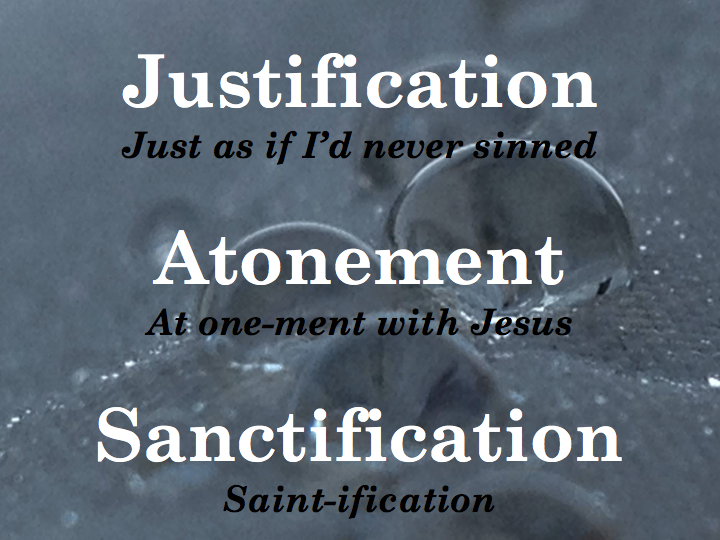
Justification = just-as-if I had never sinned. When your sins have been forgiven, you appear to God just as if you had never sinned, so you have been justified by your faith (see Romans 3:22-24).

Atonement = at one-ment with Jesus. Christ said that He was the way, the truth, and the life, and that no one could come into the Father’s presence except through Jesus. So atonement makes at one-ment with Jesus, which allows us to enter into God’s presence (see Romans 3:25).

Sanctification = saint-ification. The Holy Spirit begins a process in our lives where He is forming us into saints. Whereas justification and atonement are one-time events, sanctification is an ongoing process that is conforming us more and more into the image of Jesus (see 2 Thessalonians 2:13).

I hope this helps you understand and apply these terms.

Thursdays With Oswald—Seeing And Hearing “Holy”

This is a weekly series with things I’m reading and pondering from Oswald Chambers. You can read the original seed thought here, or type “Thursdays With Oswald” in the search box to read more entries.

Seeing And Hearing “Holy” 

     The Bible places in the heart everything that the modern psychologist places in the head. … 

     God does alter the desire to look at the things we used to look at; and we find our eyes are guarded because He has altered the disposition of our soul life. …I will always hear what I listen for, and the ruling disposition of the soul determines what I listen for, just as the ruling disposition either keeps the eyes from beholding vanity or makes them behold nothing else. 

From Biblical Psychology

Solomon wrote, “Above all else, guard your heart, for it is the wellspring of life” (Proverbs 4:23). This is where Chambers gets the thought about our hearts doing what psychologists want our heads to do.

The more I fill my heart with God’s Word (Psalm 119:11), the more the Holy Spirit can remind me of that Word (John 14:26). The more I am tuned in to that sanctifying instruction of the Holy Spirit (Ephesians 5:26), the more holy I will live (Romans 8:4; Galatians 5:16; 1 Thessalonians 4:7).

This “tuning in” in the spiritual realm (the heart) absolutely affects the physical realm (the head). I have written before about the reticular activating system (RAS) in our brains (you can read about this here and here). The combination of the Word and the Spirit reprograms our RAS so that our eyes and ears are looking and listening for what pleases and glorifies God.

Do you want to live a holy life? Start by guarding your heart. You do this by filling your heart with the Word of God.

Why Would You Go Through It?

The process we call sanctification is usually not a lot of fun. At least not in the moment the Holy Spirit is doing His work on us.

I like to remember the definition of sanctification by saying it this way: saint-ification. Literally, the Holy Spirit is making us into saints.

So why would you or I want to go through that saint-ification process?

Is it so others will admire us? Is it so we will become the example for everyone else to follow? No!

We go through it because it glorifies God when we become saints.

And notice this: the word is saintS (plural, not singular). If you search through the New Testament you will find that this word is always in the plural. There are no singular saints. The Holy Spirit saint-ifies us to bring unity to the Body of Christ.

May the God who gives endurance and encouragement give you a spirit of unity among yourselves as you follow Christ Jesus, so that with one heart and mouth you may glorify the God and Father of our Lord Jesus Christ. (Romans 15:5-6)

Think of your physical body. You go through the process of dieting or exercising for the benefit of the entire body. Your tastebuds may really want to savor some junk food, but for the good of the whole body, you go through the discipline of eating the healthy food. Your legs may not want to go for that jog, but for the good of the whole body, you push through your exercise routine.

It’s the same way spiritually: The Holy Spirit helps you become saint-ified for the good of the whole Body of Christ. The Holy Spirit wants you to mature as a saint so that you can help other saintS, and together the unified Body of Christ can glorify God.

So allow the Holy Spirit to take you through the saint-ification process, because other saintS need your help. And God will be glorified as you do!

If you’ve missed any of the messages in the Immersed series, you can find them all here.

Thursdays With Oswald—Instantly Detecting Compromise

This is a weekly series with things I’m reading and pondering from Oswald Chambers. You can read the original seed thought here, or type “Thursdays With Oswald” in the search box to read more entries.

Instantly Detecting Compromise

     We must be continually renewed in the spirit of our mind so that the slightest beginning of compromise with the spirit of the world is detected. “Well, what’s the harm; there’s nothing wrong in it,” when you hear that you know you have the spirit of the world, because the Spirit that comes from Jesus says, “Does this glorify God?”

From Biblical Ethics

There’s a HUGE difference between a Christian being in the world and of the world. A Christian who is compromising, is slowly becoming of the world. They say, “This isn’t wrong.”

A Christian who is uncompromising, is slowly becoming in the world but of Heaven. They judge everything by whether or not it brings glory to God.

Compromise is the slow erosion. Seldom does one go from a passionate follower of God to a worldly person suddenly. It is the small compromises day after day that are the most dangerous.

So one of my frequent prayers must be—

Search me, O God, and know my heart; test me and know my anxious thoughts. Point out ANYTHING in me that offends You. (Psalm 139:23-24, NLT)