Harsh Words

Keep it closedThis is an interesting exchange between God and His people―

God says, “You have said harsh things[*] against Me.” 

“What have we said against You,” the people asked. 

“You have said, ‘It is futile to serve God…’” (Malachi 3:13-14).

We think we know better than God.

We tell God how we think it should be.

We complain that God is letting some people get away with bad stuff, and He’s not rewarding quickly enough those who are doing good stuff.

We think God doesn’t care if we do things our own way.

We think we can better manage our lives than He can.

We act like we’re in charge.

This is speaking harsh, arrogant, rude, terrible words against God. It’s really saying, “I know better, so I should be God.” This not only removes God’s blessing, but invites His punishment.

Ouch! It’s good to examine our thoughts and words to make sure we aren’t thinking or speaking harsh things against God.

[*] Some other translations say things like “You have spoken arrogantly against Me” and “You have said terrible things about Me” and “You have spoken rude words to Me.”

Night Time Reflection

Isaac WattsBefore drifting off to sleep tonight―or any night for that matter―listening to these wise words might be very beneficial.

Let not soft slumber close your eyes,
Before you’ve collected thrice
The train of action through the day!
Where have my feet chose out their way?
What have I learnt, where’er I’ve been,
From all I’ve heard, from all I’ve seen?
What have I more that’s worth the knowing?
What have I done that’s worth the doing?
What have I sought that I should shun?
What duty have I left undone,
Or into what new follies run?
These self-inquiries are the road
That leads to virtue and to God. ―Isaac Watts

Attitude Check

Attitude checkWhen we realize that nothing can thwart God’s plan, and that you and I are a part of that plan, I think there could be a couple of attitudes that might pop up: (1) Confidence―not in my abilities, but in God’s; or (2) Humility―not thinking less of myself, but thinking of myself less.

Confidence without humility leads to self-destructive pride, and humility without confidence leads to self-destructive fear. We need confidence with humility, just like Jesus demonstrated in going to the old rugged Cross.

We can see the confidence in Jesus when He claims to be the “I AM” (John 8:54-59). But we can also see the humility of Jesus when He said He would lay His life down (John 10:11, 15:13).

These two attitudes converge powerfully in John 13:1-17 when we read that Jesus knew that God had put all authority under His command (vv. 1, 3), and then He used His confident authority to serve His friends by washing their feet.

Confidence without humility won’t serve because it thinks others must serve them. Humility without confidence won’t serve because it thinks others will take advantage of them. But Jesus was confidently humble (or humbly confident) so He could serve. It’s the only time Jesus said “I have set you an example” (v. 15). Our attitude is to mirror His, and we are to confidently and humbly serve.

A humbly-confident / confidently-humble servant is known by his or her:

  • Heart―E.G.O. (edging God out) or E.G.O. (exalting God only) [*]
  • Head―having his/her thoughts aligned with the Word of God
  • Hands―serving God and others (Matthew 20:25-28)

If you were to honestly reflect on this, where do you rate yourself?

  • Are you confident that God loves you and has a plan for your life, a plan that cannot be thwarted?
  • Are you humble enough to serve others? To give up your own agenda so that God is glorified?
  • Can you honestly say you have the right E.G.O.?
  • Are your thoughts becoming more and more aligned and shaped by God’s Word?

We’ll be continuing our series on The Old Rugged Cross next Sunday, and I would love to have you join us.

[*] My thanks to Kenneth Blanchard for his insightful description of E.G.O. in his book Lead Like Jesus

Life Cartography (book review)

Life CartographyCharles Porter has a timely message for us―actually 40 timely messages―in his book Life Cartography. If you don’t believe me, perhaps you will find the subtitle of his book as intriguing as I did: “Don’t follow your dreams” and 39 other life lessons I’ve learned along the way.

This book is designed as a 40-day journey, especially applicable (in my opinion) for someone just launching out on their own. I believe a high school or college graduate would find Life Cartography especially thoughtful.

Charles has given us a candid glimpse into his life, and the thoughts he has processed after a few years of reflecting on those different life events. These lessons are then presented to us with catchy titles like “Don’t follow your dreams” and “Deal with excess baggage quickly” and “You can’t be anything you want to be.” Each chapter is short, but it will easily give you a day’s worth of thinking material as you apply the principles to your own life.

I’d recommend parents and teachers, and others who work with young adults, to pick up this book to help prepare them in a mentoring role. And then perhaps get another copy to share with someone just starting a new journey in life.

The author provided me with a copy of this book.

Disciples Indeed (book review)

If you’ve been keeping track of my reading habits, you will know how much I appreciate the wisdom of Oswald Chambers. If you are not as familiar with his works, a great book for pastors and ministry leaders to get initiated into his wisdom is Disciples Indeed.

One reason that My Utmost For His Highest has been so popular (I believe) is the singular thought that Chambers presents each day. In Disciples Indeed you are taken into Chambers’ classroom at the Bible Training College in London, where he is instructing those preparing themselves for full-time vocational ministry. His teaching style was not to weigh his students down with lengthy lectures, but to give these students a place to think more deeply about the things of God.

Disciples Indeed is made up of nearly two dozen lectures. Each lecture presents a single thought in a series of small paragraphs, some of them only a single sentence in length. Chambers’ style of teaching in bullet-point fashion was intended to present profound truths upon which the student could meditate at length. Each chapter appears short on the pages of the book, but there is so much in each lecture for us to ponder.

I highly recommend Disciples Indeed to all “Christian workers” (as Oswald Chambers called his students) who have answered God’s call on their lives to step into a role of teacher, pastor, evangelist, youth leader, or the like. I am confident that your biblical thinking will be greatly enhanced by “sitting in” on these lectures.

Am I Learning?

Listen to the podcast of this post by clicking on the player below, and you can also subscribe on AppleSpotify, or Audible. 

In the Old Testament, there’s a phrase that repeats at the end of the historical record of almost every king of Israel and Judah:

As for all the other events of his reign, and all he did, are they not written down in the annals of the kings of Israel [or] Judah?

This phrase is repeated again and again (almost 40 times!). To me, the question mark at the end of this key phrase is really more like this: These stories are all here for your benefit—are you reading them? are you learning from them?

“Those who do not learn from history are doomed to repeat it.” —George Santayana

But maybe we think, “Those things don’t pertain to me.” Or even, “C’mon, that’s as plain as the nose on your face! I don’t need to study that because everyone knows you shouldn’t act that way!” How about this…

These things happened to them as examples and were written down as warnings for us, on whom the fulfillment of the ages has come. So, if you think you are standing firm [if you think you know it all], be careful that you don’t fall! (1 Corinthians 10:11-12, my paraphrase)

In light of that, here are some questions that would serve us well:

  • Am I reading these examples?
  • Am I learning from them?
  • Am I reviewing my own personal history?
  • Am I learning from that?
  • Am I writing down my experiences (both failures and successes) so that others can learn from me?

And maybe the most important introspective question of all: When was the last time I learned something new from something old?

►► Would you please prayerfully consider supporting this ministry? My Patreon supporters get behind-the-scenes access to exclusive materials. ◀︎◀︎

Anger That Crosses The Line

Last night in our Bible study we looked at some words that David penned when he was angry. He was on the run from his son Absalom, and it seemed like everywhere he turned people were after him, or slandering him, or just doing their best to make him miserable. Yet in two back-to-back Psalms David says, “I lay down every evening and get a great night of rest.”

His sweet sleep comes from a moment of reflection before dozing off. He says:

In your anger do not sin; when you are on your beds, search your hearts and be silent. Selah.

  • Did my anger today cross the line into sin?
  • Am I allowing the time for the Holy Spirit to search my heart?
  • When the Holy Spirit points out where my anger crossed the line, do I justify my anger, or am I silent?

How do we know if our anger has not crossed that line and become sin?

Aristotle wrote, “Anybody can become angry—that is easy; but to be angry with the right person, and to the right degree, and at the right time, and for the right purpose, and in the right way—that is not within everybody’s power and is not easy.”

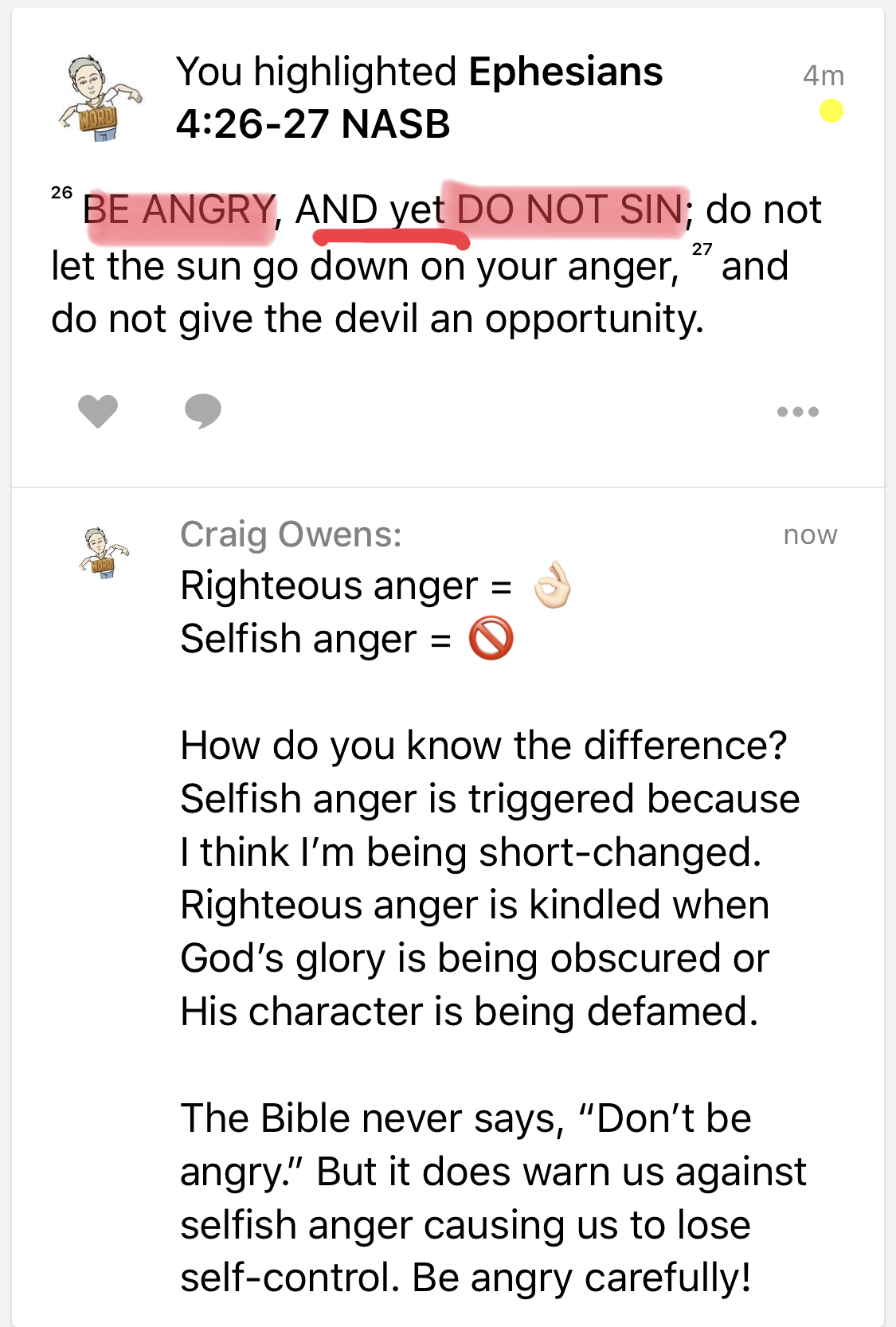
Being angry is not the issue. David said it (and Paul quoted it in Ephesians 4:26): “Be angry; just don’t sin.” God gets angry, but He does not sin. Jesus, in His public ministry, got angry, but He did not sin. We need to search our hearts to make sure our anger has not crossed the line to sin. We have to be angry in a godly way.

I see at least four ways to become angry without crossing the line into sin:

1.  Selfless Anger = anger at sin, but not angry at the sinner.

Love is not rude, it is not self-seeking, it is not easily angered, it keeps no record of wrongs. Love does not delight in evil but rejoices with the truth. (1 Corinthians 13:5, 6)

2.  Slow Anger = lengthen your fuse a bit.

Do not be quickly provoked in your spirit, for anger resides in the lap of fools. (Ecclesiastes 7:9)

My dear brothers, take note of this: Everyone should be quick to listen, slow to speak and slow to become angry, for man’s anger does not bring about the righteous life that God desires. (James 1:19, 20)

Good advice from Thomas Jefferson: “When angry, count to ten before you speak; if very angry, a hundred.”

3.  Protective Anger = when sinners entice others to join them in their sin. God is sad when people leave Him; He is angry at them when they take others with them.

But they put God to the test and rebelled against the Most High; they did not keep His statutes. Like their fathers they were disloyal and faithless, as unreliable as a faulty bow. They angered Him with their high places; they aroused His jealousy with their idols. When God heard them, He was very angry; He rejected Israel completely. (Psalm 78:56-59)

4.  Righteous Anger = against those who are keeping others from coming closer to God.

For I endure scorn for Your sake, and shame covers my face. I am a stranger to my brothers, an alien to my own mother’s sons; for zeal for Your house consumes me, and the insults of those who insult You fall on me. (Psalm 69:7-9)

This verse was recalled by Jesus’ disciples when they saw Him get angry and clear out the Temple in Jerusalem. Jesus was angry because of the religious clutter that was keeping God’s house from being a house of prayer for all nations.

I think everyone is familiar with the acrostic WWJD = What Would Jesus Do?

I’d like to propose something similar: WGGA = Would God Get Angry?

This is a great question to ask to make sure our anger does not cross that line into sin. Get angry—in a godly way—and do not sin.