Thursdays With Oswald—Pseudo-evangelism

This is a weekly series with things I’m reading and pondering from Oswald Chambers. You can read the original seed thought here, or type “Thursdays With Oswald” in the search box to read more entries.

Pseudo-evangelism

It was this form of pseudo-evangelism, so unlike the New Testament evangelism, that made [Thomas] Huxley say—“I object to Christians: they know too much about God.” … God is the only Being who can afford to be misunderstood; we cannot not, Job could not, but God can. If we are misunderstood we “get about” the man as soon as we can. St. Augustine prayed, “O Lord, deliver me from this lust of always vindicating myself.” God never vindicates Himself, He deliberately stands aside and lets all sorts of slanders heap on Him, yet He is not in any hurry.

From Baffled To Fight Better

I’m learning more and more that when people ask why God behaves in such-and-such a way that the best answer may be, “I don’t know why, but I still trust Him.” I trust Him even when I don’t have all of the answers, because I know He has all of the answers.

To try to answer for God—or, as is probably more likely, to try to defend my theology—is rightly called pseudo-evangelism. O Lord, deliver me from pseudo-evangelism!

Sharp Enough?

Long before Stephen Covey wrote about Habit 7: Sharpening The Saw, Solomon saw the value of taking time to sharpen the saw.

Using a dull ax requires great strength, so sharpen the blade. That’s the value of wisdom; it helps you succeed. (Ecclesiastes 10:10)

What are you doing TODAY to gain wisdom?

J. Wilbur Chapman asked F.B. Meyer, “What is the matter with me? So many times I fail, so many times I am powerless.”

Dr. Meyer responded, “Have you ever tried breathing out three times without breathing in once?”

What are you doing TODAY to breathe in?

Look at the mower in the summer’s day, with so much to cut down ere the sun sets. He pauses in his labor—is he a sluggard? He looks for his stone, and begins to draw it up and down his scythe, with rink-atink, rink-atink, rink-atink. Is that idle music—is he wasting precious moments? How much he might have mowed while he has been ringing out those notes on his scythe! But he is sharpening his tool. And he will do far more when once again he gives his strength to those long sweeps which lay the grass prostrate in rows before him. —Charles Spurgeon

What are you doing TODAY to sharpen yourself?

What’s Your Excuse?

It’s so easy to make excuses, isn’t it?

  • I wasn’t feeling well
  • I don’t have enough training
  • The sun was in my eye
  • The other guy was supposed to….
  • I don’t have the right tools
  • If only….
  • I can’t because….

John Maxwell has started a new teaching series where he presents a one-minute lesson on one word every day. Today’s lesson was on excuses. Watch the clip here.

Here are some other quotes on excuses:

“Ninety-nine percent of failures come from people who have the habit of making excuses.” —George Washington Carver

“There’s a difference between interest and commitment. When you are interested in doing something, you do it only when it is convenient. When you are committed to something, you accept no excuses only results.” —Kenneth Blanchard

“Obstacles are not excuses for failure, they are opportunities for growth.” —Craig T. Owens

“People who are good at making excuses are seldom good at anything else.” —Benjamin Franklin

Let’s stop making excuses and start taking responsibility! 

Hmmm

Feats of thinking may create reputation, but habits of thinking create character. —A.W. Tozer

If this is true, then I’ve got some questions to ask myself:

  • How do I think?
  • How am I processing the world around me?
  • Do I see the hand of God in daily events?
  • Can I find His truth at work?
  • Am I learning from what I experience each day?
  • Do I think positively or negatively?
  • Do difficulties cause faith or fear?
  • Am I thinking long enough?
  • Do my thoughts produce a Christ-like attitude?
  • Do I take time to think about my thoughts?

Two more thinking quotes for today:

Life consists of what a man is thinking about all day. —Ralph Waldo Emerson

Summing it all up, friends, I’d say you’ll do best by filling your minds and meditating on things true, noble, reputable, authentic, compelling, gracious—the best, not the worst; the beautiful, not the ugly; things to praise, not things to curse.Philippians 4:8

Pray First, Then Preach

As I have mentioned in earlier posts, not only is this a week of prayer for our church, but I have also declared 2011 to be The Year Of Answered Prayer. As a result, I’m reading and studying more about prayer, and praying more too.

This post is mostly for my fellow pastors.

Pastors, I came across two quotes this morning to which we should pay careful attention. The first is from Augustine’s On Christian Teaching, and the second is from E.M. Bounds’ Power Through Prayer.

“He should be in no doubt that any ability he has and however much he has derives more from his devotion to prayer than his dedication to oratory; and so, by praying for himself and for those he is about to address, he must become a man of prayer before becoming a man of words. As the hour of his address approaches, before he opens his thrusting lips he should lift his thirsting soul to God so that he may utter what he has drunk in and pour out what has filled him.” —Augustine

The character of our praying will determine the character of our preaching. Light praying will make light preaching. … The preacher must be preeminently a man of prayer. His heart must graduate in the school of prayer. In the school of prayer only can the heart learn to preach.” —E.M. Bounds

Before you prepare it, pray it.

Before you preach it, pray it.

After you preach it, pray it some more.

Pastors, let’s be men and women of prayer before we’re men and women of words.

Thought Patrol

Have you ever found yourself in circumstances that weren’t exactly what you had planned or hoped for? You know, things are just not going your way? What do you do then? How do you handle this? I suggest the first place to start is by thinking about your thinking.

I know that may sound a little unusual, but I have often times had to stop to think about what I’m thinking about. To ask myself, “Why am I thinking that?”

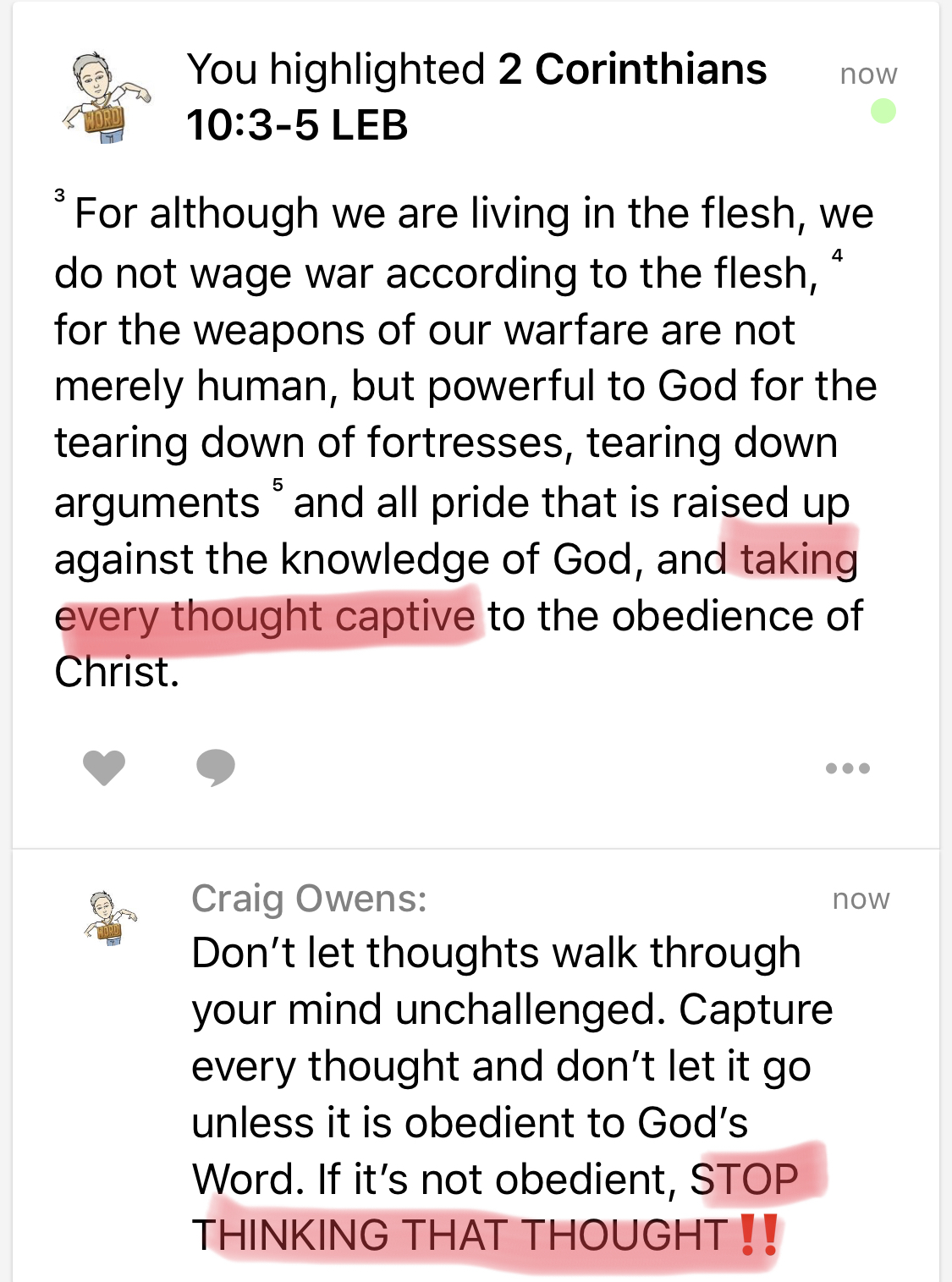
I believe this is what the Bible is really saying when it tells us to take every thought captive. If we don’t, our negative thoughts can lead us to unplanned places and can keep us trapped there. But if we will take time to think about what we’re thinking about, we can discover the key to freedom from that undesirable place.

A few quotes to get us started:

“No man has ever succeeded who kept his mind on negative things… and no man ever rises above his thoughts of himself.” —C.M. Ward

“You are today where your thoughts have brought you. You will be tomorrow where your thoughts take you.” —James Allen, As A Man Thinketh

“They themselves are makers of themselves by virtue of the thoughts which they choose and encourage; that mind is the master-weaver, both of the inner garment of character and the outer garment of circumstance, and that, as they may have hitherto woven in ignorance and pain they may now weave in enlightenment and happiness.” —James Allen, As A Man Thinketh

“Only when you assume full accountability for your thoughts, feelings, actions, and results can you direct your own destiny; otherwise, someone or something else will.” —Roger Conners, Tom Smith & Craig Hickman, The Oz Principle

“Summing it all up, friends, I’d say you’ll do best by filling your minds and meditating on things true, noble, reputable, authentic, compelling, gracious—the best, not the worst; the beautiful, not the ugly; things to praise, not things to curse. Put into practice what you learned from me, what you heard and saw and realized. Do that, and God, who makes everything work together, will work you into his most excellent harmonies.” —Philippians 4:8, The Bible

Let’s all work on patrolling our thoughts today.

Reaction Action

“Action has killed its thousands. Reaction its tens of thousands.” —E. Stanley Jones

  • Yes, he pulled out in front of you [action], but is tailgating him any better [reaction]?
  • Sure, she embarrassed you [action], but is slandering her any better [reaction]?
  • Yep, he lied to you [action], but is harboring a lifelong grudge any better [reaction]?
  • Okay, she tripped you [action], but is slapping her any better [reaction]?
  • That pastor betrayed your confidence [action], but is assassinating his character any better [reaction]?

“Vengeance is a passion to get even. It is a hot desire to give back as much pain as someone gave you. … The problem with revenge is that it never gets what it wants; it never evens the score. Fairness never comes. The chain reaction set off by every act of vengeance always takes its unhindered course. It ties both the injured and the injurer to an escalator of pain. Both are stuck on the escalator as long as parity is demanded, and the escalator never stops, never lets anyone off.” —Lewis Smedes

“But I tell you not to try to get even with a person who has done something to you. When someone slaps your right cheek, turn and let that person slap your other cheek.” —Jesus Christ

Anger That Crosses The Line

Last night in our Bible study we looked at some words that David penned when he was angry. He was on the run from his son Absalom, and it seemed like everywhere he turned people were after him, or slandering him, or just doing their best to make him miserable. Yet in two back-to-back Psalms David says, “I lay down every evening and get a great night of rest.”

His sweet sleep comes from a moment of reflection before dozing off. He says:

In your anger do not sin; when you are on your beds, search your hearts and be silent. Selah.

  • Did my anger today cross the line into sin?
  • Am I allowing the time for the Holy Spirit to search my heart?
  • When the Holy Spirit points out where my anger crossed the line, do I justify my anger, or am I silent?

How do we know if our anger has not crossed that line and become sin?

Aristotle wrote, “Anybody can become angry—that is easy; but to be angry with the right person, and to the right degree, and at the right time, and for the right purpose, and in the right way—that is not within everybody’s power and is not easy.”

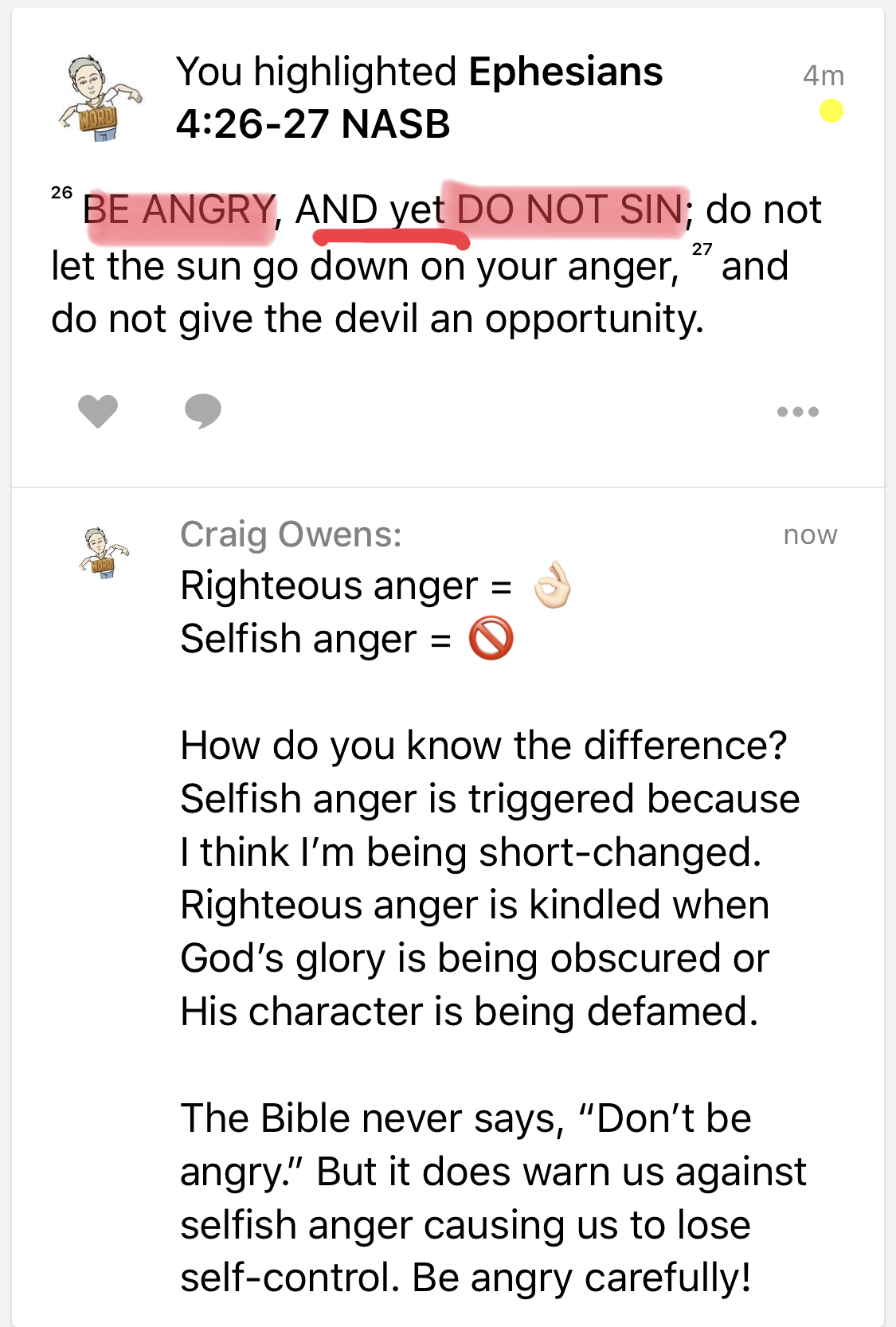
Being angry is not the issue. David said it (and Paul quoted it in Ephesians 4:26): “Be angry; just don’t sin.” God gets angry, but He does not sin. Jesus, in His public ministry, got angry, but He did not sin. We need to search our hearts to make sure our anger has not crossed the line to sin. We have to be angry in a godly way.

I see at least four ways to become angry without crossing the line into sin:

1.  Selfless Anger = anger at sin, but not angry at the sinner.

Love is not rude, it is not self-seeking, it is not easily angered, it keeps no record of wrongs. Love does not delight in evil but rejoices with the truth. (1 Corinthians 13:5, 6)

2.  Slow Anger = lengthen your fuse a bit.

Do not be quickly provoked in your spirit, for anger resides in the lap of fools. (Ecclesiastes 7:9)

My dear brothers, take note of this: Everyone should be quick to listen, slow to speak and slow to become angry, for man’s anger does not bring about the righteous life that God desires. (James 1:19, 20)

Good advice from Thomas Jefferson: “When angry, count to ten before you speak; if very angry, a hundred.”

3.  Protective Anger = when sinners entice others to join them in their sin. God is sad when people leave Him; He is angry at them when they take others with them.

But they put God to the test and rebelled against the Most High; they did not keep His statutes. Like their fathers they were disloyal and faithless, as unreliable as a faulty bow. They angered Him with their high places; they aroused His jealousy with their idols. When God heard them, He was very angry; He rejected Israel completely. (Psalm 78:56-59)

4.  Righteous Anger = against those who are keeping others from coming closer to God.

For I endure scorn for Your sake, and shame covers my face. I am a stranger to my brothers, an alien to my own mother’s sons; for zeal for Your house consumes me, and the insults of those who insult You fall on me. (Psalm 69:7-9)

This verse was recalled by Jesus’ disciples when they saw Him get angry and clear out the Temple in Jerusalem. Jesus was angry because of the religious clutter that was keeping God’s house from being a house of prayer for all nations.

I think everyone is familiar with the acrostic WWJD = What Would Jesus Do?

I’d like to propose something similar: WGGA = Would God Get Angry?

This is a great question to ask to make sure our anger does not cross that line into sin. Get angry—in a godly way—and do not sin.

Standing On A Promise

Just before Joshua’s farewell address to the Israelites, he makes one final comment to sum up the whole campaign that secured Israel’s borders—

Not one of all the Lord’s good promises to the house of Israel failed; every one was fulfilled.

Every one.

You can trust God! You can stand on His promises. They will not fail; they will all be fulfilled.

Dr. Robert Lockyear estimates that there are 7,457 promises of God in the Bible!

Which one are you standing on today? Get into God’s Word, and let His promises get into you. Write them down. Memorize them. Repeat them again and again. Believe that not one of all the Lord’s good promises will fail.

Here are a few you can stand on:

  • He forgets your forgiven sins.
  • He will give you abundant life now, and eternal life later.
  • Nothing can separate you from His love.
  • All things are working together for the good for those who love God.
  • He will never leave or forsake you.
  • He will continue to develop the best in you.
  • He will never place you in a situation where you cannot stand.

(check out all of the biblical references for these promises by clicking here)

“We take away from this most precious promise, and, by refusing to take it in its fullness lose the fullness of its application and power. Then we limit God’s power to keep: we look at our frailty more than His omnipotence. Where is the line to be drawn, beyond which He is not ‘able’? Why should we pare down the promises of God to the level of what we have hitherto experienced of what God is ‘able to do,’ or even what we have thought He might be able to do for us? Why not receive God’s promises, nothing doubting, just as they stand?” —Frances Ridley Havergal

What promise are you standing on today?

So Long, Status Quo!

What’s holding you back from making a change today? What’s keeping you from breaking with the pack? What status quo in your life needs to go bye-bye?

“Status quo, you know, is Latin for ‘the mess we’re in.’” —Ronald Reagan

“The soft-minded man always fears change. He feels security in the status quo, and he has an almost morbid fear of the new. For him, the greatest pain is the pain of a new idea.” —Martin Luther King, Jr.

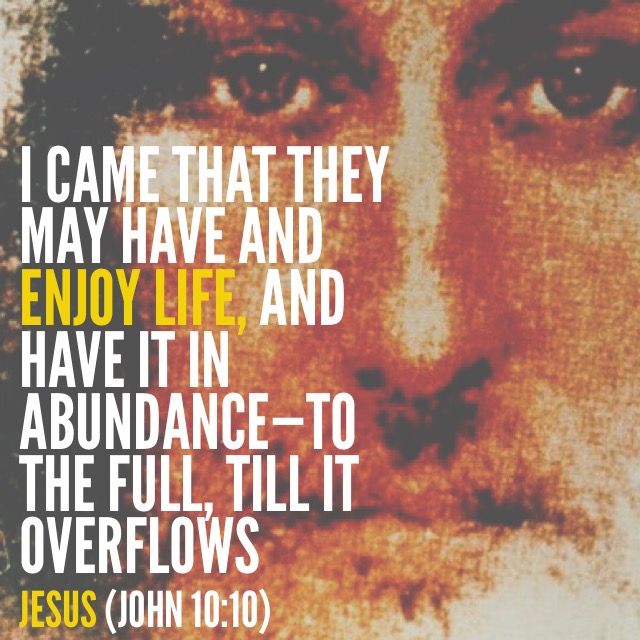
“I have come that you might have life to the full [away from the status quo].” —Jesus Christ

The gate is wide
The road is paved in moderation
The crowd is kind and quick to pull you in
Welcome to the middle ground
You’re safe and sound and
Until now, it’s where I’ve been

‘Cause it’s been fear that ties me down to everything
But it’s been love, Your love, that cuts the strings

So long status quo
I think I just let go
You make me want to be brave
The way it always was
Is no longer good enough
You make me want to be brave
Brave, brave

I am small
And I speak when I’m spoken to
But I am willing to risk it all
I say Your name
Just Your name and I’m ready to jump
Even ready to fall

Why did I take this vow of compromise?
Why did I try to keep it all inside?

I’ve never known a fire that didn’t begin with a flame
Every storm will start with just a drop of rain
But if You believe in me
That changes everything
So long, I’m gone

—Nicole Nordeman, Brave