Neglect Of Our Gift

Pastors, I’m challenged by these words from Charles Bridges—

It is indeed a ‘neglect of the gift of God that is in us,’ to trifle either in the study or in the pulpit. God will bless our endeavors—not our idleness. Our Master, and our people for our Master’s sake, have a just claim to our best time and talents, our most matured thoughts, and most careful studies. To venture upon this infinite work of God with slender furniture, proves a guilty unconcern to our high responsibility.

Idleness is not just laziness (although it can be that too). Think of your car when it’s idling: perhaps it’s not in gear, or maybe your foot is still on the brake. In either case, the car is not moving along to its full potential.

It’s the same for us. If we’re not moving along to our full potential as pastors, we’re idling. And that, in the words of Charles Bridges, is a neglect of the gift of God that is in us.

How might you and I be idling?

  • Not spending enough time in prayer? If we’re not praying, we’re operating in our own strength, not in God’s strength.
  • Hunting for a text to share, instead of seeking the mind of the Lord and letting Him reveal the text we should share?
  • Taking on too many projects?
  • Not delegating?
  • Not organizing or planning ahead?
  • Not taking care of our physical health, so we’re battling staying alert or staying healthy?
  • Not spending enough time in personal devotions, so our “tank” is nearly dry?

Those are just a few thoughts that came to my mind. The Holy Spirit can reveal where you may be idling and possibly neglecting such a precious gift, if you will ask Him.

Let’s always be men and women who live up to the full potential of what God has called us to. I’m praying for you!

Sola

On October 31, 1517, a sea change in world history was begun. On that day Martin Luther nailed his 95 theses to the door of a church, challenging the traditions of organized religion which he believed had strayed far from the instructions in the Bible.

The Reformation had been launched.

I truly believe that we all must be students of history, partly because all of his story is His Story. When we study history, we can see how God is working out His Story.

Second, we also need to know our history because as George Santayana rightly said, “Those who do not learn from history are doomed to repeat it.”

A third reason to (re)learn the thoughts brought out during the Reformation is for doctrinal strength. It’s important to know not only what why believe but why we believe it. And there are some valuable doctrinal truths in the history of the Reformation.

Finally, I believe an important part of learning is unlearning. Sometimes we accept something just because it’s been handed down to us. That is in large part what Luther and other reformers were challenging, and calling us to unlearn tradition and relearn what the Bible has to say.

So beginning this Sunday we will be walking through the five Sola doctrinal statements the reformers taught. I am really looking forward to relearning and unlearning, and just outright learning the biblical truths of the five solas.

I hope you can join me at Calvary Assembly of God.

Here are the topics we covered in this series:

THAT Kind Of Church

Listen to the podcast of this post by clicking on the player below, and you can also subscribe on AppleSpotify, or Audible.

The book of James is written to a bunch of Christians. James knew his audience was the Church (see James 1:1).

Keep that firmly in mind when you read these words from James 3:2—

We all stumble in many ways. (New International Version)

For we all often stumble and fall and offend in many things. (Amplified Bible)

Indeed, we all make many mistakes. (New Living Translation)

I hate to break the news to you, but that means:

  • Your pastor’s not perfect
  • Your church isn’t perfect
  • You’re not perfect

You attend a church with people who stumble, and offend, and mess it up. Your pastor stumbles, and offends, and messes up. And so do you!

Isn’t that wonderful?! We all make mistakes! So we all need to give and receive the same forgiveness. We all need to extend grace to others and receive grace from others. You need to help others back up when they stumble, and you need to admit when you’ve stumbled, and let others help you get back up.

Abraham Kuyper wrote—

“Sin is a destroyer that creeps in everywhere. Therefore we must expect an imperfect church. In fact, we church members carry the sin of the world with us into the church, too often hiding it under a veil of spirituality. If the church were not the Bride of His Son, surely God would in holy wrath destroy not first of all the church, but rather first of all the wretched sin-ridden church.”

To these beautifully imperfect Christians, James concludes his teaching with these words:

Confess your sins to each other and pray for each other so that you may be healed. The prayer of a righteous man is powerful and effective. … My brothers, if one of you should wander from the truth and someone should bring him back, remember this: Whoever turns a sinner from the error of his way will save him from death and cover over a multitude of sins. (James 5:16, 19-20)

Yeah, let’s be THAT kind of church!!

►► Would you please prayerfully consider supporting this ministry? My Patreon supporters get behind-the-scenes access to exclusive materials. ◀︎◀︎

Commissioned = Struggling

As I like to do on Fridays, this post is especially for my fellow pastors.

I have become [the church’s] servant by the commission God gave me to present to you the Word of God in its fullness. (Colossians 1:25)

Let’s be honest: What pastor wouldn’t say he/she wants to “serve” the church?

But look at Paul’s definition of a servant of the church (Colossians 1:24-2:5):

  • Suffering
  • Rejoicing in that suffering
  • Proclaiming the gospel
  • Admonishing the saints
  • Teaching with all wisdom
  • Maintaining a passion for everyone’s perfection
  • Laboring
  • Struggling

That’s quite a list!

Paul also says, “I want you to know how much I am struggling for you” (2:1). The word here and in 1:29 come from the same root word meaning: A contest (whether sports or a courtroom trial) in which there is a large audience, and in which one contestant is representing a larger group.

It’s like an Olympic athlete competing for his country, or an attorney speaking on behalf of her clients.

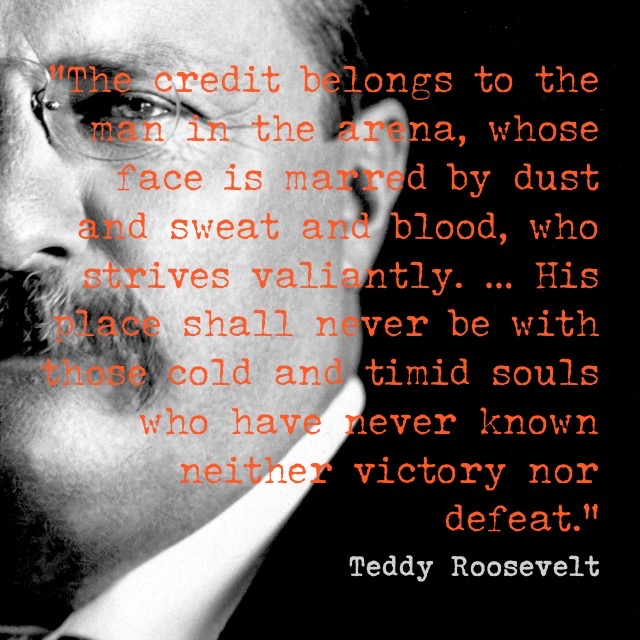
Then Paul adds, “I tell you this so that no one may deceive you by fine-sounding arguments” (2:4). In other words, actions speak louder than words. As Teddy Roosevelt famously said—

“It is not the critic who counts; nor the many who point out how the strong man stumbles, or where the doer of deeds could have done them better. The credit belongs to the man in the arena, whose face is marred by dust and sweat and blood, who strives valiantly…who knows the great enthusiasms, the great devotions, who spends himself in a worthy cause, who at the best knows in the end the triumph of high achievement, and who at the worst, if he fails, at least fails while daring greatly, so that his place shall never be with those cold and timid souls who have never known neither victory nor defeat.”

Pastor, stay in the arena!

Don’t walk away from the struggles!

Persevere through the difficulties!

People are watching you. What people? Specifically those sheep whom God has commissioned you to shepherd in His pasture. So stay in the fight!

I’m praying for you!

My Great Desire

From Oswald Chambers—

I want to ask a very personal question—How much do you want to be delivered from? You say, “I want to be delivered from wrong-doing”—then you don’t need to come to Jesus Christ. “I want to walk in the right way according to the judgment of men”—then you don’t need Jesus Christ. But some heart cries out—“I want, God knows I want, that Jesus Christ should do in me all He said He would do.”

How many of us “want” like that?

God grant that this “want” may increase until it swamps every other desire of heart and life.

Do you want, more than you want your food, more than you want your sleep, more than you want anything under heaven, or in heaven, that Jesus Christ might so identify you with Himself that you are His first and last and forever?

God grant that the great longing desire of your heart may begin to awaken as it has never done, not only the desire for the forgiveness of sins, but for identification with Jesus Himself until you say, “I live; yet not I, but Christ liveth in me.”

I want Jesus more than anything! I want Him to have all of me!

God, grant that the great desire of my heart may begin to awaken as it have never done before!

It’s Not Anger Management

Listen to the podcast of this post by clicking on the player below, and you can also subscribe on AppleSpotify, or Audible.

Aristotle had an insightful quote that was almost accurate—

“Anybody can become angry—that is easy; but to be angry with the right person, and to the right degree, and at the right time, and for the right purpose, and in the right way—that is not within everybody’s power and is not easy.”

I agree with most of this, but I would argue that it’s not within anybody’s power to express their anger in the right way.

The Bible says that our challenge is to not sin when we are angry (Ephesians 4:26). But most anger is selfishly provoked. That means, I’m angry because I have been offended, or my “rights” have been violated, or someone injured me.

If my anger has been selfishly provoked, how can I be expected to express my anger in any other fashion but selfishly?!

Instead of me trying to manage my anger, I need to listen to the Holy Spirit’s voice. There is one important question the Spirit asks us (which comes from Jonah 4:9)—

Do you do well to be angry?

  • Is it good for me to be angry with this? or should I let this go?
  • Is my anger righteously provoked? or is it selfishly provoked?
  • Does this grieve the Holy Spirit (Isaiah 63:10)?

God’s Spirit within you is never silent. He will either confirm that your anger is righteously provoked (as it was with Jesus in John 2:13-17), or it’s selfishly provoked (as it was with Jonah). That’s why you must ask yourself that question and allow the Holy Spirit to help you answer it: Do I do well to be angry?

If you answer “yes,” and the Holy Spirit confirms this in your heart, then He will help you to be angry with the right person, and to the right degree, and at the right time, and for the right purpose, and in the right way (as Aristotle said).

And if you answer “no,” the Holy Spirit is the only one who can help put out the flames of your anger in a healthy way.

So don’t try to manage your temper. Listen to the Holy Spirit asking you, “Do you do well to be angry?” And let Him guide you from there.

If you want to check out the other messages in our series called Ticked Off! you may click here.

►► Would you please prayerfully consider supporting this ministry? My Patreon supporters get behind-the-scenes access to exclusive materials. ◀︎◀︎

4 Myths About Your Temper

This morning I shared with my congregation—in part one of our Ticked Off! series—three myths about anger. I want to add a fourth here…

1.  Anger is a sin. 

God is angry numerous times; in fact, the Old Testament alone has hundreds of verses that mention God’s anger. In the New Testament, Ephesians 4:26 says, “…in your anger do not sin….” It doesn’t say, “don’t get angry,” but “when you’re angry, don’t sin.”

2.  Anger is always destructive. 

Some great advances have been brought about by people who got angry. For instance, Martin Luther, the father of the reformation, wrote, “When I am angry I can write, pray, and preach well, for then my whole temperament is quickened, my understanding sharpened, and all mundane vexations and temptations gone.”

3.  Anger doesn’t affect me.

Anger affects you physically. In one medical study researchers found that people who had strokes were more likely to have experienced anger in the two hours prior to having their stroke. It also affects your relationships. After you blow up, people close to you are injured and began to distance themselves from you.

4.  I can manage my anger.

Anger has a tendency to completely seize you, making it next to impossible to manage the furnace of emotions that is raging inside you. You cannot manage your anger! Instead, you need God’s help.

Check out the messages in this series by clicking here.

Going Up, Please

I’m leading a fun discussion at the En Gedi Youth Center with a bunch of excited 6th graders. Our class is called “An Elevation, A Mirror, And A Guy Called Bob” which is based on John Maxwell’s book Winning With People.

In Winning With People, Dr. Maxwell shares 25 principles for improving our interpersonal skills. In my class at the youth center, we’ve already covered the lens principle and the elevator principle.

The elevator principle basically says that we can only take people up or take them down in our interactions with them. There are no “neutral” interactions. I’m encouraging our students to always take people up.

One way we do that is by pausing to T.H.I.N.K before we speak. Before speaking, ask yourself, “Is what I’m about to say…

  • True
  • Helpful
  • Inspiring
  • Necessary
  • Kind?”

This isn’t just good advice for 6th graders. We all would do well to remember to T.H.I.N.K. As Winston Churchill said,

“By swallowing evil words unsaid, no one has ever harmed his stomach.”

Just Passin’ Through

This world is not my home. I’m just a traveler passing through. At times this world sure is beautiful! I love the sunsets, and the thunderstorms, and the oceans, and the forests. I love the animals, and the art, and the music.

But this is not my home. C.S. Lewis wrote—

“The books or the music in which we thought the beauty was located will betray us if we trust to them; it was not in them, it only came through them, and what came through them was longing. These things—the beauty, the memory of our own past—are good images of what we really desire; but if they are mistaken for the thing itself they turn into dumb idols, breaking the hearts of their worshipers. For they are not the thing itself; they are only the scent of a flower we have not found, the echo of a tune we have not heard, news from a country we have never yet visited.

And the Apostle John gave me this warning—

Do not love this world nor the things it offers you, for when you love the world, you do not have the love of the Father in you. For the world offers only a craving for physical pleasure, a craving for everything we see, and pride in our achievements and possessions. These are not from the Father, but are from this world. (1 John 2:15-16 NLT)

This is not my home. I’m just passin’ through, and enjoying the scents and echoes of my Heavenly Homeland!

Prayer Before Words, Prayer After Words

Pastor, as you are putting the finishing touches on your message for Sunday, even as you are getting ready to begin the service, consider this counsel from Augustine of Hippo—

“He should be in no doubt that any ability he has and however much he has derives more from his devotion to prayer than his dedication to oratory; and so, by praying for himself and for those he is about to address, he must become a man of prayer before becoming a man of words. As the hour of his address approaches, before he opens his thrusting lips he should lift his thirsting soul to God so that he may utter what he has drunk in and pour out what has filled him.”

Pray for yourself—that you would be a living example of what you preach.

Pray for your vocabulary—that the Holy Spirit would direct your words.

Pray for your ego—that you would not be puffed up nor brought down by the people’s response.

Pray for your congregation—that they would receive and apply the Word of God.

Pray for your community—that they would desire the life of Christ that is evident in you and your congregation.

And on Monday morning perhaps you will pray this prayer of commitment from Augustine—

Breathe in me, O Holy Spirit, that my thoughts may all be holy. 

Act in me, O Holy Spirit, that my work, too, may be holy. 

Draw my heart, O Holy Spirit, that I love but what is holy. 

Strengthen me, O Holy Spirit, to defend all that is holy. 

Guard me, then, O Holy Spirit, that I always may be holy. 

Amen.

I’m praying for you this weekend!