“Faith is not content with ‘fleeting pleasures.’ It is ravenous for joy. And the Word of God says, ‘In Your presence there is fullness of joy; at Your right hand are pleasures forevermore’ (Psalm 16:11). So faith will not be sidetracked into sin. It will not give up so easily in its quest for maximum joy.
“The role of God’s Word is to feed faith’s appetite for God. And, in doing this, it weans my heart away from the deceptive taste of lust.
“At first, lust begins to trick me into feeling that I would really miss out on some great satisfaction if I followed the path of purity. But then I take up the sword of the Spirit and begin to fight. …
“As I pray for my faith to be satisfied with God’s life and peace, the sword of the Spirit carves the sugar coating off the poison of lust. I see it for what it is. And by the grace of God, its alluring power is broken.” —John Piper
When you have a decision to make, isn’t it nice when you know the outcome of each option ahead of time? I mean, it makes it way easier to decide when you know what you’re going to get with each decision.
Like just before the Israelites head into the Promised Land, God says, “You can choose Me and have a whole lot of blessings, or you can choose another god and miss out on all My blessings” (Deuteronomy 30:11-20).
Easy choice, right?
I think the songwriter of Psalm 125 had that Deuteronomy passage in mind when he wrote his song of ascent. Basically, he says, you can trust God (v. 1) or you can walk on crooked paths (v. 5). What does it mean to trust God? Literally it means to have a confident expectation that He is Who He says He is, and He does what He says He’s going to do.
To help make the decision easier, the songwriter lists four blessings that come when we trust God—
We become as secure and unshakeable as Heaven is (v. 1).
We experience God’s “surroundedness” over, around, above and beneath us (v. 2).
We escape evil’s clutches (v. 3).
We experience God doing good for us (v. 4).
Of course, we can also choose not to trust God. We can try another path on our own. The curse for doing that is pretty sad—God will allow those who aren’t responsive to His voice to walk away from Him (v. 5).
Just like the story of the prodigal son (in Luke 15), the Father will allow you to walk away, but He will continue to long after you. And hopefully like that wayward son you will “come to your senses” and return to your Father. When you do, He will run to you, wrap you in His love, restore you to His family, and allow you to experience all of His blessings again!
The choice is up to you. I pray you will choose life and blessing and surroundedness, and God’s goodness toward you.
…laughed at for living out your biblical convictions?
…excluded from the “in” crowd?
…put down because your morals are too strict?
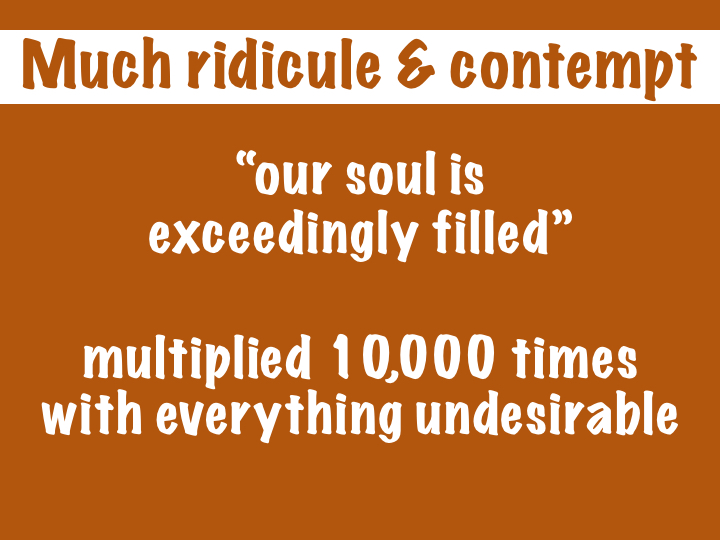
The writer of the song of ascent in Psalm 123 must have experienced this quite a bit. He uses phrases like we have endured much contempt and we have endured much ridicule.
These are not words which the songwriter could easily brush off. One translation says, “our soul is exceedingly filled with the scorning” of these ridiculing people. In other words, it’s not something he could just brush off by thinking, “They don’t know what they’re talking about.”
Literally translated, the phrases exceedingly filled mean bad things multiplied 10,000 times!
The ridicule and the contempt hurts! So the psalmist cries out Mercy! three times. This isn’t like saying “Uncle,” or having your cornerman throw in the towel, or even tapping out in a UFC match. This is a soul crying out, “God, if You will give me Your gracious favor for one more round, I will not tap out, I will not go down, I will go through!”
So he looks to the only One who can help him—my eyes wait upon Jehovah. Just like a servant who is completely dependent on his master for his daily bread, just like a maid who is trusting her mistress will give her favor, this guy says, “My eyes are fixed on Jehovah! If He can’t help me, no one can.”
The songwriter’s conclusion is this: “I will continually lift my eyes up to You, to You Whose throne is in heaven.” There are distractions, and hurts, and those who ridicule me—lots of them!—but I will develop the habit of redirecting my eyes UPto look to God.
When I feel anxious: I will redirect my eyes UP.
When I feel scorned: I will redirect my eyes UP.
When I’m hurt by others: I will redirect my eyes UP.
When I’ve had my fill of ridicule and contempt: I will redirect my eyes UP.
When I don’t think I can answer the bell for another round: I will redirect my eyes UP.
No matter what: I will redirect my eyes UP!
Check out the full video of this encouraging message. And if you are in the area, join us this Sunday as we continue our look at the Psalms of Ascent.
This is a weekly series with things I’m reading and pondering from Oswald Chambers. You can read the original seed thought here, or type “Thursdays With Oswald” in the search box to read more entries.
Is It Human Or Divine?
It is easy to say that human love and Divine love are one and the same thing; actually they are very far from being the same. It is also easy to say that human virtues and God’s nature are one and the same thing; but this, too, is actually far from the truth. We must square our thinking with facts. Sin has come in and made a hiatus between human and Divine love, between human virtues and God’s nature, and what we see now in human nature is only the remnant and refraction of the Divine. Human virtues according to the Bible are not promises of what human nature is going to be, but remnants of what human nature once was. …
As Christians we must learn to trace things to their right source. God makes very distinct the difference between the qualities that are Divine and those that are human. John 15:13 has reference to human love, which lays down its life for its friends. Romans 5:8 has reference to the Divine love, which lays down its life for its enemies, a thing human nature can never do.
From The Psychology Of Redemption
We must be very careful about looking at our life, and then trying to match it up with something we see in Scripture. It should always be the other way around—look at Scripture first, and then see if my life squares with what I see in God’s Word.
Even harder: see if my life squares with what I see in the life of Jesus as presented to me in God’s Word.
In Psalm 139 David began His prayer by saying, “God, You have searched me thoroughly, and You know me completely.” Then he ended his prayer by inviting God to search him yet again. This should be the ongoing posture and attitude of a Christian: asking the Holy Spirit to constantly show us where our lives fall short of the Christian lifestyle presented in the Bible.
Listen to the podcast of this post by clicking on the player below, and you can also subscribe on Apple, Spotify, or Audible.
Valley times come to all people. Even Christians.
The Songs Of Ascent in the Psalms imply this, since the pilgrims are ascending from a valley to the place of worship in Jerusalem. But this idea of going through a valley is especially seen in Psalm 121.
The psalmist starts by saying I lift my eyes up to the hills. He then sings that he found his help in God. This idea of help is not what we think of in today’s world. It’s not like dialing 911, reporting our need, and waiting for help to arrive. It’s not even like driving to a hospital, checking into the emergency room, and waiting for a doctor to see us.
The idea of help in the Bible is a picture of surrounding. It’s not something we have to wait to arrive, but something—or should I say Someone—Who is already right there!
In verses 4-8, the phrase watch over is used five times. This too gives us the idea of the closeness of our help. The Hebrew word translated watch over has four powerful word pictures:
A Gardener carefully watching over his precious garden.
A Soldier dutifully guarding a valuable treasure.
A Watchman diligently scanning the horizon for any approaching enemies.
A Shepherd lovingly attending to his flock.
I especially like the picture of a shepherd because of another valley reference. The opening words to Psalm 23 are, “The Lord is my Shepherd.” Then we read of 10 blessings the Good Shepherd gives His sheep while they pass through the Valley of the Shadow of Death. Our Shepherd…
Gives us His confidence so we will fear no evil
Reveals His close, intimate presence
Protects us with His rod
Guides us with His staff
Brings comfort to our hurts
Provides us with food
Anoints us with His blessings
Pours out His overflowing blessings
Allows His goodness and love to always follow us
Gives us the assurance of eternal life
Then adding a couple of more blessings from Psalm 121, we see He…
11. Never lets our foot slip (121:3)
12. Never sleeps or slumbers, so that we can rest securely (121:3-4)
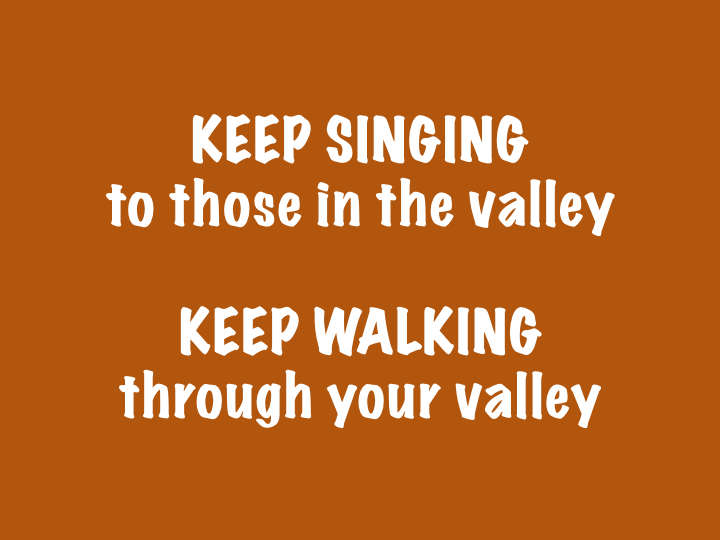
Remember these songs of ascent are sung by those coming out of the valley. They are sung to remind us of God’s deliverance, they are also sung as encouragement to those still in the Valley.
Jesus went through the darkest Valley anyone has ever gone through. It wasn’t just the valley of the shadow of death, He went through death, hell, and the grave. He overcame for you and me! He now walks with us in our valleys. He says to us, “I’ve been there, done that, and have the scars to prove it. I will never leave you or forsake you. I know this valley. I know how to get you out of this valley. Trust Me!”
We, too, who have been through the valleys and are now singing the song of ascent, need to sing loudly for those who are still in the valleys. We need to sing songs of assurance to them: “I have been in that same valley. I know how dark it is. But I know God watched over me and brought me safely through. Now I have a much better vantage point. And I say to you, trust Him! He is watching over you too. He will not let your foot slip. He will not sleep or slumber. He will protect you, and anoint you, and feed you, and give you His own dear presence. Don’t stop walking!”
Previously I wrote about NOT trying to change our bad behaviors. That’s because our behavior is a natural outcome of several other factors (read more about that by clicking here). The important progression goes like this: Thoughts → Values → Attitudes → Behaviors.
The two areas we can address are our thoughts and attitudes. When it comes to interacting with other people, notice carefully the words Jesus said: “Love your neighbor as yourself” (Mark 12:31).
Jesus says that our thoughts about ourselves can limit our thoughts about others. If your thoughts are limited, your value on people and healthy relationships will slide. If those values drop, your attitude about others will begin to sour. And with those thoughts, values and attitude dropping, isn’t it natural to expect that you will struggle getting along with others?
So you must get this clear—
God had a plan for you from before the beginning of time (Ephesians 2:10)
God knit you together in your mother’s womb (Psalm 139:13-18)
Because you are you-nique, you hear and see the world uniquely, and you respond uniquely. You and I respond mostly by habit.
Habits are good when they are healthy. But unhealthy habits create assumptions and blind spots that can hinder our relationships.
To make new relationship habits requires three things:
Knowledge (what do I need to do)
Skill (how do I need to do it)
Desire (I really want to make this change)
If you want to make some new communication habits, get knowledge from people who love you and from reading the Bible. Then read some books or attend some seminars that will give you new skills. Then combine those with your sincere desire to want to improve your relationship habits, and watch for great things to happen!
I am leading our church through a training on our communication styles. Please join us on Sunday as we learn how to better get along with others. I’d love for you to join us either in person or on our Periscope broadcast.
Last week I spoke and wrote about some tools you might use to study your Bible. Now I’d like to share some Bible study projects you might try with those new tools. As always, I recommend that beginning Bible studies go verse by verse through the Bible. I believe you will lay a strong foundation for your faith when you systematically put God’s Word into your heart.
Book By Book
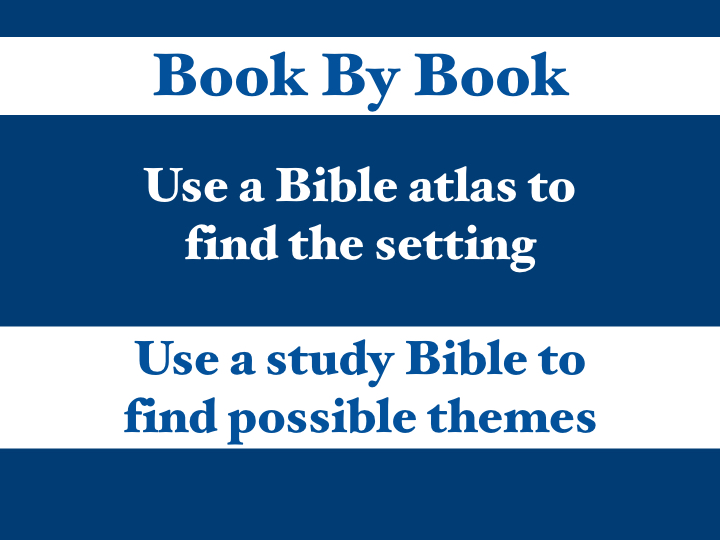
I’ll use the book of Ephesians as an example. Using my Bible atlas I find that the city of Ephesus is located along an important trade route, and it is the Roman capital of the province of Asia. My Full Life Study Bible tells me that because so much trade passed through this city, this letter was probably intended to be a circular letter for all of the communities near Ephesus. As a result, Paul is not addressing any specific problems in this church, but writes theological ideas for a broad spectrum of people.
As I begin reading, I paused in the first verse when I came to the phrase “the faithful in Christ.” I asked myself, “What does it mean to be faithful IN Christ? Can I be faithful outside of Him?” By the time I got to verse 3, I saw a similar phrase: “every spiritual blessing in Christ.” Now I went back and used a blue highlighter (there’s nothing special about blue, it just happened to be the first highlighter I grabbed), and marked those two “in Christ” phrases. I see two more in verse 4: “He chose us in Him” and “holy and blameless in His sight.” Going through the whole book I discovered 36 times the phrases “in Christ” or “in Him.” This is helpful to me to know the kind of security I have in Jesus.
Another thing that stood out to me were Paul’s prayers for the church. I see His very moving prayers in passages like 1:15-19 and in 3:14-21. I also see in 6:18 that he tells us to pray all kinds of prayers for ourselves and for others. And I see in 6:19 that Paul asked the church to pray for him too.
And always look for “therefore” phrases. For example in 4:24-25 or 4:32-5:1. The “therefore” phrases tell us how to live or think in light of the ideas that were just shared.
Chapter By Chapter
A good place to do this is in the Psalms or Proverbs. These are usually stand-alone chapters. When reading the chapters in these two books, I love reading them in parallel with other translations. For example, check out this from Psalm 1.
In Psalm 59, notice the superscript (or introduction). This gives us some background information to the psalm. Using my concordance, I found that this psalm was written this time in David’s life.
There is usually a theme to each chapter of the Proverbs, so try to discover that. In Proverbs 2, I noticed the “if … then” statements. In the first four verses I see things like “IF you will seek wisdom like this,” and then in verses 5-22 I see a whole bunch of blessings that follow the “then” that starts verse 5.
Word By Word
Sometimes I like to go really deep in a passage, so I slow down and look at it word by word. Here you need to use a Strong’s Concordance of the Bible. I like the one available on Blue Letter Bible. For example, next to 2 Peter 1:5, you can hover over the word “Tools” and select “Interlinear.” Clicking on “Interlinear” you will see all of the Greek words that make up this verse. By clicking on the Strong’s number, you can see the definition of that Greek word. Scrolling down a bit, you can see all of the other verses where that Greek word is used in the New Testament.
In this video I go into more detail on how I undertake all of these Bible studies. And be sure to join us next week as we take another look at different types of Bible studies.
You probably hear Christians say quite frequently, “You should read your Bible.” But one thing you may not hear as often is why you should read your Bible. There are probably many more reasons, but here are four reasons why I believe reading your Bible should be a daily part of your life.
(1) To help spot errors.
When the devil tempted Jesus, it is noteworthy that Jesus didn’t try to use logic, or persuasion, or even willpower. Every temptation was blocked by Jesus saying, “It is written” as He quoted Scripture.
In the second temptation, the devil tried the same tactic. He, too, quoted a couple of verses from the Psalms, but he took them out of their context. So notice Christ’s reply, “It is also written” (Matthew 4:7). The best way to spot error is to know the full counsel of God’s Word. This tactic the devil tried with Jesus wasn’t something new, but it was something he used on the very first humans: “Did God really say…” (Genesis 3:1), and he will try it again on you!
(2) To clarify your emotions.
Most of us allow our emotions to control our actions. Or sometimes we wrestle with, “My heart says one thing, but my head says something else!” In this tug-of-war, we allow our emotions to determine our beliefs, and then our beliefs determine our actions. This is not only dangerous, but it is contrary to what the Bible teaches.
The healthy way to respond is by fully knowing what we believe, and then acting according to our beliefs. Our proper emotional response will then follow those actions.
Look at the example of Jesus in John 2:13-16. He was ticked off at how people were misusing His Father’s house, and He did some serious house cleaning! Just reading those four verses, you may get the idea that Christ’s emotions carried Him away. But check out verse 17, in which we see He was acting in accordance to His beliefs, which were fully grounded in Scripture.
(3) To know prophesy.
All of the Scriptures point to Jesus, so all of the Scriptures are illuminated by Christ (Luke 24:27, 45). If you want to know what is happening in our world, turn to the pages of Scripture and see how Jesus is revealed. This will help you put even current events into perspective.
(4) To give sound answers.
When people need help, I want to be able to give them real answers. Not my opinion, but truth that they can apply. The Apostle Peter told us to always be prepared to give people an answer that is based on our knowledge of Jesus (1 Peter 3:15).
“Beware of saying, ‘I haven’t time to read the Bible, or to pray’; say rather, ‘I haven’t disciplined myself to do these things.’” —Oswald Chambers
Can I challenge you to do something I challenged my whole church to do … Make a commitment to read the Bible every day for the next seven days. See what happens as God meets with you, and reveals Himself and His wisdom to you, every day.
God wants to meet with us. He loves hearing our voice and talking to us. We can come into His presence at anytime, with anything and everything that’s on our heart, and know for sure that He is waiting to hear from us.
But there is one thing that can short-circuit this intimate relationship. And if we don’t deal with this one thing quickly, it could lead to disastrous results.
This one thing is unconfessed sin.
Adam and Eve sinned, and started a downward slide that we continue in today. First, they tried to cover up their sin (Genesis 3:7). Think about this for a moment. They made clothes out of fig leaves. What happens to leaves when are detached from their vine? Yep, they die and shrivel up!
Next, they tried to hide from God (Genesis 3:8-10). Really? You can hide from God?! That’s sort of like a toddler covering her eyes and thinking since she can’t see daddy, he can’t see her either.
Then they made excuses for their sin (Genesis 3:11-13). Of course, they said, we would have never sinned on our own. She made me do it! The devil made me do it!
None of this worked. Instead it kept them in fear of God’s presence!!
A beautiful prayer of confession of his sin is David’s prayer in Psalm 51. Notice this:
He was assured of God’s unfailing love and His great compassion (v. 1).
He confessed his sin without excuse. Five times in verses 1-3 he says my transgression, my sin, my iniquity.
It works so much better when God does the restoring! Instead of the fig leaves which were dying, God Himself made clothes for Adam and Eve (Genesis 3:21). This was a foreshadowing of the of way God will clothe all men and women who confess their sin, and place their faith in Christ’s work on Calvary (Ephesians 5:26-27).
Don’t let unconfessed sin keep you from God’s presence! Quickly confess your sin, and let God clothe you in the righteousness of Jesus.
What good is it to pray if we don’t expect to receive anything from God? Isn’t that just making “prayer” a superstition? Instead, the Bible tells us that we can have “a remarkable degree of confidence” that when we take something to God in prayer, we can expect something great (1 John 5:14-15)!
Our prayer closet should be the safest place for us to express ourselves. You might have a close friend with whom you can “be yourself.” You can pour everything out to your friend, knowing that they will still love you. And yet, even with that really close, true-blue friend there are still times you hold back.
God doesn’t want that from us.
Check out David’s prayer closet. He had no problems telling God how he felt about the bad guys who were after him (Psalm 56:5-7; 57:3; 58:6-8; 59:13). Here’s the important thing to note: David poured out these words only in God’s presence. We don’t read anywhere in the Bible where David yelled these words at his enemies, or even shared these thoughts with his close friends.
Instead David said, “Trust in Him at all times, O people; pour out your hearts to Him, for God is our refuge” (Psalm 62:8). Pouring out your heart to anyone else can sound like gossiping, picking a fight, or whining!
When David got it all out in God’s presence, he experienced two really cool things:
He came away with an expectation of God’s help—my soul, wait thou only upon God; for my expectation is from Him.
What about you? Are you being honest in prayer? Are you pouring out all of your hurts and doubts and frustrations to your Heavenly Father? Do you expect Him to answer you?
Here’s how you can tell if you aren’t praying with total honesty … you will walk out of your prayer closet still in turmoil. When you truly unload your heart in God’s presence, He will give you a peace that is so beyond anything you could have worked up yourself (Philippians 4:6-7).
Check this out…
Join me next Sunday as we continue our look at Practical Prayer.



 “Faith is not content with ‘fleeting pleasures.’ It is ravenous for joy. And the Word of God says, ‘In Your presence there is fullness of joy; at Your right hand are pleasures forevermore’ (Psalm 16:11). So faith will not be sidetracked into sin. It will not give up so easily in its quest for maximum joy.







 Craig T. Owens