The King’s Currency

Listen to the podcast of this post by clicking on the player below, and you can also subscribe on AppleSpotify, or Audible.  

Because you know that the testing of your faith produces perseverance (James 1:3). 

Dr. Henry Halley noted, “Perseverance here transcends the idea of bearing affliction; it includes the idea of standing fast under pressure, with a staying power that turns adversities into opportunities.” The opportunity is to allow my life to be valuable currency for my King to use for His pleasure and purpose. 

The Greek word for “testing” has several aspects to it, but all of them point to this truth: God desires purity, and He is the final Judge on the value of my purity. It has been said that the only faith that can be trusted is a faith that has been tested—and passed the test! 

James in this verse, and Peter in 1 Peter 1:7, are the only New Testament writers to use the Greek word dokimion, which means testing for purity and genuineness. 

These trials will show that your faith is genuine. It is being tested as fire tests and purifies gold—though your faith is far more precious than mere gold. So when your faith remains strong through many trials, it will bring you much praise and glory and honor on the day when Jesus Christ is revealed to the whole world. (1 Peter 1:7 NLT) 

These verses insist that God has a loving and specific purpose in His refining process. The Septuagint uses dokimion when David declares the absolute purity—and the standard of all purity—that is found in God’s Word: The words of the Lord are flawless, like silver purified in a crucible, like gold refined seven times (Psalm 12:6). 

James says this purifying process “produces perseverance.” Paul takes this a step further in saying that perseverance produces character (Romans 5:4). This word for character is the word from which dokimion comes: dokime. This is defined as a proven character, or having received the the stamp of approval from God. Paul uses this word again…

Another reason I wrote you was to see if you would stand the test and be obedient in everything. (2 Corinthians 2:9) 

But you know [Timothy’s] proven character, that as a son with his father he served with me in the gospel. (Philippians 2:22) 

All of this testing and refining and proving is to make me valuable for God’s use, and to be one who points others to Him. 

Dokime comes from dokimos, which James uses this way: “Having stood the test” (James 1:12). Other translations of this phrase read: 

  • When he has been approved (NKJV) 
  • The man who doesn’t give in (TLB) 
  • Proven to be genuine (NET) 

Dokime means beings pleasing, acceptable, and valuable to God and men. It is money of undiminished value—currency of the highest purity. Just as monarchs would have their image stamped into the metal of the official coinage of their realm, the stamp of approval on my life comes from God but is seen by men and valued by men—

Because anyone who serves Christ in this way is pleasing to God and receives human approval (Romans 14:18). 

Greet Apelles, whose fidelity to Christ has stood the test (Romans 16:10). 

For it is not the one who commends himself who is approved, but the one whom the Lord commends (2 Corinthians 10:18). 

Do your best to present yourself to God as one approved, a worker who does not need to be ashamed and who correctly handles the word of truth (2 Timothy 2:15). 

This is why I must “consider it pure joy” (James 1:2) when God puts me through His purifying process. He sees value in me that is not yet currency that can be placed into circulation. He wants my life to be spendable for His glory, so He loving removes anything that would diminish His image being seen in the currency of my life. 

As the Christmas hymn captures: “Adam’s likeness now efface; stamp Thine image in its place”! 

Make me valuable and useful for You, my King. Purify me and put me into circulation for Your glory. 

►► Would you please prayerfully consider supporting this ministry? My Patreon supporters get behind-the-scenes access to exclusive materials. ◀︎◀︎
Empowered Understanding And Application

Listen to the podcast of this post by clicking on the player below, and you can also subscribe on AppleSpotify, or Audible. Check out the video content in this post by clicking here. 

The baptism in the Holy Spirit brings an empowerment that nothing else can—You will receive POWER to be My witnesses (Acts 1:8). 

I remember sitting with a group of leaders who were discussing personnel issues that was slowly becoming nothing more than a gripe session. I shared a story from the Book of Acts about some disagreements between some saints, and then made an application that caused all of these leaders to look at me in wonder. One said, “I had no idea that was in the Bible,” and another added, “I knew that story was there, but I never thought of applying that to this situation.” That wasn’t me, but the Holy Spirit who opened up His Word to that situation. 

My friend Greg and I are writing a series of books for the business community called Business by the Book, where we are applying biblical insights to every “box” of a typical corporate flowchart. People who have already reviewed sections of our book are having a similar response: “I had no idea these examples and applications were there!” 

We are surrounded by messages right now—messages we cannot hear. There are some persuasive arguments, some angry rants, some happy tunes, and some special sporting events. But we cannot tune into those messages with having a radio receiver set to the precise frequency. The Holy Spirit does the same thing for Christians. 

Check out David talking about the speech of Creation in Psalm 19:1-4. 

(See all of the Scriptures in this post by clicking here.) 

Jesus used Creation too—telling us to look at the birds and flowers (Matthew 6:26, 28) or to consider the farmer sowing seeds (Matthew 13:3-9). 

In Romans, Paul tells us that Creation is enough (1:19-20) but that God also gave us His Law (2:12) and a conscience (2:15). When men rejected these things, God sent prophets and then His One and Only Son. 

Those without the Holy Spirit are deaf to this speech, unable to understand it nor apply it to their lives, as Jesus goes on to tell His audience in Matthew 13:10-12. 

We have already talked about the Holy Spirit as the Spirit of Truth (John 16:7-15), but notice that one of the first things He does is convict us of sin (v. 8). Without this conviction, we are unable to repent of the things which are keeping us spiritual blind and deaf (Ezekiel 12:1-2). 

Oswald Chambers noted, “Spiritual insight is in accordance with the development of heart purity.” How true! And that’s exactly what Jesus went on to say in Matthew 13:13-15. Paul echoes this—

But people who aren’t spiritual can’t receive these truths from God’s Spirit. It all sounds foolish to them and they can’t understand it, for only those who are spiritual can understand what the Spirit means. (1 Corinthians 2:14 NLT). 

One of the prophecies about Jesus included His reliance on the Holy Spirit—not His natural mind—to discern what God was doing and how Jesus would fulfill Scripture (Isaiah 11:1-5). 

This Spirit-empowered insight was anticipated by Solomon: If you will turn (repent) and give heed to My reproof, behold, I Wisdom will pour out My Spirit upon you, I will make My words known to you. (Proverbs 1:23 AMPC) 

We can then know the sayings of the wise and be able to understand and apply these truths (Proverbs 24:23, 32). See how Peter did this in Acts 10:17, 28. 

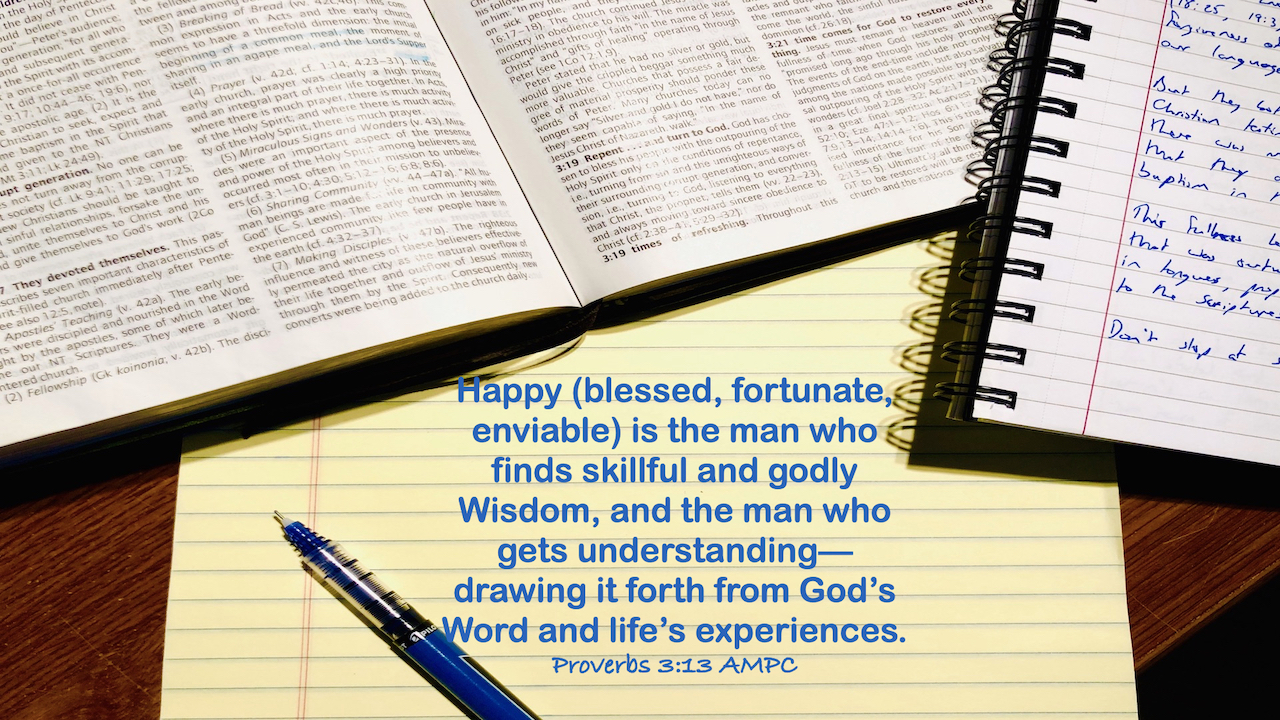
Happy (blessed, fortunate, enviable) is the man who finds skillful and godly Wisdom, and the man who gets understanding—drawing it forth from God’s Word and life’s experiences. (Proverbs 3:13 AMPC) 

The Spirit-baptized Christian is empowered to understand God’s speech through His Word, His Creation, and their life experiences, and then to make Christ-honoring applications of that understanding! 

Why would we settle for anything less than this?! So don’t stop at salvation, but press on to be baptized in the Holy Spirit. 

If you’ve missed any messages in this series about the power of Pentecost, you can find the full catalog by clicking here. 

►► Would you please prayerfully consider supporting this ministry? My Patreon supporters get behind-the-scenes access to exclusive materials. ◀︎◀︎
Sabbath-rest

Listen to the podcast of this post by clicking on the player below, and you can also subscribe on AppleSpotify, or Audible.


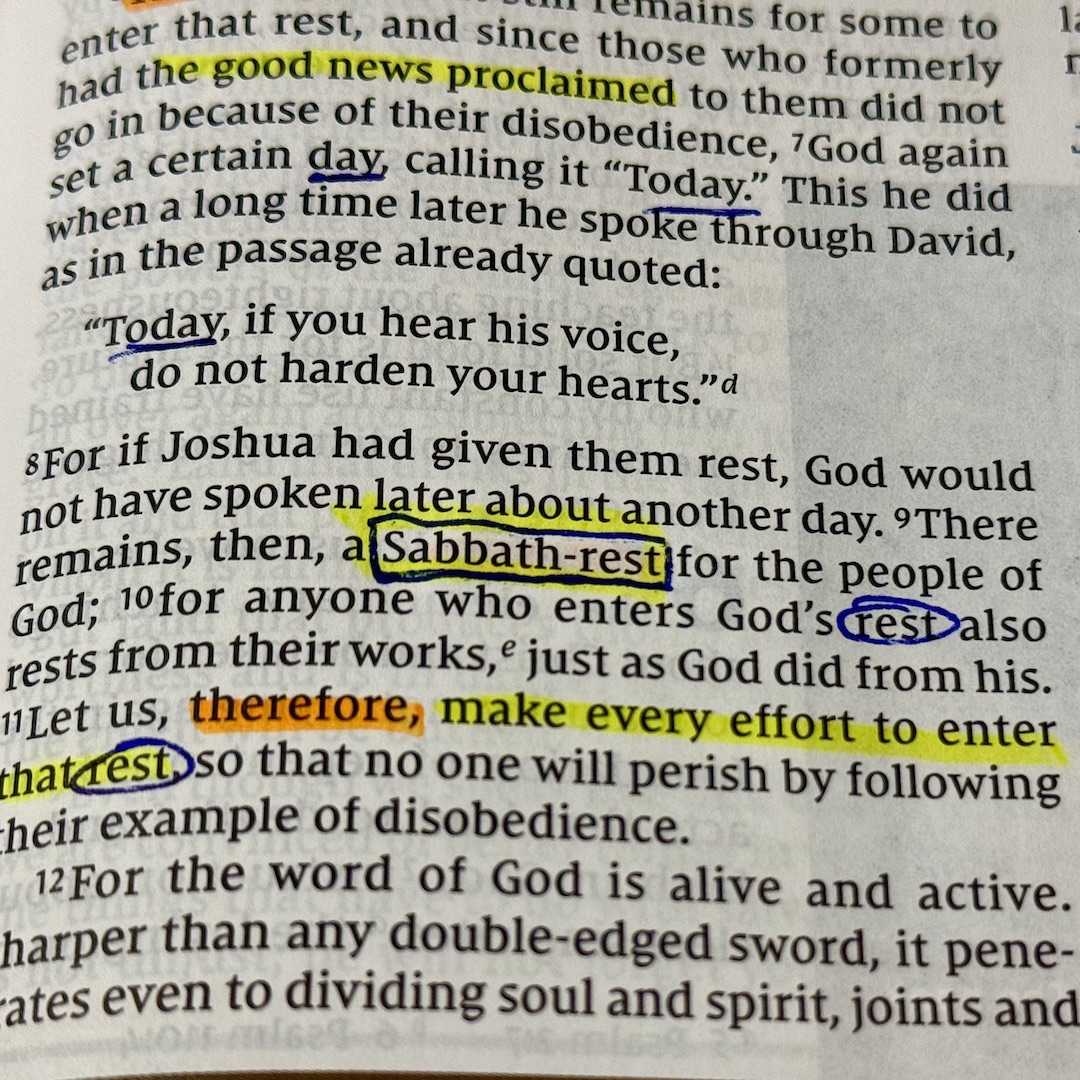
There remains a Sabbath-rest for the people of God. (Hebrews 4:9) 

The word Sabbath-rest (Greek: sabbatismos) is unique in all of Scripture. This is the place of total and complete contentment in God’s presence—uninterrupted and undiminished for all of eternity. 

This is a unique word because it is a unique rest that only Jesus made possible for us. 

This rest is exclusive to those who rest “from their works” (v. 10) and stand secure in their loving obedience of God. In other words, this rest is for those who realize that it is only faith in Jesus that can bring them into the Sabbath-rest. 

This is a rest that was promised long before Jesus made His advent on earth. The Greek word katapausis is translated into the English word “rest” and appears eight times in the New Testament—with seven of those showing up in the Book of Hebrews (3:11, 18; 4:1, 3, 5, 10, 11). These references remind us of the frustration of not being able to obtain this rest on our own efforts. 

The only other use of this word for “rest” is in Stephen’s sermon in Acts 7:49, in which he quotes God saying, “‘Heaven is My throne, and the earth is My footstool. What kind of house will you build for Me?’ says the Lord. ‘Or where will My resting place be?’” Again, God is telling us that the place of Sabbath-rest is not within our power to construct on our own. 

Of the seven uses in the Book of Hebrews, most of them are referring to an Old Testament passage in Psalm 95:7-11, echoing the failure of the Israelites to experience the Sabbath-rest because of their sin. But the Old Testament word for “rest” (menuha) keeps pointing to the hope of the Sabbath-rest of Hebrews 4:9. 

Check out the other places menuha is used as it points to the culminating Sabbath-rest that Jesus makes possible. 

The people vainly searching for rest: So they set out from the mountain of the Lord and traveled for three days. The ark of the covenant of the Lord went before them during those three days to find them a place to rest. (Numbers 10:33) 

The realization that the place of rest wasn’t found: Since you have not yet reached the resting place and the inheritance the Lord your God is giving you. (Deuteronomy 12:9) 

Learning that God’s rest is only available because God Himself will fulfill His promise of rest: Praise be to the Lord, Who has given rest to His people Israel just as He promised. Not one word has failed of all the good promises He gave through His servant Moses. (1 Kings 8:56) 

Jesus is portrayed as the Good Shepherd Who leads His people to His resting place: He makes me lie down in fresh, tender, green pastures; He leads me beside the still and restful waters. (Psalm 23:2 AMPC) 

Jesus is prophesied to be the One Who makes this resting place a reality: In that day the Root of Jesse will stand as a banner for the peoples; the nations will rally to Him, and His resting place will be glorious. (Isaiah 11:10) 

Nothing can compare to this Sabbath-rest that Jesus makes possible! No one can create this place. Jesus tells us that if we will be yoked with Him, He will take us into His rest—

Come to Me, all you who are weary and burdened, and I will give you rest. Take My yoke upon you and learn from Me, for I am gentle and humble in heart, and you will find rest for your souls. For My yoke is easy and My burden is light. (Matthew 11:28-30) 

For the Lamb at the center of the throne will be their Shepherd; “He will lead them to springs of living water.” “And God will wipe away every tear from their eyes.” (Revelation 7:17) 

There remains a Sabbath-rest for the people of God. A rest that Jesus died to pay for, and rose from the grave to show that He alone has the power to take you from the grip of sin into His flawless, eternal, perfect, all-satisfying rest! Don’t miss out on this, but come to Jesus as your Savior and Shepherd. 

►► Would you please prayerfully consider supporting this ministry? My Patreon supporters get behind-the-scenes access to exclusive materials. ◀︎◀︎
Our Cornerstone

Listen to the podcast of this post by clicking on the player below, and you can also subscribe on AppleSpotify, or Audible. 

Last week we saw that the essential confession is not just, “I believe You are the Christ the Son of the living God,” but also, “I will take up my cross and follow You!” (Matthew 16:16-18, 24). Notice that these are “red letter words”—words spoken by Jesus. They are not “they say” words (like v. 14; Matthew 7:21-23). 

(Check out all of the Scriptures I use in this post by clicking here.)

Look at the very next red letter words in Matthew 7:24-27. Notice the two parts: hears and puts them into practice. That’s our verbal and our lifestyle confession. What are we hearing and putting into practice? “These words of Mine.” 

Jesus is our Cornerstone. The dictionary defines this as, “something that is essential, indispensable; the chief foundation on which something is constructed or developed.” 

Some sandy things to build your life upon: 

  • what your family practiced 
  • what your pastor preached 
  • what your friends believe 

You know how you will know how sure your foundation is? When the storms come! I recently heard a well-known scholar and Christian apologist in an interview. He was asked by a skeptic of Christianity if he had doubts, and he responded, “Sure, I have doubts. But I choose to believe what the Bible says.” And I thought, “How sad to live this way.” We have a reliable, unshakable foundation in Jesus (2 Corinthians 1:18-22; 1 Corinthians 15:58). 

Religions and philosophies have come and gone. 

Spiritual giants have stumbled, and fierce tyrants have growled and then died. 

Traditions and societies have changed through the millennia. 

But the red letter words of Jesus stand firm through every season and storm (2 Timothy 2:19). 

Our Cornerstone remains unmovable and we can stand on Him unshaken. This foundation…

  • …was prophesied—Isaiah 28:16; Psalm 118:22 
  • …was fulfilled—Matthew 21:42; Acts 4:11-12 
  • …is still standing today—Ephesians 2:19-20; 1 Peter 2:4-6 
  • …will still be standing for all eternity—Revelation 21:5; John 14:1-4 

So there is no need to be afraid. There is no need to get frustrated. There is no need to engage in meaningless debates with the “they say” crowd. Stand firm on the red letter words—our Cornerstone. 

“On Christ the solid rock I stand, all other ground is sinking sand!” 

Check out all of the other messages in this “I Will Build My Church” series here. 

►► Would you please prayerfully consider supporting this ministry? My Patreon supporters get behind-the-scenes access to exclusive materials. ◀︎◀︎

Strength To Pray

Listen to the podcast of this post by clicking on the player below, and you can also subscribe on AppleSpotify, or Audible. 

In the day when I cried out, You answered me, and made me bold with strength in my soul. (Psalm 138:3 NKJV)

Prayer requires stick-to-it-iveness, which means it takes strength to pray. 

Therefore, being physically or emotionally drained makes it challenging to be alert and attentive in prayer. When we’re tired, our thoughts often drift; it’s hard to stay focused. 

Sometimes one of the most helpful things you can do for your spiritual growth is to get a good night’s sleep (or take a nap). 

Jesus did this (Matthew 14:22-23). He was very aware of His physical and emotional levels. When He was tired, He took a nap; when He was drained from ministry, He got alone with His Heavenly Father for refreshing (Mark 1:35, Luke 5:16). 

(Check out all of the Scriptures I mention here.) 

Jesus told His disciples to pray so they wouldn’t give in to temptation (Luke 22:40, 45-46). Prayer does strengthen us against the enemy’s attack, but physical and emotional stamina helps us too. 

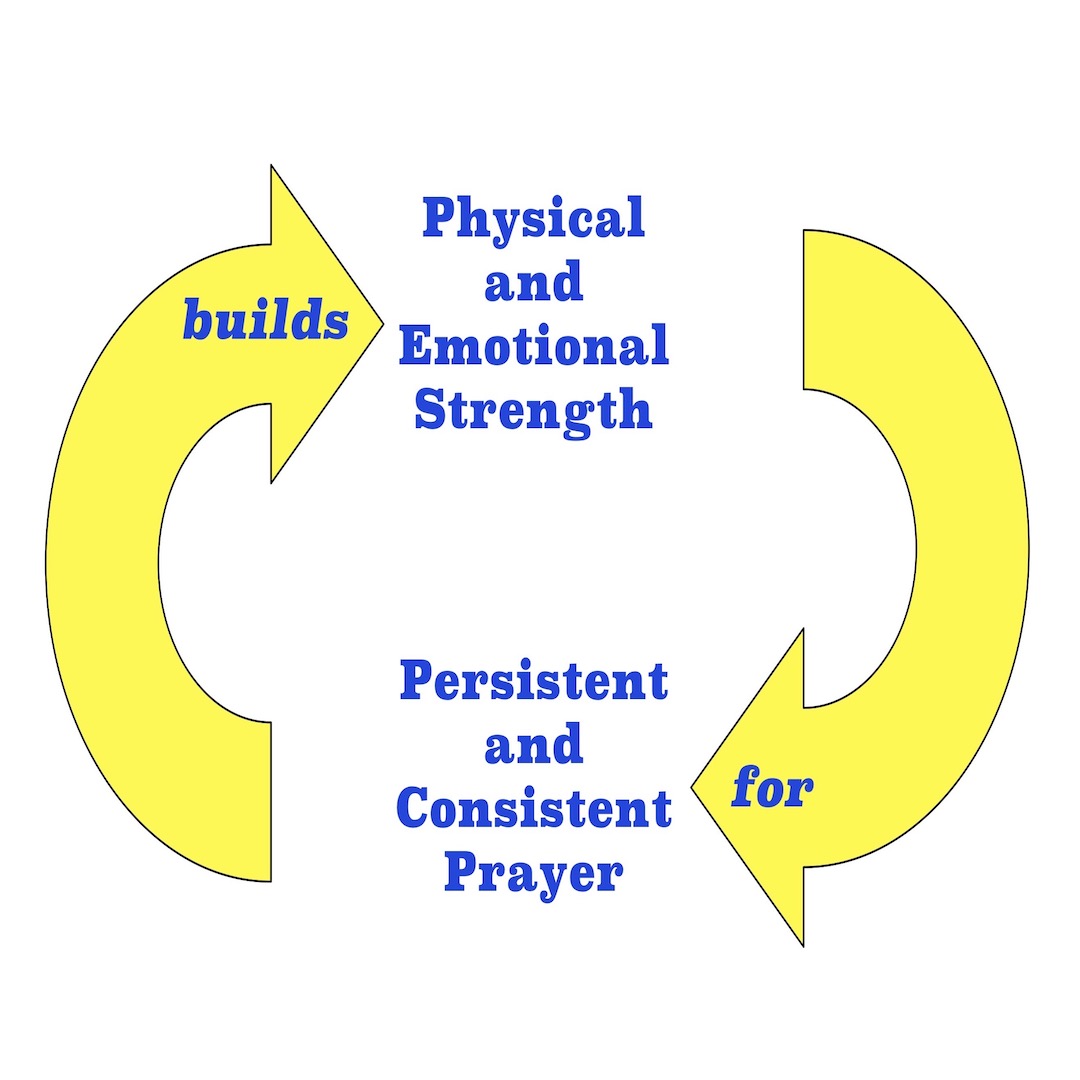
Notice the full cycle—we need physical and emotional strength to pray persistently and consistently, and prayer enhances our physical and emotional reserves to help us pray. So do all three: 

  1. Pray 
  2. Take care of your body 
  3. Take care of your emotions 

Download the graphic → Strong prayer cycle

When all three components of your being—spirit, body, soul—are alert and healthy, you will find your prayer life fully engaged. If one area becomes depleted, listen to the always-practical counsel of the Holy Spirit. Pray, rest, talk to a friend or a counselor so you can return to the optimal position of strength. 

Yes, it takes strength to pray, but in prayer your strength is renewed. 

►► Would you please prayerfully consider supporting this ministry? My Patreon supporters get behind-the-scenes access to exclusive materials. ◀︎◀︎
Prayer Changes My Maturity

Listen to the podcast of this post by clicking on the player below, and you can also subscribe on AppleSpotify, or Audible. 

Prayer can unleash God’s miracles. Sometimes the most visible miracles are the changes that are seen in us—our attitude, our expectation, our focus, and our maturity.  

Maturity is not stuffy and stodgy. Those folks actually become quite childish when others around them don’t “act right,” according to their standards. The most mature people are the most childlike. 

Do you want proof for that last statement? The most mature Person to ever live on earth was Jesus, and He loved being around kids and having children around Him (Mark 10:13-14). 

(Check out all of the Scriptures in this post by clicking here.) 

His teaching examples were frequently quite simple—farmers, birds, flowers, trees, and even going to the bathroom!. He knew their songs (Luke 7:31-32), and many of His interactions with the overly-mature religious leaders were quite playful and childlike (Mark 11:27-33). 

Jesus wants us to come to our Father like children (Mark 10:15-16). “Like a little child” means childlike, which is the exact opposite of childish. Those who think they are too mature for such simplistic things are actually the ones who are childish. 

Jesus uses the Father-child relationship over and over to teach us about praying to a Father who is desirous of giving us the best things (Matthew 6:7-9; Luke 12:32). 

One of the Psalms of Ascent written by David strikes this childlike note (Psalm 131). Verse 1 describes the childishness he’s giving up, and verse 2 describes the childlikeness he is taking on: 

  • “my heart is not proud”—not focused on me (v. 1a) 
  • “my eyes are not haughty”—overly grown up (v. 1b) 
  • “I don’t concern myself with matters too great or too awesome for me to grasp” (v. 1c NLT) 
  • instead I am stilled, quieted, trustingly at peace (v. 2) 
  • and then David calls all of us to this same childlikeness (v. 3) 

Jesus taught about persistent prayer in Luke 18:1-8 and then used a scenario from the temple to illustrate His point (Luke 18:9-17), contrasting the childish pseudo-maturity of the overly-religious man and the childlike maturity the childlike man. And then, as directed by the Holy Spirit, Luke includes the same exchange Mark used about Jesus taking up children in His arms to bless them.  

Childlike is loving dependent; childish is fiercely independent. 

Childlike is trusting someone wise; childish always knows best. 

Childlike is imaginative; childish is realistic. 

Childlike is persistent; childish is whining. 

I love the Henry Wadsworth Longfellow poem called The Children’s Hour. As you read through this, imagine our Heavenly Father as Longfellow and yourself as his three daughters. 

Between the dark and the daylight,
When the night is beginning to lower,
Comes a pause in the day’s occupations,
That is known as the Children’s Hour.

I hear in the chamber above me
The patter of little feet,
The sound of a door that is opened,
And voices soft and sweet.

From my study I see in the lamplight,
Descending the broad hall stair,
Grave Alice, and laughing Allegra,
And Edith with golden hair.

A whisper, and then a silence:
Yet I know by their merry eyes
They are plotting and planning together
To take me by surprise.

A sudden rush from the stairway,
A sudden raid from the hall!
By three doors left unguarded
They enter my castle wall!

They climb up into my turret
O’er the arms and back of my chair;
If I try to escape, they surround me;
They seem to be everywhere.

They almost devour me with kisses,
Their arms about me entwine,
Till I think of the Bishop of Bingen
In his Mouse-Tower on the Rhine!

Do you think, O blue-eyed banditti,
Because you have scaled the wall,
Such an old mustache as I am
Is not a match for you all!

I have you fast in my fortress,
And will not let you depart,
But put you down into the dungeon
In the round-tower of my heart.

And there will I keep you forever,
Yes, forever and a day,
Till the walls shall crumble to ruin,
And moulder in dust away! —Henry Wadsworth Longfellow

We mature by trading childishness for childlikeness. We mature best by coming to God our Father in prayer as a child comes to his father. 

Let prayer change your maturity! 

If you’ve missed any of the other messages in this series on how prayer changes us, you can find them all here. 

►► Would you please prayerfully consider supporting this ministry? My Patreon supporters get behind-the-scenes access to exclusive materials. ◀︎◀︎
Only The Good Ol’ Days?

Listen to the podcast of this post by clicking on the player below, and you can also subscribe on AppleSpotify, or Audible. 

Sometimes when Christians get anxious about a situation, it appears that they have forgotten that God is just as loving and strong today as He was in the good ol’ days. We need to guard against this misunderstanding. 

This is a clip from the sermon Review Your History, which was a part of our mini-series called “What to do in a crisis.” 

The Scriptures I reference in this clip—Psalm 107; Isaiah 59:1; Hebrews 2:18, 13:8.

Let’s use this prayer to remember that God isn’t just the God of the good ol’ days, but He is still just as loving and powerful today as He has ever been—

“God, You have been faithful—You have rescued me. Now help me to see that You are still Sovereign over this current situation—You are doing something in the midst of this crisis.”

►► Would you please prayerfully consider supporting this ministry? My Patreon supporters get behind-the-scenes access to exclusive materials. ◀︎◀︎
Prayer Changes My Attitude

Listen to the podcast of this post by clicking on the player below, and you can also subscribe on AppleSpotify, or Audible. 

In The Matrix, Neo is fascinated by a young man who appears to be bending spoons simply by looking at them. Neo sits down on the floor across from this young man and takes a spoon in his hand. Although young, this boy gives sage counsel to Neo, “Don’t try to bend the spoon, for that is impossible. Instead remember that there is no spoon. That way you will see that it is not the spoon the bends, but you are the one who bends.” 

There is a nugget of truth here for anyone who has ever been face-to-face with an impossible situation. The God who does the “impossible” has offered us the means to see His omnipotence at work—He has told us that we can bring our impossibles to Him in prayer. Prayer changes things! 

In God’s perfect will, sometimes the impossible is done before our very eyes, and sometimes we see that it is not the situation that bends, but it is we who bend, becoming more godly, wise, and mature because of what God has imparted to us. Heartfelt prayer is never a meaningless exercise. Without exception, something is changed with every single prayer we offer to God. 

There are many of us who have experienced a miraculous answer to prayer. We prayed to God in a bitter season of our life and experienced His sweetness come to our rescue. These answered prayers are testimonies of God’s love and power. 

Think about people you know who are struggling with the bitterness of life. I wonder: do they know that there is a sweetness that only God can bring? Brian Ridolfi noted, “Vinegar is not bitter to those who have not tasted honey.” Peter told us we are to crave more and more of God’s sweetness “now that you have tasted that the Lord is good” (1 Peter 2:2-3). This isn’t primarily for us, but it is to us and through us so that a watching world can recognize their bitterness as contrasted to the sweetness in our Savior. 

One of the things prayer changes is my attitude about the things of God. When I say “attitude” I am referring to how an airplane pilot defines this term: The nose of the plane in relation to the horizon. If the attitude of the plane is up, the plane and all of its passengers are climbing. 

There is a man we meet in the Gospels whose name means “whom God enlightens.” The answer to prayer he received was an attitude-changer for him, everyone around him, and his family. Check out his story in Luke 8:40-56. 

Jairus is called “a ruler of the synagogue.” He is the final authority on what happens in his synagogue. He came and “fell at [Jesus’] feet, pleading with Him” [pleaded earnestly—Mark 5:23], which sounds like a posture of intense prayer to me! 

We don’t know how long the journey was to Jairus’ home, but it was made longer by “the crowds [that] almost crushed [Jesus].” It was made even longer by an interruption of yet another healing (vv. 43-48). During this delay, there is not a word of protest from Jairus as he is clinging to his faith in Jesus. 

Jairus gets the news, “Your daughter is dead.” 

Jesus reignited Jairus’ faith with the words, “Don’t be afraid; just believe, and she will be healed.” Matthew 9:18 records Jairus’ renewed faith-filled prayer as he acknowledges, “My daughter has died.” 

The family and friends gathered at Jairus’ house were “wailing and mourning.” The AMPC says, Jesus saw “the tumult and the people weeping and wailing loudly” (Mark 5:38). Why? Because they knew she was dead—this was now an impossible situation. 

But let me ask you: Is it possible that Jesus allowed this delay so that the little girl would become beyond all human hope? I think it is. Jesus was going to do something that absolutely no one could take any credit for. Jesus said, “Stop wailing. She is not dead but asleep.” They laughed at Him! 

After this dead little girl stood up, who was laughing then? I think Jesus was—He always gets the last laugh and the best laugh! 

The Greek word for “wail” (alaladzo) has an interesting root word (alala) which means the cry of soldiers running to the battlefield. And then when those soldiers return victoriously, they have a total change in their attitude so alaladzo is now a joy-filled shout (Psalm 47:1; 66:1-3).  

(1) Jairus had an attitude change. I believe became a Christ-follower in the truest sense of the word. Why do I think this? Because we know his name. There are four “synagogue rulers” described in the New Testament: three that become Christians we know by name (Crispus [Acts 18:8], Sosthenes [Acts 18:17], Jairus) and one who remains anonymous because he was bitter that Jesus healed someone on a Sabbath (Luke 13:14). 

(2) The scorning mourners who knew the girl was dead had an attitude change. They spread the laughter everywhere (Matthew 9:26). 

(3) What about us? An encounter with Jesus changes us (Romans 12:2; 2 Corinthians 3:18). In order to “taste and see” how good God is, we must be people who are consistently prayerful and expectant of His wonder-working power. Let’s change our wailing into a battlecry, our mourning into praise, so that God can chance our tears into laughter! 

A world steeped in bitterness needs to see the sweetness of our God—Come and see what God has done, His awesome deeds for mankind! (Psalm 66:5). 

Keep up with all of the messages in this prayer series by clicking here. 

►► Would you please prayerfully consider supporting this ministry? My Patreon supporters get behind-the-scenes access to exclusive materials. ◀︎◀︎
In Dire Straits

dire straits:
[dahyuhr streyts]   / ˈdaɪər ˈstreɪts /
→ very difficult circumstances.

In Psalm 142, David relates the dire straits he was in:
Enemies closing in.
Trapped in a dead-end cave.
No one around to help.

I look for someone to come and help me, but no one gives me a passing thought! No one will help me; no one cares a bit what happens to me. (Psalm 142:4 NLT)

When there is no earthly way you can get out of the jam you’re in, it’s a perfect time for God to show you that He cares enough to do what no one else can do or will do!

Don’t throw in the towel; throw your hands up to God.

Then I pray to You, O Lord. I say, “You are my place of refuge. You are all I really want in life.” (Psalm 142:5 NLT) 

If you are in dire straits, you may also want to check out: 

Year-End Review (2025 Edition)

Listen to the podcast of this post by clicking on the player below, and you can also subscribe on AppleSpotify, or Audible. 

I like to take some time at the end of each calendar year to both look back and look forward. Throughout biblical history, whenever God was ready to take His people into a new chapter, He always took time for them to review the ground they had already covered. So as we get ready to go into 2026, here is a look back at the things God taught us in 2025 through these sermon series I shared with the wonderful folks at Calvary Assembly of God.

Our Prayer BookGod has given us an amazing Book! The Bible addresses the human condition—all our desires, frustrations, hopes, and the only path on which we can find eternal and unfading joy. The Bible not only tells us how to live, but it also tells us how to pray. And it’s as we pray that the principles in the Scripture come alive with fresh applications for our daily life. We don’t have to fumble around, attempting to find the right words to pray and then wondering if those prayers were heard on high. We can learn to pray in agreement with God’s perfect will. God has spoken to us through His Word, and He invites us to use His words to form our prayers back to Him. I love beginning each new year with a reminder of the power of prayer.

When Sheep Bite SheepNo one likes to be mistreated—especially when the one that hurts us is one we would have thought of as an ally or even a friend. These slights become even more painful when they take place inside the Christian community. When sheep bite sheep, our natural response is to lash out to try to even the scales of justice. But the Bible consistently and clearly calls Christians to pursue a supernatural response. This is a highly practical series of messages on how you can respond in a Christ-honoring way when you are bitten by another sheep in God’s pasture.

Grief Into JoyAt the end of your rope … down for the count … nothing but gray skies all around … unable to see any light at the end of the long, dark tunnel. Ever been there? The reality is, we all have been there. But the good news is that we don’t have to stay there! God is always at work to turn our apparent no-win, dark, hopeless situations into something bright and glorious! He is working in ways that no human mind could have dreamed up, and working on our behalf in a way no human power could ever hope to rival. God specializes in turning grief into joy! We are approaching the time of year where we remember the death of Jesus. Without a doubt that was the darkest, most grief-stricken day in all of history. Yet that time of mourning was completely forgotten in the overwhelming joy that exploded from an empty tomb on Resurrection Sunday!

We Are: PentecostalPentecost for over 1500 years was a celebration in Jerusalem that brought in Jews from all over the world. But on the Day of Pentecost which came just ten days after Jesus ascended back into heaven, the meaning of Pentecost was forever changed! Followers of Jesus—now empowered by an infilling of the Holy Spirit—began to take the good news of Jesus all over the world. These Spirit-filled Christians preached the Gospel and won converts to Christ even among hostile crowds, performed miracles and wonders, stood up to pagan priests and persecuting governmental leaders, and established a whole new way of living as Christ-followers. We, too, can be Pentecostal followers of Jesus Christ today. We can experience an anointing and an empowering in our lives that turns ordinary Christianity into extraordinary Christianity!

All Hail King JesusThe Bible closes with a vivid picture of Jesus as the undisputed King of kings, and we look forward to that time when all creation bows before Him. Even more so, we cannot wait to be with our King for ever and ever! The psalmists of Israel also foresaw the coming of this King, especially in the example they had in their King David. Many of the poetic words they penned esteemed Jesus as the King for Whom they longed. David himself not only saw the future coming of the Eternal King, but he also looked back in time to see Jesus reigning as King before time began. It is these royal psalms that we will be studying as we celebrate the first arrival on Earth of our King and as we anticipate the second coming of our Royal Majesty. The more clear our vision is of this King, the more we will worship Him, follow Him, and invite others to know Him as their own Lord and Master.

B.A.S.I.C. ChristianityWhen someone invites Jesus into their heart, they are immediately justified in God’s sight and have the assurance of Heaven as their eternal home. But then the question comes, “Now what?” Our justification is immediate but our sanctification is an ongoing, lifelong process. Sanctification is what brings fruitfulness to a Christian’s life and what allows that fruitful life to be a testimony to others. The Bible gives us the B.A.S.I.C.s of this Christian life, and that’s what we will be exploring over the next few weeks.

Earnestly ContendJude, the half-brother of Jesus, wrote a letter to the church. He said he was hoping to write about salvation, but looking at the conditions in the culture around him, he felt urged by the Holy Spirit to challenge Christians to “contend for the faith that was once for all entrusted to the saints.” What does this word “contend” mean for us today? Are Christians supposed to be combative about sharing their faith? Are they supposed to argue with anyone and everyone who disagrees with them on any point? Jude gives us Holy Spirit-inspired wisdom to understand how to deal with those who have departed from the purity of biblical truth.

What To Do In A CrisisLook back through the pages of history and you will see a common theme. Whether it’s world history or your own personal history, you have so much for which you can give thanks. In tough times, we tend to become forgetful because we are so focused on the intensity of the moment. But if we will simply look back in time, we will see just how faithful God has been to us. We bring our focus back to Him in our trying times when we remember and rehearse “the wonderful things He has done” (Psalm 107). The season of Thanksgiving is a good time for us to be reminded of the powerful resource we have when we are giving thanks for our blessings. Thankful people are confident people because they choose hope in God’s faithful provision over grumbling about their current circumstances.

Jesus Is…Over 700 years before He was born in Bethlehem, God spoke through the prophet Isaiah to describe the Messiah that was coming. Peter said that until the advent of Jesus, the prophets continued to scour the evidence of who this Messiah was going to be. When Jesus finally came to earth as a Man, young and old alike were thrilled to proclaim that the One they had been longing for had made His long-expected appearing! As Jesus lived on earth, died on Calvary, and was resurrected back to life, He continued to fulfill all that had been prophesied about Him. Isaiah said of Jesus: “He will be called Wonderful Counselor, Mighty God, Everlasting Father, Prince of Peace.” This Advent season we will take some time to unpack what each of these majestic titles mean. We will explore how Jesus demonstrates that He is truly worthy of each of these titles, and we will see how that knowledge should thrill our hearts as we celebrate His first Advent and eagerly long for His Second Advent.

If you live in northern Kent County and don’t have a home church, I would be thrilled for you to visit me at Calvary Assembly of God this year.

►► Would you please prayerfully consider supporting this ministry? My Patreon supporters get behind-the-scenes access to exclusive materials. ◀︎◀︎