The Bitter Helps The Sweet

Listen to the podcast of this post by clicking on the player below, and you can also subscribe on AppleSpotify, or Audible. 

Have you ever been going through a difficult time in your life and wondered to yourself, “What in the world is going on here?” I might have a different way for you to think about that!

Check out this episode of The Podcast.

Some resources from this episode:

The Scriptures I reference: Romans 5:3-5; James 1:2-4; 1 Peter 1:7; Romans 8:28

Here are a couple of blog posts with some additional thoughts on this: Hard Times and Probably Not a Straight Path.

And this video—How can Christians best process difficulties?  

My new book When Sheep Bite is available for pre-order!

Here are a bunch of ways to get in touch with me and follow along with other projects on which I am involved

►► Would you please prayerfully consider supporting this ministry? My Patreon supporters get behind-the-scenes access to exclusive materials. ◀︎◀︎

Avoiding The Bad Days

Listen to the podcast of this post by clicking on the player below, and you can also subscribe on AppleSpotify, or Audible. 

Would you like to avoid having a bad day? I have the solution for you!

Check out this episode of The Podcast.

Resources mentioned in this video:

►► Would you please prayerfully consider supporting this ministry? My Patreon supporters get behind-the-scenes access to exclusive materials. ◀︎◀︎

Flatten The Rollercoaster

Listen to the podcast of this post by clicking on the player below, and you can also subscribe on AppleSpotify, or Audible. 

I’m not a fan of rollercoasters, but I know a lot of people who really like them. Some even travel all over the world to experience unique rollercoasters. The anticipation as the cars climb slowly up the big hill, knowing that there’s no stopping this thing now! Then the rush of emotions, a deep breath and a laugh at the end (usually laughing at our friends’ responses while on the ride), and then we just walk away. The moment of anticipation leading up to the big drop was usually longer and more intense than the ride itself. 

Not only do people travel all over to find rollercoasters, some people seem to have their emotions perpetually on rollercoasters. 

One of the telltale signs of someone with an immature mental health is the way every situation gets blown out of proportion before anything even happens. Then as an event unfolds, their exaggerations continue: the molehills are mountains, every valley is the valley of the shadow of death, the night is a nightmare, the “crisis” is lasting forever, no one has ever gone through what they’re going through, and the list goes on. 

To break out of this habit requires us developing emotional capacity. John Maxwell describes it like this: “Emotional capacity is the ability to handle adversity, failure, criticism, change, and pressure in a positive way.” Just as athletes have to develop lung capacity or muscle capacity, developing emotional capacity takes time, patience, and diligence. 

Increased emotional capacity is not escaping from our problems or even learning coping skill. Escapism never allows us to confront the things that are keeping our emotional capacity immature. On the other hand, maturing emotional capacity is learning to pause to get perspective so that we can avoid turning every mountain into a molehill, and every challenge into a do-or-die battle.  

Mentally healthy people don’t try to escape, but they learn how to de-escalate by getting a new perspective. Or to use the language of our first mental health strategy, they get off their old, well-worn paths. 

Let me illustrate this by looking at two emotions which seem to be the most rollercoaster-ish. 

(1) The first rollercoaster emotion is anger 

Out-of-proportion anger can either burn everyone around us when we explode, or it can eat away inside us if we hold it in. Neither of these are healthy emotional responses. Jesus got angry at the religious crowd that was keeping people away from God’s kingdom, but He didn’t ride the rollercoaster that led to a sinful expression of His anger. 

God asked Jonah a very helpful question: Have you any right to be angry? (Jonah 4:4). When we feel the Holy Spirit asking us this question, our defiant first response is almost always, “Yes! I didn’t do anything wrong! It was all him!” Solomon would counsel us to cross-examine that thought (Proverbs 18:17). 

Sometimes God will bring someone else across our path to help us pause to get perspective—to flatten the rollercoaster. For instance, God used Abigail to help David (see the story in 1 Samuel 25). However the Holy Spirit cross-examines us, we need to learn to truly listen. James told us: 

My dear brothers and sisters, take note of this: Everyone should be quick to listen, slow to speak and slow to become angry, because human anger does not produce the righteousness that God desires. (James 1:19-20)

(2) The second rollercoaster emotion is fear 

Fear usually causes us to fight or flight. Those are the natural responses, but the supernatural response is to pause to evaluate. I love the reminder that F.E.A.R. means false evidence appearing real. 

As with anger, our first pause to get perspective on this potential rollercoaster that can plunge us into a deep, dark valley should be to cross-examine the false evidence of fear. 

When the group of ladies came to the tomb of Jesus on the Sunday following His crucifixion, they were already battered and bruised in their emotions. Finding an empty tomb brought even more fear in their hearts. But there is a keyword in this account that will help us: 

In their fright the women bowed down with their faces to the ground, but the men [angels] said to them, “Why do you look for the living among the dead? He is not here; He has risen! Remember how He told you, while He was still with you in Galilee: ‘The Son of Man must be delivered over to the hands of sinners, be crucified and on the third day be raised again.’” Then they remembered His words. (Luke 24:5-8)

The Holy Spirit can help us remember the truth in God’s Word to counteract the fear-inducing false evidence (2 Timothy 1:7; John 14:26), but we must pause to listen to this evidence before this rollercoaster emotion picks up speed. 

The bottom line: Don’t try to escape your strong emotions. Pause. Cross-examine the evidence with the help of God’s Word, the Holy Spirit, and a friend to get a healthy perspective. This can help you flatten the rollercoaster before your emotions run away with you. 

If you’ve missed any of the other mental health strategies we’ve already covered in this series, you can find the full list by clicking here. 

►► Would you please prayerfully consider supporting this ministry? My Patreon supporters get behind-the-scenes access to exclusive materials. ◀︎◀︎

Eternal

Listen to the podcast of this post by clicking on the player below, and you can also subscribe on AppleSpotify, or Audible. 

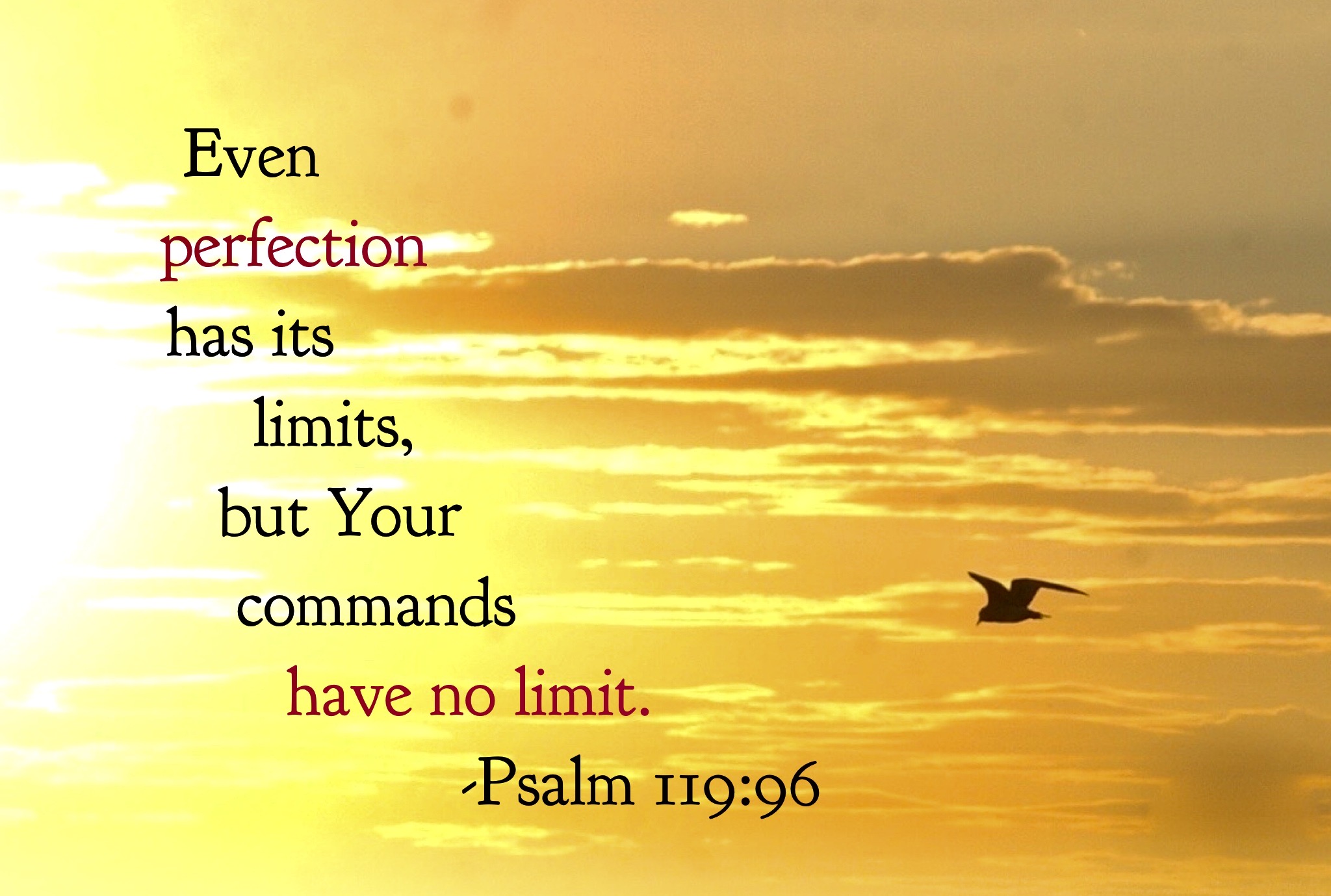
Psalm 119 is divided into twenty-two 8-verse segments, with each verse of the segments beginning with its own Hebrew letter. Lamedh is found in verses 89-96, and lamedh is the tallest of all the Hebrew letters, so that means it stands out. 

Lamedh shows us big proportions. Words like eternal, boundless, established, enduring, and forever are prominent in these eight verses. The psalmist is inviting us to climb up into God’s Word and get a bigger view, a higher vantage point of who God is. 

Consider the opening verse of this section: Your Word, O LORD, is eternal; it stands firm in the heavens. Eternal—think of the implications! If what God says—His Word—is eternal, then…

  • it continues through all generations (v. 90) 
  • it endures even when everything else fades away (vv. 90-91) 
  • it has no limits or frontiers (v. 96) 

At every single moment in my life, my eternal, enduring, limitless God knows the outcome or consequence of each option I could choose. His Word can so transform my mind that I can always choose the most Christ-glorifying option. The Spirit of Truth—my eternal Counselor—can guide me with God’s Word. 

I never have to be at a loss. I am never stumped. I always have access to eternal Truth. 

The psalmist got this: If Your law had not been my delight, I would have perished in my affliction (v. 92). 

Through God’s firmly-established Word I have—

  • Eternal Counsel 
  • Enduring Help 
  • Limitless Strength

And you have all of this, too, through God’s Word! 

Psalm 119 is a great place to start to make Bible reading a daily habit. Scientists tell us that you only need 21 days to make a new habit, and in Psalm 119 you have 22 days of daily reading that will transform your heart and mind. 

►► Would you please prayerfully consider supporting this ministry? ◀︎◀︎

The Spirit Of Truth

Listen to the podcast of this post by clicking on the player below, and you can also subscribe on Apple or Spotify.

When I was 4 years old, I heard my echo for the first time as I yelled “Hello!” to a barn on the other side of a pasture. I was totally convinced that I had a friend in that barn yelling back to me, and I ended up being a bit disappointed later when I discovered that it was just my own sound waves bouncing back to me. 

To my 4-year-old brain, a little friend yelling back from the barn was absolutely true. It was maturity and new information that taught me differently. Isn’t this an ongoing story for all of us? Many things seem true from our current perspective, but then as we get older or smarter we realize that our original belief—what we really believed to be true—is now invalidated. 

Rarely does anyone admit, “I was immature back then,” but we usually try to justify ourselves by saying, “If I would have known back then what I know now….” But the fact is it will always be an impossibility for you to know then what you know now. 

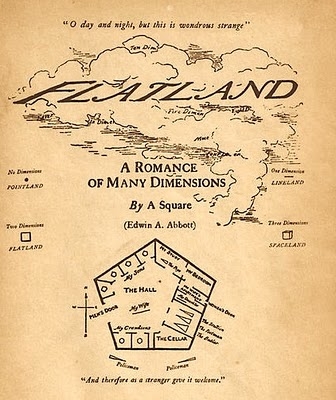
In 1880, Edwin A. Abbott wrote Flatland, a favorite book of Albert Einstein. Abbott was a college-trained mathematician and theologian; in fact, he was actually better known for his theological writings than for this book. In this fabulous little book, Square, who lives in two-dimensional Flatland, cannot perceive height or depth. So what appears to him to be a wall, would merely be a line to you and me. One day Sphere from three-dimensional Spaceland visits Flatland, trying to explain to Square what his world was really like, but Square and his other Flatlanders could never fully grasp the idea. 

When Jesus was interviewed by Pilate, it sounds as though Pilate is missing a “dimension.” Pilate tries to state things the way that he understands them, but Jesus is revealing to him a whole new dimension (see John 18:33-38). The word Jesus uses for “truth” in this conversation means objective truth: something that is always true, regardless of where or when we live. Jesus explained that He as God IS objective truth. Any of our truth statements that aren’t grounded in God are subjective truth statements at best. 

Listen to how John describes Jesus: In the beginning—before all time—was the Word (Christ), and the Word was with God, and the Word was God Himself. He was continually existing in the beginning co-eternally with God. All things were made and came into existence through Him; and without Him not even one thing was made that has come into being. In Him was life and the power to bestow life, and the life was the Light of men. The Light shines on in the darkness, and the darkness did not understand it or overpower it or appropriate it or absorb it and is unreceptive to it. (John 1:1-5 AMP) 

Here’s the absolutely amazing thing: Jesus wants us to have this same insight into heavenly dimensions! Jesus said He would ask the Father to send us the Holy Spirit, Whom He called “the Spirit of Truth” (John 14:6, 16-17; 15:26; 16:12-13).

The Spirit of Truth…

  • …reminds us of the words of Jesus—John 14:26 
  • …helps us testify to others about the Truth—John 15:26-27 
  • …continually reveals objective truth to us—John 16:12-13 
  • …gives us truthful words to share with other “Flatlanders” who doubt the words of God—Matthew 10:16-20 
  • …and helps us spot and refute the falsehoods of the antichrist—1 John 2:18-27  

[Check out all of these Scriptures by clicking here.]

I love the King James Version of 1 John 2:20—But ye have an unction from the Holy One, and ye know all things. Being baptized in the Spirit of Truth means that you have access to an eternal perspective. You are no longer bound by the dimensions and paradigms of this “Flatland” but you are seeing things from God’s transcendent perspective. 

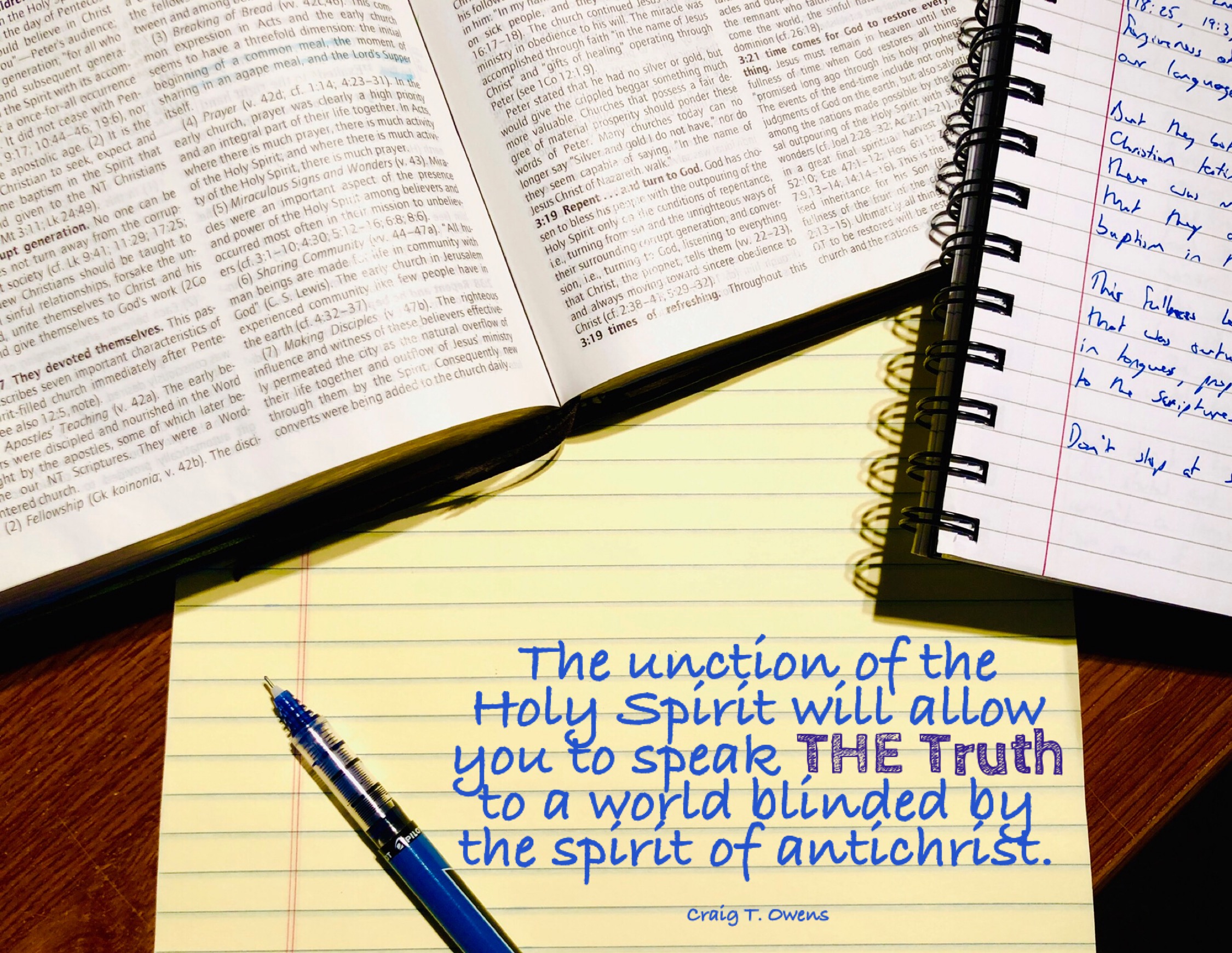
The unction of the Holy Spirit will allow you to speak THE Truth to a world blinded by the spirit of the antichrist. 

If you’ve missed any of the messages in our series We Are: Pentecostal, you can access the full list by clicking here.

►► Would you please prayerfully consider supporting this ministry? ◀︎◀︎

Perspective In The Middle Of The Storm

Listen to the podcast of this post by clicking on the player below, and you can also subscribe on Apple or Spotify.

Have you ever read the children’s book Alexander and the Terrible, Horrible, No Good, Very Bad Day? Poor Alexander, his day just seemed to get worse—nothing was going right. He wakes up with gum in his hair, trips on his skateboard, and drops his favorite sweater in the sink filled with water. Breakfast doesn’t get any better, things go sideways at school, his least-favorite food is served for dinner, his nightlight burns out. And if all that’s not bad enough, the cat decides to sleep with his brother instead of with him. 

Can you relate to Alexander? 

Doesn’t it seem like when one thing goes wrong, everything goes wrong? And if things go wrong for too many days in a row, it seems like the bad times are lasting forever! All of us have a tendency to exaggerate during the dark days. 

A psalmist named Asaph seemed to be having a terrible, horrible, no good, very bad day of his own. Listen to some of his words, including the exaggerations of how bad he thought everything was: 

Why have You rejected us forever, O God? … Your foes roared in the place where You met us… They said in their hearts, “We will crush them completely!” They burned every place where God was worshiped in the land. … How long will the enemy mock you, O God? Will the foe revile Your name forever? Why do You hold back Your hand? (Psalm 74:1, 4, 8, 10, 11) 

In the middle of the storm, we tend to not only exaggerate how bad things are but we also seem to lose our bearings and we can even lose sight of God. I think that’s what was happening to Asaph in the first half of his lament. But then we come to the middle verse of this psalm and we notice the beginning of a change in perspective: “But You, O God, are my King from of old; You bring salvation upon the earth” (v. 12). 

Aha! In the middle of his terrible, horrible, no good, very bad day, Asaph stopped looking at all the bad things around him and turned his gaze upward. “Look,” he tells himself, “there is God still reigning as the Supreme King!” Asaph begins to recount all that God has done, using the phrase “It was You” who did these miraculous things five times in the next five verses. 

In the middle of the storm, Asaph has to remind himself…

  • God existed before time began
  • He is still the sovereign ruler in this present moment 
  • He gets the final and decisive word at the end
  • He never forgets His covenant of love with His people 
  • He defends His cause and His people 
  • His desires can never be thwarted or even delayed a single moment 
  • He is the only One who exists as the Eternal I AM
  • His love and His power are unmatched and unrivaled anywhere in the universe 
  • He will rise up to save me 

My friend, I implore you to remember these words of Asaph. Commit them to your memory now, so that when your terrible, horrible, no good, very bad day happens—when it seems like everything is going to go wrong forever—that you can spot those lying exaggerations, you can turn your gaze upward, and you can find hope in knowing your God not only has all power to save you in the storm, but He has unlimited love that wants to save you through the storm. 

Look up, look up, look up and see your God reigning supremely over even the worst terrible, horrible, no good, very bad day. 

►► Would you please prayerfully consider supporting this ministry? ◀︎◀︎

Poetry Saturday—Growing Down

Listen to the podcast of this post by clicking on the player below, and you can also subscribe on Apple or Spotify.

Mix a grunt and a grumble, a sneer and a frown,
And what do you have? Why old Mr. Brown,
The crabbiest man in our whole darn town.
We all called him Grow-Up Brown:
For years each girl and boy and pup
Heard “Grow up, grow up, oh grow up.”
He’d say, “Why don’t you be polite?
Why must you shout and fuss and fight?
Why can’t you keep dirt off your clothes?
Why can’t you remember to wipe your nose?
Why must you always make such noise?
Why don’t you go pick up your toys?
Why do you hate to wash your hands?
Why are your shoes all filled with sand?
Why must you shout when I’m lying down?
Why don’t you grow up?” grumped Grow-Up Brown.

One day we said to Grow-Up Brown,
“Hey, why don’t you try growing down?
Why don’t you crawl on your knees?
Why don’t you try climbing trees?
Why don’t you bang on a tin-can drum?
Why don’t you chew some bubble gum?
Why don’t you play kick-the-can?
Why don’t you not wash your hands?
Why don’t you join the baseball team?
Why don’t you jump and yell and scream?
Why don’t you try skipping stones?
Why don’t you eat ice cream cones?
Why don’t you cry when you feel sad?
Why don’t you cuddle with your dad?
Why don’t you have weenie roasts?
Why don’t you believe in ghosts?
Why don’t you have pillow fights?
Why don’t you sleep with your teddy at night?
Why don’t you swing from monkey bars?
Why don’t you wish on falling stars?
Why don’t you run in three-legged races?
Why don’t you make weirdie faces?
Why don’t you smile, Grow-Up Brown?
Why don’t you try growing down?”
Then Grow-Up Brown, he scrunched and frowned
And scratched his head and walked around,
And finally he said with a helpless sound,
“Maybe I will try growing down.”

So Grow-Up Brown began to sing
And started doing silly things:
He started making weirdie faces
And came in first in the three-legged races.
All day he swung from monkey bars,
All night he’d lie and count the stars.
He tooted horns, he banged on drums,
He spent twenty bucks on bubble gum,
He went to all the weenie roasts,
And once he thought he saw a ghost.
He got to be great at pillow fights
And went to sleep with his teddy at night.
He flew a kite, he kick a can,
He rubbed some dirt upon his hands.
He drew some pictures, threw some stones,
He ate forty-seven ice cream cones.
He got some sand between his toes,
Got a loose tooth and a bloody nose.
He got a dog, they rolled in the mud.
He imitated Elmer Fudd.
He climbed a roof (though no one asked),
He broke his wrist—he wore a cast.
He rolled down hills, he climbed up trees,
He scuffed his elbows, skinned his knees,
He tried to join the baseball team;
When they said no, he spit and screamed.
He cried when he was feeling sad
And went and cuddled with his dad.
He wore a hat that didn’t fit,
He learned just how far he could spit,
He learned to wrestle and get tickled,
Sucked his thumb, he belched and giggled.
He got his trousers torn and stained,
He ran out barefoot in the rain,
Shouting to all the folks in town,
“It’s much more fun, this growin’ down.” —Shel Silverstein

Would you please prayerfully consider supporting this ministry? 

A Proper Perspective In An Evil Culture

Do these phrases sound familiar? 

  • The foundations are being destroyed, what can the righteous do? 
  • The faithful have vanished from among men 
  • Everyone lies to his neighbor 
  • The boastful say, “We will triumph with our tongues” 
  • The wicked freely strut about when what is vile is honored among men 

This could be said today in my neighborhood. And 20 years ago in Washington DC. And 500 years ago in Europe. But it was said over 3000 years ago!

In times like these it’s important to remember that there have always been times like these! 

In the United States, elections bring regular changes in leadership. Around the world and throughout history violent dictators are toppled, benevolent monarchies fall, dominate personalities shine brightly and fade from the scene, even people who called themselves “Great” or “the king of kings” have disappeared. What should our perspective be in changing cultures—whether they are good or evil?

In Psalms 9-12, David shares some timeless reminders.  

In Psalm 9, he contrasts the temporary track record of mortals with the transcendency of Yahweh. His Selah pauses in this psalm invite us to consider the question: Who benefits me ultimately and affects me eternally: mortals or God?

In the Septuagint, Psalms 9 and 10 make up one psalm. In our English Bible, Psalm 9 closes with the phrase “they are but men” and Psalm 10 closes by calling mankind “mere earthly mortals.” Contrast that with Yahweh who is described as “the LORD reigns forever” and “the LORD is King for ever and ever.” 

In between these eternal affirmations of God, mere earthly mortals are described as: 

  • arrogant 
  • boastful—literally saying “hallelujah” to themselves 
  • blessing all who are like them in their wicked thoughts
  • having no room in their thoughts for God 
  • even praying to themselves—which is the literal meaning of “he says to himself” that David repeats three times 

Literally this mere earthly mortal thinks of himself as god! But even as he says “nothing will ever hurt me while I’m alive” he acknowledges his mortality, admitting that he is indeed finite. 

In Psalms 11 and 12, David gives the righteous the proper perspective to handle all of this. In a word, David wants the godly to remember:

  • Remember God sees everything 
  • Remember God punishes the wicked and rewards the righteous 
  • Remember God gets the final word 

Christians can only live exemplary, anxiety-free, and God-honoring lives when we stay focused on the Infinite, on the Eternal God. With this perspective we can live out our roles as “aliens and strangers”—as the apostle Peter calls us—while we live in this evil culture.

Poetry Saturday—Indispensable Man

Sometime when you’re feeling important;
Sometime when your ego’s in bloom;
Sometime when you take for granted
You’re the best qualified in the room.

Sometime when you feel that your going
Would leave an unfillable hole;
Just follow this simple instruction,
And see how it humbles your soul.

Take a bucket and fill it with water,
Put your hand in it up to the wrist;
Pull it out and the hole that’s remaining,
Is a measure of how you’ll be missed.

You may splash all you please when you enter,
You can stir up the water galore;
But stop and you’ll find in a minute,
That it looks quite the same as before.

The moral of this quaint example
Is to do just the best that you can;
Be proud of yourself, but remember
There’s no indispensable man —Saxon White Kessinger

A Radical Change In Perspective

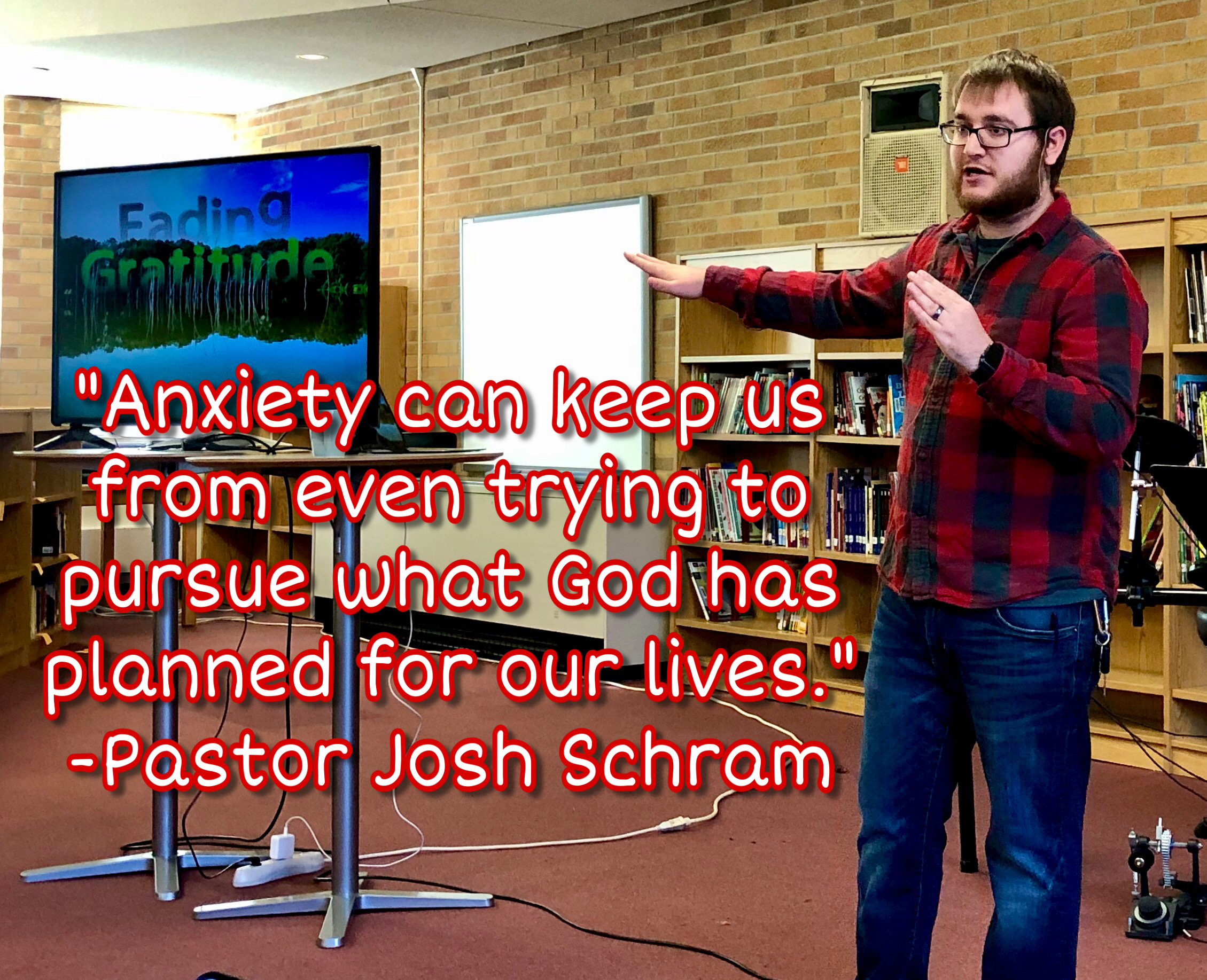
My friend Josh Schram shared a great message yesterday, wrapping up our series called Fading Gratitude. 

Josh was transparent about some of the struggles he overcame during his younger years, explaining how his decision to be grateful even for those roadblocks completely changed his perspective.

When we’re not intentional, our gratitude naturally begins to fade. It’s not that we’re intentionally ungrateful, but we just merely forget to be thankful. 

Our fading gratitude creates a domino effect. When gratitude fades we live with… 

Anxiety can keep us from even trying to pursue what God has planned for our lives. 

When a large group of people needed to be fed, a couple of Jesus’ disciples forgot about the miracles Jesus had already done in the past, and as a result, they became anxious about what to do next. 

Philip replied, “Even if we worked for months, we wouldn’t have enough money to feed them!” Then Andrew, Simon Peter’s brother, spoke up. “There’s a young boy here with five barley loaves and two fish. But what good is that with this huge crowd?” (John 6:7-9)

Yet Jesus multiplied more than enough for everyone to eat AND there were more leftovers than there was food that they originally started with! “So they picked up the pieces and filled twelve baskets with scraps left by the people who had eaten from the five barley loaves” (John 6:13).

That’s why Jesus tells us, So don’t worry about tomorrow, for tomorrow will bring its own worries. Today’s trouble is enough for today” (Matthew 6:34). When we’re grateful for what God provided yesterday, and we’re thankful for what He’s providing today, it will cut short any feelings of anxiety about what God will do again tomorrow!

“No amount of regret changes the past, no amount of anxiety changed the future, but any amount of gratitude changes the present.” —Ann Voskamp 

Gratitude can radically change our perspective! 

If I’m not choosing gratitude, then gratitude is fading. I can be grateful for things I originally thought were holding me back. I can give those things to Jesus—He is not only more than enough but He also gives back to me more than I gave to Him.