
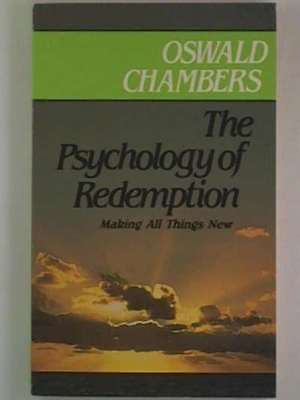
The Psychology Of Redemption (book review)

The Psychology Of RedemptionTo put psychology (a social science) and redemption (a decidedly theological term) together in the same title seems a bit paradoxical. Yet Oswald Chambers was such a well-rounded, well-studied man, that The Psychology Of Redemption seems like a perfect topic for him to tackle!

Chambers himself described these collection of thoughts this way: “Christian Psychology is based on the knowledge of the Lord Jesus Christ, not on the knowledge of ourselves. It is not the study of human nature analyzed and expounded, but the study of the new life that is born in us through the Redemption of our Lord, and the only standard of that new life is our Lord Himself.”

Chambers goes on to explain in this outstanding work that our true self was marred when Adam sinned. We were made by God, so we can best understand ourselves (psychology) when we are reestablished in our original relationship with God (redemption). So the topics that Oswald Chambers goes into in this book are some of the deepest topics of any I have read to-date in his books. But he does it in such an accessible way, that anyone from a novice, to a trained psychologist, to a trained theologian will find value in his thoughts.

Editor David Lambert further advises us: “To profit by this book demands concentrated thought, with Bible in hand, and with a humble eagerness to ‘act on the Word, instead of merely listening to it and deluding yourselves’ (James 1:22).’”

Thursdays With Oswald—God’s Plan For Building Spiritual Muscles

Oswald ChambersThis is a weekly series with things I’m reading and pondering from Oswald Chambers. You can read the original seed thought here, or type “Thursdays With Oswald” in the search box to read more entries.

God’s Plan For Building Spiritual Muscles

     If a man has used his arm only for writing, and then becomes a blacksmith, he will groan for days with the tremendous pain in the deltoid muscle until by practice the time comes when there is no more pain because the muscle has become rightly adjusted to its new work. 

     The same thing happens spiritually, God begins to teach us how to walk and over and over again we begin to howl and complain. May God save us from the continual whine of spiritual babes—“Teach us the same things over and over again, don’t give us the revelations of God which are painful, give us the ‘simple gospel,’ what we have always believed, don’t tell us of things we have never thought about before, because that causes pain” (Hebrews 5:12). Of course it does. 

     Thank God there is a pain attached to being saved, the pain of growing until we come to maturity where we can do the work of a son or daughter of God. … 

     Look back over your life in grace, whether long or short, and ask yourself which are the days that have furthered you most in the knowledge of God—the days of sunshine and peace and prosperity? Never! The days of adversity, the days of strain, the days of sudden surprises, the days when the earthly house of this tabernacle was strained to its last limit, those are the days when you learned the meaning of this passion of “Go.” 

From The Philosophy Of Sin

The only way to build physical muscles is to push them beyond their comfort level.

The only way to build physical stamina is to run farther than you have run before.

The only way God can build our spiritual muscles—and our spiritual stamina—is to push us beyond our comfort zone, to challenge us to go deeper and farther than we’ve gone before. Don’t push Him away. God loves you too much to leave you where you are!

Thursdays With Oswald—6 Questions About Your Relationship With Jesus

Oswald ChambersThis is a weekly series with things I’m reading and pondering from Oswald Chambers. You can read the original seed thought here, or type “Thursdays With Oswald” in the search box to read more entries.

6 Questions About Your Relationship With Jesus

“How much more shall the blood of Christ, Who through the enteral Spirit offered Himself without blemish unto God, cleanse your conscience from dead works to serve the living God?” (Hebrews 9:14)

     Our right to ourselves in every shape and form was destroyed once and for ever by the death of Jesus, and we have to be educated into the realization of what this means in all its fullness. We have to come to a relationship to the Cross in thought as well as in life. … 

     We are here with no right to ourselves, for spiritual blessing for ourselves; we are here for one purpose only—to be made servants of God as Jesus was. …

   “How much more” does the death of Jesus mean to us today than it ever has before? Are we beginning to be lost in wonder, love and praise at the marvelous loosening from sin, and are we so assimilating the nature of Jesus that we bear a strong family likeness to Him?

     The most devout among us are too flippant about this great subject of the death of Jesus Christ. When we stand before the Cross, is our every common pious mood stripped off? … 

     How does all the profound thought underlying the death of Jesus touch us? The writer to the Hebrews instantly connect it with conscience—“How much more shall the blood of Christ,…cleanse your conscience from dead works to serve the living God?” Has conscience the place in our salvation and sanctification that it ought to have? … 

     Are you thankful to God for your salvation and sanctification, thankful He has purged your conscience from dead works? Then go a step further; let Jesus Christ take you straight through into identification with His death until there is nothing left but the light at the foot of the Cross, and the whole sphere of the life is hid with Christ in God. 

From The Philosophy Of Sin

I challenge you: take some time to thoughtfully answer these questions.

Thursdays With Oswald—Jesus Doesn’t Counteract satan

Oswald ChambersThis is a weekly series with things I’m reading and pondering from Oswald Chambers. You can read the original seed thought here, or type “Thursdays With Oswald” in the search box to read more entries.

Jesus Doesn’t Counteract satan

     If all Jesus Christ can do is to run a parallel counteraction with what satan can do, His right name is “Culture,” not “Savior”; but His revealed nature was stated by the angel to Mary, and repeated over and over again, “Thou shalt call His name Jesus; for He shall save His people from their sins.”

     The slight views of salvation, the sympathetic drifty views that all Jesus Christ can do is to put in us a principle that counteracts another principle, will cause anyone who is got to the last limit to blaspheme God for a thing like that. It all comes from a flimsy, wrong view of sin. If that is all He can do, what is the good of calling Him Savior? … 

     It is sin that He came to cope with; He did not come to cope with the poor little mistakes of men, they cope with their own mistakes; He came to give them a totally new stock of heredity, that is, He came to implant into them His own nature, so that satan’s power in the soul is absolutely destroyed, not counteracted.

From The Philosophy Of Sin

For far too long, far too many people in church circles have bought into a lie. The lie is that Jesus and satan are fighting-it-out to see who will come out as champion. As though the outcome of the struggle was somehow in doubt!

Jesus has already won! He already holds the keys to death, hell and the grave. He already defeated satan. He is already Champion: King of Kings and Lord of Lords!

The only thing that is still in doubt is this: Will you allow Jesus to “implant His own nature” in you? Will you allow Him to be Champion of your life?

Chambers also wrote, “Sin is the radical twist with a supernatural originator, and salvation is a radical readjustment with a supernatural Originator.” Let the Champion Originator—the One who has already won!—implant a new life in you.

Thursdays With Oswald—What “Religious” Things Perplex You?

Oswald ChambersThis is a weekly series with things I’m reading and pondering from Oswald Chambers. You can read the original seed thought here, or type “Thursdays With Oswald” in the search box to read more entries.

What “Religious” Things Perplex You? 

     If we are perplexed over the question of sanctification, or about the baptism of the Holy Ghost, we ourselves are the reason why we are bothered. God has written a Book, and the phrases “sanctification” and the “baptism of the Holy Ghost” are His, not man’s; why do we not go to Him about it? 

     We are the reason why we do not go; we dare not go. If we honestly ask God to baptize us with the Holy Ghost and fire, anything that happens is His answer, and some appalling things happen. If we accept the revelation that our body is the temple of the Holy Ghost, are we prepared to ask God to fulfill the purpose of the Holy Ghost in our body? If we are, watch the consequences—that friendship must go, that book, that association, everyone of them must decay off like a lightning flash. 

     If anyone has a difficulty in getting through to God, it is never God who is to blame. We can get through to Him as soon we want to, there is nothing simpler.

From The Psychology Of Redemption

I believe Chambers’ line of reasoning goes like this:

  • God has revealed His full will in the inspired words of Scripture.
  • The same Holy Spirit Who inspired the Bible can illuminate our hearts.
  • We don’t have insight because we either don’t ask for it [James 1:5], or we don’t really want to hear the truth [James 4:3].
  • Asking for help while posturing ourselves to obey will quickly bring clarity—“Jesus Christ’s life must work through our flesh, and that is where we have to obey. So many go into raptures over God’s supernatural salvation, over the wonderful fact that God saves us by His sovereign grace (and we cannot do that too much), but they forget that now He expects us to get ourselves into trim to obey Him” (Oswald Chambers).

Thursdays With Oswald—Is It Human Or Divine?

Oswald ChambersThis is a weekly series with things I’m reading and pondering from Oswald Chambers. You can read the original seed thought here, or type “Thursdays With Oswald” in the search box to read more entries.

Is It Human Or Divine? 

     It is easy to say that human love and Divine love are one and the same thing; actually they are very far from being the same. It is also easy to say that human virtues and God’s nature are one and the same thing; but this, too, is actually far from the truth. We must square our thinking with facts. Sin has come in and made a hiatus between human and Divine love, between human virtues and God’s nature, and what we see now in human nature is only the remnant and refraction of the Divine. Human virtues according to the Bible are not promises of what human nature is going to be, but remnants of what human nature once was. … 

     As Christians we must learn to trace things to their right source. God makes very distinct the difference between the qualities that are Divine and those that are human. John 15:13 has reference to human love, which lays down its life for its friends. Romans 5:8 has reference to the Divine love, which lays down its life for its enemies, a thing human nature can never do.

From The Psychology Of Redemption

We must be very careful about looking at our life, and then trying to match it up with something we see in Scripture. It should always be the other way around—look at Scripture first, and then see if my life squares with what I see in God’s Word.

Even harder: see if my life squares with what I see in the life of Jesus as presented to me in God’s Word.

In Psalm 139 David began His prayer by saying, “God, You have searched me thoroughly, and You know me completely.” Then he ended his prayer by inviting God to search him yet again. This should be the ongoing posture and attitude of a Christian: asking the Holy Spirit to constantly show us where our lives fall short of the Christian lifestyle presented in the Bible.

Thursdays With Oswald—Thinking Like Christians

Oswald ChambersThis is a weekly series with things I’m reading and pondering from Oswald Chambers. You can read the original seed thought here, or type “Thursdays With Oswald” in the search box to read more entries.

Thinking Like Christians 

     The New Testament insists on an instructed mind as well as a vital experience. … 

     There is always a quarrel between our common sense and the revelations made in God’s Book. We must lose our soul in order to find it. We have to be born from above and receive the Holy Spirit into our spirit, and then begin to construct another soul, or way of reasoning, and to do this we must accept not only the facts that come to us through our common sense, but the facts that come by revelation. We say seeing is believing, but it is not. We must believe a thing is possible before we should believe it even though we saw it (John 20:29). … 

     Our beliefs will mock us unless something comes into us from God, because nothing has any power to alter us save the incoming of the life of God. The Holy Spirit is the One Who makes experimentally real in us what Jesus Christ did for us. … The great need for men and women is to receive the Holy Spirit. Our creeds teach us to believe in the Holy Spirit; the New Testament says we must receive Him (Luke 11:13). Are you powerless in your life? Then, for Christ’s sake, get at Reality! Ask God for the Holy Spirit. … 

     We starve our minds as Christians by not thinking, and we cannot think as Christians until we are born from above. So many of us have a good spiritual experience, but we have never thought things out on Christian lines. It is just as true that a man may live a Christian life without thinking as that a man may think a Christian life without living it. We have to learn to combine the two, and to do this we must build up our minds on these great truths. 

From The Psychology Of Redemption

How are you doing at thinking AND living a Christian life? To do both, you must receive the Holy Spirit, and begin to rely on Him for both Christian thinking and living.

Thursdays With Oswald—Working Out God’s Will

Oswald ChambersThis is a weekly series with things I’m reading and pondering from Oswald Chambers. You can read the original seed thought here, or type “Thursdays With Oswald” in the search box to read more entries.

Working Out God’s Will

     We do not enter into the life of God by imitation, or by vows, or by ceremonies, or by Church membership; we enter into it by its entering into us at Regeneration. The Cross of Jesus Christ is the gateway into His life. … 

     The world is that system of things which organizes its life without any thought of Jesus Christ. … 

     Nothing blinds in the mind to the claims of Jesus Christ more effectually than a good, clean-living, upright life based on self-realization. For a thing to be satanic does not mean that it is abominable and immoral. The satanically managed man is moral, upright, proud, and individual; he is absolutely self-governed and has no need of God. … 

     When by the Cross of Christ we have entered into the experience of identification with our Lord, then there comes the practical working out of Matthew 11:29, “Take My yoke upon you, and learn of Me; for I am meek and lowly in heart.” … 

     God will bring across our path people who embody the characteristics that we have shown to Him—stubbornness, pride, conceit, opinionatedness, sensuality, a hundred little meannesses. “Now,” He says, “love them as I have loved you.” 

From The Psychology Of Redemption

So God’s will is not something we learn by going to church, or imitating someone we think to be a godly person. God’s will is living like Jesus:

  • Totally abandoned to God’s will
  • Staying linked to Jesus
  • Loving the people that God brings across our path like God loves us

How are you doing?

Thursdays With Oswald—Is Jesus Worth It?

Oswald ChambersThis is a weekly series with things I’m reading and pondering from Oswald Chambers. You can read the original seed thought here, or type “Thursdays With Oswald” in the search box to read more entries.

Is Jesus Worth It? 

     With regard to all the pleasures and sciences and interests of this life, push this simple consideration, “Is this the kind of thing the Son of God is doing in the world, or is it what the prince of this world is doing?” Not, “Is it right?” but “Is it the kind of thing the Son of God would be doing in the world?” If it is not, then don’t touch it. 

     If you only give up wrong things for Jesus Christ, don’t talk any more about being in love with Him. If you want to do a thing all the time, it is no virtue not to do it! Jesus Christ takes the “want to” out of us and enables us to do in this world the things He would be doing if He were here. 

     We say, “Why shouldn’t I? It isn’t wrong!” What a sordid thing to say! When we love a person, do we only give up what is wrong for him? Love is not measured by what it gets, but by what it costs, and our relationship to Jesus Christ can never be on the line of, “Why shouldn’t I do this?” Our Lord simply says, “If any man will be My disciple, those are the conditions” (see Luke 14:26-27 and 33). Is He worth it?

From The Psychology Of Redemption

What do you think: Is Jesus worth it?

Thursdays With Oswald—What Prayer Does In Us

Oswald ChambersThis is a weekly series with things I’m reading and pondering from Oswald Chambers. You can read the original seed thought here, or type “Thursdays With Oswald” in the search box to read more entries.

What Prayer Does In Us

     Prayer is the point where the reality of God merges with human life. Until we are born from above, prayer with us is honestly nothing more than a mere exercise; but in all our Lord’s teaching and in His own personal life, as well as in the emphasis laid on prayer by the Holy Ghost after He had gone, prayer is regarded as the work (see John 14:11-13). … 

     If prayer is the highest reach of communion possible between Almighty God and the Son of Man, what part ought prayer to play in our lives? … 

     Prayer is not meant to develop us, but to develop the life of God in us after new birth.

From The Psychology Of Redemption

In another lesson, Chambers reminds us that prayer is easy for us because it cost Jesus so much to make it possible for us.

Jesus knew the value of prayer, which is why it was an essential priority all throughout His earthly life. Now we have access to the same Almighty God through the name of Jesus. Yes, Jesus is interceding for us, but we don’t have to stop there—we should never stop there!—because Christ’s death and resurrection makes a way for us to go right into Almighty God’s presence.

Prayer is powerful! Prayer brings the life of God right down into our own souls.

So… what part ought prayer to play in your life?