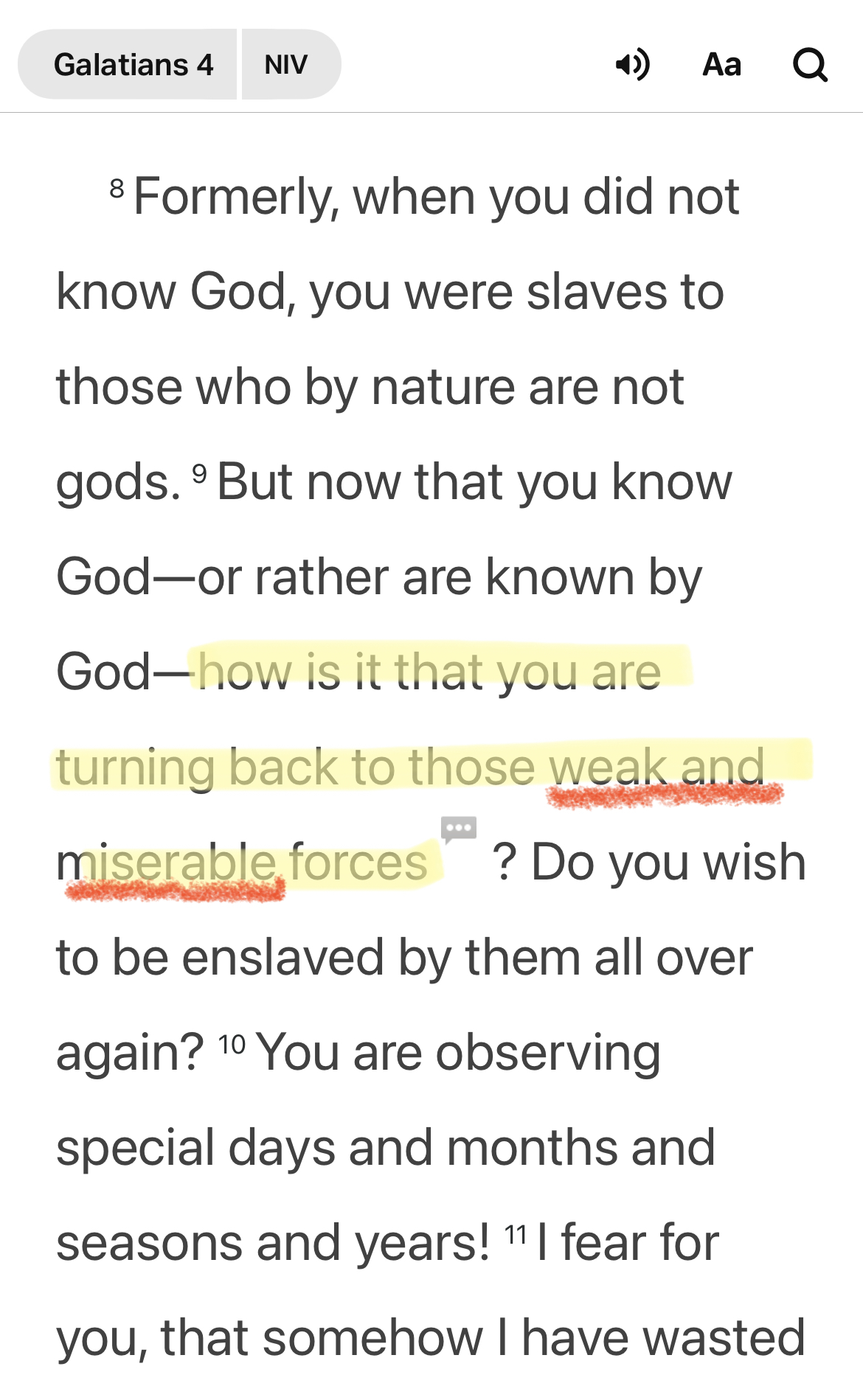
The Apostle Paul asked the Christians in Galatia an important question:
How is it that you are turning back to those weak and miserable principles? (Galatians 4:9)
The two words together in the Greek—weak and miserable—imply things that impoverish us and reduce us to lowly paupers and beggars. That’s not a pretty picture!
Look at the contrast between the princely life and the pauper’s life.
Those who follow Christ:
Are called sons of God (Galatians 4:6a)
Experience Abba Father’s favor (4:6b)
Are heirs to God’s Kingdom (4:7)
Those who don’t follow Christ:
Live as slaves (4:7)
Are separated from God’s favor (4:1-3)
Live as miserable beggars (4:9)
Why would anyone choose the miserable beggar’s life?
Here’s the principle: Everyone serves someone! I will either serve God and be called His son, or I will serve myself (my desires, my passions, my way of doing things) and be called a stranger to God.
Do I want to be in control, or do I want to let God be in control? When I try to control my own life, not only am I not in control, but I actually become a slave to my own passions. Ironic, isn’t it?
The choice is simple, but the choice must be made every day. I must choose to serve God in every moment of every day. It’s the only way to avoid the miserable life, and live the blessed life God has for me.
Artificial Maturity is a must-read book by Dr. Tim Elmore for parents, pastors, youth pastors, teachers, coaches, and managers—anyone who works with youth. You can read my full review of this invaluable book by clicking here.
The opening words of Psalm 119 describe the end result of going through what I’m calling the P119 Spiritual Workout. In a word: Blessed.
In fact, this word is so exciting that the Hebrew language uses the emphatic thought here. Bringing that into English means that the first two verses of this chapter both begin…
O!! How blessed!!
That’s a wonderful goal, but the next two verses seem to bring us crashing back to earth. In order to enjoy these heights of blessing we are asked to live like this:
They do nothing wrong as they walk in His ways (v. 3).
God’s precepts are to be fully obeyed (v. 4).
Yikes! Nothing wrong?! Full obedience?! No mistakes?!
Even Jesus said, “Be perfect, therefore, as your Heavenly Father is perfect” (Matthew 5:48).
But pay attention to this: The sign of a maturing Christian is not one who never sins;the sign of a maturing Christian is one who is closing the gap between sin and repentance.
How does that work? Here’s the progression…
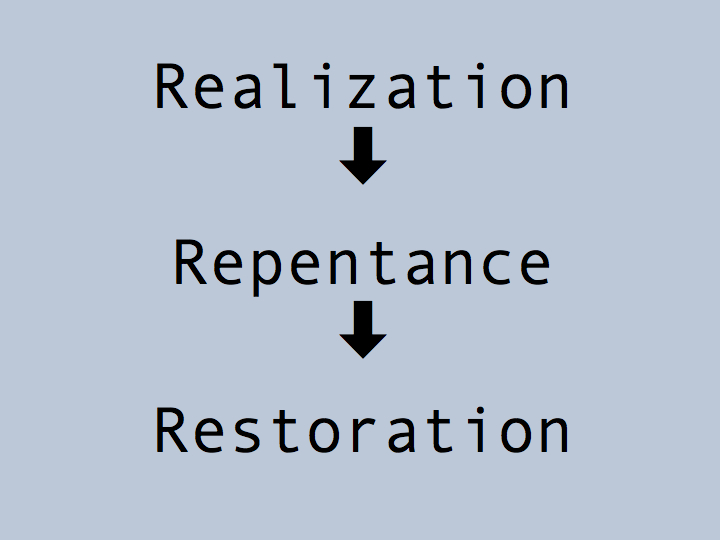
Realization of sin → Repentance of sin → Restoration of God’s blessing
The time gap between our repentance and God’s restoration is faster than the blink of an eye—faster than you can even comprehend. What often takes us a while is moving from realization to repentance. Instead, we explain, and justify, and make excuses, and drag our feet.
But a maturing Christian invites the inspection of the Holy Spirit through the reading of God’s Word and then is quick to realize sin and repent from it. When God restores us, do you know how we appear to Him? PERFECT!!
So realizing our sin, repenting of that sin, and experiencing God’s restoration is the fastest way to live as those who do nothing wrong and who are fully obeying God’s precepts.
Don’t wait any longer: realize and repent, and then experience God’s restoration as you stand perfect in His presence!
Now about ______________________: We know that we all possess knowledge. Knowledge puffs up, but love builds up. (1 Corinthians 8:1)
Fill in this blank with something you consider (as Dr. Charles Ryrie calls them) a “morally indifferent” practice. In other words, something that is not a black-in-white, do-it-and-you’re-sinning issue. What goes in your blank?
…skipping church?
…drinking alcohol?
…smoking a cigar?
…dancing?
We all have knowledge about such things, but where’s the love?
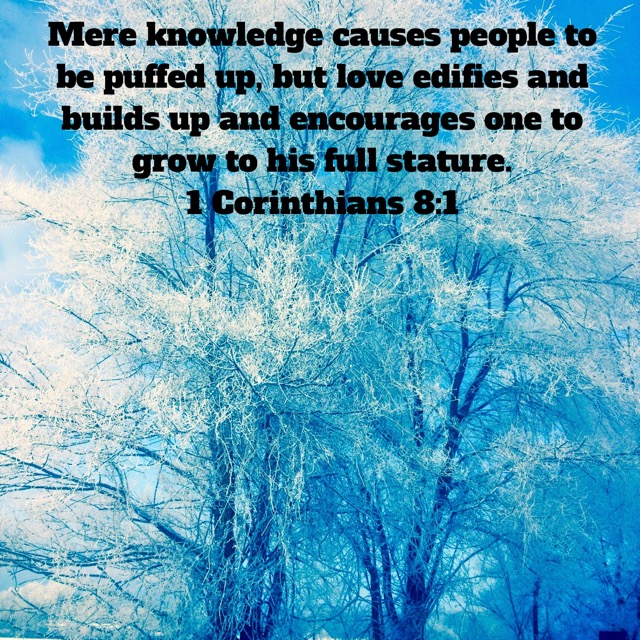
Love builds up. Knowledge only benefits me; love benefits all. The Amplified Bible says it this way, “love edifies and builds up and encourages one to grow to his full stature.”
The Greek word for builds up means “to promote growth in Christian wisdom, affection, grace, virtue, holiness, blessedness; to grow in wisdom and piety.”
The question, “Does this fill-in-the-blank item hinder a weaker brother?” is too puffy. The better question is, “Does this help my weaker brother grow?”
That’s the question love asks.
Love avoids the negative-growth items and even the neutral-growth items. Love seeks only those things which promote positive growth.
It’s too puffy to ask, “Does this hurt someone.”
It’s too puffy to say, “This is no big deal!”
We need to ask, “Does this help everyone?” If we can’t answer “yes,” leave it alone!
I like to remember the definition of sanctification by saying it this way: saint-ification. Literally, the Holy Spirit is making us into saints.
So why would you or I want to go through that saint-ification process?
Is it so others will admire us? Is it so we will become the example for everyone else to follow? No!
We go through it because it glorifies God when we become saints.
And notice this: the word is saintS (plural, not singular). If you search through the New Testament you will find that this word is always in the plural. There are no singular saints. The Holy Spirit saint-ifies us to bring unity to the Body of Christ.
May the God who gives endurance and encouragement give you a spirit of unity among yourselves as you follow Christ Jesus, so that with one heart and mouth you may glorify the God and Father of our Lord Jesus Christ.(Romans 15:5-6)
Think of your physical body. You go through the process of dieting or exercising for the benefit of the entire body. Your tastebuds may really want to savor some junk food, but for the good of the whole body, you go through the discipline of eating the healthy food. Your legs may not want to go for that jog, but for the good of the whole body, you push through your exercise routine.
It’s the same way spiritually: The Holy Spirit helps you become saint-ified for the good of the whole Body of Christ. The Holy Spirit wants you to mature as a saint so that you can help other saintS, and together the unified Body of Christ can glorify God.
So allow the Holy Spirit to take you through the saint-ification process, because other saintS need your help. And God will be glorified as you do!
This is a weekly series with things I’m reading and pondering from Oswald Chambers. You can read the original seed thought here, or type “Thursdays With Oswald” in the search box to read more entries.
Spiritual Personality
When we receive the Holy Spirit, He so energizes our spirit that we are able to detect things that are wrong, and we are able to rectify them if we ‘mind’ the Holy Spirit. This is the Scotch use of the term ‘mind,’ and it means ‘remember to obey.’ It carries with it the meaning of another Scotch word, ‘lippen,’ that is, ‘trust.’ Mind the Holy Spirit, mind His light, mind His convictions, mind His guidance, and slowly and surely the sensual personality will be turned into a spiritual personality.
It’s not too often that I think of personality in a spiritual light. But God created me as a unique person, complete with my own personality. He gave me the personality He did on purpose: to glorify Him.
Left to myself, my personality is highly self-serving. But when I “mind” the Holy Spirit, He helps me live out my God-given personality in a way that is more and more God-serving and God-glorifying.
“You must ‘work out your own salvation’ which God has worked in you already (Philippians 2:12). Are your speech, your thinking, and your emotions evidence that you are working it ‘out’? If you are still the same miserable, grouchy person, set on having your own way, then it is a lie to say that God has saved and sanctified you.”
Listen to the podcast of this post by clicking on the player below, and you can also subscribe on Apple, Spotify, or Audible.
As a pastor, one of your responsibilities is to point out what may be harmful in someone’s life. We have a word for that: confrontation.
Handled correctly, confrontation can lead to restoration and newfound maturity. Handled incorrectly, and, well, let’s just say it can get very ugly!
I just heard the story of a pastor who felt like he needed to confront one of his board members. I don’t really know this pastor, nor do I know the board member; I don’t know what was said in their meeting, but I have heard about the outcome, and it got ugly.
Samuel was going to be sent by God to confront King Saul about the sin he had committed. Look at this passage:
Then the word of the Lord came to Samuel: “I am grieved that I have made Saul king, because he has turned away from Me and has not carried out My instructions.” Samuel was troubled, and he cried out to the Lord all that night. (1 Samuel 15:10-11)
Did you catch how Samuel responded? He cried out to the Lord all that night.
Perhaps if we, as pastors, cried before we confronted the results might be more healthy.
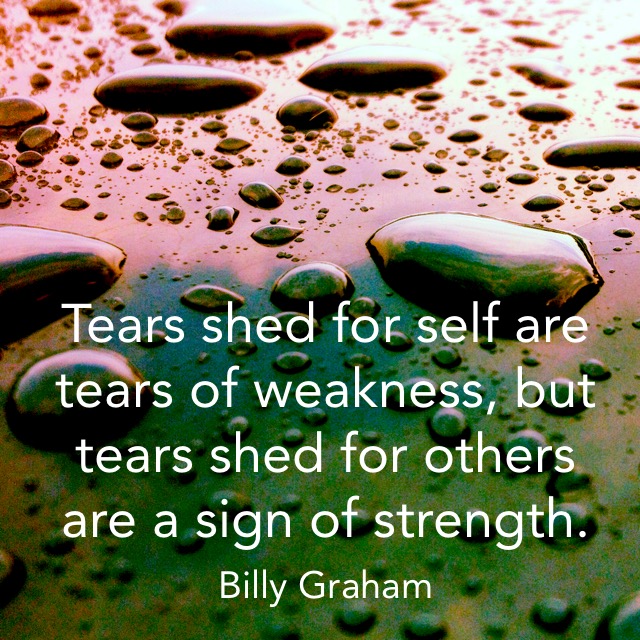
“Tears shed for self are tears of weakness, but tears shed for others are a sign of strength.” —Billy Graham
Nehemiah was another pastoral/prophetic figure that was going to confront the inhabitants of Jerusalem about their sin.
When I heard these things, I sat down and wept. For some days I mourned and fasted and prayed before the God of heaven. Then I said: …I confess the sins we Israelites, including myself and my father’s house, have committed against You. (Nehemiah 1:4-6)
Before Nehemiah confronted the sins of the people, he tearfully took a hard look at himself, and then asked for forgiveness. Jesus shared this same concept with these words:
Why do you look at the speck of sawdust in your brother’s eye and pay no attention to the plank in your own eye? How can you say to your brother, “Let me take the speck out of your eye,” when all the time there is a plank in your own eye? You hypocrite, first take the plank out of your own eye, and then you will see clearly to remove the speck from your brother’s eye. (Matthew 7:3-5)
So before you confront your brother or sister, let the Holy Spirit confront you. Then, if it’s needed, confess your sin and ask God’s forgiveness. Let the Holy Spirit remove things in your life so that you can see clearly how to lovingly confront your brother.
Cry before you confront. Cry over your sin. Cry over the sinful state of your brother or sister. Plead with the Lord for this time of confrontation to lead to restoration and maturity.
The Assembly of God fellowship has several classifications for churches, the highest one being “general council status.” Yesterday our membership voted unanimously to move into this category!
Here are some of the miracles of the day:
My predecessor, Joel Baxter and his wife Kristina, were in attendance. They live and minister in Wisconsin now, so I didn’t think they would be able to attend, but they showed up and surprised us all. Pastor Joel laid the foundation on which we can now build, and I am so grateful for him. I’m also grateful for the prayer of blessing he prayed over us.
Pastor Joel shared a couple of prophesies that had been spoken over this church. One is that we would be a light to northern Kent County, and the other was that ministry would flow from this church to the cities and communities surrounding us. Amen!
Two precious ladies in our church have been at Calvary since its beginning decades ago, and they got to be the first two signers of our general council resolution.
We had several people visiting for the first time that stuck around to watch this historic vote. I love the testimony that this was for them.
Every vote we have taken among our membership has been unanimous. Truly this is a group of people who are one in spirit and purpose.
Notice that I said that we are growing up—not grown up. I’m thrilled with where we are, but we still have a long way to go to…
…prepare God’s people for works of service, so that the body of Christ may be built up until we all reach unity in the faith and in the knowledge of the Son of God and become mature, attaining to the whole measure of the fullness of Christ. (Ephesians 4:12-13)
And in case you haven’t heard me say it lately:
I ♥ My Church!
If you live in West Michigan and don’t have a church home, I would love for you to join us next Sunday!
This is a weekly series with things I’m reading and pondering from Oswald Chambers. You can read the original seed thought here, or type “Thursdays With Oswald” in the search box to read more entries.
The Intimacy Of God
The 139th Psalm ought to be the personal experience of every Christian. My own introspection, or exploration of myself, will lead me astray, but when I realize not only that God knows me, but that He is the only One who does, I see the vital importance of intercessory introspection. Every man is too big for himself, thank God for everyone who realizes it and, like the Psalmist, hands himself over to be searched out by God. We only know ourselves as God searches us. ‘God knows me’ is different from ‘God is omniscient’; the latter is a mere theological statement; the former is a child of God’s most precious possession—‘O Lord, Thou hast searched me, and known me.’
I love the line, “We only know ourselves as God searches us.”
He knows me better than I know myself. If I ever hope to mature, I can only do so as I make this my daily prayer:
Search me, O God, and know my heart; test me and know my anxious thoughts. Point out anything in me that offends You, and lead me along the path of everlasting life. (Psalm 139:23,24)



 The Apostle Paul asked the Christians in Galatia an important question: