Thursdays With Oswald—Bitter, Dogmatic, Intolerant, And Utterly Un-Christlike

This is a weekly series with things I’m reading and pondering from Oswald Chambers. You can read the original seed thought here, or type “Thursdays With Oswald” in the search box to read more entries.

Oswald ChambersBitter, Dogmatic, Intolerant, And Utterly Un-Christlike

     Spiritual maturity is not reached by the passing of the years, but by obedience to the will of God. Some people mature into an understanding of God’s will more quickly than others because they obey more readily, they more readily sacrifice the life of nature to the will of God, they more easily swing clear of little determined opinions. 

     It is these little determined opinions, convictions of our own that won’t budge, that hinder growth in grace, and makes us bitter and dogmatic, intolerant, and utterly un-Christlike. 

From Bringing Sons Unto Glory 

Ouch! It’s so important that I read God’s Word with a heart ready to obey whatever the Holy Spirit shows me, even if it means sacrificing what I’ve always thought to be true. I must not cling to my own “little determined opinions” if I want to grow in spiritual maturity.

The contrast is crystal clear: Either I am maturing through complete obedience to God, or I am becoming bitter and dogmatic, intolerant, and utterly un-Christlike.


A Checklist For Growth

Listen to the podcast of this post by clicking on the player below, and you can also subscribe on Apple, Spotify, or Audible. 

Take just a moment to read these words from the apostle Peter—

So then, dear friends, since you are looking forward to this, make every effort to be found spotless, blameless and at peace with Him. … Therefore, dear friends, since you have been forewarned, be on your guard so that you may not be carried away by the error of the lawless and fall from your secure position. But grow in the grace and knowledge of our Lord and Savior Jesus Christ…. (2 Peter 3:14, 17-18)

How do I know I’m looking forward and growing? Here’s a checklist that needs to be reviewed regularly:

  • Am I spending more time preparing for my future than I am repairing my past?
  • Do I know that growth is both hard and rewarding work?
  • Do even the littlest of sins disturb me, rob me of peace, and send me quickly to confession and repentance?
  • Do I filter all my reading, studying, and learning through the standard of Scripture?
  • Is my faith stronger now than it was a year ago?
  • Am I exhibiting more Christ-like characteristics—grace, forgiveness, patience—now than I was last year?
  • Am I thrilled every time I get to learn more about Jesus?
  • Am I more reliant on the Holy Spirit now than I have been in the past, and do I converse with Him more frequently?
  • Would those closest to me say that I am becoming more like Jesus?

I hope we can all answer “Yes” to more and more of these items!

Growth is not automatic—this is especially true for spiritual growth. Growth must be intentional or it will not happen. I want to keep going forward in Christ!

May we add our “Amen” to Peter’s prayer: May God give you more and more grace and peace as you grow in your knowledge of God and Jesus our Lord (2 Peter 1:2).

►► Would you please prayerfully consider supporting this ministry? My Patreon supporters get behind-the-scenes access to exclusive materials. ◀︎◀︎

Love Is… (part 3)

Love Is… worsheet 3True love—or the Greek word agape—is a hard-working verb. It’s not mushy. It’s not puppy love. It’s not even romantic. It’s a love that is determined to love another no matter what! It’s the kind of love God extended toward us when we weren’t doing anything worthy of His love, and it’s the kind of love Jesus told we as us His disciples would be known for.

We just wrapped up a series called Loving The Unloveable where we explored what the Bible says about how we are to live out this agape love, especially to those who seem “unloveable.” We went through a list of 15 facets of this love spelled out in 1 Corinthians 13.

You can read about the first five facets by clicking here.

You can read about the second set of attributes by clicking here.

Here are the final five—

Love is protecting

  • The King James Version says love bears all things. So we need to ask, “What does love bear?”
  • The Greek word means: “protecting by covering with silence.”
  • In other words, we bear with the insults of an unloveable/unloving person by refusing to talk about them in a negative way.
  • Agape doesn’t talk about people (unless it’s a conversation with God); agape only talks lovingly to people. Agape protects their reputation.

Love is trusting

  • Love has a high confidence in success. Not my success, but God’s success. So we keep believing for a breakthrough; keep trusting God to accomplish something; keep doing our part in pointing out the best (or the best that is yet to be) in others.

Love is hopeful 

  • The Amplified Bible says: love’s hopes are fadeless under all circumstances.
  • So we work now, but we are always looking forward to the future with joy and full confidence.
  • Think about a farmer: After he plants the seed, he doesn’t see it any more. But his outlook remains hopeful. So he waters a seed he cannot see. He fertilizes a seed he cannot see. He works the ground for a seed he cannot see.
  • Our acts of love may be planting a seed, or fertilizing, or watering. Every part is vital; no part can be skipped. And we remain hopeful of a harvest.
  • Let us not become weary in doing good, for at the proper time we will reap a harvest if we do not give up. (Galatians 6:9)

Love is persevering

  • I love the Greek definition: “enduring through every circumstance without ever weakening.”
  • Never let your love waver. Keep on being patient, and kind, and forgiving, and all of the other characteristics of agape listed in 1 Corinthians 13. All of them are irreplaceable and effective! 

Love is maturing

  • Love continues to grow up.
  • Agape is creative, never stagnant or stuck in a rut. Agape finds new ways to express itself.

Here’s where the real test comes in: How will you apply these attributes of love to someone in your life? More specifically: to someone you think is “unloveable”?

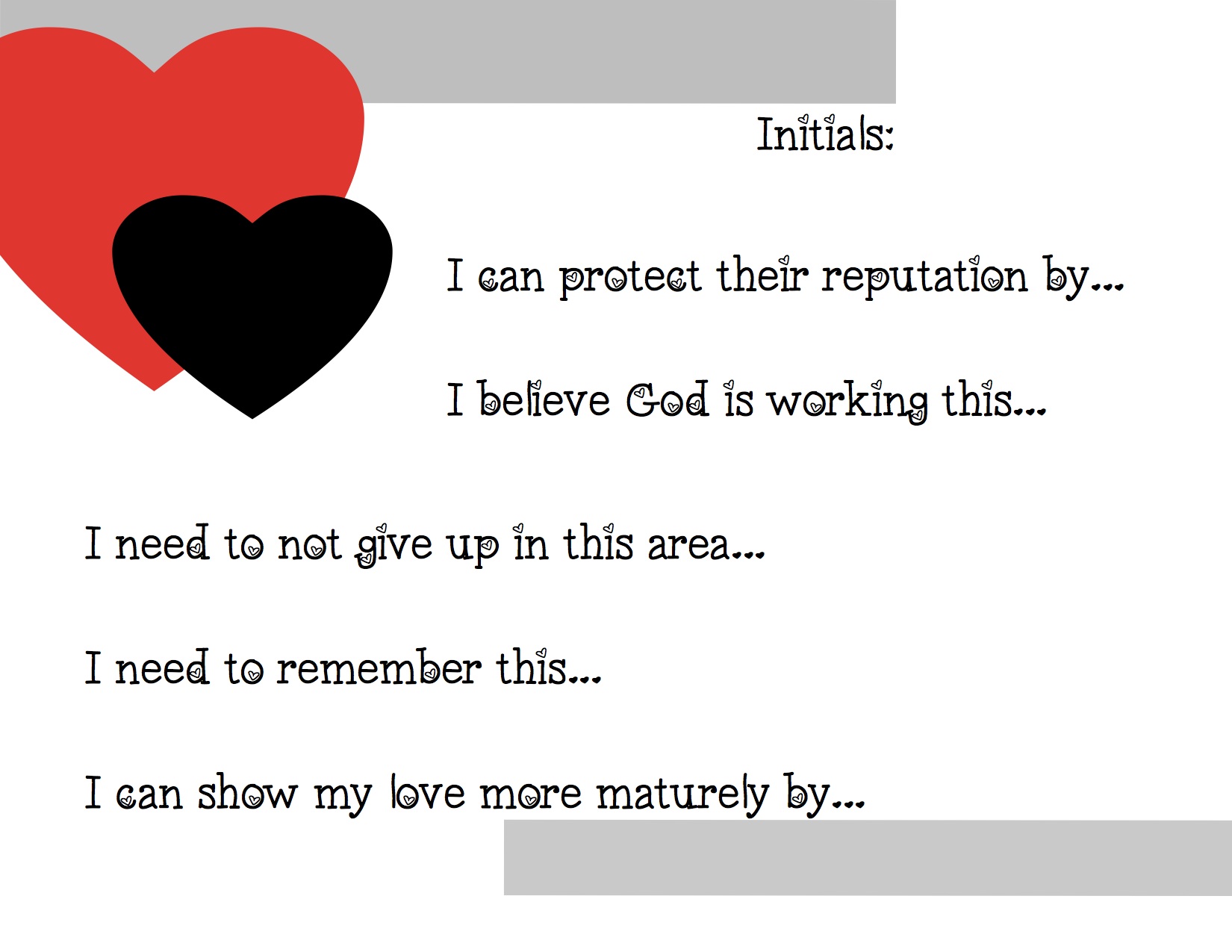
I know you have someone in your life that you think is unloveable. With that person’s face clearly in mind, how will you fill in the blanks:

  1. I can protect their reputation by…
  2. I believe God is working in this…
  3. I need to not give up in this area…
  4. I must remember this…
  5. I can how my love more maturely by…

If you would like a downloadable PDF of this worksheet, click here -–> Love Is… worsheet 3

If you would like to download the other worksheets, or if you missed any of the messages in our Loving the Unlovable series, you can check them all our here.

Thursdays With Oswald—Don’t Let Others Stumble Because Of Me

This is a weekly series with things I’m reading and pondering from Oswald Chambers. You can read the original seed thought here, or type “Thursdays With Oswald” in the search box to read more entries.

Don’t Let Others Stumble Because Of Me

     There is a difference between “offense” and “stumbling.” And they were offended in Him. But Jesus said unto them, “A prophet is not without honor, save in his own country…” (Matthew 13:57). But Jesus knowing in Himself that His disciples murmured at this, said unto them, “Does this cause you to stumble?” (John 6:61; see also Matthew 5:29; 11:6; 13:41; 16:23; 17:27; 18:6-7). Offense means going contrary to someone’s private opinion, and it is sometimes our moral duty to give offense.

     …Stumbling is different from offense. For example, someone who does not know God as well as you do, loves you and continually does what you do because he loves you, and as you watch him you begin to discern that he is degenerating spiritually, and to your amazement you find he is doing what you are doing. No offense is being given, but he is stumbling, distinctly stumbling.

From Biblical Psychology

In 1 Corinthians 8 and 9 Paul talks about not causing someone else to stumble because of what we do. It’s a fine line sometimes between offense and stumbling, but it’s a distinct line that the Holy Spirit can help us discern.

Jesus often offended people because their mindset was so rigid, and He didn’t act in a way that fit their rigid religious stereotypes. But Jesus was very cautious about making sure He never caused someone to stumble. As Matthew points out, Jesus fulfilled the prophesy of Isaiah: He will not quarrel or cry out…. A bruised reed He will not break, and a smoldering wick He will not snuff out… (Matthew 12:19-20; Isaiah 42:1-4).

My prayer: Lord Jesus, please don’t let others stumble because of me! Let me have the discernment of the Holy Spirit to know when to offend, but to never cross the line to cause others to stumble. May I have Your same gentle spirit to not quarrel, and to treat the “bruised reeds” with utmost care.

Ask & Act

Listen to the podcast of this post by clicking on the player below, and you can also subscribe on Apple, Spotify, or Audible.

Do you want to mature as a Christian? I do! So here’s the first step…

…you may be mature and complete not lacking anything. If any of you lacks wisdom, he should ask God… (James 1:4-5).

The dictionary defines mature as “complete in natural growth or development; fully developed in body or mind as a person.” The Bible has a higher definition of maturity. The phrase mature and complete (the King James Version actually says perfect) is just one word in the Greek: teleios. It’s the same word Jesus uses when He sets this standard for maturity:

Be perfect [teleios], therefore, as your Heavenly Father is perfect [teleios]. (Matthew 5:48)

Yikes! Talk about a high standard! I certainly can’t reach that level of perfect maturity on my own! That’s why James says we should pray for wisdom. The kind of wisdom God gives is heavenly knowledge that is perfectly practical on earth. It fits with the prayer Jesus taught us to pray, “Your will be done on earth, even as it is in Heaven.”

But there is more to maturity than just asking for wisdom. I have ASK for wisdom and then I have to ACT on that wisdom—but when he asks, he must believe and not doubt (James 1:6).

Growing in maturity is never a passive process; I must be actively engaged. God will not waste knowledge or experience. He won’t give it to me unless I’m going to be obedient enough to mature by its application.

Ask and act. God wants you to be teleios (perfectly mature) because it brings glory to Him. So ask for wisdom, but then be ready to act on it. This is the only path to godly maturity.

►► Would you please prayerfully consider supporting this ministry? My Patreon supporters get behind-the-scenes access to exclusive materials. ◀︎◀︎

More And More

Listen to the podcast of this post by clicking on the player below, and you can also subscribe on Apple, Spotify, or Audible.

There’s a popular cliché that many motivators use to challenge people to go beyond where they are. They will cheer them on by saying, “C’mon, let’s raise the bar!” The only problem is, once someone clears the bar’s next height, they usually celebrate and then stop trying to go any higher.

Christians should be especially on guard against this mindset. It’s not a one-time thing. I don’t simply invite Jesus into my life and then set Him on a shelf. If I’m going to live a life that pleases God, I must learn how to do so more and more.

…We instructed you how to live in order to please God, as in fact you are living. Now we ask you and urge you in the Lord Jesus to do this more and more (1 Thessalonians 4:1).

The KJV says, “abound more and more.” This means that there is no set level I’m trying to reach, but that the level is always higher—there’s always more, my capacity is always increasing.

More and more is a single word in the Greek language. It means:

  • More willingly
  • More readily
  • Sooner

When the Holy Spirit speaks to me, do I respond and obey more willingly? more readily? sooner? If I do, then I am truly abounding more and more.

The mark of my maturity is a more willing, faster obedience.

This relentless focus on pleasing God more and more then overflows in the way I cheer on and encourage my brothers and sisters. Paul uses the exact same Greek word for more and more when he says a few verses later: “We urge you, brothers, to [express brotherly love] more and more” (vv. 9-10).

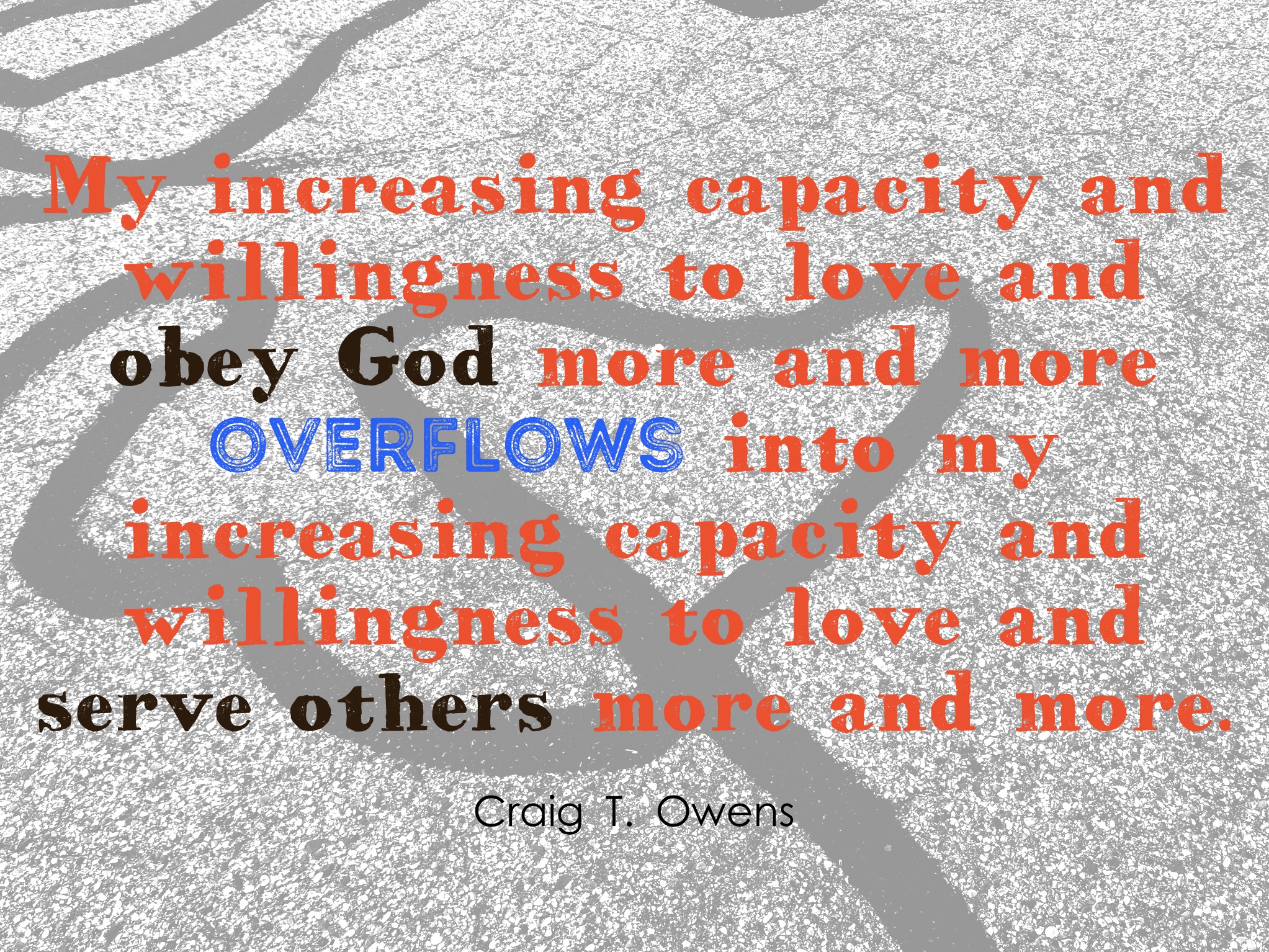
My increasing capacity and willingness to love and obey God more and more overflows into my increasing capacity and willingness to love and serve others more and more.

My prayer for you and for me: Holy Spirit, help us to hear Your voice, to abound more and more in our obedience to Your direction, and to express our love more and more to others.

►► Would you please prayerfully consider supporting this ministry? My Patreon supporters get behind-the-scenes access to exclusive materials. ◀︎◀︎

GrowING

Listen to the podcast of this post by clicking on the player below, and you can also subscribe on Apple, Spotify, or Audible.

A few checklist items for a growING Christian (from Philippians 4:4-9):

  • Learning to rejoice in the Lord. Always.
  • Maturing in gentleness.
  • Becoming more consciously aware of God’s omnipresence.
  • Decreasing in anxiety.
  • Constantly praying.
  • Increasingly thankful.
  • Learning to remain peaceful.
  • Becoming more discerning of what goes into my mind.
  • Learning and relearning biblical principles.

I observe four things about this list:

  1. None of the verbs in the Greek are past tense. These are all on-goING processes.
  2. If this list is changed from in-process to fully-completed, it sounds like Jesus.
  3. I have to decide daily to be growING.
  4. I cannot grow through this list without help: I need the Holy Spirit.

This is a rather short list, but it’s filled with a lifetime of growING opportunities.

If I decide today that I want to be growING, my Heavenly Father will bring me into more opportunities where the Holy Spirit will help me develop and exhibit the qualities of Jesus Christ.

Are you ready to do some growING today? If so, ask the Holy Spirit to take you into your next growING lesson.

►► Would you please prayerfully consider supporting this ministry? My Patreon supporters get behind-the-scenes access to exclusive materials. ◀︎◀︎

From A Frustrating Life To An Exciting Life

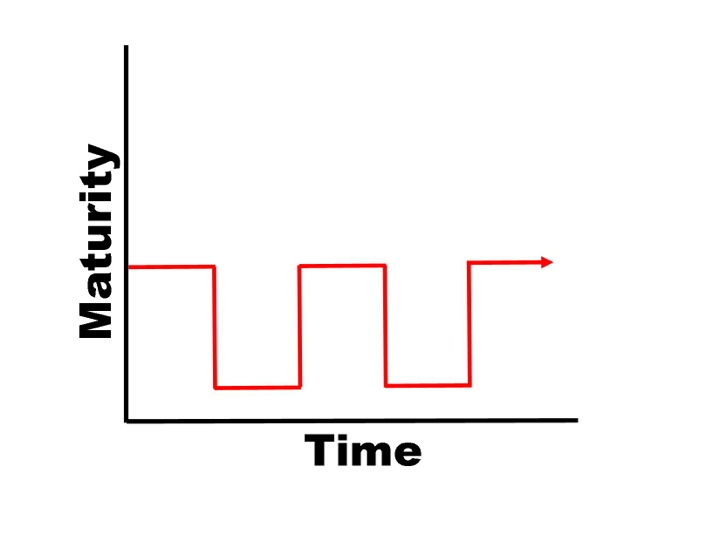
In our P119 Spiritual Workout series, we’ve looked at the similarities between an exercise program for our physical bodies, and spiritual growth for our souls. There are so many parallels for us to look at, but one of them that rings true for everyone is the up-and-down, on-and-off cycles that so many of us experience.

You know how it goes…

  • Your diet is going great and you are dropping some pounds (yea!), and then you go on vacation and all of your gains are lost (boo!).
  • You are doing really well at sticking with your new exercise routine (yea!), and then a head cold and some rainy weather knock you off your plan and it’s really hard to start back up again (boo!).
  • You are reading your Bible, and praying, and feeling so close to God (yea!), and then relationship issues, trouble at work, and a leaky hot water tank send you reeling (boo!).

We all hope our spiritual growth (or diet or exercise routine) would take us to new heights, but this up-and-down again cycle makes it feel like we aren’t getting anywhere:

In Psalm 119:49-56 the psalmist experienced this exact same up-and-down cycle:

  • He’s tight with God (v. 49)
  • Then he experiences suffering (v. 50a)
  • Only to recall God’s promises (v. 50b)
  • And then he’s getting mocked for this faith (v. 51)
  • But he’s quick to remember God and find comfort in Him (v. 52)
  • Only to get his eyes off of God and onto the godless, which causes him trouble (v. 53)
  • But he remembers God’s ways again and is comforted by singing songs about God (vv. 54-55)

Sound familiar? Up-and-down. Close-to-God-and-far-away. On-and-off. Yea!-and-Boo!

HOW DO WE BREAK OUT OF THIS?!?

The key is found in the final verse—This has been my practice: I obey Your precepts (v. 56, NIV). Look how some other translations render this verse:

  • This I had, because I kept Thy precepts (KJV).
  • This is how I spend my life: obeying Your commandments (NLT).
  • This I have had [as the gift of Your grace and as my reward]: that I have kept Your precepts… (AMP).

When we put this all together we get the solution that helps us break free from the up-and-down again cycle—

It’s ONLY by focusing on God’s GRACE everyday!

When we focus on God and His gift of grace to us, we minimize the ups-and-downs. How? Because the focus is not on what I’m doing or what others aren’t doing, but on God, His faithfulness, and His grace to us.

When God’s grace becomes our focus, we can break free from the up-and-down cycle—

If you have missed any of the messages in our P119 series, you can access them all by clicking here.

Praying For Your Healthy Friends

When do people typically ask you to pray for them? My guess it’s when things aren’t going so well for them.

How about you? When do you usually ask others to pray for you? When things are going well, or when you’re in a tough spot.

Why is it that we usually only think about prayer for sick friends or for friends in desperate need?

The apostle Paul wrote a letter to the Christians at Ephesus to encourage them. This church, as far as we know, wasn’t asking Paul for advice, and they weren’t facing intense persecution. They were mostly a spiritually healthy group.

So Paul wrote this to his healthy friends—

I have not stopped thanking God for you. I pray for you constantly. (Ephesians 1:16)

Paul went on to share with us his prayer for strong, spiritually healthy people (vv. 17-22). He asked God to make his healthy friends even stronger. He asked God to give them:

  • a super-abundance of the Holy Spirit
  • more wisdom and revelation
  • deeper intimacy with God
  • greater hope
  • greater power
  • and more strength

I’m not suggesting we stop praying for people in need. We definitely need to keep doing that. But perhaps it’s time to make a list of your healthy friends, and ask God to give them even more of Himself!

Conformed To His Image (book review)

Oswald Chambers challenges my thinking about the Christian walk like few other authors can. His insights are always so profound, and yet at the same time awaken me to the realization that I am the one who makes the Christian walk something complex. In Conformed To His Image, I was yet again challenged to simply follow Jesus.

Chambers brilliantly turns secular psychology upside down. He takes what psychology wants to ascribe to our minds and emotions, and brings it back to a Scriptural basis that puts these things where they are supposed to be: in the soul.

The thought of being “conformed” rubs against the human desire to be free and in charge of our own destiny. Somehow being “conformed” feels like being controlled and giving up our unique personality. So Chambers contrasts the natural human tendencies for freedom and calling our own shots with what the Bible says about surrendering to God.

Chambers presents Jesus not as some superhuman, extraordinary Man. But He shows the life of Jesus to be what we should all be able to live out daily. Jesus was perfectly conformed and submitted to the will of His Father. And, he says, if we will submit as well, the Holy Spirit will conform us into the image of Jesus.

Beware: this book is not light reading. This is a heavy-duty, confrontational book that will challenge you to submit to the Holy Spirit as perhaps you never have before in your Christian walk. However, if you are ready to take the plunge into a much deeper, more intimate relationship with your Heavenly Father, Conformed To His Image is the resource for you.