(Extra)Ordinary People

Listen to the podcast of this post by clicking on the player below, and you can also subscribe on AppleSpotify, or Audible. 

Paul addresses his letter to the church at Philippi like this, “all God’s holy people … the overseers and deacons” (Philippians 1:1). Notice that Paul addresses all of the saints, whether they are in a position of leadership or not. 

In verse 5, Paul says he is grateful for their “partnership in the Gospel.” Some translations use the word “fellowship” instead of partnership. This is the Greek word koinonia. By the use of this word Paul is recognizing the close relationship the church members have with their leaders, with each other, with Paul, and even with other Christians in other cities. 

The root word is koinos. The Levitical Jews used this word to designate anything that their religious rules deemed unclean, common, or ordinary. One of the things these Jewish leaders would have called unclean are Gentile people. Which means they would have referred to the saints who made up the bulk of this assembly at Philippi as unclean and unworthy of God’s love! 

But here is Paul using this ordinary word in an extraordinary way. That is, he is calling ordinary people something extraordinary: saints! Remember in the opening verse he addressed his letter to “God’s holy people.” The word holy here means the exact opposite of common or unclean—it means people set apart for God’s special use. 

The “extra” that elevated common, ordinary, unclean people to the extraordinary position of being called a saint is their personal relationship with Jesus as their Savior and Lord. 

Jesus makes the ordinary extraordinary!

Still today, our koinonia is something extraordinary. When common, ordinary, blood-cleansed people remain in relationship with Jesus and other fellow saints, God can do extraordinary things through them. Our common bond with our Savior and with other saints is itself a testimony to the life-changing power anyone can have in Jesus! 

When you are in fellowship with God and in fellowship with God’s holy people, there is nothing ordinary about you. You are an extraordinary testimony of God’s loving, transforming, and keeping power! 

►► Would you please prayerfully consider supporting this ministry? My Patreon supporters get behind-the-scenes access to exclusive materials. ◀︎◀︎

Serving The Body

Listen to the podcast of this post by clicking on the player below, and you can also subscribe on AppleSpotify, or Audible. 

Last week we were reminded that sanctification (or as I call it “saint-ification”) is an ongoing process that usually involves the help of other saints. There is something else we need to do with other saints: serve them. 

We are all a part of the same Body so it is beneficial for the whole Body if we care for every part of the Body (1 Corinthians 12:25 AMPC; Ephesians 5:30). 

(Check out all of the Scriptures in this post by clicking here.) 

In order to serve others, we are going to have to check our attitude. We have been called to have the attitude that Jesus had about the Church (Ephesians 5:29; Philippians 2:3-7; John 13:3-5, 14-17). 

We must all know: 

  • I have a gift—notice the phrase each of you in 1 Peter 4:10 
  • I must use my gift to serve the Body of Christ (Luke 17:10)

In the early Church, we see so much togetherness that they rewrote the definition of the Greek word koinonia (see Acts 2:42). Here’s what koinonia looks like in the Church:

(1) Testifying in church (Psalm 40:9-10 NLT) 

(2) Being present with saints outside of church. From Acts 20-28, the pronouns “we” and “us” are used over 80 times! Paul was blessed simply by Luke being with him, just as saints are blessed when you are truly with them. 

(3) Love notes when a saint is absent. The apostle John was brilliant at this. Look at his three epistles: 

  • dear children 9x in 1 John  
  • chosen / dear lady 2x in 2 John  
  • dear friend 4x in 3 John  

(4) Hospital-ity whenever it’s needed. Be a place of healing and refreshment for the saints God has placed in your life, just as Philemon did (Philemon 2-7, 22). 

What a testimony it is when we live this way (Romans 12:10, 13)! 

Remember the saint-ification process brings fruitfulness, joy-fullness, and an enhanced testimony. I love this quote from Richard Stearns, “The beautiful simplicity of our faith is that it distills down to the exact same bottom line for both the brilliant theologian and the five-year-old child: love God and love each other—period. Everything else derives from that.” 

If you’ve missed the “B” or “A” in our series B.A.S.I.C. Christianity, you can check those out here. 

►► Would you please prayerfully consider supporting this ministry? My Patreon supporters get behind-the-scenes access to exclusive materials. ◀︎◀︎
Delighted To Go To Church

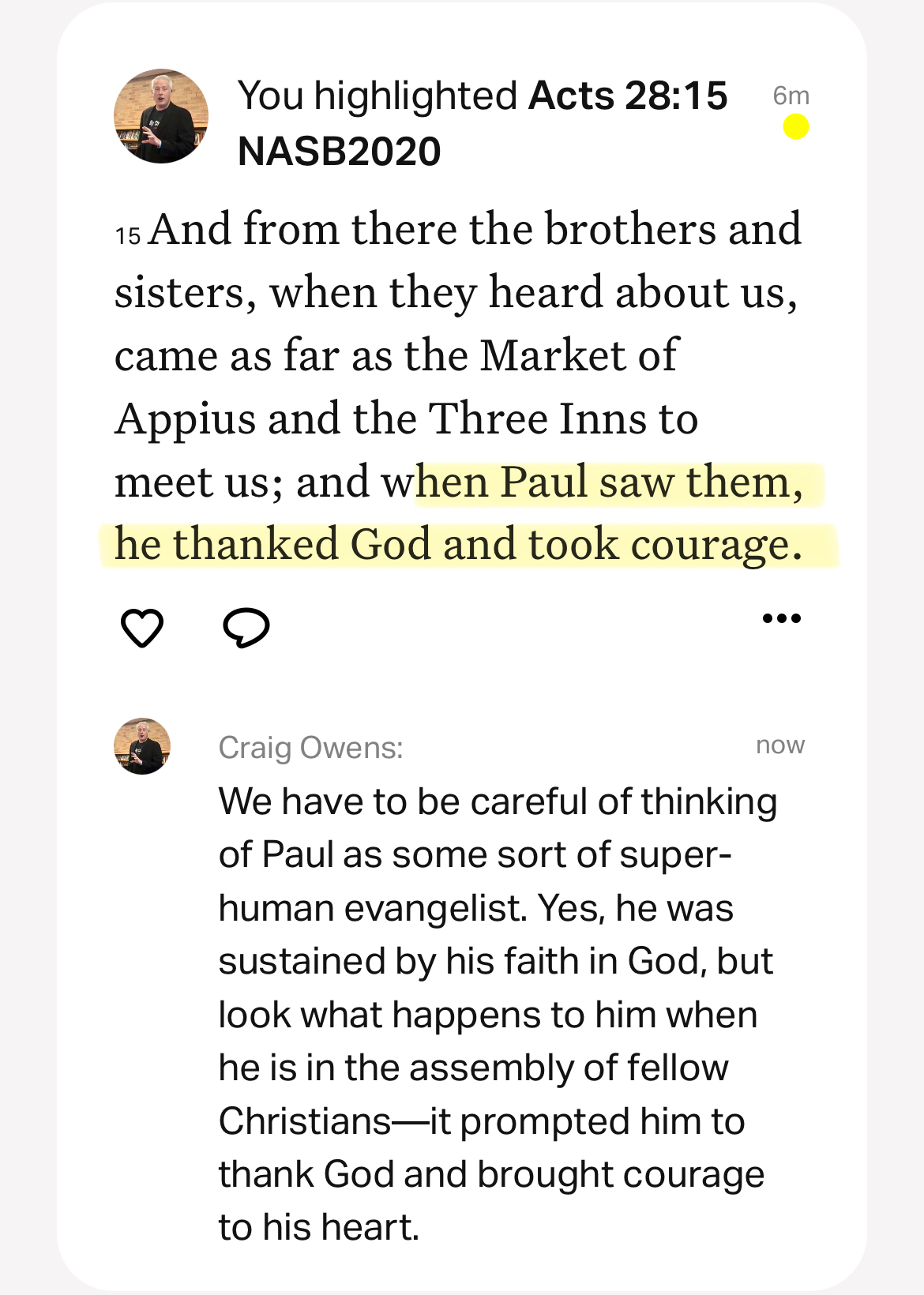
And from there the brothers and sisters, when they heard about us, came as far as the Market of Appius and the Three Inns to meet us; and when Paul saw them, he thanked God and took courage. (Acts 28:15) 

We have to be careful of thinking of Paul as some sort of super-evangelist. Yes, he was sustained by his faith in God, but look what happens to him when he is in the assembly of fellow saints—it prompted him to thank God and brought courage to his heart. 

Do you have to go to church to be a Christian? Of course not. But you will be encouraged and you will be the source of encouragement to others when you gather together regularly. 

As the writer of Hebrews tells us—

Let’s hold firmly to the confession of our hope without wavering, for He who promised is faithful; and let’s consider how to encourage one another in love and good deeds, not abandoning our own meeting together, as is the habit of some people, but encouraging one another; and all the more as you see the day drawing near. (Hebrews 10:23-25) 

You may also be interested in these related posts:

Go Deep—Gift Of Koinonia

John uses the word “fellowship” four times in 1 John 1:3, 6-7. This is the Greek word koinonia, which means intimacy of relationship. The whole purpose of the motivational gifts, the operational gifts, and the leadership gifts is to bring maturity and unity to the Body of Christ. This maturity brings out the fruit of the Spirit. 

All of these gifts of the Holy Spirit are intended to help us demonstrate the fruit of the Spirit in ways that make the Kingdom of God visible and desirable. A key component is our koinonia that draws us together as one Body. Two key phrases that appear generously throughout the New Testament Church are one another and each other. 

Download the participant’s guide for this lesson here → Gift of koinonia handout

Here’s how koinonia is supposed to be demonstrated—

  1. Loving one another—John 13:34-35; 15:12, 17; Romans 13:8; 1 Thessalonians 4:9; 1 Peter 1:22, 3:8; 1 John 3:11, 23; 4:7, 11-12
  2. Sharing in each other’s practical needs—Acts 2:44-45, 4:32-35 
  3. Devoted to one another—Romans 12:10
  4. Honoring one another—Romans 12:10; Philippians 2:3 (AMP); 1 Peter 5:5
  5. Living in harmony with each other—Romans 12:16 
  6. Not judging one another—Romans 14:13 
  7. Building each other up—Romans 14:19 NLT 
  8. Empathizing with each other—Romans 15:5 AMP; 1 Corinthians 12:25 AMP; 1 Peter 3:8 TLB 
  9. Accepting each other—Romans 15:7 
  10. Instructing one another—Acts 2:42; Romans 15:14; Colossians 3:16 
  11. Agreeing with one another—1 Corinthians 1:10 
  12. Encouraging one another—2 Corinthians 13:11; Ephesians 5:19; 1 Thessalonians 4:18, 5:11; Hebrews 3:13, 10:25
  13. Serving each other—Galatians 5:13 
  14. Patiently bearing with one another—Ephesians 4:2; Ephesians 4:3 TLB 
  15. Speaking the truth in love to one another—Ephesians 4:15; Colossians 3:9
  16. Forgiving one another—Ephesians 4:32; Colossians 3:13 
  17. Submitting to one another—Ephesians 5:21 
  18. Acting like Jesus toward each other—Philippians 2:5 
  19. Doing what is good for one another—1 Thessalonians 5:15 
  20. Spurring one another on—Hebrews 10:24 
  21. Regularly meeting with one another—Acts 2:46; Hebrews 10:25 
  22. Looking after each other—Hebrews 12:15 AMP 
  23. Confessing sins to one another—James 5:16 
  24. Showing hospitality to each other—1 Peter 4:9 
  25. Doing the hard work of getting along with each other—James 3:17-18 MSG

Those things lead to #26, which starts the cycle over again at #1. 

  1. Increasing our love for one another—1 Thessalonians 3:12; 2 Thessalonians 1:3; Hebrews 13:1; 1 Peter 4:8 

Our koinonia in the church is encouraging for the saints and it is a blessing for the unsaved because of all of the good things a unified, strong, loving church can do. Koinonia ultimately becomes one of the greatest witnessing tools. Jesus prayed—

My prayer is not for them alone. I pray also for those who will believe in Me through their message, that all of them may be one, Father, just as You are in Me and I am in You. May they also be in Us so that the world may believe that You have sent Me. (John 17:20-21)

Links & Quotes

“…and let us all hasten to approach to perfect manhood, to the measure of the completed growth of the fullness of Jesus Christ, in Whom let us love one another, praise one another, correct one another, encourage one another, pray for one another, that with Him in one another we may reign and triumph.” —Columbanus, Letter to Certain Bishops, Irish, early 7th century

This is pretty cool: Mastodon bones were discovered in our community. It is cool to think that these amazing creatures were wandering around in our neighborhood.

Have you ever wondered how the laws of the Old Testament era should be applied to New Testament Christians? Theologian T.M. Moore has an excellent series of articles on this, but I think his post The Church is not Ancient Israel is especially informative.

Here is one way the Holy Spirit can speak to us—

“It is not the body of truth that enlightens; it is the Spirit of truth who enlightens. If you are willing to obey the Lord Jesus, He will illuminate your spirit. He will inwardly enlighten you. The truth you have known intellectually will now be known spiritually. Power will begin to flow up and out, and you will find yourself changed—marvelously changed.” —A.W. Tozer

“The greatest tragedy of life is not unanswered prayer, but unoffered prayer.” —F.B. Meyer

This is pretty cool: some fossilized human footprints in the salt flats of Utah. “Both creationist and uniformitarian scientists agree that these tracks were made during the Ice Age, although they disagree about when the Ice Age occurred. Creationists think these footprints are just a few thousand years old. However, evolutionists think the tracks are more than 10,000 years old, because they believe the wet conditions needed to form and preserve the footprints have been absent from the Great Salt Lake area for at least that long. … wet Ice Age deserts are extremely difficult for evolutionary scientists to convincingly explain. However, the Bible’s real history makes much better sense of both these wet deserts and preserved Ice Age footprints.”

Don’t cut corners to get more. Instead, be faithful, do your best work, and the “more” will follow at the right time—

“With-ness”

…fellowship… (four times in 1 John 1:3, 6, 7)

The word “fellowship” is the Greek word koinonia. It means intimacy of relationship.

All of the apostle John’s books carry this key theme: Jesus loves us so this is how we should live differently because of that love. 

Koinonia means giving all I’ve got to someone else, and graciously receiving all they have to give to me. This creates a… 

  • … oneness
  • … togetherness
  • … with-ness

Our with-ness creates a visible witness of God’s love. 

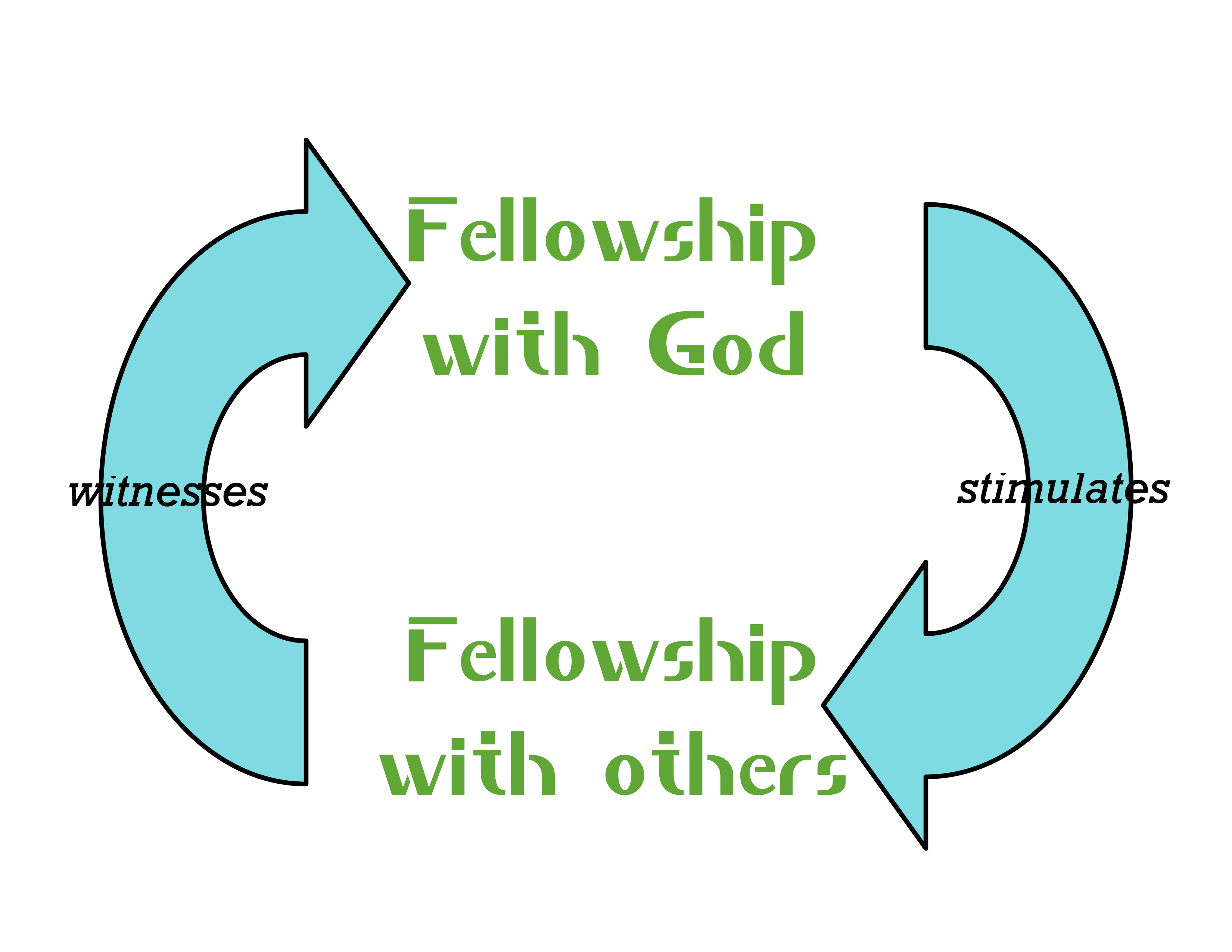
John says that fellowship with God can’t help but be expressed in fellowship with others. And then fellowship with others stimulates us to a deeper relationship with God. This love dance is itself a picture of the Ultimate Koinonia of the Trinity—“I am in You, Father, and You are in Me. These followers of Us are in Me and I in them,” said Jesus.

Don’t try to pursue a relationship with Jesus on your own, but find people that you can be in fellowship with and then watch how that deepens your fellowship with God!

Koinonia

All inIn 2007, Dave Kinnaman & Gabe Lyons published a book called unChristian. In it they reported the cultural view of Christians: haters, judgmental, hypocritical, too involved in politics, out of touch, insensitive, boring.

Do any of these words fit Jesus? No, I’ve never heard anyone—whether in the Bible or in the history of that day—call Jesus a hypocrite, or boring, or a hater. Do any of these words fit the apostles who began to spread the message of Jesus Christ after His ascension? No! Again, I’ve never read anywhere where the early Christians were called judgmental, or too political, or out of touch.

But if these labels are thrown at Christians today—Do not be surprised, my brothers, if the world hates you (1 John 3:13)—the Bible tells us how to reverse them: By living counter culture, by living according to God’s Word. In a word, by living in koinonia.

This is a Greek word that isn’t used in the Gospels, but shows up just after the first Church is born on the day of Pentecost. It’s a word and a concept that simply won’t work in a pragmatic culture, but works powerfully in a biblical counter culture. The word is usually translated fellowship in English.

Koinonia is how the Trinity operates (see 2 Corinthians 13:14). All three Persons of the Godhead are mentioned in fellowship with each other. There is no rivalry in the Trinity, but if any part of it is diminished, so is its total effectiveness and glory.

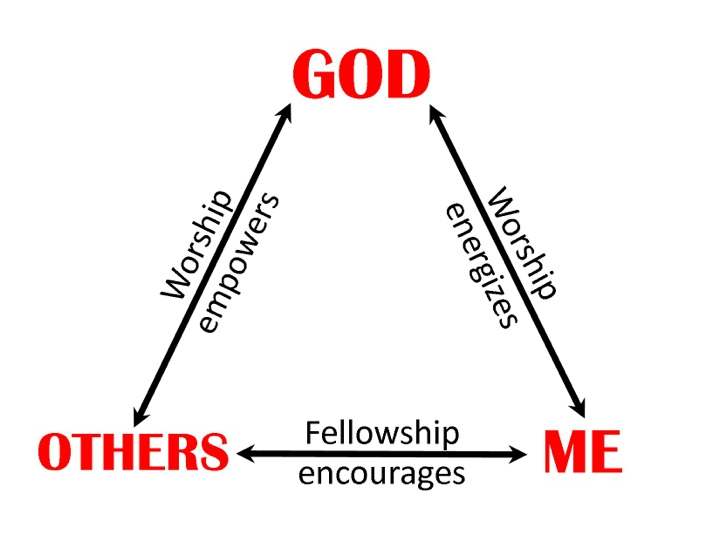
trinity of koinoniaChristians are called to be part of a trinity of koinonia as well.

  • When I worship God, I am energized to be in fellowship with others.
  • My fellowship with others that flows from my love for God empowers them to worship God for themselves.
  • The overflow of that relationship with God encourages others to be in fellowship with me.
  • And that fellowship energizes me to worship God even more deeply, which encourages my fellowship with others, which empowers them for deeper worship… and on and on and on it goes!

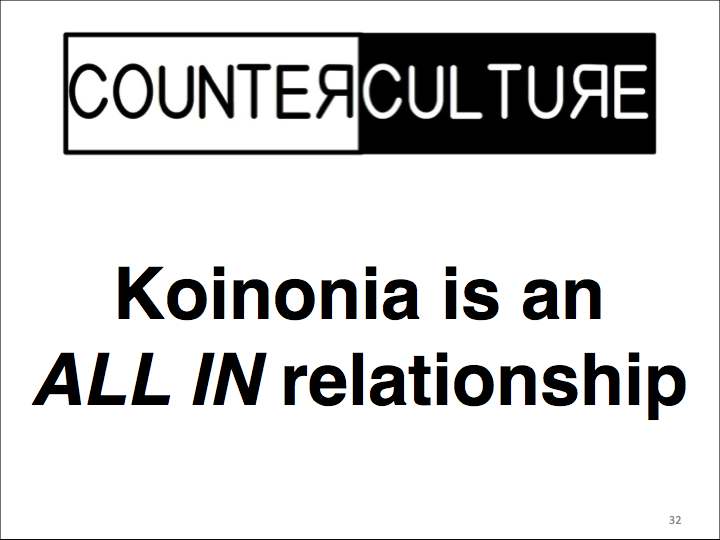
Koinonia is an ALL IN relationship. It’s not something I can dabble in, or be involved with occasionally. I’m either in koinonia, or I’m not.

To see a great example, look at the Christians the very first time the word koinonia is used in Scripture. Acts 2:42-47 shows us how the Christians were not only all in (the Bible uses the word devoted), but how others in the community responded: they were in awe and viewed the Christians with favor. And as a result, lives were being changed every single day.

Yes! That’s what I want to be a part of! How about you?