Listen to the podcast of this post by clicking on the player below, and you can also subscribe on Apple, Spotify, or Audible.
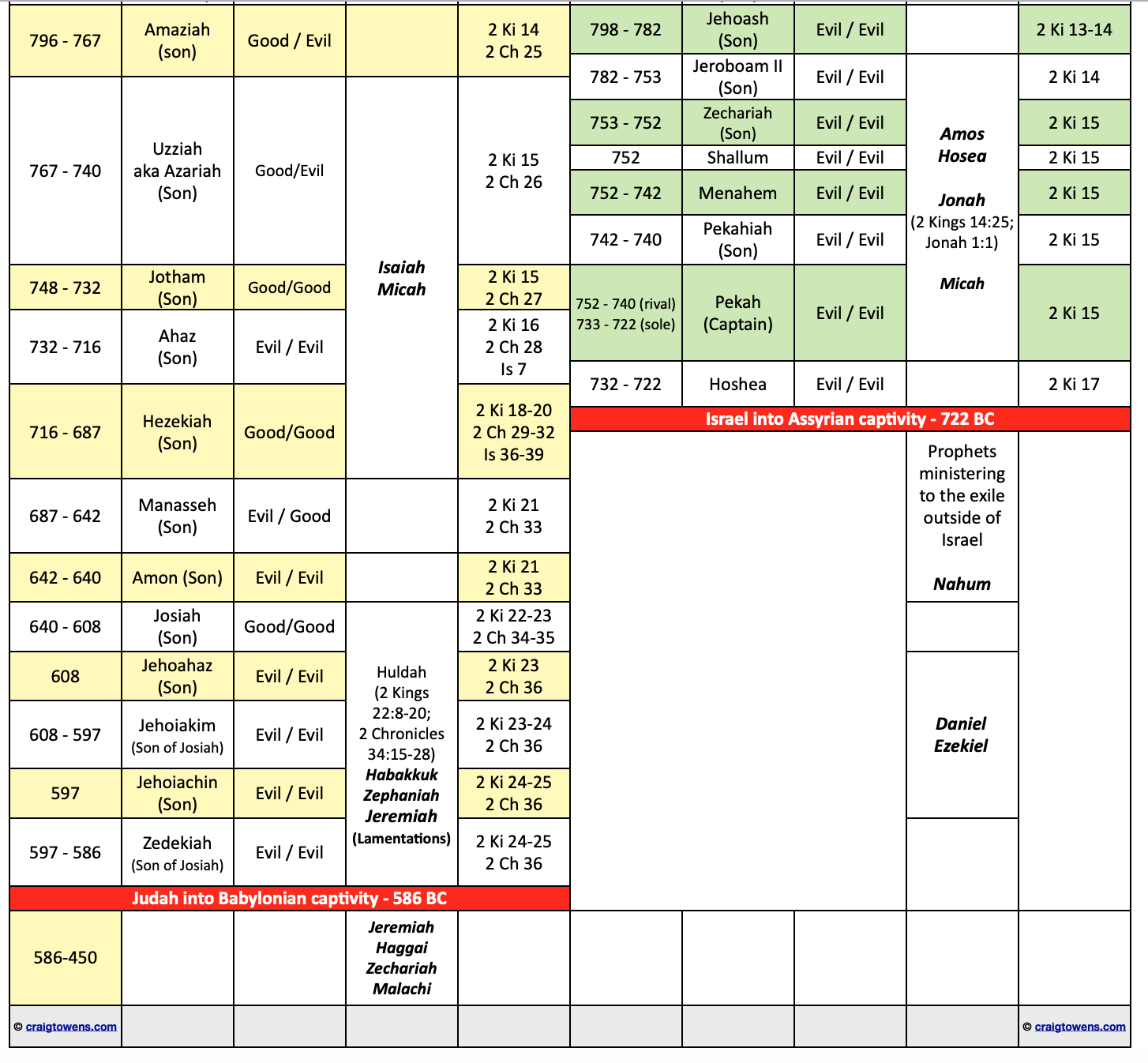
Back in 2014, I was reading through the history of the divided kingdoms of Judah and Israel. The historical accounts of these kingdoms in both the Books of Kings and Chronicles go back-and-forth from kings in the north to kings in the south. I was having trouble keeping them all straight, so I began designing a side-by-side chart to help me.
I had no idea that this chart would be viewed and downloaded by other Bible students literally thousands and thousands of times each year.
You can find all of the download information for this chart by clicking here.
Listen to the podcast of this post by clicking on the player below, and you can also subscribe on Apple, Spotify, or Audible.
The Bible is not only the inspired Word of God but it is rooted in history too. Every prayer was prayed by a real person in distress, and every song of praise was lifted up by someone who personally experienced God’s deliverance.
The reason why this is so important is that it makes God’s Word relatable and applicable to us. If the Bible merely contained moral stories set in some make-believe world, we may have a hard time seeing how to apply the principles to our daily lives. But, thankfully, this isn’t the case. We can read the real-life experiences of real historical people and then we can allow the Holy Spirit to help us apply this inspired Word to our lives.
There is a collection of 15 songs in the Book of Psalms called “The Songs of Ascent.” Even these songs have an important historical background.
Second Chronicles ends with this proclamation from King Cyrus: “The Lord, the God of heaven, has given me all the kingdoms of the earth and He has appointed me to build a temple for Him at Jerusalem in Judah. Anyone of His people among you—may the Lord his God be with him, and let him go up” (2 Chronicles 26:23).
The phrase “let him go up” is both literal (since Jerusalem is 2500 feet above sea level) and spiritual. Listen to these words from King Solomon, “The way of life winds upward for the wise, that he may turn away from hell below” (Proverbs 15:24 NKJV).
The Songs of Ascent were a rallying cry—an encouragement to all pilgrims to keep climbing up.
In Hebrew literature, the main point is usually found in the middle of the poem or story, unlike our Western literature which puts the payoff at the end. In the first Song of Ascent, the middle is verse 4. But the second half of Psalm 120 seems out of place for people ascending up to Jerusalem to worship God. Verse 5 begins with the words, “Woe to me.”
The psalmist is expressing his pain in living among the people of Meshech and Kedar. The people of Meshech were vicious people who traded human lives for money and who conducted themselves as terrorists (Ezekiel 27:13; 32:26). Their name literally means “drawing away.” The people of Kedar were nomadic sons of Ishmael. Being nomadic means they were never at rest. Their name literally means “dark place.” Very noteworthy is that there is no mention of God in verses 5-7.
The middle verse of this song (v. 4) turns the people of Meshech and Kedar over to God. It is a reminder that we are not the ones to dispense justice. If God knew how to overthrow the powerful kingdoms of Judah, Babylon, and the Medes, if He knew to call Cyrus by name at just the right moment, He also knows how to deal with these sinners.
This Song of Ascent shows the stark contrast between keeping our eyes on the dark culture around us versus keeping our eyes on the God who is never weighed down by the darkness. As we go higher up, we focus more on God; as His saints focus on Him, His light shines on them; as His light shines on them, they point sinners living in dark valleys to the God of light and love.
Staying down is easy. Getting up requires intentional effort. Going up requires us to overcome the pull of sin and the frustration of watching for judgment to fall on sinners.
Continually going up glorifies God, has eternal rewards for saints, and creates a compelling testimony for sinners.
Going up is a lot of effort, but the rewards are so worth it! As the apostle Paul reminded his friends in Rome, “I consider that our present sufferings are not worth comparing with the glory that will be revealed in us” (Romans 8:18). Let’s keep climbing up and let’s keep lifting our eyes to the only One who has the eternal light.
Listen to the podcast of this post by clicking on the player below, and you can also subscribe on Apple, Spotify, or Audible.
This is what the Lord Almighty says: “Cut down the trees and build siege ramps against Jerusalem. This city must be punished…” (Jeremiah 6:6).
When I read these 2500-year-old words it makes me shudder. Why? Because if we changed “Jerusalem” to “Washington, D.C.” and “Judah” to “America,” the sins of the people sound eerily the same:
arrogantly closed ears refusing to listen to God’s Word
people calling the loving message of the Bible “offensive”
the predominance of greed
deceptive “prosperity” preachers who are only in it for their own personal gain
shameless, detestable lifestyles
open rebellion against God’s laws
constant slandering of God and of people created in God’s image (vv. 10-28)
God says, “This city must be punished.”
But still, a hope remains. God also says, “Take warning, Jerusalem [or America], or I will turn away from you” (v. 8).
There is still time for repentance! There is still time to take heed of this loving warning and turn away from sin. That’s what repentance truly means—seeing our sins as disgusting in God’s sight, asking for forgiveness, and turning away from those sins.
Repentance means an about-face, so that instead of the catalog of sins that I just listed, we instead see:
a humility that hears and obeys God’s Word
living in contentment with God’s blessings and not lusting for anything more
listening to preachers who faithfully, lovingly, and boldly speak exactly what God has spoken to their hearts
being ashamed of our former sinful lifestyle, and gratefully receiving the forgiveness that Jesus purchased for us
and having a passion to help everyone live in this God-glorifying way
Repent, America! There is still time before God’s judgment falls on us. The historical record is there for all to read: Unrepented sin received God’s righteous judgment. But in His mercy, God is still giving us time to repent today. Don’t miss this golden opportunity!
King Josiah was the last God-fearing king Judah had. After Josiah died, “the peopleof the land” made Jehoahaz king of Judah. He only reigned three months.
After Jehoahaz died, “Pharaoh Necomade Eliakim son of Josiah king” after Egypt subdued Judah. Pharaoh changed his name to Jehoiakim, took all of Judah’s treasures, and imposed a tribute on Judah, forcing Jehoiakim to tax all the citizens.
Later on, Jehoiakim became a vassal king of Nebuchadnezzar. After Jehoiakim died, his son Jehoiachin only reigned as king for three months before he was deposed by Nebuchadnezzar.
Nebuchadnezzar then “made Mattaniah” king. He also imposed tribute and changed the king’s name to Zedekiah.
King Zedekiah rebelled and was executed, after which Nebuchadnezzar “appointed Gedaliah as governor.” Gedaliah was assassinated shortly thereafter, completing the collapse of Judah and sending the people into exile in Babylon for the next 70 years.
Oh, what misery for the people of Judah for this last 20-year span under these final kings! The consequences of the leaders’ continual rebellion against God brought such uncertainty and heartache for the citizens.
A mark of a godless leader is the wake of misery that follows him for generations afterward.
Lord God, help me to see that my actions today have consequences for tomorrow. I want to leave an empowering, God-honoring legacy for the next generations, but this can only happen as I remain obedient to You!
This is part 51 in my series on godly leadership. You can check out all of my posts in this series by clicking here.
The vision of Isaiah…in the days of Uzziah, Jotham, Ahaz, and Hezekiah, kings of Judah (Isaiah 1:1).
Israel (the 10 northern tribes) was in the final stages of collapse, with kings only serving short spans, idolatry running rampant, and enemies closing in on every side. Isaiah boldly proclaimed that Judah was on the same path unless she repented and turned wholly to God.
Uzziah—who started off well, but fell away from God
Jotham—who faithfully served God
Ahaz—who never wanted to serve God
Hezekiah—who led a powerful revival in the return to worshiping God alone
Isaiah’s message never waivers. Through 66 chapters, 4 monarchs, and 60 years of ministry, Isaiah never compromises, waters down, nor alters the message God has given him.
But he does use different methods to deliver God’s consistent message—sometimes he thunders, sometimes he weeps, sometimes he uses illustrated messages, sometimes he speaks plainly, and sometimes he uses word pictures.
A mark of a godly leader is one who is both immovable and flexible.
Immovable on God’s principles; flexible on his delivery.
Can that be said of you and me?
This is part 21 in my series on godly leadership. You can check out all of my posts on this topic by clicking here.
Pastor Phillips Brooks visited Israel in the mid-1800s. While there he visited a small church just outside of Bethlehem. Listening to the worshipful songs being sung in that quiet countryside, he was inspired to pen the words to O Little Town Of Bethlehem.
Because of that quiet setting, notice how Rev. Brooks notices things we often miss—
little town on Bethlehem
in thy dark streets
while mortals sleep
no ear may hear His coming
But little does not mean insignificant. And just because we can’t see or hear something doesn’t mean it doesn’t exist or it isn’t important.
Sometimes we’ve looked and listened and waited and searched for so long that we have given up and we begin to drift off to sleep. We continue to live in our own “little town” surrounded by silence. And we are in danger of missing a miracle right in our midst!
We know today that Jesus was born in Bethlehem. But did you know that this little town was still so obscure in Christ’s day that many people in Israel were unaware of what went on there? (See John 7:41-43). Even after King Herod had gruesomely killed all the baby boys in Bethlehem, scarcely anyone outside of that town knew about it or cared about it.
But God cared. And He knew exactly what He was doing.
But when the proper time had fully come, God sent His Son (Galatians 4:4)—the exact right moment—to be born in Bethlehem—the exact right place (Micah 5:2). Notice even Micah says of Bethlehem though you are small among the clans of Judah, giving birth to the title of Rev. Brooks’ poem.
How small was it? Look at the description of the territory for the tribe of Judah (in Joshua 15), and you can easily glossed over the names of all of the towns. But look more closely and you will see something you didn’t read in that list of towns. Take a close look at all 38 cities: it’s still missing.
There are a couple of very notable figures that dominate the Old and New Testaments, and they have something in common—King David and Jesus both come from the tribe of Judah. And both of them were born in Bethlehem. But in the list of towns in Judah’s territory, there isabsolutely no mention of Bethlehem.
This town either didn’t exist, or it was so “insignificant” that Joshua didn’t even think to mention it. It would be almost another 500 years before David would be born in Bethlehem, and then another 900 years after that before Jesus would be born in this little town of Bethlehem.
God had in mind for the greatest earthly king in Israel’s history and the King of all kings to come from such humble origins… from a village that didn’t even make the list. Bethlehem was ready for these kings at just the right moment!
Jesus said heaven and earth will pass away, but His words will never pass away. What promise in His Word do you need to cling to?
Just as those awaiting the Messiah clung to Micah’s promise until it came to pass, you must find God’s promise for you in His Word, cling to it, and don’t let go until it comes to pass in your little town.
“In times of extraordinary crisis ordinary measures will not suffice. The world lives in such a time of crisis. Christians alone are in a position to rescue the perishing. We dare not settle down to try to live as if things were ‘normal.’ Nothing is normal while sin and lust and death roam the world, pouncing upon one and another till the whole population has been destroyed.” —A.W. Tozer
“I want you to know how to study theology in the right way. I have practiced this method myself. … The method of which I am speaking is the one which the holy king David teaches in Psalm 119. … Here you will find three rules. They are frequently proposed throughout the psalm and run thus: Oratio, meditatio, tentatio [prayer, meditation, trial]. …
“You should completely despair of your own sense and reason, for by these you will not attain the goal. … Rather kneel down in your private little room and with sincere humility and earnestness pray God through His dear son, graciously to grant you His Holy Spirit to enlighten and guide you and give you understanding. [Psalm 119:18, 27, 33, 34-37]. …
“Second, you should meditate. This means that not only in your heart but also externally you should constantly handle and compare, read and reread the Word as preached and the very words as written in Scripture, diligently noting and meditating on what the Holy Spirit means. … Therefore, you observe how in this psalm David always says that he will speak, think, talk, hear, read, day and night and constantly—but about nothing else than God’s Word and Commandments. For God wants to give you His Spirit only through the external Word. [119:11, 15, 48, 24, 47, 93, 97] …
“Third, there is the tentatio, the trial. This is the touchstone. It teaches you not only to know and understand, but also to experience how right, how true, how sweet, how lovely, how mighty, how comforting God’s Word is: it is wisdom supreme. This is why you observe that, in the psalm indicated, David so often complains of all sorts of enemies. … For as soon as God’s Word becomes known through you, the devil will afflict you, will make a real [theologian] of you.” [119: 67-68, 71] —Martin Luther, on the 119th Psalm
On the Biblegateway website, Jacob Edson has taken my chart and added even more details and cross-references to related Scriptures for each of the kings on this chart.
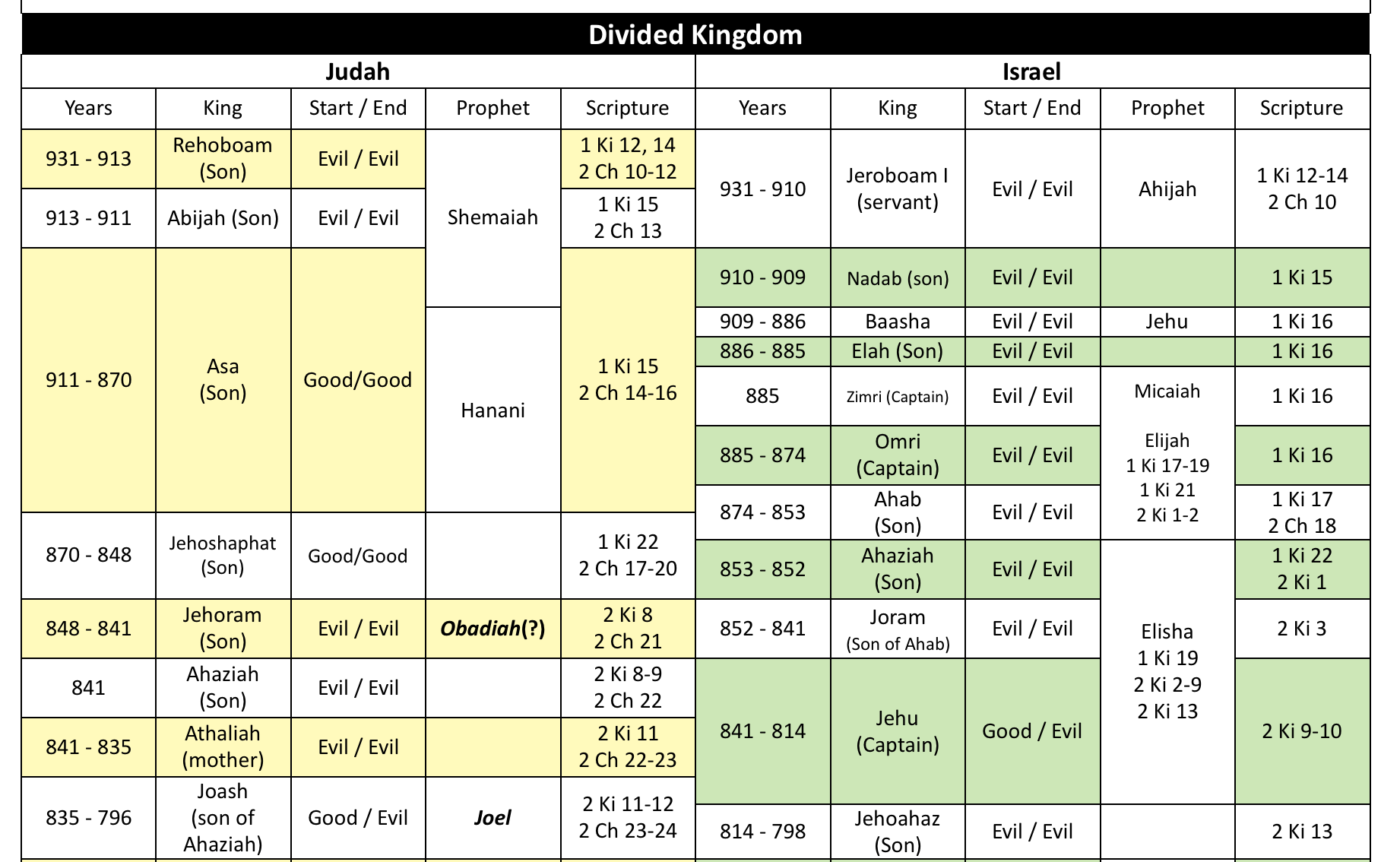
One challenging point in history is the divided kingdoms of Israel (the 10 northern tribes) and Judah (the 2 southern tribes). What makes it challenging when reading straight through the Bible is the history is covered in 1 and 2 Kings and then again in 1 and 2 Chronicles. In the midst of these kingdoms, several prophets are sent by God. Some of these prophets only have their words recorded in Kings or Chronicles, while others have their words recorded elsewhere in the Bible (usually the book name is the prophet’s name).
In trying to keep all of these people and messages clear in my mind, I have put together a list of all the kings and prophets during the period of the divided kingdom (roughly 931-586 BC).
You can click the picture above to get a larger view, or you can download a PDF copy by clicking here → Kings of Israel & Judah ←
I am not a biblical scholar, nor do I have a history degree. This is just a chart I put together to help me in my Bible reading, and I thought it might help someone else too. I would welcome any corrections or clarifications that anyone would offer on this humble work.
Not all of these updates are reflected in the screenshots on this page, but they are all in the PDF version.
**UPDATE 1: several people pointed out some tweaks I needed to make to this chart, and I am grateful for the input! This is the revised copy as of August 28, 2017.
**UPDATE #2: a few more tweaks … this is the revised version as of July 31, 2014.
**UPDATE #3: I have posted a chart zooming in on the chronology of the Old Testament prophets which I recreated from the Archeological Study Bible. You can read it and download it by clicking here.
A couple of notes:
Prophets who also have their words recorded in a book that bears their name are listed in bold italics.
The “start / finish” designation for each of the reign of the kings is clearly my subjective opinion.
Sometimes you will see dates for two kings’ reigns that overlap. These are where there was a co-regency (that is a father and son ruling simultaneously).
The prophets that are listed under the Israel side after Israel had gone into captivity are the prophets that God was using to speak to the Israelites in exile.
**UPDATE #4: I continue to do more research and get feedback from people far wiser than me. The latest version is dated August 28, 2017.
**UPDATE #5:The original chart stopped when Israel and Judah went into captivity. I have now added another line to show the prophets who continued to prophesy to both the exiles in Babylon, as well as to those who returned to Israel later.
**UPDATE #6: Scholars are unsure of the date of Obadiah. We know that it took place after invaders had caused problems in Judah (Obadiah 11)—and Edom responded in a way that angered God. Some scholars place this date after Nebuchadnezzar’s conquest of Judah in 586 BC, but since post-exilic prophets always named Nebuchadnezzar or Babylon, I think it’s more likely to have occurred during the reign of Jehoram around 840 BC (see also 2 Chronicles 21:8-10). Added Huldah as a prophetess during the reign of Judah’s King Josiah.
**UPDATE #7: Thanks to Anthony Wimmer, this chart is now available in French → Rois d’Israel & Juda
**UPDATE 8: I am always appreciative of the interaction with those who have downloaded my chart and are digging into the dates. After a few conversations, I have modified the chart slightly on the lower right quadrant of the last page to show those prophets who were ministering to the Israelites who were in captivity.
As for all the other events of his reign, and all he did, are they not written down in the annals of the kings of Israel [or] Judah?
This phrase is repeated again and again (almost 40 times!). To me, the question mark at the end of this key phrase is really more like this: These stories are all here for your benefit—are you reading them? are you learning from them?
“Those who do not learn from history are doomed to repeat it.” —George Santayana
But maybe we think, “Those things don’t pertain to me.” Or even, “C’mon, that’s as plain as the nose on your face! I don’t need to study that because everyone knows you shouldn’t act that way!” How about this…
These things happened to them as examples and were written down as warnings for us, on whom the fulfillment of the ages has come. So, if you think you are standing firm[if you think you know it all], be careful that you don’t fall! (1 Corinthians 10:11-12, my paraphrase)
In light of that, here are some questions that would serve us well:
Am I reading these examples?
Am I learning from them?
Am I reviewing my own personal history?
Am I learning from that?
Am I writing down my experiences (both failures and successes) so that others can learn from me?
And maybe the most important introspective question of all: When was the last time I learned something new from something old?










 Craig T. Owens