The Power In Rejoicing

Rejoice in the Lord always. I will say it again: Rejoice! … Do not be anxious about anything, but in everything, by prayer and petition, with thanksgiving, present your requests to God (Philippians 4:4, 6).

Paul isn’t playing around here—when he says to rejoice, it’s not a suggestion or a good idea. He says REJOICE with the force of a commandment!

Even the Greek word for rejoice isn’t a mild “yea!” It carries with is the idea of big joy! It’s the kind of rejoicing that is…

  • exceedingly great!
  • overflowing!
  • bubbling up!
  • never ending!
  • continuously gushing!

Why would Paul make this kind of rejoicing a command? Because God is serious about pointing us to the only path that will guard our hearts and minds. When we are rejoicing, praying, and thanksgiving, then the peace of God, which transcends all understanding, will guard your hearts and minds in Christ Jesus (Philippians 4:7).

Do you realize how much of our worrying is pointless? My friend Scott pointed out the following research:

  • 40% of the things we worry about will never even happen
  • 30% of the things we worry about happened in the past and cannot be changed
  • 12% of our worries are regarding health issues we don’t even have
  • 10% of our worries are about our friends and loved ones which are based on rumors

That means … only 8% of the things we worry about have any basis in reality!

Think about that—9 out of 10 things that consume our minds with worry aren’t even worth our time!

That’s why Paul commands rejoicing as a means to freedom and peace.

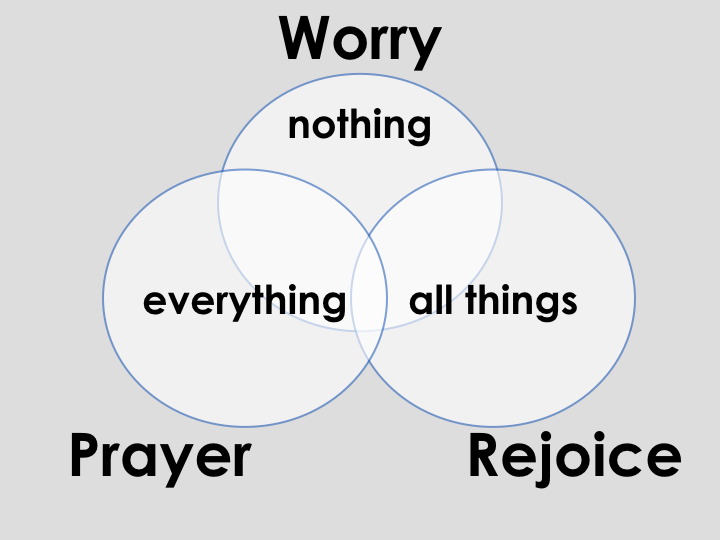
  • What should we worry about? Nothing! 
  • What should we pray about? Everything!
  • What should rejoice about? All things!  

This is the one and only path to transcendent peace! 

This is part two in our series The Antidote For Anxiety. Be sure to check out the video below, and also check out the first part of this series—Honk! Honk! Honk!


Saturday In The Psalms—Joy In The Desert

A psalm of David when he was in the wilderness of Judah (preface to Psalm 63).

Being in a desert place, you would expect David to say things like, “my soul thirsts,” “my flesh longs,” and “I am in a dry and thirsty land where there is no water.”

But what’s unexpected is what David found that satisfied. Not food and water, but “my soul thirsts for You,” “my flesh longs for You,” and “O God, You are my God.”

David knew that when outward conditions were at their worst, his focus needed to be at its best—and it needed to be on God. So David made the following commitments:

  • Early will I seek You
  • I have looked for You
  • I remember You on my bed
  • I meditate on You in the night watches
  • My lips shall praise You
  • My soul follows close behind You
  • I shall rejoice in God

Because of these commitments, David could reach the following conclusions:

  • Your lovingkindness is better than life
  • My soul is satisfied
  • I will rejoice in the shadow of Your wings
  • Your right hand upholds me

David found joy in the desert by changing his focal point!

I can reach the same conclusions that David reached, IF I am willing to make the same commitments David made.

In the desert places, I must deliberately and continually turn my eyes and thoughts FROM the desert TO God’s goodness.

Honk! Honk! Honk!

First of all, I encourage you to watch the first few minutes of the video below for an amazing story about honking horns. Trust me on this one—it’s a memorable story that will go along way toward helping you defeat anxiety when it rears its ugly head in your life.

What kills joy and happiness and gratitude? Anxiety is the killer.

What makes people so full of joy-killing anxiety? In a word: fear. Fear of missing out … Fear of falling short … Fear of not measuring up … Fear of bad things that might happen.

If anxiety kills joy, what kills anxiety? Anxiety—the joy-killer—is itself killed when joy is expressed.

Being grateful for what you have kills the anxiety of what you don’t have.

Being thankful for what you have kills the fear of what you may be missing.

Being grateful for what you have kills the anxiety of the bad stuff that may never even happen.

If joy kills anxiety, how can we develop more of it? Most people would say, “If you’re happy, give thanks” or “If you’re happy, honk.” But really it’s the other way around: “If you want to be happy, honk!”

Don’t fret or worry. Instead of worrying, pray. Let petitions and praises shape your worries into prayers, letting God know your concerns. Before you know it, a sense of God’s wholeness, everything coming together for good, will come and settle you down. It’s wonderful what happens when Christ displaces worry at the center of your life. (Philippians 4:6-7)

Honking your thanks is not only good for you, but it’s good for everyone around you who hears your “honk! honk!” of gratitude. David experienced this in Psalm 34:1-3. Even when he was at a low point, when he started praising God other anxious people began to experience joy as well.

Can I challenge you to join me in doing two things for at least the rest of this month:

  1. Keep a gratitude journal in a notebook, on your computer, or in your phone or tablet. Regularly write down those things for which you are grateful.
  2. Don’t keep your gratitude to yourself, but share it with the world. Use hashtag #honk to let people know you are using joy to kill anxiety in your heart.

Honk! Honk! Honk! It’s good for you; it’s good for others; and it brings glory to God.

Joyless Christianity??

“Many—would I overstate the case if I said the majority?—of those who confess their faith in Christ and enter into association with the community of believers have little joy in their hearts, no peace in their minds, and from all external appearances are no better morally than the ordinary educated citizen who takes no interest whatever in religion and, of course, makes no profession of Christianity. Why is this? I believe it is the result of an inadequate concept of Christianity and an imperfect understanding of the revolutionary character of Christian discipleship.

“True faith brings a spiritual and moral transformation and an inward witness that cannot be mistaken. These come when we stop believing in belief and start believing in the Lord Jesus Christ indeed. …

“One of the first changes will be a shift of interest from earth to heaven, from men to God, from time to eternity, from earthly gain to Christ and His eternal kingdom.” —A.W. Tozer, in Man—The Dwelling Place Of God

Is Christ’s Gospel Full Of Abundant Life Or Not?

“Since a saint’s gloom reflects unkindness on God Himself, how can we recommend His satisfying love if it does not satisfy us? The world thinks the Christian life is depressing anyway, a dry meal where very little wine of joy is tasted. Why will you confirm their deception, Christian? Why should they have your example as evidence against Jesus and His Word, which promises peace and joy to everyone who comes to this table?

“God forbid that your behavior, which should hold forth ‘the word of life’ and demonstrate the reality of it in the eyes of the world, ever disagree or throw doubt on His Word (Philippians 2:16). …

“When unbelievers see Christians sad as they hold the cup of salvation in their hands, they suspect that the wine is not so good as preachers say it is. … Christian, do not give unbelievers reason to imagine, by seeing you limping through the race, that they must forfeit happiness if they become Christians and spend the rest of their lives in a house of mourning, with a team of losers.

“Is Christ’s Gospel full of abundant life or not?” —William Gurnall, in The Christian In Complete Armor (emphasis mine)

The Joy Of Understanding

Then Ezra read from the Book of the Law in the open square… (Nehemiah 8).

I love the simplicity of this! No sermon; just a straightforward reading of God’s Word. And look at how everyone responded…

  • “The ears of all the people were attentive to the Book of the Law”
  • There was a respect for the Word of God and the God of the Word—“When he opened it all the people stood up…[then] they bowed their heads and worship the Lord with their faces to the ground”
  • The religious leaders “helped the people to understand the Law”
  • “So they read distinctly from the book, in the Law of God; and they gave the sense, and helped them understand the reading”

The result—“And all the people went their way to eat and drink, to send portions [to those in need] and rejoice greatly, because they understood the words that were declared to them.

A mark of a godly leader is one who helps people make sense of God’s Word.

And when the people understand the Word, they are more likely to joyfully put it into practice.

This is Part 10 in my series on godly leadership. To read my other posts, please click here.

Thursdays With Oswald—Ready For God … No Matter What

Oswald ChambersThis is a weekly series with things I’m reading and pondering from Oswald Chambers. You can read the original seed thought here, or type “Thursdays With Oswald” in the search box to read more entries.

Ready For God—No Matter What

     The greatest need of the missionary is to be ready to face Jesus Christ at any and every turn…. The great battle all along is not so much against sin, as against being so absorbed in work that we are not ready to face Jesus Christ. … This attitude of being ready to face Him means more and more disentanglement from so-called religious work, and more and more intense spiritual reality in so-called secular work. The whole meaning of the Christian life from Our Lord’s standpoint is to be ready for Him. … 

     Jesus appears in the most illogical connections, where we least expect Him…. When we are rightly related to God, life is full of spontaneous joyful uncertainty and expectancy—we do not know what God is going to do next; and He packs our life with surprises all the time. …  

     Readiness implies a right relationship to God and a knowledge of where we are at present. We are so busy telling God where we should like to go. Most of us are waiting for some great opportunity, something that is sensational, then we cry—“Here am I; send me.” … But readiness for God and for His work means that we are ready to do the tiniest thing or the great big thing, it makes no difference. … 

     Remember there is no such thing as prominent service and obscure service; it is all the same with God. 

From So Send I You (emphasis mine)

I fear that many Christians have the idea that “missionary work” or “ministry work” is a separate calling from their “real work.” But according to both the biblical examples and these thoughts from Oswald Chambers, ALL work can be spiritual / missionary / ministry work if we are simply ready for God to use us.

What about you? Are you ready to be surprised by God? Are you ready to be His ministry whenever and wherever He wants to use you?

Saturday In The Psalms—Overcoming Overwhelming Problems

…whom shall I fear? … of whom shall I be afraid? (Psalm 27:1)

Not just enemies are confronting David, but entire armies of wicked people had him surrounded! War and trouble are on every side, trying to overwhelm David.

Yet David is not just not afraid, he is filled with joy!

Why? He has heard God, even in the midst of the evil turmoil, say, “Seek My face.” And David responded, “Yes, Lord, I will seek Your face!” In fact, David declared there was nothing more fortifying for him than to be in God’s presence, gazing on God’s beauty and majesty, and learning more of God’s ways.

In this place David has peace, joy, protection, salvation, courage. In this place David’s overwhelming problems are overcome by God.

David’s conclusion is one for all who are experiencing overwhelming problems—

Wait on the Lord;
be of good courage,
and He shall strengthen your heart;
Wait, I say, on the Lord!

How To Experience More Of Christ’s Joy

“Many people are selective about which parts of themselves they bring to Me in prayer. Some hesitate to approach Me about traits they consider shameful or embarrassing. Others are so used to living with painful feelings—loneliness, fear, guilt, shame—that it never occurs to them to ask for help in dealing with those things. Still others get so preoccupied with their struggles that they forget I’m even here. This is not My way for you, beloved.

There are hurting parts of you that I desire to heal. Some of them have been with you so long that you consider them facets of your identity. You carry them with you wherever you go, barely aware of their impact on your life. I want to help you learn to walk in freedom. However, you are so addicted to certain painful patterns that it will take time to break free from them. Only repeatedly exposing them to My loving presence will bring you long-term healing. As you grow increasingly free, you’ll be released to experience My joy in greater and greater measure!” —Jesus (in Sarah Young’s Jesus Always)

One-And-Done? Ongoing? Later?

If I were to ask five different Christians to give me a definition of sanctification, I just might get five different definitions!

Part of this comes from incorrect either-or thinking. However, Jesus seems to tell us that sanctification requires a both-and thinking.

In Christ’s prayer for His followers in John 17, He uses the word sanctified three times (see verses 17-19). Although He is using the same Greek word each time, He uses a different “flavor” of the word to make it really clear what He means.

First of all, the Greek word for sanctified means the process of being made into a saint. So sometimes I like to say the word this way: SAINT-ified.

Check out Christ’s prayer. First He says, “I sanctify Myself,” and then He says, “that they too may be truly sanctified.” Same Greek word, but each time is slightly tweaked.

Jesus uses a “flavor” of Greek which means sanctification is something that He has done completely and totally on His own once and for all. In other words, Christians are completely and totally sanctified at the very moment they surrender their life to Him.

But when He talks about His followers, the “flavor” of Greek means sanctification is something that is an ongoing process. In other words, we are being SAINT-ified.

So which is it? Sanctified once, or sanctified through an ongoing process?

It’s not either-or. It’s both-and!

Think about a married couple. From the moment the pastor says, “I now pronounce you husband and wife” they are married. It is done; fully completed. There is nothing the bride or groom can do to become more married.

However, the groom can begin to look at the marriage through his bride’s eyes. Then he can serve her in a way that helps her feel more joy, more satisfaction, and more fulfillment within the marriage. Neither of them becomes more married, but they can get more enjoyment within the marriage.

The same thing for Christians. At the moment we ask Jesus to be our Lord and Savior we are saved from the penalty of our sins. We can’t be more saved. But through the process of SANIT-ificiation we can experience more joy, more satisfaction, and more fulfillment within our relationship with Jesus.

My paraphrase of 1 Peter 1:15-16—But just as He who called you has paid for your once-for-all saint-ification, so keep on being saint-ified in all you do; for it is written: “Be holy, because I am holy.”

What about you? Are you satisfied with just being saved, or are you striving for a joy-filled, more fulfilling, increasingly satisfied relationship with Jesus Christ? It can truly be a wonderful both-and relationship!