Poetry Saturday—Walking With God

Alas, my God, that we should be
Such Strangers to each other!
O that as Friends we might agree,
And walk, and talk together!
Thou know’st my Soul doth dearly love
The Place of Thine Abode;
No Music drops so sweet a Sound,
As those two words, My God.

I long not for the Fruit that grows
Within these Gardens here;
I find no sweetness in their Rose
When Jesus is not near:
Thy gracious Presence, O my Christ
Can make a Paradise;
Ah, what are all the goodly Pearls
Unto this Pearl of Price!

May I taste that Communion, Lord,
Thy people have with Thee?
Thy Spirit daily talks with them,
O let it talk with me!
Like Enoch, let me walk with God,
And thus walk out my Day,
Attended with the Heavenly Guards
Upon the King’s High-way.

When wilt Thou come unto me, Lord?
O come, my Lord most dear!
Come near, come nearer, nearer still;
I’m well when Thou art near.
When wilt Thou come unto me, Lord?
I languish for Thy Sight;
Ten Thousand Suns, if Thou art Strange,
Are shades instead of Light.

When wilt Thou come unto me, Lord?
For, till Thou dost appear,
I count each Moment for a Day,
Each Minute for a Year.
Come, Lord and never from me go,
This World’s a darksome Place;
I find no Pleasure here below,
When Thou dost veil Thy Face.

There’s no such Thing as Pleasure here;
My JESUS is my All;
As Thou didst shine or disappear,
My pleasures rise and fall.
Come, spread Thy Savour on my Frame,
No sweetness is so sweet;
Till I get up to sing Thy Name,
Where all Thy Singers meet. —Thomas Shepherd


Thursdays With Spurgeon—Evidence Of Christian Maturity

This is a weekly series with things I’m reading and pondering from Charles Spurgeon. You can read the original seed thought here, or type “Thursdays With Spurgeon” in the search box to read more entries.

Evidence Of Christian Maturity

     One of the first evidences that anyone is a child of God is that he hates with a perfect hatred and seeks to live a holy, Christlike life. … 

     I bless God that I have learned to have very little respect for the vision of the man with the measuring line. When I see an angel with it, I am glad enough; but when I see a man with it, I tell him that he must give me a warrant from God and show me how he is to know the elect by any other method than that laid down by our Lord Jesus Christ: “Ye shall know them by their fruits” (Matthew 7:16). … 

     He who truly grows in grace does not say, “Dear me! I can feel that I am growing; bless the Lord! Let’s sing a hymn. ‘I’m a-growing! I’m a-growing!’” I have often felt that I was growing smaller; I think that is very probable, and a good thing, too. If we are very great in our own estimation, it is because we have a number of cancers, or foul gatherings, that need to be lanced, so as to let out the bad matter that causes us to boast of our bigness. 

From The Autobiography Of Charles Spurgeon 

Some Dos and Don’ts for Christian growth:

Do—hate those things that keep you from God’s presence
Do—seek to be conformed to the image of Jesus

Don’t—look at other people as your measuring line
Do—make sure your life is fruitful according to God’s standards

Don’t—brag about your growth
Do—humbly thank God for your growth
Do—be quick to repent of un-Christlike things the Holy Spirit reveals to you


Walk This Way

In his letter to the Christians in Ephesus, Paul uses the word “walk” seven times to instruct them how to follow the path Jesus laid down for us. 

In Greek, the word for “walks” (peripatēo) means something that regulates my life, or something that keeps me on the right path. It’s my lifestyle that is kept in proper boundaries by something outside of me. 

First of all, notice how Paul tells Christians how not to walk. DON’T WALK THIS WAY…

…following pop culture (2:2)—Living a certain lifestyle because “everyone” is doing it, or because some popular people are living that way. 

…without thinking about why you’re walking the way you are (4:17)

…without comparing your walk to truth (5:8)—Living a life because it feels good to me is a dangerous way to live. I must make sure there is an objective truth that is keeping me on a proper path.

…foolishly (5:15)—To be foolish is either (a) not knowing the truth, (b) not applying the truth I have been shown, or (c) choosing to disregard the truth I’ve been given. 

Instead, Paul tells Christians to WALK THIS WAY

…knowing I am God’s workmanship, created for a great purpose (2:10)—It may take me some time to discover my purpose and my talents, but I keep at it. 

…worthy of my vocation (4:1)—Once I have discovered my talents, I develop them into strengths that will benefit others. 

…lovingly (5:2)—Just as Jesus did! 

…in the light of God’s truth (5:8)—This is the exact opposite of foolishly walking. It means I seek the truth and I apply the truth to my life. 

…circumspectly (5:15)—Not wasting my moments, but making sure I am giving 100 percent every single day.

When I WALK THIS WAY people will inevitably notice that I’m motivated not by popularity with people, but by intimacy with God (5:2-7). They will see that my path is bordered by the principles in God’s Word (5:8-14; Psalm 119:105). And they will notice that my life has purpose and is productive (5:15-20). 

All Christians should ask themselves:

  • Is Jesus pleased with the path I’m on today?
  • Can others follow my footsteps toward their own relationship with Christ? 

If you can answer “yes” to those questions, then Jesus will be pleased that you WALK THIS WAY! 

[You can check out the Scriptures I referenced in this post by clicking on DON’T WALK THIS WAY and WALK THIS WAY above.]

Don’t Go—Flow

“…My time has not come…” —Jesus (John 7).

Jesus never rushed. He was never late. He was never early. Nor did He ever remain silent when He should have spoken. Nor did He ever misspeak. 

His timing and His wording were always spot on.

This wasn’t just a “Jesus thing,” as He told His followers that we could flow in God’s timing just as He was doing. 

We don’t have to try to figure out our timing or our wording by external standards (v. 24). But when we are so immersed in the same Holy Spirit that directed Jesus, we simply flow in His living water to where we need to be, when we need to be there. Whether it’s time to speak or time for silence, the Holy Spirit can again flow our thoughts and words perfectly. 

Others won’t understand. 

They have their own agenda, and they will want me to be a part of their plans (vv. 3-5, 18, 32-36, 42, 52). I must listen to the unmistakable voice of the Spirit and squelch the voices of the crowd. 

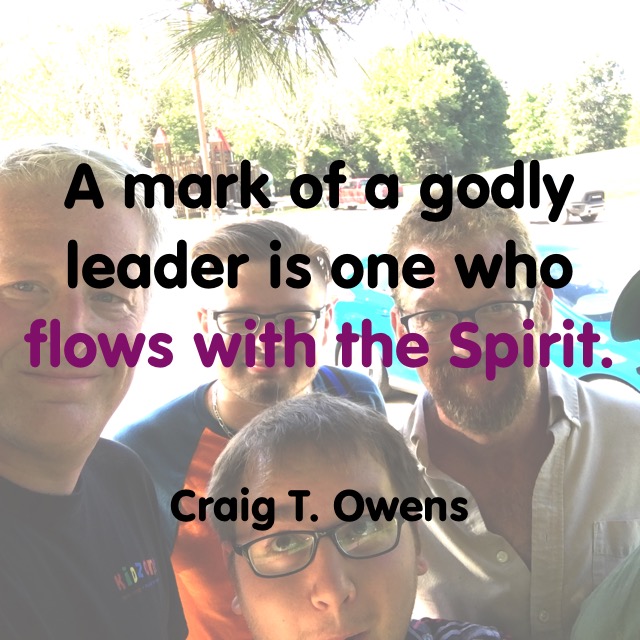
A mark of a godly leader is one who flows with the Spirit of God.

Don’t go with the flow of culture or others’ agendas. Don’t try to figure out where you need to be or what you need to say. Simply flow in the Spirit. Then your timing and your wording will be just as spot-on as Jesus showed us. 

This is part 38 in my series on godly leadership. You can check out all of my posts in this series by clicking here.

Poetry Saturday—These Eyes Have Never Seen

Jesus, these eyes have never seen
that radiant form of Thine;
the veil of sense hangs dark between
Thy blessed face and mine.

I see Thee not, I hear Thee not,
yet art Thou oft with me;
and earth hath ne’er so dear a spot
as where I meet with Thee.

Yet, though I have not seen, and still
must rest in faith alone,
I love Thee, dearest Lord, and will,
unseen, but not unknown.

When death these mortal eyes shall seal,
and still this throbbing heart,
the rending veil shall Thee reveal
all glorious as Thou art. —Ray Palmer

Do Not Dwell On The Past

“Forget the former things; do not dwell on the past. See, I am doing a new thing! I am a God of surprises—infinitely more creative than you can imagine. … As you journey along your life-path with Me, refuse to let the past define you or your expectations of what lies ahead. You may feel as if the road you are on is tiresome or even a dead end. That is because you’re projecting the past into the future. The roadblock you are straining to see up ahead is really just an illusion. The future is in My hands, and I can do surprising things with it! …

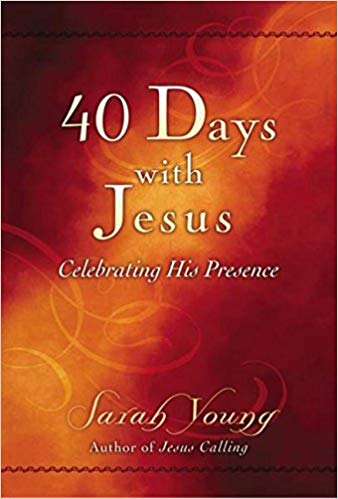
“You need My presence each moment to accomplish My purposes in your life. Sometimes you are tempted to take shortcuts, in order to reach your goal as quickly as possible. But if the shortcut requires turning your back on My peaceful Presence, you must choose the longer route. Walk with Me along paths of Peace; enjoy the journey in My Presence.” —Jesus (in Sarah Young’s 40 Days With Jesus)

Not How But Who

This is part 3 in our series looking at phrases that sound biblical and then asking, “Is that in the Bible?

Statement #3—This is how you should take Communion.… Is that in the Bible? Quite simply: No, it’s not. 

Every church seems to celebrate Communion with its own unique style, typically following an age-old tradition. There’s nothing wrong with traditions per se. The only thing we have to watch out for is when traditions become the focal point, instead of the thing the tradition is pointing us to. Almost as if we are celebrating the celebration (see Isaiah 1:11-14; Mark 7:1-8). 

In 1054 AD the Great Schism occurred between the Roman church (in West) and the Byzantine church (in East). One issue that led to this schism was Communion. The West used unleavened bread, saying that sin was removed. The East said that sounded like they were adopting Judaism, so they used leavened bread, saying that the “rising” symbolized new life. 

Even today there are differences and disagreements—only administered by a priest … only certain church officials can “bless” the elements … a common cup … individual cups … unfermented juice … fermented wine … unleavened wafers … pieces torn off a full loaf of bread. The Bible never says about Communion, “Do it this way.” All of these are man’s traditions. 

Passover was first instituted in Exodus 13. This is before the Law is given through Moses (Exodus 20) and before the instructions for the tabernacle are given (Exodus 25). In the first version, the sacrifice of the lamb was in individual homes, the lamb’s blood was shed on the doorposts of that home, and the family ate the lamb, unleavened bread, and bitter herbs together at home. 

After the tabernacle was operational, there was a change (Deuteronomy 16). Now the sacrifice of the lamb was in the tabernacle, the lamb’s blood was sprinkled on the altar, but the family still ate the lamb, unleavened bread, and bitter herbs together at home. 

By the time of Jesus, there were newer traditions which weren’t prescribed in the Bible that involved as many as five cups of wine, a very specific order that the meal was presented, and the singing of Psalm 113-118 (sometimes people sang all the way through Psalm 138). 

In the last supper Jesus shares with His disciples, we see some of these later elements. We read about the different cups of wine, the unleavened bread, the supper of lamb, and the singing of a hymn (Luke 22:14-20; Matthew 26:26-30; Mark 14:22-26; 1 Corinthians 11:23-26). 

I want to specifically focus on the second cup of wine Jesus used in this supper. Paul calls this cup the cup of thanksgiving and the cup of the Lord (1 Corinthians 10:16, 21). Why? Because Jesus switched cups with us! 

The Bible tells us that we have all sinned, and therefore we are supposed to drink the cup of God’s wrath—For in the hand of the Lord there is a cup of His wrath, and the wine foams and is red, well mixed; and He pours out from it, and all the wicked of the earth must drain it and drink its dregs (Psalm 75:8 AMP). 

But Jesus switched cups with us. He took the full wrath of God upon Himself, and then gave us God’s new covenant of forgiveness—“The days are coming,” declares the Lord, “when I will make a new covenant with the people of Israel and with the people of Judah. It will not be like the covenant I made with their ancestors when I took them by the hand to lead them out of Egypt, because they broke My covenant…. This is the covenant I will make with the people of Israel after that time,” declares the Lord. “I will put My law in their minds and write it on their hearts. I will be their God, and they will be My people. … For I will forgive their wickedness and will remember their sins no more.” (Jeremiah 33:31-34). 

Jesus said, “When you drink this, do this in remembrance of Me.” THIS is what we’re called remember and celebrate! 

It’s not HOW we celebrate Communion but WHO we remember when we do celebrate. 

Let’s not celebrate the celebration, but let’s celebrate the Savior who paid the price so that we could celebrate the forgiveness of our sins under God’s new covenant! 

Thursdays With Spurgeon—“Follow Me”

This is a weekly series with things I’m reading and pondering from Charles Spurgeon. You can read the original seed thought here, or type “Thursdays With Spurgeon” in the search box to read more entries.

“Follow Me”

     “As Jesus passed on from there, He saw a man named Matthew sitting at the tax office. And He said to him, ‘Follow Me.’ So he arose and followed Him” [Matthew 9:9]. … I know another man, not named Matthew, but Charles, and the Lord said to him, “Follow Me,” and he also arose and followed Him. I do not know all that He saw when He looked upon me. I fear that He saw nothing in me but sin and evil and vanity, but I believe that He did say to Himself concerning me, “I see one to whom I can teach My truth, and who, when he gets ahold of it, will grip it fast and never let it go, and one who will not be afraid to speak it wherever he is.” So the Lord saw what use He could make of me. There is an adaptation in men, even while they are unconverted, that God has put into them for their future service. Luke was qualified to write his gospel because he had been a physician, and Matthew was qualified to write the particular gospel that he has left us because he had been a publican. There may be something about your habits of life, and about your constitution and your condition that will qualify you for some special niche in the church of God in the years to come. Oh, happy day, when Jesus shall look upon you and call you to follow Him! Happy day, when He did look upon some of us, and saw in us what His love meant to put there, that He might make of us vessels of mercy meet for the Master’s use! 

From The Autobiography of Charles Spurgeon

What was true of the apostle Matthew and Charles Spurgeon in past history is true of you today! 

God has plans for you. He has implanted a combination of gifts, talents, and personality in you that is unique to anyone else on this planet. He did this because He foresaw how you could be of use in fulfilling His plans for His kingdom.

Listen! Do you hear Him calling? He is saying to YOU, “Follow Me.” Will you answer that call? 

Poetry Saturday—A Good Confession

It seemed as if nothing less likely could be
Than that light should break in on a dungeon so deep;
To create a new world were less hard than to free
The slave from his bondage, the soul from its sleep.

But the Word had gone forth, and said, Let there be light,
And it flashed through my soul like a sharp passing smart;
One look to my Savior, and all that dark night,
Like a dream scarce remembered, was gone from my heart.

I cried out for mercy, and fell on my knees,
And confessed, while my heart with keen sorrow was wrung;
’Twas the labor of minutes, and years of disease
Fell as fast from my soul as the words from my tongue. —Frederick William Faber

9 Quotes From “40 Days With Jesus”

Sarah Young does a masterful job in helping us hear Jesus speak to us in the first-person, as she weaves Scripture together so beautifully. Check out my full book review by clicking here. 

“Taste and see that I am good. The more intimately you experience Me, the more convinced you become of My goodness.” 

“Follow Me one step at a time. … Keep your mind on the present journey, enjoying My Presence. Walk by faith, not by sight, trusting Me to open up the way before you. … I set the pace in keeping with your needs and My purposes.” 

“Walking in the light of My presence blesses you in many ways. Good things are better and bad things are more bearable when you share them with Me. As you bask in My Love-Light, you are better able to love others and enjoy fellowship with them. You are less likely to stumble or fall because sins are garishly obvious in My holy Light. As you walk in this Light with Me, I encourage you to exult in My righteousness.” 

“Although your new self is being conformed to My image, this process does not erase the essence of who you are. On the contrary, the more you become like Me, the more you develop into the unique person I designed you to be.” 

“Holiness is letting Me live through you. Since I dwell in you, you are fully equipped to be holy. Pause before responding to people or situations, giving My Spirit space to act through you. Hasty words and actions leave no room for Me; this is atheistic living. I want to inhabit all your moments—gracing your thoughts, words, and behavior.” 

“Talk with Me about every aspect of your day, including your feelings. Remember that your ultimate goal is not to control or fix everything around you; it is to keep communing with Me. A successful day is one in which you have stayed in touch with Me, even if many things remain undone at the end of the day.” 

“Do not let your to-do list (written or mental) become an idol directing your life. Instead, ask My Spirit to guide you moment by moment.” 

“Exceeding Joy is for both you and Me. I delight in you now, but this Joy will be astronomically magnified when you join Me in Glory. The Joy you will experience in heaven is so far beyond anything you have known on earth that it is indescribable. Nothing can rob you of this glorious inheritance which is imperishable and will not fade away.” 

“Thankfulness is not some sort of magic formula; it is the language of Love, which enables you to communicate intimately with Me.”