15 Quotes From “I Am A Follower”

I Am A Follower by Leonard Sweet turned my leadership thoughts upside down (or is that right-side up?). I would strongly encourage you to read this book, especially if you are in church “leadership.”

It wasn’t easy to do, but here are 15 great quotes from I Am A Follower —

“The Greek noun perichoresis was the early church’s favorite word to describe the interrelationship of the holy Trinity. When the prefix peri (around) is linked with the root of the verb choreuein (to dance), a compelling metaphor is formed or  ‘choreographed’ to describe the ‘one nature in three Persons’ of God the Father, Son, and Holy Spirit. Literally they ‘dance around.’ The choreia or dance of God is the choreography of the cosmos, the interrelationship of Creator, creation, and life itself, the holy creativity of the All in All.”

“Following is the most underrated form of leadership in existence.”

“The cry for leadership is deafening amid our social disintegration, our moral disorientation. We have come to believe that we have a leadership crisis while all along we have been in a drought of discipleship. The Jesus paradox is that only Christians lead by following.”

“The church has become what [Dwight] Eisenhower predicted: a place where everyone is trying to get everyone else to do what they want done but don’t want to do themselves.”

“Leadership is a function. Followership is an identity. … Leadership is a functional position of power and authority. Followership is a relational posture of love and trust. … Being a follower is less about showing how much you know than showing humble gratitude for how much there is to be known.”

“Have we made Christianity more a moment of decision than a momentum for life? Both are important, but have we spent more time on how you become a Christian than on what it means to live as a Christian? Both are important, but have we made holiness more about a destination than a direction?” 

“But to think we can capture and tame Truth is a delusional trap. In fact, the desire for command and control above our desire to please God dams up the rivers of Living Water.”

“Christ does not ask of His followers great success or great fame or great distinction. Christ expects of His followers what He expected of Himself: simply ‘to do the will of Him Who sent Me.’”

“Never in the history of humanity has knowledge been more accessible and of such quality. But when our thirst for information, expertise, and control begins to outrun our thirst for Christ, we can easily trade the waters of the Spirit for a soda-pop substitute. When we place our faith in fillers instead of allowing the Spirit to fill us, we end up selling out not only Christ but ourselves.”

“Leadership culture is strength based. Followership culture is weakness based. …We bless others naturally through our strengths. But we bless others supernaturally through our weaknesses.”

“The disciples were instructed to feed the sheep, not lead them. Christ will lead them. Jesus is the Shepherd. We are the sheep. All of us.”

“Near the end of John’s gospel we find Jesus’ poignant words: ‘As You have sent Me into the world, so I have sent them into the world.’ Did you catch that sneaky as? Jesus’ commissioning of His disciples was simply an echo of His own commissioning.”

“The relationship between leader and follower is this: leaders are over, followers are among. We are all Jesus followers.”

“The leadership paradigm creates folk heroes. Followership creates heroes who are folk.”

“Jesus told His disciples that the sheep always know the Master’s voice. To follow Jesus is not to demand road signs but to respond to the Voice of the Spirit along the way.”

Thursdays With Oswald—In Christ I Can

This is a weekly series with things I’m reading and pondering from Oswald Chambers. You can read the original seed thought here, or type “Thursdays With Oswald” in the search box to read more entries.

In Christ I Can

     We are made sons and daughters of God through the Atonement and we have a tremendous dignity to maintain; we have no business to bow our necks to any yoke saving the yoke of the Lord Jesus Christ [Matthew 11:28-30]. …

     Every detail of our physical life is to be absolutely under the control of the new disposition which God planted in us by means of identification with Jesus Christ, and we shall no longer be allowed to murmur ‘can’t.’ There is no such word as ‘can’t’ in a Christian’s vocabulary if he is rightly related to God; there is only one word and that is ‘can.’

From Biblical Psychology

Sometimes Christians are known more for what we’re against than what we’re for. I think Oswald Chambers would say that is because we don’t really understand the full power of the Atonement.

We can better understand that word by saying it “at one-ment.” We have been made one with Christ. You hear this in Jesus’ prayer for us in John 17, I in them and You in Me, in order that they may become one and perfectly united, that the world may know and definitely recognize that You sent Me and that You have loved them even as You have loved Me.”

When we are in this sort of relationship, we don’t even say can’t to sin. Instead, we say I can live a holy life because of Christ in me!

As Paul said, we can say:

I CAN do everything through Christ Who gives me strength. (Philippians 4:13)

Thoughts From C.S. Lewis

I’ve been re-reading some of my notes that I made on a collection of essays from C.S. Lewis. He is one of my favorite authors, always helping me to see the spiritual realm in a whole new light.

These are just a few quotes that have me thinking…

“A live body is not one that never gets hurt, but one that can to some extent repair itself. In the same way a Christian is not a man who never goes wrong, but a man who is enabled to repent and pick himself up and begin over again after each stumble—because the Christ-life is inside him, repairing him all the time, enabling him to repeat (in some degree) the kind of voluntary death which Christ Himself carried out.”

“There are two ways in which the human machine goes wrong. One is when human individuals drift apart from one another, or else collide with one another and do one another damage. The other is when things go wrong inside the individual—when the different parts of him either drift apart or interfere with one another.”

“Those cautions which the tempter whispers in our ears are all plausible…. That is the truth in the temptation. The lie consists in the suggestion that our best protection is a prudent regard for the safety of our pocket, our habitual indulgences, and our ambitions.”

“When a man is getting better he understands more and more clearly the evil that is still left in him. When a man is getting worse he understands his own badness less and less. … Good people know about both good and evil: bad people do not know about either.”

If you haven’t read C.S. Lewis for yourself, he writes in so many different genres that you can find something for almost any taste: science fiction, children’s fairy tales, theology, apologetics, and on and on. He was truly gifted by God to see our world in a different light, and you will be greatly enriched by reading as much as you can from this master author.

I Am A Follower (book review)

About a decade ago I was moved into a position of leadership that seemed way too big for me. So to prepare myself, I began to read all of the leadership materials I could find: Bible-based leadership, marketplace leadership, anything I could find that would help me grow as a leader. I thought I was progressing as a leader, until I read I Am A Follower by Leonard Sweet.

Just a few pages into I Am A Follower I read this: “Following is the most underrated form of leadership in existence.” And thus I was confronted by a message that seemed 180-degrees out-of-phase with what I’ve been learning for the past decade.

In pointing time and time and time again to the life of Jesus, Len Sweet makes the case that Jesus is the only Leader, and the rest of us are followers. Jesus showed us perfect leadership by being a perfect Follower. In fact, He is the perfect Follower, as no one has ever followed God as He did. Some of us may follow Christ a little sooner, or a little closer, or a little more persuasively. Those, Dr. Sweet would say, are better called “first followers.”

Dr. Sweet uses phrases like the dance of life, and the transformation of viewpoint. These are not phrases that a leader uses, but they are the paradigm of followers. Check out this quote:

“The cry for leadership is deafening amid our social disintegration, our moral disorientation. We have come to believe that we have a leadership crisis while all along we have been in a drought of discipleship. The Jesus paradox is that only Christians lead by following.” (Leonard Sweet)

This book is a prophetic word: it is calling us back to true biblical-centeredness, true Christ-likeness, true discipleship. This is a book that took me a while to read, and will take me even longer to process. It’s a paradigm-busting game-changer…

…and it’s right on target.

Go get this book today!

I am a Thomas Nelson book reviewer.

What Is “Success” For A Church?

“How’s it going,” a fellow pastor asked me. “How’s your church doing?”

If you’re a pastor, you probably get asked this often. How do you answer this question? Do you tell them what your attendance was on Sunday morning? Or about the newest program you’ve started?

When you look in the mirror and ask yourself, “How’s it going,” is your answer related to nickels and noses (offerings and attendance)? Is it how many people complimented your last sermon?

Listen to these sobering words:

Worldliness is not the trap that most endangers us as Christian workers; nor is it sin. The trap we fall into is extravagantly desiring spiritual success; that is, success measured by, and patterned after, the form set by this religious age in which we now live. 

We have a commercialized view—we count how many souls have been saved and sanctified, we thank God, and then we think everything is all right. (Oswald Chambers)

We need to be very careful about how we define “success” in a church setting. Let’s use Jesus as our example:

  • How big was His congregation? Twelve men. One betrayed Him, nine ran away when the going got tough, and one denied he even knew Him. Even after being raised from the dead (!) there were only 120 people in the upper room.
  • How much money did His church have? Not even enough to buy a gravesite for the Messiah.
  • What did people think of His sermons? Some of His sermons made people so mad they wanted to stone Him. And after one sermon the Bible says: From this time many of His disciples turned back and no longer followed Him (John 6:66).

Maybe “success” in the church is more like…

  • …people being reconciled to God. Remembering that “our work is not to save souls, but to disciple them” (Chambers).
  • …seeing disengaged people becoming actively involved in engaging others with the Gospel.
  • …“Never seek[ing] after anything other than the approval of God” (Chambers).
  • …to say with Jesus, “The Spirit of the Lord is on Me, because He has anointed Me to preach good news to the poor. He has sent Me to proclaim freedom for the prisoners and recovery of sight for the blind, to release the oppressed, to proclaim the year of the Lord’s favor” (Luke 4:18-19).

These are just some of my thoughts. What else should be on this list? How would you define “success” in the church?

I have also shared some questions that can help pastors and ministry leaders better gauge the level of effectiveness in their ministry.

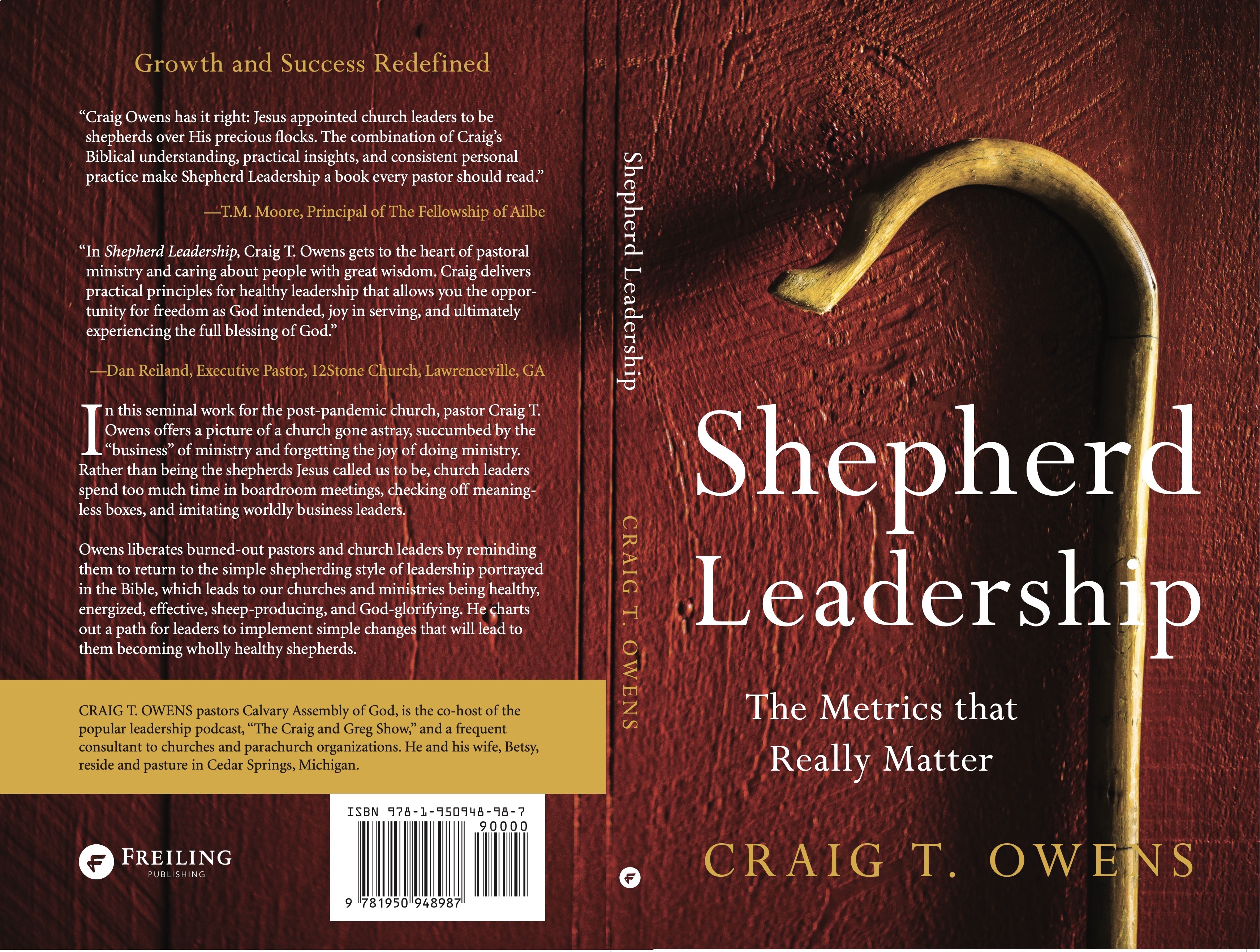
UPDATE: This post was one of the seed thoughts that went into fashioning my book Shepherd Leadership: The Metrics That Really Matter.

God Is For You!

I cross paths with far too many people who think God is unapproachable, distant, or—perhaps worst of all—angry with them.

But listen to this good news: God is for you! 

God created you to be in relationship with Him.

When Paul writes in Romans 8:31, “If God is for us, who can be against us,” it’s not a wondering, uncertain “if” (as in, “I wonder if this is true?”). No! What Paul is saying is, “If you already know that God is for you, why are you wondering about who or what is against you?”

Here are the facts (all from Romans 8):

  • The Holy Spirit is interceding for you (vv. 26, 27)
  • God is working out all things for your good (v. 28)
  • God justifies you (vv. 30, 33)
  • God will give you everything He gave Jesus (v. 32)
  • Jesus is interceding for you (v. 34)
  • Nothing and no one can ever separate you from God’s love (vv. 35-39)

Let me state it again—

God is for you!

Nothing can stand between you and God!

You Do Not Make Use Of Christ As You Ought To Do…

“Believer, you do not make use of Christ as you ought to do. When you are in trouble, why do you not tell Him all your grief? Has He not a sympathizing heart, and can He not comfort and relieve you? No, you are going about to all your friends, save your best Friend, and telling your tale everywhere except into the bosom of your Lord. … There is nothing Christ dislikes more than for His people to make a show-thing of Him, and not to use Him. He loves to be employed by us. The more burdens we put on His shoulders, the more precious will He be to us.” —Charles Spurgeon

Co-Workers

Obvious statement #1: Church ministry is not lone ranger work.

I needed to state that not only as a reminder to myself, but to my other pastor friends too. It seems like we can often lose sight of this fact. We can become so focused on the next sermon, the next appointment, the next Board meeting, the next outreach that we are actually worshiping the ministry instead of worshiping God through our ministry.

Oswald Chambers gave this warning:

“Beware of any work for God that causes or allows you to avoid concentrating on Him. A great number of Christian workers worship their work. The only concern of Christian workers should be their concentration on God. … A worker who lacks this serious controlling emphasis of concentration on God is apt to become overly burdened by his work. … Consequently, he becomes burned out and defeated. There is no freedom and no delight in life at all. His nerves, mind, and heart are so overwhelmed that God’s blessing cannot rest on him.”

When we are more focused on the work than on God, we can easily begin to feel over-worked and under-appreciated. And this usually leads to us either bearing down to work harder or to simply throwing in the towel.

There is a healthy alternative: link arms with The Co-Worker—

Walk with me and work with Me—watch how I do it. Learn the unforced rhythms of grace. I won’t lay anything heavy or ill-fitting on you. Keep company with Me and you’ll learn to live freely and lightly.” (Matthew 11:29, The Message)

Link with The Co-Worker, and then you will do ministry out of the overflow of your personal worship. Remember, you are a co-worker, not a solo-worker.

Obvious statement #2: Church ministry is not just for the pastor.

Church member, you too are a co-worker with Christ. And with your pastor.

The apostle Paul reminded the church at Corinth that “we are God’s fellow workers” (1 Corinthians 3:9). In other words, we’re all in this together. You need your pastor, and your pastor needs you.

Allow me to paraphrase a quote from President Dwight Eisenhower:

“Never let yourself be persuaded that one [pastor] is necessary to the salvation of America. When [the Church] consists of one leader and [a bunch of] followers, it will no longer be [the Church].”

The Church is a beautiful thing! It functions best when:

  • Pastor and church member are both linked with Christ
  • The pastor is not a lone ranger
  • The church members are not spectators

Ready? Go BE the Church of Jesus Christ!

Keep Your Eye On The Ball

My son is playing baseball for his high school this season. Whether I’m at a game or a practice, whether the Red Hawks are up to bat or out in the field, I hear the phrase over and over again: Keep your eye on the ball!

Pretty good advice.

It’s awfully hard to field the ball when you are distracted by something else. It’s next to impossible to hit the ball when you don’t watch it all the way from the pitcher’s hand.

As a pastor, people tell me frequently about a stumble into sin, a failure in their marriage, a relapse into their addiction, a slip of the tongue. And I want to repeat the phrase over and over again: Keep your eyes on Jesus!

It’s awfully hard to say no to sin that seems so attractive when you aren’t looking at the surpassing beauty of Christ.

It’s really hard to stay committed in your marriage when you don’t look at the perfect Bridegroom.

It’s almost impossible to stay morally clean unless your eyes are fixed on the perfect Savior.

Charles Spurgeon gave this warning—

“Some creature steals away your heart, and you are unmindful of Christ upon whom your affection ought to be set. Some earthly business engrosses your attention when you should fix your eye steadily upon the Cross. It is the incessant turmoil of the world, the constant attraction of earthly things which takes away the soul from Christ.”

I love the chorus of the old hymn:

Turn your eyes upon Jesus
Look full in His wonderful face
And the things of earth will grow strangely dim
In the light of His glory and grace

Keep your eye on your Savior!

Church-In-A-Box

Did you ever play with a Jack-in-a-box? You turned the crank, listened to the song, and waited for the funny-looking Jack to pop out of the box. Then you stuffed Jack back in the box and did it again.

And again, and again!

It was predictable.

It happened like clockwork. After awhile, though, the predictability became boring, and the Jack-in-a-box ended up collecting dust on the shelf.

Sometimes I’m concerned that our churches are becoming like a church-in-a-box. Like the predictable Jack-in-a-box, we turn the crank of showing up on Sunday, going through the same routine, waiting for God to show up, and then stuffing it all back into the box, only to repeat it all again the next Sunday.

And the next Sunday, and the next Sunday!

It’s predictable. It happens like clockwork. After awhile, though, the predictability can become boring, and our church-in-a-box ends up collecting dust on the shelf.

Here’s what I’m pondering:

  • Why do we meet on Sunday mornings?

There are as many mentions in the Bible about Christians meeting on other days as there are mentions about the first day of the week.

  • Why do we get so hung up on the “order of service”?

None of the New Testament writers taught about that. Yet if you want to anger some folks, just change up the Sunday routine.

  • Why do we dress a certain way to go to church?

Jesus had only one set of clothes, which means He wore the same thing to the synagogue as He wore the rest of the week. Yet we expect people to “dress correctly” for church.

  • Why do we call what happens on Sunday “worship,” and what happens the rest of the week “work”?

Shouldn’t everything we do bring glory to God? Shouldn’t all of our lives be worship?

  • Why do we complain about a church service not “moving us,” when we don’t feel the Holy Spirit moving the other six days of the week?

I’m not trying to pick a fight. Really.

I’m just wondering if perhaps we’ve gotten used to church-in-a-box. And if we have, perhaps we’ve also put God in a box too. Maybe we’ve become so accustomed to showing up on Sunday, dressing a certain way, following a certain routine, singing certain songs, and then expecting God to pop out and thrill us.

And then we put it all away until the next Sunday.

Wouldn’t God be more glorified if we didn’t put Him in a box? If we worshiped Him every day, not just Sunday? If we felt His Spirit animating us in everything we do, not just in the churchy things we do? If He popped up all throughout the week, in all sorts of places (like work, school, the grocery store, home)?

What do you think? Have we put church (and God) in a box? If so, how should we change?