This is a weekly series with things I’m reading and pondering from Oswald Chambers. You can read the original seed thought here, or type “Thursdays With Oswald” in the search box to read more entries.
The Wisdom In Appearing Foolish
A man can kill his own wisdom by living a part; he can atrophy his real life by keeping up a certain role. … It takes a tremendous amount of relationship to God for a man to be what he is. …
A wise man who has built his life in confidence in God will appear a fool when he is amongst people who are sleek and cunning. … If you stand true to your faith in God, there will be situations in which you will come across extortioners, cunning, crafty people, who use their wits instead of worshiping God, and you will appear a fool. Are you prepared to appear a fool for Christ’s sake? …
If you are going to be true to God, you will appear a fool amongst those who do not believe in God, and you must lay your account with this. Jesus said, “Every one therefore who shall confess Me before men…,” and it tests a man for all he is worth to confess Jesus Christ.
From Shade Of His Hand
Oswald Chambers is referencing Solomon’s words—Extortion turns wise people into fools, and bribes corrupt the heart (Ecclesiastes 7:7).
True wisdom comes from a trusting relationship to God as He is revealed in His Word, which to cunning people “who use their wits instead of worshiping God” sounds like pie-in-the-sky foolishness. Much like satan did with Eve, they will ask you, “Did God really say that?” and you are faced with a decision: will you stand true to God’s wisdom and look like a fool in their eyes?
Jesus said it would take the courage that comes from a sold-out relationship to Him to be able to endure the bribes and barbs of the world’s cunning people.
I pray we can all be wise enough to be willing to appear as fools in the world’s eyes!
D.L. Moody challenges all Christians to stick with prayer a little longer. Far too many of us give up too soon, and miss out on the miracle God wants to do. Check out my review of Prevailing Prayer by clicking here.
“The two first and essential means of grace are the Word of God and Prayer. … If we read the Word and do not pray, we may become puffed up with knowledge, without the love that buildeth up. If we pray without reading the Word, we shall be ignorant of the mind and will of God, and become mystical and fanatical, and liable to be blown about by every wind of doctrine.”
“The reason we so often fail in moving our fellowmen is that we try to win them without first getting power with God. Jesus was in communion with His Father, and so He could be assured that His prayers were heard.”
“It is not by eloquent sermons that perishing souls are going to be reached; we need the power of God in order that the blessing may come down.”
“Our Master’s prayers were short when offered in public; when He was alone with God that was a different thing, and He could spend the whole night in communion with His Father. My experience is that those who pray most in their closets generally make short prayers in public.”
“In Proverbs 28:9 we read, ‘He that turneth away his ear from hearing the law, even his prayer shall be abomination.’ Think of that! It may shock some of us to think that our prayers are an abomination to God, yet if any are living in known sin, this is what God’s Word says about them.”
“There is a great deal more said in the Bible about praise than prayer; yet how few praise-meetings there are! David, in his Psalms, always mixes praise with prayer. Solomon prevailed much with God in prayer at the dedication of the temple; but it was the voice of praise which brought down the glory that filled the house. … However great our difficulties, or deep even our sorrows, there is room for thankfulness.”
“Even if nothing else called for thankfulness, it would always be an ample cause for it that Jesus Christ loved us, and gave Himself for us.”
“When the church, the pulpit, and the pew get united, and God’s people are all of one mind, Christianity is like a red-hot ball rolling over the earth, and all the hosts of death and hell cannot stand before it.”
“We are not told that Jesus ever taught His disciples how to preach, but He taught them how to pray. He wanted them to have power with God; then He knew they would have power with man.”
“It is not the most beautiful or the most eloquent language that brings down the answer; it is the cry that goes up from a burdened heart.”
“Some people think God does not like to be troubled with our constant coming and asking. The only way to trouble God is not to come at all. He encourages us to come to Him repeatedly, and press our claims.”
“The Lord delights in hearing His children make their requests known unto Him—telling their troubles all out to Him; and then we should wait for His time.”
“Let our prayer be that God may advance His work, not for our glory—not for our sake—but for the sake of His beloved Son whom He hath sent.”
Have you ever been tiptoeing through your house in the dark and stubbed your pinky toe? When that happens, is it only your pinky toe that hurts? No! It seems like your whole body gets into the action!
This is a simple way to understand that what affects one part of our life affects all parts of our life. We can’t simply quarantine one part that is having difficulty because that one part will eventually spread its pain everywhere else.
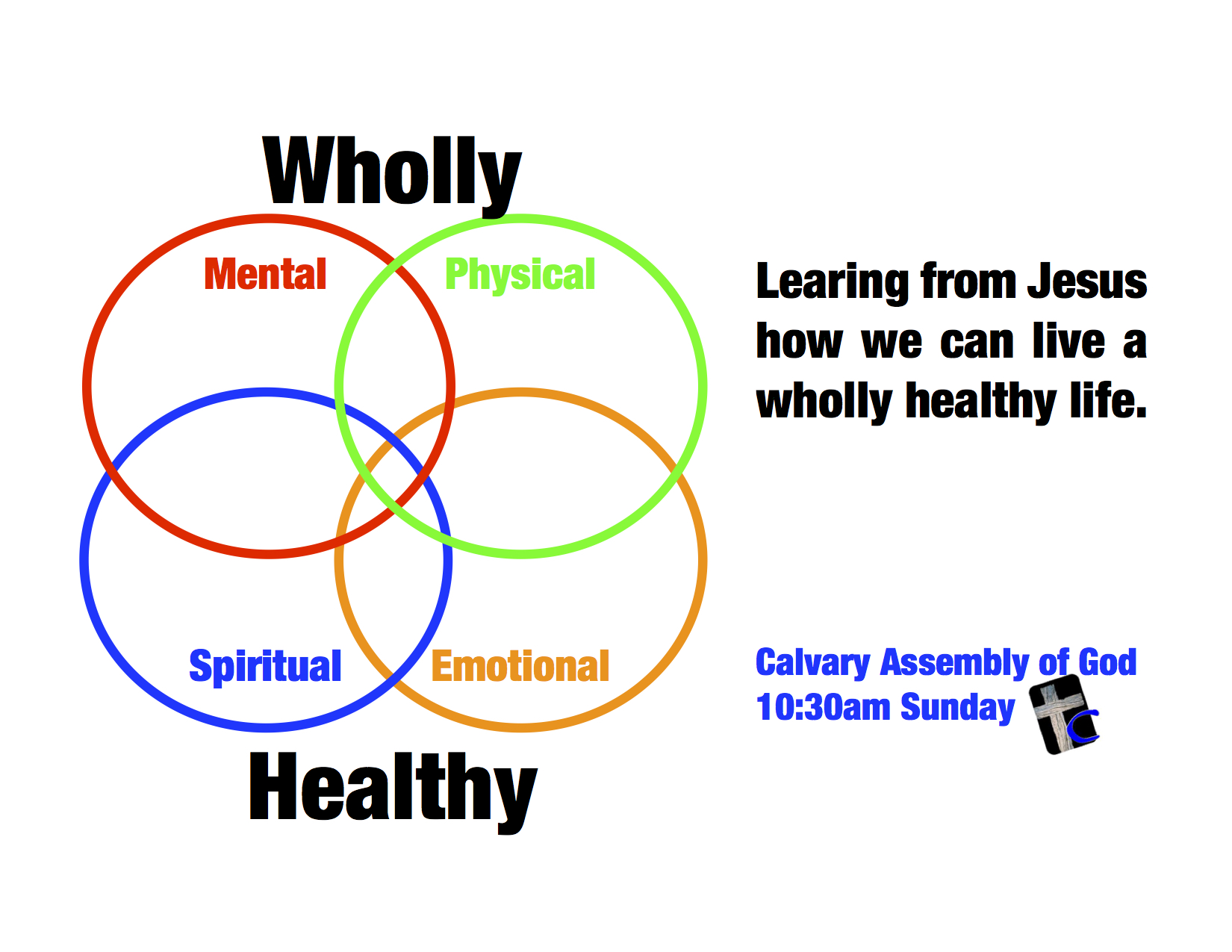
Humans were created as beings with several integrated parts. We have a physical body, we have a mind, we have emotions, and we have a God-breathed soul. If one of these parts becomes diseased, eventually all of the other parts will be affected, unless something is done to bring healing.
If we are dis-eased in any area, our health will be compromised in all areas.
Fortunately for us, Doctor Luke noted something about the health of Jesus during His earthly life. What Luke shows is how God intends for all of us to live—wholly healthy.
Modern medical science and psychology show us what the Bible pointed out long ago: We are integrated beings, and every part needs to be functioning optimally so that our whole being can function optimally.
Join us this Sunday as we begin a new series called Wholly Healthy. You will not only learn the importance of being aware of your health in four key areas, but you will also learn some practical thoughts for maintaining your optimal health.
If you missed any of the messages in this series, check them out here:
Christians often talk about God in terms of the “Trinity.” That is, the One True God revealed in three Persons: Father, Son, and Holy Spirit.
This is sometimes a difficult concept to grasp, especially since the word Trinity doesn’t specifically appear in the Bible. But make no mistake, just because the word isn’t there doesn’t mean it’s not true. Consider…
God’s Three-in-One nature is first exhibited when man is created (Genesis 1:26).
When the prophesy is given about Jesus being born in human flesh, He is given all the titles of the three Persons of the Godhead (Isaiah 9:6).
At Christ’s baptism we see Jesus in human form, we see the Holy Spirit descending as a dove, and we hear the Father’s voice announcing His approval of His Son (Matthew 3:16-17).
Jesus Himself said He would ask the Father to send the Holy Spirit to the Christians (John 14:16).
And just as Jesus ascended into Heaven, He told His followers to baptize people into all three Persons of the Godhead (Matthew 28:19).
But I think the best expression of the Trinity is revealed in three simple words. John talks about how all three Persons of the Trinity are involved in the life of a Christian. And then he sums it all up in three words—
“GOD IS LOVE”
Each Person of the Godhead is encouraging and illuminating and pointing to the other Persons in the Trinity. Love is perpetually being received and given. We humans are created in God’s image … we are created to receive and to give God’s love. That’s why John tells us that we know and rely on the love God has for us (that’s the receiving part), and that whoever lives in love lives in God, and God in him (that’s the giving part).
When Adam and Eve sinned, they were dis-membered from God. As a result, every human in their natural state longs for connection with God and others, but feels separated, isolated, unloved, and even unlovable.
Love re-members!
Jesus came to be broken and crushed and to feel the pain of separation from God. It was out of this brokenness that He could do the work of re-membering us to the fullness of the Trinity.
When Jesus shared His last supper with His disciples, He took bread (which is made from broken wheat kernels) and wine (which is made from crushed grapes). He told us as often as we eat the bread and drink the wine we are to remember how He was broken and crushed for us.
Remembering Christ’s work on the Cross re-members us to the fullness of the Trinity.
Sin and satan want to keep us feeling separated, unloved, and unloveable. But when we were the least worthy of His love, God—Who IS love—was broken and crushed to re-member us to Him.
If you feel lonely, separated, isolated, unloved or unloveable, I urge you to remember what Jesus did for you. He loved you enough to be broken and crushed for your re-membering to all of God’s love.
Check out this video where I explain this amazing thought in more detail…
This is a weekly series with things I’m reading and pondering from Oswald Chambers. You can read the original seed thought here, or type “Thursdays With Oswald” in the search box to read more entries.
What To Do With Spiritual Barriers
The inevitable barriers are there in every one of our lives. … The thing to do is to recognize that the barriers are inscrutable, that they are not by chance but entirely by God’s permission, and they should be faced and not ignored. …
The peril of the inevitable barriers is that if I have not faced the facts sufficiently, I am apt to blame God for them. There is one fact more that I do not know, and that fact lies entirely with God, not with me. It is no use to spend my time saying, I wish I was not like this, I am just like it. The practical point in Christianity is—Can Jesus Christ and His religion be of any use to me as I am, not as I am not? Can He deal with me where I am, in the condition I am in?
From Shade Of His Hand
What a wretched man I am! Who will rescue me from this body that is subject to death? Thanks be to God, Who delivers me through Jesus Christ our Lord!(Romans 7:24-25)
To keep me from becoming conceited because of these surpassingly great revelations, there was giving me a thorn in my flesh, a messenger of satan, to torment me. Three times I pleaded with the Lord to take it away from me. But He said to me, “My grace is sufficient for you, for My power is made perfect in weakness.” Therefore I will boast all the more gladly about my weaknesses, so that Christ’s power may rest on me. That is why, for Christ’s sake, I delight in weaknesses, in insults, and hardships, persecutions, and difficulties. When I am weak, then I am strong. (2 Corinthians 12:7-10)
For I am convinced that neither death nor life, neither angels nor demons, neither the present nor the future, nor any powers, neither height nor depth, nor anything else in all creation, will be able to separate us from the love of God that is in Christ Jesus our Lord.(Romans 8:38-39)
“The Bible point of view seems to cover most of the facts” (Oswald Chambers).
“Beware of loving praise from men more than praise from Me. One of the effects of the Fall is that people are overly concerned about what others think of them…. I don’t want you to be preoccupied with how other people view you. I have lovingly shielded you from being able to read the minds of others. What they think of you is really ‘none of your business.’ People’s thoughts are unreliable—distorted by their sinfulness, weaknesses, and insecurities. Even if they praise you to your face, some of their thoughts about you will be quite different. I am the only One who sees you as you truly are. … Instead of seeking praise from men, seek to see Me looking at you. My loving approval of you is shining from My face.” —Jesus (in Sarah Young’ s book Jesus Always)
Jesus had a way of praying that sounds unusual to our ears because He didn’t pray “normal” prayers. His prayers were bold statements! But Jesus also taught us to pray just like He did.
Most prayers that Christians pray sound like they come from the same formula. We may start with something like, “Heavenly Father” or “Dear God.” Then we probably spend some time praising God for His greatness before we make our requests of Him. Often our requests include something like “If this is Your will, I ask You to please heal/help/answer/etc.” And then almost always the prayer concludes, “In Jesus’ name, Amen!”
When Jesus prayed, His prayers sounded more like commands than requests. He would say things like, “Be clean” or “Rise up and walk” or “Blind eyes, be opened.” He usually didn’t ask His Father if it was His will to heal/help/answer/etc. And He never concluded a prayer by saying, “In My name, Amen!”
In Luke 6 there is a story about a man with a withered hand. Jesus healed him by speaking to the man, not to God. He said, “Stretch out your hand,” and when the man did so, his hand was completely restored. Jesus spoke with the authority of the Creator.
I believe this was possible because Jesus had an unbroken conversation with His Father and the Holy Spirit. Certainly He had set times of prayer (see Mark 1:35, Mark 6:45-46, and Luke 6:12-13 as examples), but Jesus also told us that He only did what His Father told Him to do (John 5:19), and He only said what His Father told Him to say (John 12:49).
I know sometimes people want to say, “Yeah, but this is Jesus we’re talking about! C’mon, He’s the Son of God, so of course He could do these things.” But remember that the miracle of Christ’s Incarnation is that He chose NOT to do these things out of His Deity while He was on Earth, but restricted Himself only to His humanity. That’s why the Bible says that everything we face, Jesus also faced in the flesh (Hebrews 2:14-18).
But perhaps another example from someone who had no Deity in his nature might help. Consider Joshua—this man spent more time in God’s presence, listening to His voice, than even Moses (Exodus 33:11). So when the time came, Joshua could pray an incredibly bold prayer: He actually spoke to the sun and the moon and told them to stand still in the sky, AND THEY OBEYED HIM!
Just like Jesus spoke to the man with the withered hand in the authority of the Creator, Joshua spoke to the sun and the moon in the same authoritative voice. How could these men do that? Because they were familiar with God’s voice, and when He told them to speak out boldly, they simply obeyed.
Jesus said we could pray the same way—Very truly I tell you, whoever believes in Me will do the works I have been doing, and they will do even greater things than these, because I am going to the Father. And I will do whatever you ask in My name, so that the Father may be glorified in the Son. You may ask Me for anything in My name, and I will do it (John 14:12-14, emphasis added).
How can we learn to pray this boldly? We need to spend more and more time in dialogue with God. We need to become increasingly aware of the His abiding presence with us. Then we, too, can pray in the Creator’s authority.
Praying this way glorifies God!
Get together with a friend this week and work through these application questions:
Am I spending time in planned prayer and Bible reading?
How can I make myself more aware of God’s perpetual presence?
In Jesus Always by Sarah Young, we hear Jesus speak the words of Scripture to us in His first-Person voice.
“I am training you to view your life from a heavenly perspective—through eyes of faith. When things don’t go as you had hoped to, talk with Me. Seek My face and My guidance. I will help you discern whether you need to work to change the situation or simply accept it.”
“The more you keep your gaze on Me—in quiet times and busy times—the better you can reflect My glory to other people. … When you are aware that I am present with you, you’re less likely to do or say something that’s displeasing to Me. When you’re struggling with difficult circumstances or painful feelings, awareness of My presence offers courage and comfort.”
“If you aspire to reach the heights—especially the high places of achievement and recognition—be prepared to shoulder the responsibilities that accompany success. But don’t forget to enjoy the satisfaction of accomplishing good things with Me, through Me, and for Me.”
“Pursuing a close walk with Me is the best way to live in the present. Keep bringing your thoughts back to Me whenever they wander. Return to Me joyfully, beloved. I will take great delight in you and rejoice over you with singing.”
“You tend to waste energy trying to determine whether your resources are adequate for the day. You keep checking your ‘power gauge’ instead of looking to Me for My provision. How much better to simply acknowledge your insufficiency when you awaken! This frees you to rely on My boundless sufficiency.”
“Your becoming a Christian was only the beginning of the work I’m doing in you. You need to be made new in the attitude of your mind and to put on the new self—becoming increasingly godly, righteous, and holy. This is a lifelong endeavor, and it is preparing you for heaven’s glory.”
“See Me smiling on you in radiant approval. My limitless love falls continually upon you, like heavenly snowflakes that melt into your upturned face. No matter how distressing your circumstances, this love is sufficient to sustain you. Someday you will even ascend to Heaven on it. I eagerly anticipate the time when I will take you into glory—to be with Me forever!”
Be sure to check out my review of Jesus Always by clicking here, and you can read the first set of quotes I shared from this book here.
If you’d like to be notified immediately when I post more quotes, please subscribe to my blog, and be sure to follow me on Twitter and Tumblr, where I share inspiring quotes every day.
I know suggesting that Jesus might have some “bad habits” sounds a bit sacrilegious, but you’ve got to check out my review of Leonard Sweet’s thought-provoking book (which you can find by clicking here). I have already shared a few quotes from this book here, but there were just too many good ones for just one post!
“Jesus’ mysterious, open-ended, twisty endings [to His stories] were brilliantly conceived, and His lack of explanation was perfectly pitched. He wanted people not only to think about the story and to converse with each other about the story, but also to ask Him about the story. Ultimately, Jesus’ stories were about cultivating a relationship with Him. We call it discipleship.”
“The people Jesus was interested in the most, the ones Jesus celebrated the most, were those who asked questions like He did. … Jesus loves people who would not just listen to Him, but who would follow Him, learn from Him, and be in relationship with Him—and with God.”
“Why do we feel that to be good and faithful Christians, we must not look too happy, not enjoy ourselves too much, when throughout the Scriptures, God clearly loves a party?”
“For Christians, every day is a reminder of the Resurrection. Each and every day should be a grand celebration of God’s amazing gift of Jesus. Everything in life is filled with Resurrection moments. And every person is filled with Resurrection hope just waiting to be celebrated. The church above all should be a place of festivities and joy. People should look at the church and think, What joyful people!”
“The ‘Nice God’ of therapeutic culture leads one to expect that if I have a need, God needs to meet my need. This is Christianity as Niceianity. For Jesus, God is loving and merciful and true but not necessarily ‘nice.’ The holy God is dangerous, because the holy God is truth.”
“Traveling with Jesus is not always dignified, pretty, or easy. Jesus takes the common routes and dangerous pathways, seeks out the messy and the dirty and the difficult. But traveling with Jesus is also beautiful, for those who follow Jesus also bring God’s lost and dirty people home to God—to be renewed, to be cleansed, to be clothed, to be loved.”
“How often does our ‘religion’ get between us and God? Are we so filled up with religion and all its trappings that there isn’t room for the inpourings of God’s presence and the outpourings of God’s power?”
“Jesus is the way into a life of truth, not a way out of life’s problems, difficulties, failures, and missteps.”
“Jesus was inclusive, but while He accepted people as they were, He didn’t affirm them as they were; He transfigured them into the singular images of God they were created to be.”
More quotes from The Bad Habits Of Jesus coming soon. And you can also follow me on Twitter and Tumblr to read some great quotes each and every day.



 Begone unbelief, my Savior is near,






 Craig T. Owens