40 Days Of Prayer For The USA

There has always been something special in the Bible about:

  • 40 days of prayer
  • The hunger of God’s people for Him to move
  • God’s miraculous, powerful response

Elections in the United States are always a pivotal time. The Bible makes it clear that God sets people in positions of authority in our governments, but His Word also makes it clear that it is the responsibility of Christians to pray for their leaders.

The presidential election takes place on November 6, 2012. That means that September 28 marks the 40-day point. Will you please join me in prayer beginning September 28 and continuing for the next 40 days?

We need to humble ourselves to ask for God’s help (we can’t make productive change happen on our own) and to ask God to give His wisdom to those who will be elected on that day (they can’t make productive change happen on their own).

You can find some prayer resources from Max Lucado by clicking here.

God answers the prayer of humble, hungry people. Let’s be that praying people!

Getting Back Up When Life Has Knocked You Down

The Bible never presents life as some sort of pie-in-the-sky, walk-in-the-park, everyday-is-always-rosy picture. If it did, we would reject the Bible because our experiences would immediately tell us otherwise. Instead, the Bible realistically portrays the challenges, and the pain, and the heartache, and the disappointments of life. But as it does so it also shows us that God’s way is the only way out of our sorrow and into His joy!

In our P119 Spiritual Workout series, we saw the bookends of the section daleth (Psalm 119:25-32) are:

I am laid low in the dust (v. 25) → You have set my heart free (v. 32).

How do we get this freedom when we are knocked down and laid low in the dust?

The Jews saw the Hebrew letter daleth as a door. Specifically, a door through which humble people stepped into a greater realization that He is God, and I’m not … that He has the answers, and I don’t … that He is in control, and I’m not. So part of going from down in the dust to a free heart is humbly acknowledging that you need God’s help!

In verses 26 and 27, the psalmist recalls his past history, and in so doing he is reminded that God has always been there. God has never left him nor forsaken him, so here’s what the psalmist resolves to do:

  • Teach me = I learned something before, so let me learn again.
  • Let me understand = help me to discern, distinguish; tell things apart. This word is used for things that are divinely disclosed; in other words, they’re things you and I cannot figure out on our own.
  • Meditate = talk with my soul about these new things the Holy Spirit has disclosed to me.

In verse 28, the psalmist says that his soul is weary with sorrow (or as the King James Version states it: my soul melteth for heaviness). The only way to overcome this is to ask for God’s help to energize us to go forward.

In the final four verses of this section you can sense the psalmist’s strength returning as he makes these bold statements:

  • keep me from deceitful ways (v. 29a) = keep me from lying to myself (NLT).
  • be gracious to me (v. 29b) = give me the privilege of knowing Your instructions (NLT).
  • I have chosen (v. 30a) = I have determined (NLT).
  • I have set (v. 30b) = I am long-sighted (on God), not short-sighted (on my problems).
  • I hold fast (v. 31) = the KJV says I have stuck to it!
  • I run (v. 32) = I will [not merely walk, but] run the way of Your commandments (AMP).

So when you are sad/disappointed/injured, run TO God. Don’t cling to your own (old) ways of thinking. Let Him take you from I am laid lowYou have set my heart free.

If you have missed any of the messages in our P119 series, you can access them all by clicking here.

How To Avoid Getting A Big Head

John Wesley said that harsh words spoken to us actually provide a helpful balance:

“Who could bear honor and good report, were it not balanced by dishonor?”

In other words, if the only things said to you are words of praise, it’s awfully hard to keep from getting a big head! So when the painful words come, it is important to evaluate them, but also recognize that they might be just the medicine you need to reduce ego swelling. 

It’s Not Me; It’s You

Listen to the podcast of this post by clicking on the player below, and you can also subscribe on AppleSpotify, or Audible. 

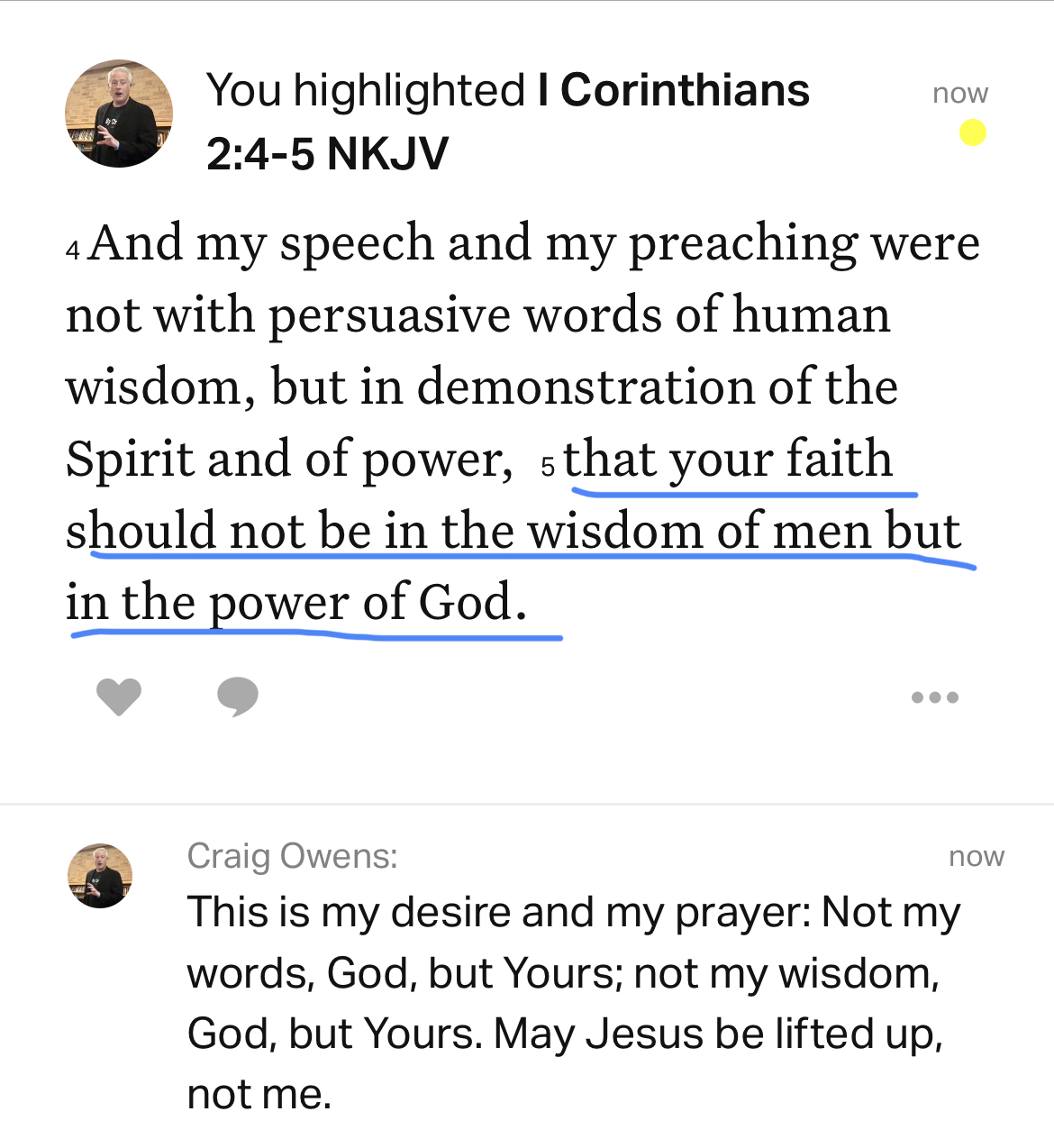
When I first came to you, dear brothers and sisters, I didn’t use lofty words and impressive wisdom to tell you God’s secret plan. For I decided that while I was with you I would forget everything except Jesus Christ, the One Who was crucified. I came to you in weakness—timid and trembling. And my message and my preaching were very plain. Rather than using clever and persuasive speeches, I relied only on the power of the Holy Spirit. I did this so you would trust not in human wisdom but in the power of God. (1 Corinthians 2:1-5)

I only want Jesus lifted up; not me.

As Your Spirit gives me words to share, may people turn to You; not me.

May anyone who hears me desire more of You; not me.

May my messages create a hunger and thirst for You; not me.

I want people to find encouragement in You; not me.

May I find my strength to minister in You; not in me.

May people only follow You; not me.

May everyone who hears me be impressed with You; not me.

It’s all about You, Jesus; not me.

►► Would you please prayerfully consider supporting this ministry? My Patreon supporters get behind-the-scenes access to exclusive materials. ◀︎◀︎

Thursdays With Oswald—Serving Like Christ

This is a weekly series with things I’m reading and pondering from Oswald Chambers. You can read the original seed thought here, or type “Thursdays With Oswald” in the search box to read more entries.

Am I Serving Like Christ?

The Son of Man did not come to be served, but to serve… (Matthew 20:28)

     Jesus also said, ‘Yet I am among you as the One who serves’ (Luke 22:27). Paul’s idea of service was the same as our Lord’s—‘…ourselves your bondservants for Jesus’ sake’ (2 Corinthians 4:5). We somehow have the idea that a person called to the ministry is called to be different and above other people. But according to Jesus Christ, he is called to be a ‘doormat’ for others—called to be their spiritual leader, but never their superior. Paul said, ‘I know how to be abased…’ (Philippians 4:12). Paul’s idea of service was to pour his life out to the last drop for others. And whether he received praise or blame made no difference. As long as there was one human being who did not know Jesus, Paul felt a debt of service to that person until he did come to know Him. But the chief motivation behind Paul’s service was not love for others but love for his Lord.

     …The institutional church’s idea of a servant of God is not at all like Jesus Christ’s idea. His idea is that we serve Him by being the servants of others. Jesus Christ actually ‘out-socialized’ the socialists. He said that in His kingdom the greatest one would be the servant of all (see Matthew 23:11). The real test of a saint is not one’s willingness to preach the gospel, but one’s willingness to do something like washing the disciples’ feet—that is, being willing to do those things that seem unimportant in human estimation but count as everything to God.

From My Utmost For His Highest

I cannot add anything to this brilliant observation. But I can tell you the parts that the Holy Spirit is really working in my heart:

  • “…called to be a ‘doormat’ for others—called to be their spiritual leader, but never their superior.” God, help me to keep my pride in check.
  • “The real test of a saint is not one’s willingness to preach the gospel, but one’s willingness to do something like washing the disciples’ feet.” May I never shrink back from willingly serving at the lowest level of society.

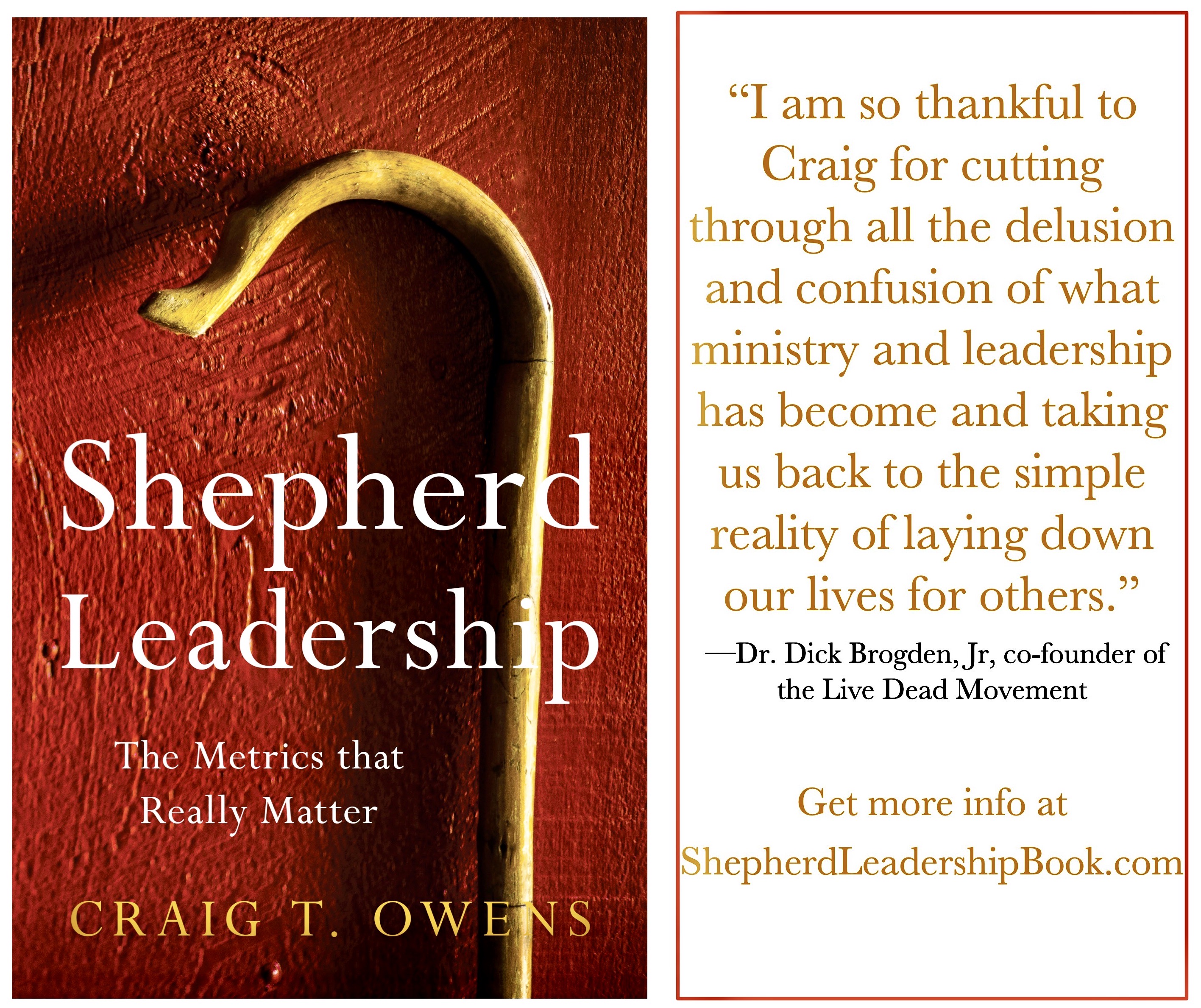
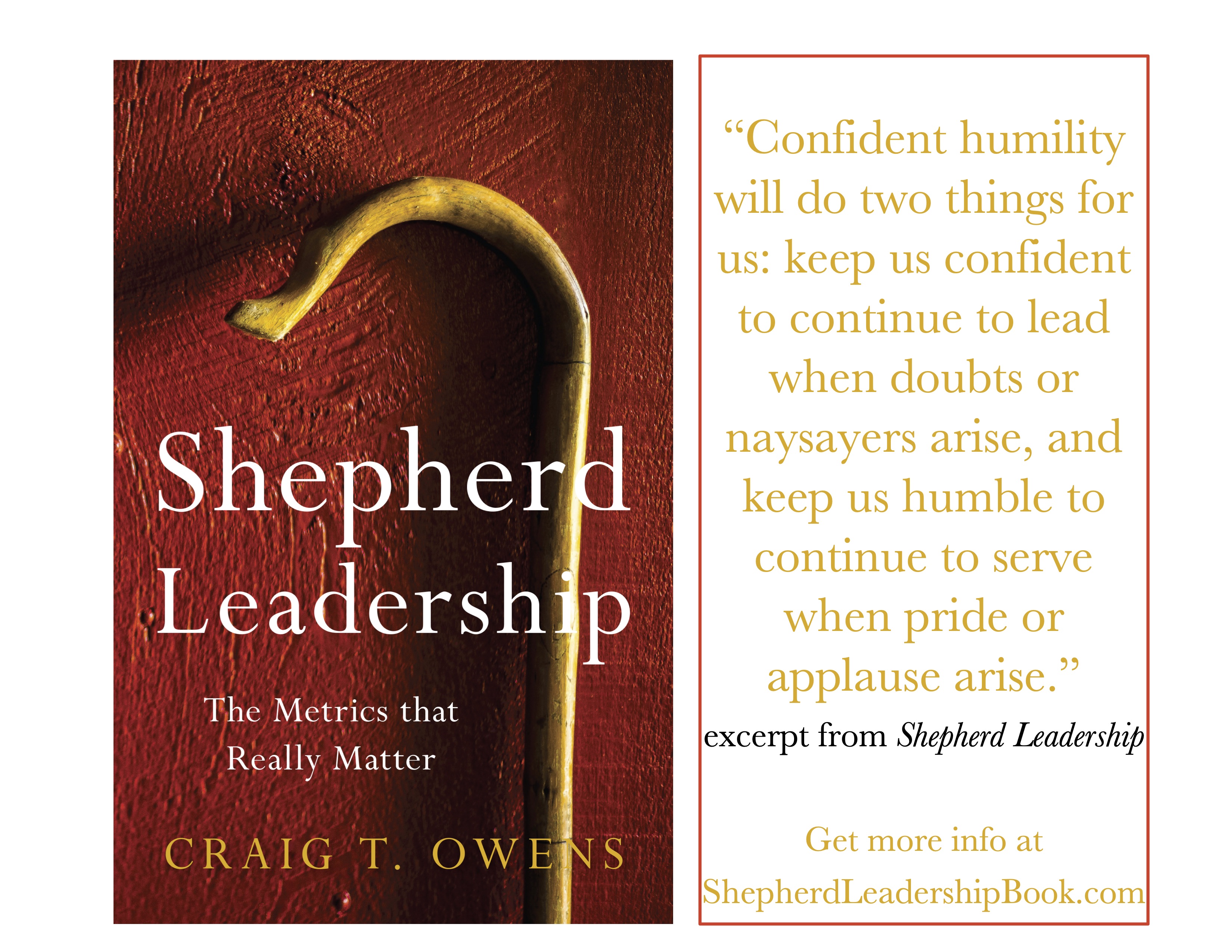
UPDATE: This idea of servant-leaders plays prominently in my book Shepherd Leadership: The Metrics That Really Matter.

Whose Reputation?

When I graduated from high school and began to look for a job, I had very little to put on my resume. Over time, however, I gained some experience, and began to accumulate some skills and accomplishments. Every once in awhile someone would even tell me, “That will look good on your resume!”

This might work fine in a job-hunting role, but it will never do as a disciple of Jesus Christ. In fact, Jesus told a pretty pointed story about a resume-building Pharisee in Luke 18. This man was described as one who was “confident of [his] own righteousness and looked down on everybody else.” He emphasized all his good qualities, and did his best to make himself look good at the expense of others (see vv. 11-12). Jesus said, this type of man who exalts himself, will be humbled by God.

Another man was praying at the same time as this reputation-conscious Pharisee. But this man didn’t try to make himself look good. Instead he prayed, “God, be merciful to me, a sinner” (v. 13). Jesus said this man “went home justified before God” (v. 14). As C.S. Lewis said,

“Humility is not thinking less of myself. Humility is thinking of myself less.”

I’m not trying to promote my accomplishments, but God’s accomplishments.

I’m not trying to put my skills in the spotlight, but God’s magnificence.

I’m not trying to make myself famous, I want God to be famous.

I don’t need to look good, but I certainly do want God to look good.

If you want to live this way, I challenge you to pray this prayer:

Dear God, I am humbled by my sins. But I am confident that through the forgiveness paid for by Jesus You receive me as justified. May I die to my reputation so I may live exalted by You.

To check out all of the messages in our Live Dead series, please click here.

Proper Preaching

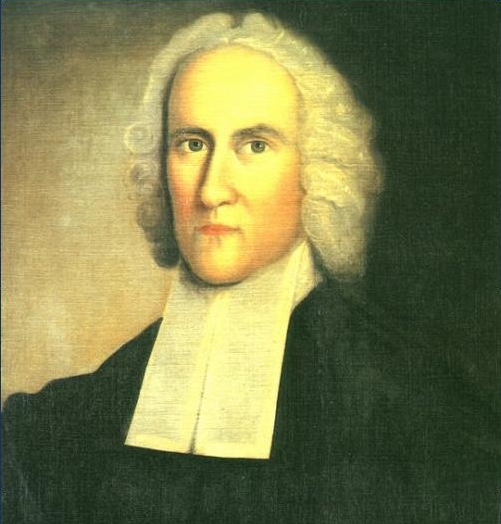
Jonathan Edwards was a brilliant man. His words here are spoken directly to preachers. I endeavor to handle my God-given responsibilities like this:

“Pure Christian humility has no such thing as roughness, or contempt, or fierceness, or bitterness in its nature; it makes a person like a little child, harmless and innocent, that none need to be afraid of, or like a lamb, destitute of all bitterness, wrath, anger, and clamor; agreeable to Ephesians 4:31. With such a spirit as this ought especially zealous ministers of the gospel to be clothed, and those that God is pleased to employ as instruments in His hands of promoting His work. They ought indeed to be thorough in preaching the word of God, without mincing the matter at all; in handling the sword of the Spirit, as the ministers of the Lord of hosts, they ought not to be mild and gentle; they are not to be gentle and moderate in searching and awakening the conscience, but should be sons of thunder. The Word of God, which is in itself sharper than any two-edged sword, ought not to be sheathed by its ministers, but so used that its sharp edges may have their full effect, even to the dividing asunder soul and spirit, joints and marrow. Yet they should do it without judging particular persons, leaving it to conscience and the Spirit of God to make the particular application. But all their conversation should savor of nothing but lowliness and good-will, love and pity to all mankind; so that such a spirit should be like a sweet odor diffused around them wherever they go. They should be like lions to guilty consciences, but like lambs to men’s persons. This would have no tendency to prevent the awakening of men’s consciences, but on the contrary would have a very great tendency to awaken them. It would make way for the sharp sword to enter; it would remove the obstacles, and make a naked breast for the arrow. —Yea, the amiable Christ-like conversation of such ministers in itself, would terrify the consciences of men, as well as their terrible preaching; both would co-operate to subdue the hard, and bring down the proud heart.”

Exhaustion Relief

I was reading and meditating on Matthew 11:28-30. These are the notes just as a jotted them down in my journal. I pray they will be as helpful for you as they were for me.

Come—without delay

to Me—Jesus is my only Source

all—no one is ever excluded from Christ’s call

you who are weary—I feel like I have been working hard, but gaining little ground

and burdened—and my conscience is bugging me because I feel I’m falling short of what God requires

and I will—only Jesus can do this

give you resta quiet, calm, patient expectation of a better future

Take—I need to apply what Jesus says to my life right now

My yoke upon you—Christ’s power to fulfill God’s requirements

and learn from Me—I must get in the habit of doing things His way

for I am gentle—strong enough to help me, but in a way that doesn’t overwhelm me

and humble in heart—He has the perfect attitude toward our Heavenly Father, and He can show me how to live this way too

and you will find rest—an intermission from my struggles

for your souls—the real me

For My yoke is easy—virtuous and pleasant

and my burden is light—relieving my conscience from worry and guilt

Why do I wait until I am wearied and burdened before I come to Christ? Why don’t I just take His yoke upon me daily? It’s my self-imposed burdens, from trying to do things my own way, that wear me out and beat me up! O stubborn pride! that keeps me toiling away, trying to do life my way. Submit and be free, O my soul!

A Pastor’s Work

I have blogged before about how heavy I feel the responsibility of being a pastor. When I think of the awesome responsibility God has given me as His under-shepherd to His precious people, I am humbled.

Humility is a good thing.

Since the pastor is “out in front” at every gathering, speaking to the people, leading the church in a particular direction, people tend to view their pastor as their leader. And without humility, the people’s esteem can “puff up” a pastor. Unfortunately, I’ve been around pastors who have gotten a little too, shall I say, “puffy.”

So this dose of godly wisdom from J.C. Ryle is just the preventative medicine I need:

“We should beware of resting our claim to the people’s attention on our outward [pastoral] call only. It will never do to tell our people, ‘We are your ordained ministers, and therefore you must believe and follow whatever we tell you.’ On the contrary, we must tell them to prove our teaching by Scripture, and not to receive it unless it is scriptural. That man has no right to expect the attention of his people, who does not preach the Gospel and live the Gospel. The rule of Paul is clear on this point. He told the Thessalonians to esteem their ministers very highly ‘for their work’s sake’ (1 Thessalonians 5:13). When there is no ‘work’ done, it is vain to expect the people’s esteem.

Pastors, do the work of humbly working as God’s servant to His people. Use your position to serve, not to presume upon others.

Church attendees, make us pastors “prove our teaching by Scripture.” We don’t get to say, “Because I’m the pastor and I say so!”

UPDATE: This post went into my thinking for my book Shepherd Leadership: The Metrics That Really Matter.

Thursdays With Oswald—Why Did God Choose Me?

This is a weekly series with things I’m reading and pondering from Oswald Chambers. You can read the original seed thought here, or type “Thursdays With Oswald” in the search box to read more entries.

Why Did God Choose Me?

Oh, the bravery of God in trusting us! Do you say, “But He has been unwise to choose me, because there is nothing good in me and I have no value”? That is exactly why He chose you. As long as you think that you are of value to Him He cannot choose you, because you have purposes of your own to serve. But if you will allow Him to take you to the end of your own self-sufficiency, then He can choose you to go with Him.

From My Utmost For His Highest

If God chose me because I was so special, and if I did something valuable for Him, who would get the glory for that? I would.

But I want to exalt God only

But we have this treasure in earthen vessels, that the excellency of the power may be of God, and not of us. (2 Corinthians 4:7)

Brothers, think of what you were when you were called. Not many of you were wise by human standards; not many were influential; not many were of noble birth. But God chose the foolish things of the world to shame the wise; God chose the weak things of the world to shame the strong. He chose the lowly things of this world and the despised things—and the things that are not—to nullify the things that are, so that no one may boast before Him. It is because of Him that you are in Christ Jesus, who has become for us wisdom from God—that is, our righteousness, holiness and redemption. Therefore, as it is written: “Let him who boasts boast in the Lord.” (1 Corinthians 1:26-31)

I want to go with You, Lord. Please keep me humble!