Thursdays With Spurgeon—Honey In My Mouth

This is a weekly series with things I’m reading and pondering from Charles Spurgeon. You can read the original seed thought here, or type “Thursdays With Spurgeon” in the search box to read more entries.

Honey In My Mouth

He will glorify Me, for He will take of what is Mine and declare it to you. All things that the Father has are Mine. Therefore I said that He will take of Mine and declare it to you. (John 16:14-15) 

     So we actually receive, through Jesus Christ, by the Spirit, what is in the Father!  

     Ralph Erskine, in the preface to a sermon upon the fifteenth verse, has a notable piece. He speaks of grace as honey for the cheering of the saints, for the sweetening of their mouths and hearts. But he says that in the Father, ‘The honey is in the flower….’ In the Son, ‘the honey is in the comb…. But then we have honey in the mouth. That is the Spirit taking all things and making application of them, by showing them to us and making us to eat and drink with Christ and share of these things….

From Honey In My Mouth

My grandfather had honeybees on his farm and I was fascinated by them. So much so that in my ecology class in college, I wrote my final research paper on the fascinating inner workings of the honeybee hive. My grandfather would often plant various crops so that the nectar from those flowers would give a distinct flavor to the honey. 

The nectar of a flower has everything in it to make honey except for one thing: a honeybee’s care. The nectar has to be transported back to the hive where it then undergoes the process of being transformed into honey—precise temperatures, storage, and evaporation processes are perfectly overseen by the bees until edible honey emerges. 

Ralph Erskine’s analogy of this nectar-to-honey process is very apropos to the things of God. Our Heavenly Father said that His thoughts are higher than our thoughts: they are inaccessible by our finite human minds (Isaiah 55:8-9). Jesus came as the revelation of all of the things of the Father, declaring to us all that God has for us. Jesus added, “I still have many things to say to you, but you cannot bear them now” (John 16:12), which is why the Holy Spirit illuminates the inspired Word of God.

Do you see the whole Trinity active in this process? The Father creates, the Son reveals, and the Spirit makes accessible (or, if you will, the Spirit makes edible). 

The Holy Spirit not only makes the things of God edible to us, but He gives us new tastebuds. No longer will the things of the world satisfy our tastes, no longer will we find any satisfaction in them, no longer will those earthly things nourish us. What the Father has created, and the Son has revealed, the Spirit will make real—and delicious!—to us.
 

Thursdays With Spurgeon—Poetic Groans

This is a weekly series with things I’m reading and pondering from Charles Spurgeon. You can read the original seed thought here, or type “Thursdays With Spurgeon” in the search box to read more entries.

Our Prayer Helper 

Likewise the Spirit also helps in our weaknesses. For we do not know what we should pray for as we ought, but the Spirit Himself makes intercession for us with groanings which cannot be uttered. (Romans 8:26) 

     A man’s heart is moved when he groans. A groan is a matter about which there is no hypocrisy. A groan comes not from the lips, but from the heart. A groan, then, is a part of prayer that we owe to the Holy Spirit, and the same is true of all the prayer that wells up from the deep fountains of our inner life. [see also Jeremiah 4:19; Isaiah 38:14; Psalm 77:4, 38:8-9] … 

     That which is thrown up from the depths of the soul, when it is stirred with a terrible tempest, is more precious than pearl or coral, for it is the intercession of the Holy Spirit! … 

     Beloved, what a different view of prayer God has from that which men think to be the correct one! You may have seen very beautiful prayers in print and you may have heard very charming compositions from the pulpit, but I trust you have not fallen in love with them. Judge these things rightly. I pray you never think well of fine prayers, for before the thrice-holy God it ill becomes a sinful supplicant to play the orator! … The tail feathers of pride should be pulled out of our prayers, for they need only the wing feathers of faith. The peacock feathers of poetical expression are out of place before the throne of God. … God looks at the heart. To Him fine language is as sounding brass or a tinkling cymbal, while a groan has music in it! 

From The Holy Spirit’s Intercession

God is not looking for well-polished prayers; He’s looking for real prayers. Let’s be honest: Not even the most educated person in the world has a vocabulary sufficient enough to accurately communicate with The Almighty God! 

Our Heavenly Father wants us to come to Him in simple, childlike anticipation. Notice I didn’t say childish anticipation—there is a huge difference. What Paul is telling us in Romans 8 is that the Holy Spirit can make the most eloquent, childlike, sincere prayer out of our deepest longings in our hearts. 

Jesus reminded us, “Your Father knows the things you have need of before you ask Him” (Matthew 6:8). Our Father wants to answer our prayers, and He has given us His Holy Spirit to help us pray in a way that He can answer. 

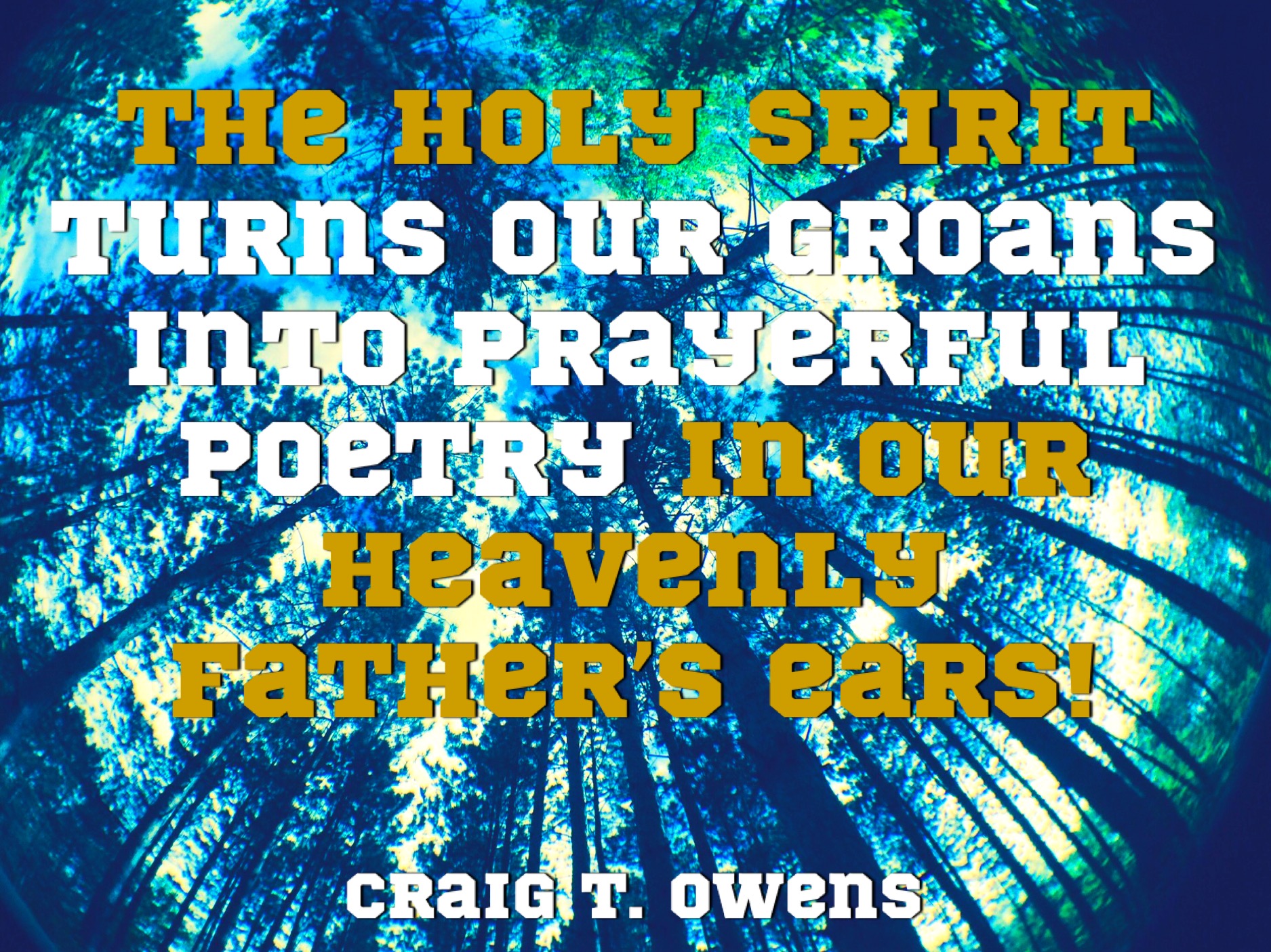
Don’t try to spruce up your vocabulary before you come to God in prayer. Just come to God in prayer, trusting that the Holy Spirit will make a beautiful prayer even out of your childlike groanings! The Holy Spirit turns our groans into prayerful poetry in our Heavenly Father’s ears!

Thursdays With Spurgeon—Our Prayer Helper

This is a weekly series with things I’m reading and pondering from Charles Spurgeon. You can read the original seed thought here, or type “Thursdays With Spurgeon” in the search box to read more entries.

Our Prayer Helper 

Likewise the Spirit also helps in our weaknesses. For we do not know what we should pray for as we ought, but the Spirit Himself makes intercession for us with groanings which cannot be uttered. Now He who searches the heart knows what the mind of the Spirit is, because He makes intercession for the saints according to the will of God. (Romans 8:26-27) 

     God helps our infirmity, and with a Helper so divinely strong, we need not fear the result! … We take our burden to our heavenly Father and tell Him in the accents of childlike confidence, and we come away quite content to better whatever His holy will may lay upon us. … 

     We bathe our wounds in the lotion of prayer and the pain is lulled; the fever is removed. But the worst of it is that in certain conditions of heart we cannot pray. We may be brought into such perturbation of mind and perplexity of heart that we do not know how to pray. … We fall into such heaviness of spirit and entanglement of thought that the one remedy of prayer, which we have always found to be unfailing, appears to be taken from us. Here, then, in the nick of time, as a very present help in time of trouble, comes in the Holy Spirit! He draws near to teach us how to pray, and in this way He helps our infirmity, relieves our suffering, and enables us to bear the heavy burden without fainting under the load. … 

     He will guide you both negatively and positively. Negatively, He will forbid you to pray for such and such a thing, even as Paul essayed to go into Bithynia, but the Spirit would not allow him. And, on the other hand, He will cause you to hear a cry within your soul that will guide your petitions, even as He made Paul hear the cry from Macedonia, saying, ‘Come over to Macedonia and help us’ (Acts 16:6-10). …  

     If I am a true believer, there dwells the Holy Spirit, and when I desire to pray, I may ask Him what I should pray for as I ought and He will help me! He will write the prayers that I ought to offer upon the tablets of my heart, and I will see them there and so I will be taught how to plead! It will be the Spirit’s own Self pleading in me and by me and through me before the throne of grace!

From The Holy Spirit’s Intercession

Oh, how many times I’ve been in desperate need but cannot find the right words to pray. The Holy Spirit understands even groans that come from my anguished heart and can help me turn those groans into perfect prayers. 

Jesus said the Holy Spirit would remind us of His words and would guide us into truth. I’ve experienced this for myself: I’m at an utter loss of what or how to pray, and then a passage of Scripture comes to my mind. I start there with that phrase. Often I will begin to read the surrounding passage from the Bible out loud and feel the gentle affirmation from the Holy Spirit as I begin to personalize that portion of Scripture into my own prayer. As Spurgeon put it, this is “the Spirit’s own Self pleading in me and by me and through me before the throne of grace!” 

What a Helper we have in the Holy Spirit!

Our Most Effective Shield And (S)word

…with Your mouth You have promised and with Your hand You have fulfilled it… (2 Chronicles 6:15). 

I rest solely on what God says—He says it and He fulfills it. 

I can live on “every Word” He speaks (Deuteronomy 8:3).

“Every Word” of God is flawless and is a protection for me (Proverbs 30:5).

None of God’s Word ever fail (Isaiah 55:11).

God gives us His Word to speak (Jeremiah 26:12; John 12:49; Luke 21:15).

We defeat our enemies by God’s Word in our mouth (Matthew 4:4, 7, 10; Revelation 12:11).

Every Word of God gives life because of the Holy Spirit’s anointing on it (John 6:63).

Every Word of God is a sword (Hebrews 4:12; Revelation 1:16; 2:12, 16; 19:15). Or as my friend Sasha reminds me God’s Word is our S(word)! 

There isn’t a more effective shield against enemies, there isn’t a more deadly weapon against temptation, there isn’t a more sure foundation in storms than the Word spoken and fulfilled by God! 

[check out all of the above passages for yourself by clicking here] 

Thursdays With Spurgeon—God’s Part, Our Part

This is a weekly series with things I’m reading and pondering from Charles Spurgeon. You can read the original seed thought here, or type “Thursdays With Spurgeon” in the search box to read more entries.

God’s Part, Our Part

     The lesson is clear to all: The wind turns mills that men make. It fills sails that human hands have spread. And the Spirit blesses human effort, crowns with success our labors, establishes the work of our hands upon us, and teaches us all through that ‘the hand of the diligent makes rich’ (Proverbs 10:4). And ‘if anybody will not work, neither shall he eat’ (2 Thessalonians 3:10). … 

     Let us do our part faithfully, spread every sail, make all as perfect as human skill and wisdom can direct, and then in patient continuance in well-doing await the Spirit’s propitious gales, neither murmuring because He tarries nor being taken unawares when He comes upon us in His sovereign pleasure to do that which seems good in His sight.

From The Holy Spirit Compared To The Wind 

We cannot do what only God can do, and God will not do what we are supposed to do. It is the Holy Spirit who can help us keep those two thoughts clear. 

It’s wrong to say, “God only helps those who help themselves.” But it’s equally as wrong to say, “I don’t need to do anything except wait for God.” In example after example in the Bible we see people doing their part while at the same time believing for God to do something miraculous:

We don’t take matters into our own hands, but neither do we sit idle waiting for something miraculous to happen. We plant, and water, and tend, and then God brings the harvest.

Spirit-Empowered To Do Good Works

Micah the prophet’s name means who is like God, or more literally: “who but God?” The implied answer, of course, is no one! 

Micah opens his letter by telling us his name, and then he closes his prophetic words with a play on his name when he says, “Who is a God like You?” (7:18-20). Who else but God could…

  • …pardon sin?
  • …forgive transgressions? 
  • …not stay angry at sinners? 
  • …delight to show mercy? 
  • …have such boundless compassion? 
  • …tread our sins under His foot?
  • …hurl our iniquities into the sea?  

NO ONE! 

In light of this, how should we respond to this amazing God? Micah asks a series of rhetorical questions about what sort of religious practices would somehow “balance the scales” for God’s amazing gifts to us. But here’s the deal: there is no way for us to balance the scales! Instead, Micah tells us this, “God has showed you what is good. What does the Lord require of you? To act justly, to love mercy, and to walk humbly with your God.” 

In other words, our response to God’s invaluable gifts must transition from a have to lifestyle to a get to lifestyle! Micah makes it clear that God’s Spirit empowers us to live this way (Micah 3:8). 

It is the Holy Spirit who empowers Christians to act justly, love mercy, and walk humbly with our God. 

The apostle Paul agrees with Micah, even echoing some of Micah’s own phrases—God’s great love, His rich mercy, His unearned grace, His forgiveness of sin, His kindness, and His salvation (Ephesians 2:4-10). Why did God do all of this? So that we could “do good works”—like acting justly, loving mercy, and walking humbly—“which God prepared in advance for us to do”!

I am saved by grace SO THAT I am free to do grace-filled, Spirit-empowered, good things. 

All of this prompts me to ask myself three introspective questions:

  1. Do I continually remind myself that I was saved by grace and not by works? I need to check my have to vs. get to attitude. 
  2. Am I aware that people are watching me? What are they seeing? Do they see godly justice, loving mercy, and humility? 
  3. Am I living like Jesus? Peter explained that Jesus “went around doing good and healing all who were under the power of the devil, because God was with Him” (Acts 10:38). Can that be said of me too? 

Who but God could call us, forgive us, and forget our sins? NO ONE! 

Who but God could empower us to live in such a way that others see His greatness too? NO ONE! 

Let’s never, ever become self-reliant or works-dependent (that’s have to living), but let’s stay so Spirit-reliant that we cannot help be get to people! 

If you’ve missed any of the other messages in our series about major lessons from the minor prophets, you can find the full list by clicking here

Thursdays With Spurgeon—Do Not Fear The Spirit’s Wind

This is a weekly series with things I’m reading and pondering from Charles Spurgeon. You can read the original seed thought here, or type “Thursdays With Spurgeon” in the search box to read more entries.

Do Not Fear The Spirit’s Wind 

The wind blows where it wishes, and you hear the sound of it, but cannot tell where it comes from and where it goes. So is everyone who is born of the Spirit. (John 3:8) 

     Sometimes the wind comes with a sweep as though it were going on forever. It comes past and dashes through the trees, sweeping away the rotten branches. Then away it goes across the Alps, dashing down an avalanche in its course, still onward. And as it flies, it blows away everything that is frail and weak. And on, on, on it speeds its way to some unknown goal. And thus it is sometimes the Spirit of God will come right through us, as if He were bearing us away to that spiritual heritage that is our sure future destiny, bearing away coldness, barrenness, everything before it. We do not lament then that we do not pray. We do not believe that we cannot pray. ‘I can do everything’ is our joyful shout as we are carried on the wings of the wind. …  

     The lower branches of the trees are scarcely moved, but the top branches are rocked to and fro by it. [The wind] is a great leveler! So is the Holy Spirit. He never sees a man high but He brings him down. He makes every high thought bow before the majesty of His might. … Now do not let this make you fear the Holy Spirit. It is a blessed thing to be rocked so as to have our hopes tested, and it is a precious thing to have our carnal confidences shaken. And how blessedly the wind purifies the atmosphere! …  

     So the Spirit of God comes and cleanses out our evil thoughts and vain imaginations, and though we do not like the hurricane, yet it brings spiritual health to our souls. …  

     The Holy Spirit is the great testing power, and the result of His operations will be to show men what they are. … Thus also we try the doctrines of men; we bring the breath of inspiration to bear upon them. … True Christians and sound doctrines have ballast and weight in them; they are not moved nor driven away. But empty professors and hollow dogmas are scattered like chaff before the wind when the Lord will blow up on them with the breath of His Spirit. Therefore examine yourselves; try the doctrines and see if they are of God.

From The Holy Spirit Compared To The Wind 

We are wise to fear the Wind of God. 

By fear I mean a holy reverencing, an appreciation of the awful weightiness of God’s presence, an ever-growing awareness of the awesomeness of the thought of standing before The Judge of the Universe—the All-holy and All-righteous King of kings. I don’t mean cowering in the corner, afraid to approach God, nor afraid of Him approaching us. 

In the first Church in the book of Acts, we see a married couple trying to lie to the Holy Spirit, a sorcerer thinking he could learn “the tricks” of the Holy Spirit, and King Herod trying to claim the majesty of God’s presence for himself (Acts 5:1-11, 8:18-24, 12:21-23). The Holy Spirit dealt powerfully and decisively with all of these pretenders. The result: the power of the Holy Spirit was unmistakably and unquestionably acknowledged! So great fear came upon all the church and upon all who heard these things. 

True Christians welcome the wind of the Spirit. He cleanses, purifies, prunes, fills, and empowers. He blows away what is impure so that He can impart more of Himself to us. 

Let us never, ever treat the Holy Spirit lightly. Let us never, ever try to put the Holy Spirit in our own little boxes. But let us be open to whenever and however He wants to blow His wind through our hearts. 


Jesus Says

Jesus says, “I will… 

…make you fishers of men” (Matthew 7:23; Mark 1:17) 

…acknowledge in Heaven those who acknowledge Me on earth” (Matthew 10:32-33) 

…give you rest” (Matthew 11:28) 

…build My church” (Matthew 16:18) 

…give you the keys of the Kingdom of Heaven” (Matthew 16:19) 

…show you whom you should fear” (Luke 12:5) 

…drive out demons and heal people” (Luke 13:32) 

…never drive away those who come to Me” (John 6:37) 

…give My life for your life” (John 6:51) 

…rise again from the dead” (Matthew 27:63; Mark 14:28; John 2:19) 

…raise up believers to eternal life” (John 6:40, 44, 54) 

…come back to take you to be with Me forever” (John 14:3) 

…do whatever you ask in My name” (John 14:13, 14; 16:28) 

…not leave you as orphans” (John 14:18) 

…ask the Father to give you an Advocate” (John 14:18) 

…give you words and wisdom that are irresistible” (Luke 21:15) 

…see you again and give you eternal joy” (John 16:22)

Oh, what a Savior!

Thursdays With Spurgeon—Unique And Purposeful

This is a weekly series with things I’m reading and pondering from Charles Spurgeon. You can read the original seed thought here, or type “Thursdays With Spurgeon” in the search box to read more entries.

Unique And Purposeful

     You cannot tell from where the wind comes [John 3:8]. You know it blows from the north or from the west, but at what particular place does that wind start on its journey? Where will it pause in its onward flight? You see that it is blowing to the east or to the west, but where is it going? From where did these particles of air originate that rush so rapidly past? Where are they going? By what laws are they guided in their course, and where will their journey end? …  

     All the true operations of the Spirit are due in no sense whatever to man but always to God and to His sovereign will. … There is arbitrariness about the wind. It does just as it pleases, and the laws that regulate its changes are unknown to man. … So is the mighty working of God! … 

     There are times when all is still and calm, when everything is quiet and you can scarcely detect the wind at all. Now just so it is with the Spirit of God. To some of us He came like a rushing mighty wind. … To others He comes so gently they cannot tell when first the Spirit of God came. … The Spirit of God, as a sovereign, will always choose His own way of operation. … 

     The wind not only differs in force, but it differs in direction. … Perhaps there never were two winds that did blow exactly in the same direction. … Now, the Spirit of God comes from different directions. … God causes the wind to blow just that way He wills. He works, also, through different texts of Scripture. You were converted and blessed under one text; it was quite another that was made useful to me. … God never repeats Himself. … Every Christian is a distinct work of divine grace on God’s part that has in it some originality, some portion distinct from all others.

From The Holy Spirit Compared To The Wind 

You are unique, a one-of-a-kind creation. God knew exactly what He was doing when He made you the way He did. God made you on purpose and for a unique purpose. 

Since you are unique, don’t expect God to speak with you like He did with someone else. He will speak with you in a unique way that is only for you. The Bible gives us many implicit principles for hearing God’s voice, but it never gives us explicit practices for hearing Him. 

God created you to do unique things that will bring Him glory, so don’t try to copy someone else. You be you. That is how God is most glorified through you!

A Hideous Strength

“…Come, let us face each other in battle” (2 Kings 14:8). 

Based on Amaziah’s request and Jehoash’s unusual parable-based response, it appears that this is the chronology of what happened:

  • Amaziah requests that Jehoash give him one of his daughters in marriage
  • Jehoash refuses
  • Amaziah attacks and defeats Edom 
  • Amaziah, feeling very proud of himself, then repeats his request to Jehoash, who again refuses
  • Amaziah begins to muster his troops to attack Jehoash and Israel
  • Jehoash defeats in Amaziah battle

Jehoash correctly diagnosed Amaziah: “You have indeed defeated Edom and now you are arrogant. Glory in your victory, but stay at home” (v. 10). 

Pride makes us think we are better than we are. Pride leads us to believe that we are owed something more. Pride comes before a fall. 

Amaziah’s pride had an expensive price tag:

  • he lost the battle
  • the walls around Jerusalem were torn down
  • the temple at Jerusalem was plundered
  • he was assassinated by his own military leaders

Pride is a hideous strength because it is a deceptive and short-lived strength.

C.S. Lewis described pride so well: “Pride gets no pleasure out of having something, only out of having more of it than the next man. We say that people are proud of being richer, or cleverer, or better looking than others. If everyone else became equally rich, or clever, or good looking, there would be nothing to be proud about. It is the comparison that makes you proud: the pleasure of being above the rest. Once the element of competition has gone, pride has gone. That is why I say that Pride is essentially competitive in a way the other vices are not. … Nearly all those evils in the world which people put down to greed or selfishness are really far more the result of Pride. … Pride is ruthless, sleepless, unsmiling concentration on the self.” —C.S. Lewis 

Oh my! We must pray: “Holy Spirit, help me guard my heart against this propensity to pride. Yes, a victory can lead to pride and a false sense of strength, but it is a hideously deceptive strength. Please remind me that: 

  • victory makes me susceptible to pride 
  • pride makes me think I’m better (stronger, more impressive, more spiritual) than I really am 
  • this hideously deceptive vice makes me forget to remain dependent on God 
  • the dependence on myself makes me vulnerable to attack and defeat.” 

Don’t let Pride be your undoing, as it was for Amaziah.