Maturing Reactions

Listen to the podcast of this post by clicking on the player below, and you can also subscribe on Apple or Spotify.

Jesus lived out the example of wholly healthy growth. The way Dr. Luke records it, the pinnacle of Christ’s health (and our health too) is seen in our relationships with other people.  

Why is relational maturity at the peak of the pinnacle? How else could you know whether you truly have mental, physical, and spiritual health unless it’s put to the test? And the ultimate test is how we react when we’re caught off guard. Our so-called Freudian slips can reveal an area of immaturity. C.S. Lewis reminds us that the suddenness of the provocation that caused the slip didn’t create our immature response, but it actually revealed what is really inside our hearts. Surely our unplanned reactions are a better indicator of our spiritual maturity than our planned actions! 

Jesus told us that our “slips” reveal what’s really inside (Matthew 15:19), but are these really unknown to us? If we’re really honest, how many times do we think unpleasant things without saying them or doing them? The Holy Spirit—the Spirit of Truth—knows so well what’s on the inside (Psalm 139:1-4). 

When we experience one of these slip ups, the devil loves to pounce! Paul calls it “sin seizing an opportunity” (Romans 7:7-11). But even as sin pounces, Paul assures us, “Therefore there is no condemnation for those who are in Christ Jesus” (Romans 8:1). 
What is the “therefore” there for? After the “therefore” the Holy Spirit as the Spirit of Adoption reminds us we are in Jesus and children of God, and the Holy Spirit as the Spirit of Intercession help us pray perfect, childlike prayers. So what comes before the “therefore” must be something that makes us feel unworthy, distant, and condemned. 

Paul explains that “we died to sin” (Romans 6:2). That word “died” means to be separated from one thing which brings about the destruction of the other thing. When we are separated from God by our sin we are dead, when are separated from our sin by God we are alive. At that moment of salvation, we stand before Almighty God justified—just as if I’d never sinned. That is irrevocable: God will never go back on that, we will never slip away from His grace. But that moment of salvation also begins a lifelong process of sanctification—or as I like to say it saint-ification. 

Remember that pyramid of growth Jesus demonstrated for us? Paul says, “I myself in my mind am a slave (Romans 7:25). The mind is where the Spirit of Truth begins His maturing, saint-ifying process in us. As our minds are transformed, then our bodies and our mouths can live out a Christlike lifestyle (see Romans 12:1-2). It’s this mind and body transformation that matures our spiritual health, which is then revealed in our relationships with others.  

Notice that it is after we have been through this transformation of mind, body, and spirit that Paul tells us the standard for God-honoring living. This is where we see even our unplanned reactions becoming more and more Christ-like (Romans 12:9-21). We cannot live out this Romans 12 mandate solely on our own willpower. We aren’t trying to become self-made people, but instead, we are allowing the Holy Spirit to make us transformed saints. Transformed saints that are known by their unplanned Christlike reactions. 

This is why I keep stressing for Christians to not stop at salvation, but to press on to be baptized in the Holy Spirit. 

If you’ve missed any of the messages in our series We Are: Pentecostal, you can access the full list by clicking here.

►► Would you please prayerfully consider supporting this ministry? ◀︎◀︎

“They” Or “You”

Listen to the podcast of this post by clicking on the player below, and you can also subscribe on Apple or Spotify.

For they have devoured Jacob and devastated his homeland. (Psalm 79:9) 

This verse is at the middle of this psalm, which in Hebrew literature makes it the central theme of this psalm. Asaph describes something that is not a very pretty situation. 

Asaph says “they” have done this. But to whom have they done it? To the Israelites? Yes, but it goes deeper than that. Or should I say it goes higher than that? “They” have actually done these terrible things to God Himself—

  • Your inheritance is invaded 
  • Your temple is destroyed 
  • Your servants are attacked 
  • Your name is dishonored 
  • insults are hurled at You 

In the New Testament, Jesus said His followers should expect persecution. But notice that Jesus said this persecution was because of Him. “They” are not really attacking Christians, but “They” are attacking Jesus Himself. When Jesus revealed Himself to the persecutor of Christians named Saul of Tarsus, He said to him, “Saul, why do you persecute Me?” 

Asaph recognizes “They” are attacking God, so he also expects that God will deal with them—

  • may Your mercy meet us 
  • may Your name be glorified 
  • may Your strong arm be revealed 
  • may Your sheep be protected 
  • may You be praised forever 

When—not if—persecution comes our way, we must remember to shift our paradigm from “They” to “You.” “They” are not to be feared, but God is to be feared and reverenced. “They” don’t get the final word, but God, “You” get the final and decisive word. When the attacks come because you stand for Christ, take your eyes off of your persecutors and put them on your God. 

►► Would you please prayerfully consider supporting this ministry? ◀︎◀︎

Powerful Childlike Prayer

Listen to the podcast of this post by clicking on the player below, and you can also subscribe on Apple or Spotify.

I was at a friend’s house and interacting with their two young children. Their son was very energetic and playful, but not very talkative. When the tikes climbed up to the kitchen counter for lunch, their mom asked them what they wanted to eat. The little girl placed her lunch order and then said, “He wants PB&J with milk.” I asked him, “Is that really what you want?” He smiled a big grin and nodded his head. Isn’t nice to have someone give us words when we are lacking in our own vocabulary? 

Last week we learned how the Spirit of Truth would help us speak truthful words to those who were antagonistic to the Good News of Jesus. If the Holy Spirit will do this when we are speaking to people who are enemies of the Cross of Christ, how much more so will He help us when we are speaking to our loving Heavenly Father! 

Here’s something we never have to doubt: God’s love for us. We don’t have to try to get our Father’s attention because He wants to lavish His love on us (Matthew 6:7-8; Luke 11:9-13; Ephesians 1:5). 

Jesus likens our coming to God as a child coming to its father. Sometimes we come with fears or tears, sometimes with hunger or thirst, or sometimes just to feel His closeness. The Holy Spirit is also called the Spirit of Adoption, and He loves to keep on reminding us how much our Father loves us (Romans 8:14-17). 

“When our perplexed spirit is so befogged and beclouded that it cannot see its own need and cannot find out the appropriate promise in the Scriptures, the Spirit of God comes in and teaches us all things and brings all things to our remembrance whatever our Lord has told us. He guides us in prayer and thus He helps our infirmity. … He will write the prayers that I ought to offer upon the tablets of my heart, and I will see them there and so I will be taught how to plead! It will be the Spirit’s own Self pleading in me and by me and through me before the throne of grace!” —Charles Spurgeon 

Our loving Father is not looking for well-polished prayers; He’s looking for real, childlike prayers. Let’s be honest: Not even the most educated person in the world has a vocabulary sufficient enough to accurately communicate with The Almighty God! So He wants us to come to Him in simple, childlike anticipation. Jesus reminded us, “Your Father knows the things you have need of before you ask Him.” Our Father wants to answer our prayers, and He has given us His Holy Spirit to help us pray in a way that He can answer (Romans 8:26-27). 

The Holy Spirit turns our tearful, childlike prayers into powerful, poetic prayers!

Don’t try to spruce up your vocabulary before you come to God in prayer. Just come to God in prayer, trusting that the Holy Spirit will make a beautiful prayer even out of your childlike groanings! The Holy Spirit turns our groans into prayerful poetry in our Father’s ears! 

If you’ve missed any of the messages in our series called We Are: Pentecostal, I’ve shared the complete list here.

►► Would you please prayerfully consider supporting this ministry? ◀︎◀︎

The Spirit Of Truth

Listen to the podcast of this post by clicking on the player below, and you can also subscribe on Apple or Spotify.

When I was 4 years old, I heard my echo for the first time as I yelled “Hello!” to a barn on the other side of a pasture. I was totally convinced that I had a friend in that barn yelling back to me, and I ended up being a bit disappointed later when I discovered that it was just my own sound waves bouncing back to me. 

To my 4-year-old brain, a little friend yelling back from the barn was absolutely true. It was maturity and new information that taught me differently. Isn’t this an ongoing story for all of us? Many things seem true from our current perspective, but then as we get older or smarter we realize that our original belief—what we really believed to be true—is now invalidated. 

Rarely does anyone admit, “I was immature back then,” but we usually try to justify ourselves by saying, “If I would have known back then what I know now….” But the fact is it will always be an impossibility for you to know then what you know now. 

In 1880, Edwin A. Abbott wrote Flatland, a favorite book of Albert Einstein. Abbott was a college-trained mathematician and theologian; in fact, he was actually better known for his theological writings than for this book. In this fabulous little book, Square, who lives in two-dimensional Flatland, cannot perceive height or depth. So what appears to him to be a wall, would merely be a line to you and me. One day Sphere from three-dimensional Spaceland visits Flatland, trying to explain to Square what his world was really like, but Square and his other Flatlanders could never fully grasp the idea. 

When Jesus was interviewed by Pilate, it sounds as though Pilate is missing a “dimension.” Pilate tries to state things the way that he understands them, but Jesus is revealing to him a whole new dimension (see John 18:33-38). The word Jesus uses for “truth” in this conversation means objective truth: something that is always true, regardless of where or when we live. Jesus explained that He as God IS objective truth. Any of our truth statements that aren’t grounded in God are subjective truth statements at best. 

Listen to how John describes Jesus: In the beginning—before all time—was the Word (Christ), and the Word was with God, and the Word was God Himself. He was continually existing in the beginning co-eternally with God. All things were made and came into existence through Him; and without Him not even one thing was made that has come into being. In Him was life and the power to bestow life, and the life was the Light of men. The Light shines on in the darkness, and the darkness did not understand it or overpower it or appropriate it or absorb it and is unreceptive to it. (John 1:1-5 AMP) 

Here’s the absolutely amazing thing: Jesus wants us to have this same insight into heavenly dimensions! Jesus said He would ask the Father to send us the Holy Spirit, Whom He called “the Spirit of Truth” (John 14:6, 16-17; 15:26; 16:12-13).

The Spirit of Truth…

  • …reminds us of the words of Jesus—John 14:26 
  • …helps us testify to others about the Truth—John 15:26-27 
  • …continually reveals objective truth to us—John 16:12-13 
  • …gives us truthful words to share with other “Flatlanders” who doubt the words of God—Matthew 10:16-20 
  • …and helps us spot and refute the falsehoods of the antichrist—1 John 2:18-27  

[Check out all of these Scriptures by clicking here.]

I love the King James Version of 1 John 2:20—But ye have an unction from the Holy One, and ye know all things. Being baptized in the Spirit of Truth means that you have access to an eternal perspective. You are no longer bound by the dimensions and paradigms of this “Flatland” but you are seeing things from God’s transcendent perspective. 

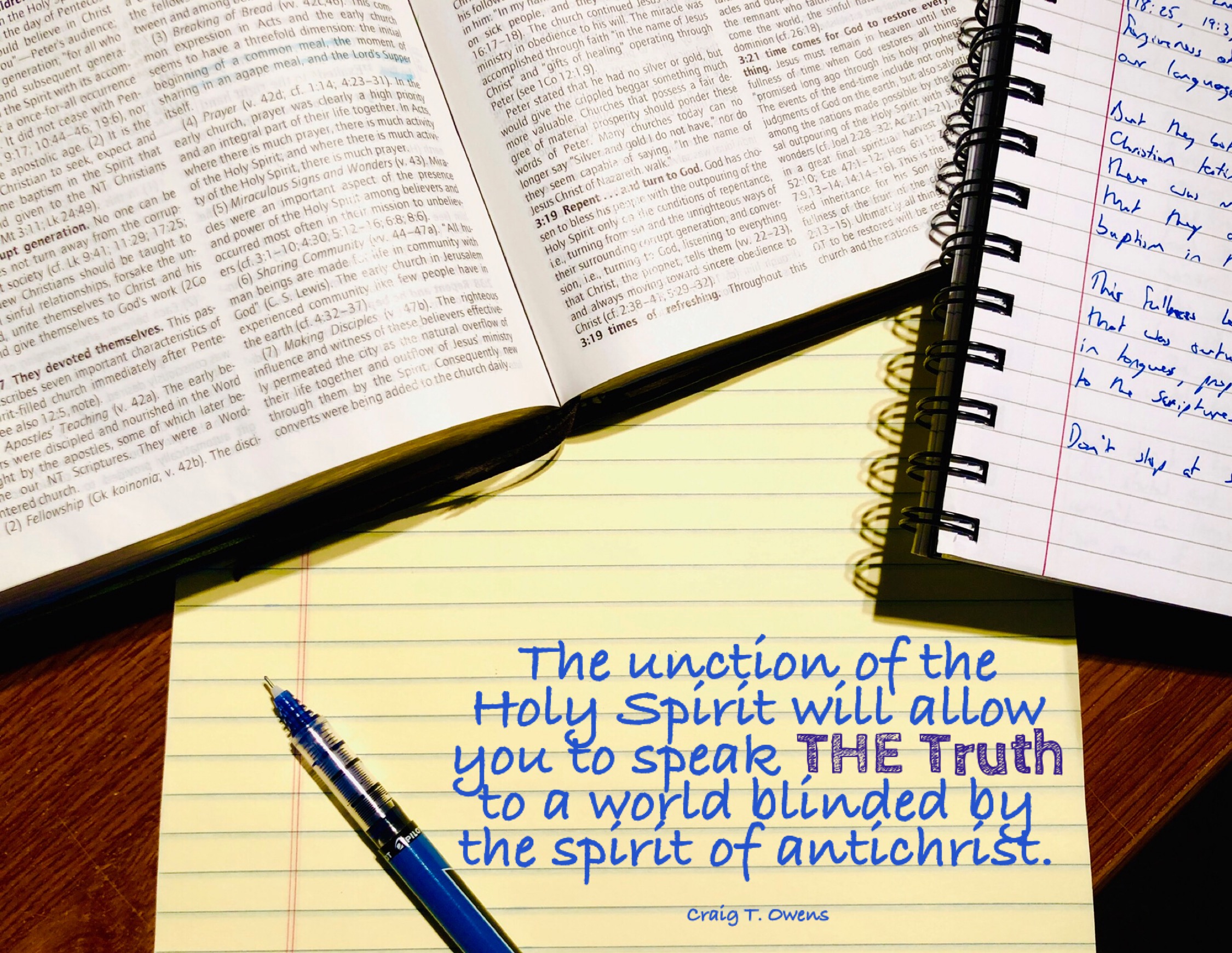
The unction of the Holy Spirit will allow you to speak THE Truth to a world blinded by the spirit of the antichrist. 

If you’ve missed any of the messages in our series We Are: Pentecostal, you can access the full list by clicking here.

►► Would you please prayerfully consider supporting this ministry? ◀︎◀︎
Reversing Entropy

Listen to the podcast of this post by clicking on the player below, and you can also subscribe on Apple or Spotify.

Don’t you wish that you could clean things up and they would stay clean? After you get everything set the way you like it, why can’t it just stay that way? Quite simply, things can’t stay clean and pristine because of the Law of Entropy. Entropy is the measure of disorder in a system, and the Law of Entropy says that unless sufficient energy is applied, an ordered system will always move toward disorder. This is as true spiritually as it is in physics. 

God created a perfectly ordered system both physically and spiritually, but man’s sin brought in disorder, disease, and decay. It gets so bad that just three chapters after man’s first sin we read, “The Lord saw how great the wickedness of the human race had become on the earth, and that every inclination of the thoughts of the human heart was only evil all the time” (Genesis 6:5).  

Throughout history, there have been revivals, reformations, and awakenings where people see the disorder and decay that sin has brought to their lives and they want to return to God. The pain of entropy causes people to repent, and the Spirit of God moves in with sufficient energy to restore. Sadly, unless the Holy Spirit’s energy is continually applied, entropy will again begin to run its downward course. 

Jesus not only came to reverse the entropy of sin (see Isaiah 9:2, 49:9; John 1:5, 8:12), but He sent us out into a sinful world to do the same thing. Jesus told us that we are salt that reverses entropy’s decay and we are light that reverses entropy’s darkness (Matthew 5:13-14). Jesus also told us that there’s no way we can maintain this entropy-reversing energy on our own—we need the Holy Spirit’s empowerment (Luke 24:49; Acts 1:8). [Check out all of these verses by clicking here.] 

Paul talked about this same idea in 2 Corinthians 3. He contrasts the ministry of the Old Testament with its fading glory, and the ministry of the New Testament with terms like more glorious, surpassing glory, and ever-increasing glory. 

Do you realize that Spirit-filled Christians never have to long for “the good ol’ days”? Being baptized in the Holy Spirit means, as Paul reminds us, that we are perpetually being transformed into the image of Jesus and we are therefore reflecting more and more of His glory. Every day can be more glorious than the day before. We don’t have to experience any entropy in our spiritual walk. 

This isn’t because of our actions. Paul says, “not that we are competent in ourselves…but our competence comes from God. … [We] are being transformed into His likeness with ever-increasing glory, which comes from the Lord, who is the Spirit.” 

Spirit-filled Christians are the agents of change in the world IF we are being transformed by the Holy Spirit. In other words, we will tend toward entropy (and uselessness) unless we have the Spirit’s energy continually applied to our lives. 

Being transformed is an ongoing, continual process. We have to have the energy of the Holy Spirit continually at work on us personally to keep us from entropy. And then we’ll be able to reflect that entropy-defeating light to a dark world. 

I’ve said this before, but I’m going to keep on saying it: Don’t stop at salvation—be baptized in the Holy Spirit. Don’t let entropy decay your salt or dim your light. Let the Holy Spirit help you reflect the light Jesus so that you can reverse the entropy of a dark, sinful world. 

If you’ve missed any of the other posts in our series called We Are: Pentecostal, you can access the full list by clicking here.

►► Would you please prayerfully consider supporting this ministry? ◀︎◀︎
An Unmistakable Response

Listen to the podcast of this post by clicking on the player below, and you can also subscribe on Apple or Spotify.

When something goes wrong, the response from most people is pretty predictable, isn’t it? Some try to ignore the problem, some complain about it, many get quite angry, and most people try to find someone or something to blame. 

These responses don’t sound very Christian-like, do they? What many people think the Christian response should be is something closer to the opening words of Rudyard Kipling’s poem—“If you can keep your head when all about you are losing theirs and blaming it on you….” 

And yet, though this sounds Christian-like, it still misses the mark for Spirit-baptized Christians. Remember that a couple of weeks ago I described the baptism in the Holy Spirit as a “distinctive doctrine.” There is nothing distinct about a Christian responding predictably like everyone else does. 

A Spirit-baptized Christian is distinguished by the miraculous ways God confirms His presence in that person’s life. What really honors God is not a predictable response or even a learned response, but an unpredictable, miraculous response: A Spirit-baptized Christian’s response to bad news should be peace and joy. 

I believe the Holy Spirit can so transform our hearts that our response becomes an unmistakable testimony of the power of God. We may experience the initial pang of regret and pain but our next response turns all the focus off of us and on to God.  

The Holy Spirit uses trials to transform our hearts and minds into Christlike thinking and action. 

Our Heavenly Father’s desire is for everyone to come into a close, personal relationship with Him. Before Jesus came this was first pictured for us in the operations of the temple and its sacrifices. Yet man’s attempts to control this hijacked what God intended. This is why we see Jesus acting in righteous anger to clear out the temple of merchants and money-changers (John 2:12-17; Luke 19:45-48). 

Oswald Chambers noted the similarities between what Jesus did in the physical temple and what the Holy Spirit does in our hearts: 

“Immediately the Spirit of God comes in we begin to realize what it means—everything that is not of God has to be cleaned out. People are surprised and say, ‘I asked for the Holy Spirit and expected that He would bring me joy and peace, but I have had a terrible time ever since.’ That is the sign He has come, He is turning out the ‘money-changers,’ that is, the things that make the temple into a trafficking place for self-realization.” 

The Holy Spirit has to disturb our man-made peace so that His peace can take its place. Or as Jesus said, “Do not think that I came to bring peace on earth. I did not come to bring peace but a sword” (Matthew 10:34). 

Jesus told us that the indwelling Holy Spirit would bring about this heart and mind transformation in His followers. The Holy Spirit doesn’t teach us how to respond in a learned, predictable way, but He transforms us to respond in an unmistakably unpredictable way (John 16:12-15, 20-22; 14:26-27). 

The transformed response of the Spirit-baptized Christian is joy in place of anger, and peace in place of frustration (James 1:2-4; Romans 5:3-5). I like how the Amplified Bible defines “blessed” in the Beatitudes Jesus lists in Matthew 5: “happy, to be envied, and spiritually prosperous—with life-joy and satisfaction in God’s favor and salvation, regardless of [the] outward conditions.” 

This transformation brings God glory and is exactly what Jesus prays for us (John 17:13-18), which is why I keep on saying: Don’t stop at salvation—press on to be baptized in the Holy Spirit! 

Your unpredictable, unmistakable peace and joy in the face of trials becomes a testimony to a watching world. 

If you’ve missed any of the posts in our series on the empowerment that comes from being baptized in the Holy Spirit, you can find the full list by clicking here.

►► Would you please prayerfully consider supporting this ministry? ◀︎◀︎

Ruth + Boaz—The Mother’s Day Version

Listen to the podcast of this post by clicking on the player below, and you can also subscribe on Apple or Spotify.

John Maxwell said, “We overestimate what we can do in a day; we underestimate what we can do in a year.” In the case of parents, I think we do the same thing: we lose sight of the big picture when we get bogged down in the details and the pressures of each day. As a result, many times we are unaware of the long-lasting rewards that come from our daily obedience and God’s eternal faithfulness. This was never more true than in the fantastic love story of Ruth + Boaz. 

Last week we looked at the history of Pentecost and what took place 50 days after the Passover, we saw a picture in the Old Testament that was fulfilled in the New Testament. The Jews saw this too. In the Hagiographa (Holy Writings), they picked one of the books of the Old Testament to read at each of the annual Jewish feasts, and the Book of Ruth was selected for Pentecost. I think this was because Ruth herself is in essence a “harvest” of God’s blessing. She is the firstfruits of the non-Jewish people whom God has engrafted into His holy family. 

The story of Ruth’s coming into God’s family is birthed out of heartache. Elimelech and Naomi live in Bethlehem, which means “house of bread,” but it was a time of famine; Elimelech’s name means “God is King,” but Israel had no king and everyone lived for themselves; Naomi’s name means “pleasant,” but her days were bitter (see Judges 21:25; Ruth 1:1-5). 

After Elimelech and his two sons die, Naomi changes her name to Mara (which means bitterness), and yet she hears “that the LORD had come to the aid of His people by providing food for them” (1:6) and she decides to return to Bethlehem. She counsels her daughters-in-law to remain with their families in Moab, but Ruth decides to cling to Naomi. 

In the face of utter hopelessness, Ruth could have chosen what was familiar—her family, her homeland, her gods—but instead she chose to cling to Jehovah. 

Perhaps when she heard that Jehovah had come to the aid of His people she realized, “I’ve never heard of Chemosh coming to the aid of his people. We sacrifice to him but he doesn’t do anything for us. This Jehovah cares for His people. I will put my faith in Him.” 

Ruth’s first step of obedience triggers a whole series of events, starting with one that the writer of this story introduces by saying, “As it turned out, Ruth found herself working in a field belonging to Boaz.” 

But this is no accident—God oversees and directs all of the details. All of history is His story. God is in charge of the tiniest of details: even down to directing Ruth to the right barley field. Ruth’s trust in Jehovah, her obedience in following Him, set things in motion that God had planned, just as Paul explained in Romans 8:28. 

Moms, at the end of the story of your life, you will look back and see so many as-it-turned-out moments. But that means you are living in an as-it-turned-out moment right now. If you believe God is overseeing the details of your life, then every moment is divinely orchestrated by Jehovah, every moment is strategic, every moment is God-directed. You must remain daily obedient to God. 

Don’t underestimate the legacy of God’s provision that is being established every single day that you remain obedient in following Him. Look at the amazing way God used Ruth and Boaz in the family tree of Jesus Christ (Ruth 4:16-22; Matthew 1:1-6).

Moms, your obedience today is preparing your children—and their future generations—for them to experience God’s provision in a coming famine (see Amos 8:11; Psalm 91).

Of course, Ruth can’t give birth to Obed without there being a father, which is why the story is called Ruth + Boaz. On Father’s Day we’ll look at the integrity of Boaz that made this possible too, so please make plans to join me then.

►► Would you please prayerfully consider supporting this ministry? ◀︎◀︎

“It Is Finished”

Listen to the podcast of this post by clicking on the player below, and you can also subscribe on Apple or Spotify.

Just before Jesus said, “I am thirsty,” John tells us that Jesus knew everything written about Him in the law had been completed and all of the prophecies about Him had been fulfilled. Jesus knew this to be true but no one else standing there would have said “Aha!” because of that statement. But Jesus left no doubt for any of us when He next said, “It is finished!

These three English words are just one word in Greek: tetelestai. It’s in the perfect tense, telling us that nothing more needs to be added to Christ’s work. It not only shares the same root word that John uses for completed and fulfilled, but it closes the circle of another dying declaration of Jesus when He quoted Psalm 22:1: “My God, My God, why have You forsaken Me?” His “It is finished” statement is also the last verse of Psalm 22.

The root word telos translated as completed, fulfilled, and finished has a very rich meaning. Here are three definitions we should consider: 

(1) To complete or bring to a conclusion

Jesus told His Father that He had finished (telos) His mission (John 17:4). Q: How do we know His mission was completed? A: Jesus sat down! Think about this: There were no chairs in the Old Testament temple because a priest never rested, there was always more work to do. But when Jesus finished His work, He sat down (see Hebrews 10:1-4, 11-12). 

(2) To discharge a debt

Since Jesus was the only One who could make the final “once for all” payment, that means that we were hopeless debtors prior to that. God foretold of His forgiveness using the picturesque language of a debt being “doubled up” when it was paid in full (see this video where I explain this concept more fully). Here’s what Jesus did: 

Having cancelled and blotted out and wiped away the handwriting of the note with its legal decrees and demands which was in force and stood against us. This note with its regulations, decrees, and demands He set aside and cleared completely out of our way by nailing it to His cross. (Colossians 2:14 AMP) 

Q: How do we know the debt was paid in full? A: The curtain that had separated us from God’s presence was torn in two.

(3) To fill up what’s missing

In this case, Jesus took what was missing by switching cups with us. He drank the cup of God’s righteous wrath—which was justly ours—and gave us His cup of righteousness in its place! (see Isaiah 51:17-22; Matthew 26:39).  

Q: How do we know we have a cup of righteousness in place of a cup of wrath? A: Dead saints of God were resurrected when Jesus died. “It is finished” was not Jesus giving up, but death giving up … it was not Jesus defeated, but death defeated! 

Jesus paid it all! There is nothing I can do to add to His completed—tetelestai—work, so I can now do what formerly was impossible: I can live a holy life for God’s glory. I can now finish (telos) my race on earth and receive the rewards God has stored up for me (see 2 Timothy 4:7-8). 

Christ’s tetelestai confession is our empowerment to live holy! 

If you’ve missed any of the messages in our series looking at the dying declarations of Jesus, you may access the full list by clicking here.

►► Would you please prayerfully consider supporting this ministry? ◀︎◀︎

Thursdays With Spurgeon—Simple Faith Is Still Powerful Faith

This is a weekly series with things I’m reading and pondering from Charles Spurgeon. You can read the original seed thought here, or type “Thursdays With Spurgeon” in the search box to read more entries.

Listen to the podcast of this post by clicking on the player below, and you can also subscribe on iTunes or Spotify.

Simple Faith Is Still Powerful Faith

     I would have you note that the faith that justified Abram was still an imperfect faith, although it perfectly justified him. It was imperfect beforehand, for he had prevaricated as to his wife and bid Sarai, ‘Say you are my sister’ (Genesis 12:13). 

     It was imperfect after it had justified him, for the next chapter we find him taking Hager, his wife’s handmaid, in order to effect the divine purpose, and so showing a lack of confidence in the working of the Lord. It is a blessing for you and for me that we do not need perfect faith to save us! ‘If you have faith as a mustard seed, you will say to this mountain, “Move from here to there,” and it will move; and nothing will be impossible for you’ (Matthew 17:20). If you have but the faith of a little child, it will save you. Though your faith is not always at the same pitch as the patriarch’s when he staggered not at the promise through unbelief, yet if it is simple and true, if it confides alone in the promise of God, it is an unhappy thing that it is no stronger, and you ought daily to pray, ‘Lord, increase my faith,’ but still it will justify you through Christ Jesus! A trembling hand may grasp the cup that bears a healing draught to the lip, but the weakness of the hand will not lessen the power of the medicine.

From Justification By Faith

A prayer that Jesus loved was simply this: “Lord, I believe; help me overcome my unbelief” (Mark 9:14-27). The recognition that Jesus alone could help is the essence of faith. 

I’ve often said that the simplest, most powerful prayer we can pray is, “Lord, help!” In just those two words we are saying, “I cannot do a thing to help myself, but, Lord, I believe Your power is limitless to help me!” 

Small faith is still powerful faith—even faith as small as a mustard seed—because it can move mountains. Childlike faith touches the heart of God. I love how Spurgeon reminds us that the weakness of the hand that grasps the cup promise does not lessen the power of the medicine in the cup. 

The best way to learn to pray in faith is simply to pray in faith. A baby doesn’t wait until he has a fully-formed vocabulary to ask his father or mother for help. Just pray! The Holy Spirit can turn even your childlike prayers into pleasing sounds in your Heavenly Father’s ears. 

Maybe you could paraphrase that father who was in desperate need of Christ’s help, “Lord, I am praying; help me to keep on praying!

►► Would you please prayerfully consider supporting this ministry? ◀︎◀︎

 

“I Am Thirsty”

Listen to the podcast of this post by clicking on the player below, and you can also subscribe on Apple or Spotify.

Jesus has just broken a 3-hour silence with His megaphone-voice cry: “My God, My God, why have You forsaken Me?” Now His final three statements will follow in rather short order, beginning with, “I am thirsty.”

It might seem trivial that Jesus expressed His desire for a drink, especially since He also knew that there was no thirst-quenching water nearby. Far from being trivial, however, this was eternally important because it completed His mission. 

Before saying, “I am thirsty,” John tells us that Jesus knew “that all was now completed.” The Greek word for know is sometimes translated as “see” and sometimes “know.” When it’s “see” it’s always in the past tense—“saw” or “have seen.” Perhaps in His 3-hour silence, Jesus was reviewing His earthly life, looking back to see what He had accomplished. Make no mistake about it, Jesus was on-mission for all 30+ years of His life in Israel. 

But now that He has seen His life, He “knows.” This word is in the perfect tense. He’s seen it all and He knows He has accomplished all He set out to complete. As He had told His audience earlier in His life, “For assuredly, I say to you, till heaven and earth pass away, one jot or one tittle will by no means pass from the law till ALL is fulfilled” (Matthew 5:18). 

In looking back on His life, Jesus saw one final thing: He needed to be given vinegar to drink just as David prophesied (Psalm 69:13-21). With that sour sip, ALL the Ts are crossed and ALL the Is are dotted! 

When John writes, “Knowing all was now completed, and so the Scripture would be fulfilled,” he uses the Greek word which means mission accomplished! 

Why did Jesus need to fulfill ALL the prophecies and complete ALL the law? Check out His earlier statement from the Amplified Bible: “For truly I tell you, until the sky and earth pass away and perish, not one smallest letter nor one little hook identifying certain Hebrew letters will pass from the Law until all things it FORESHADOWS are accomplished.” 

The law was just our temporary guardian and the temple practices were just a shadow of the realities of Heaven (see Galatians 3:23-25; Hebrews 10:1-10). ALL of them were merely pointing to Jesus, so Jesus made sure ALL of them were completed. 

His “I am thirsty” statement was really His “Amen” to His completed mission. 

Jesus fulfilled every Scripture so that we could stand on every promise! 

Check this out: “For no matter how many promises God has made, they are ‘Yes’ in Christ. And so through Him the ‘Amen’ is spoken by us to God” (2 Corinthians 1:20). 

The shadows of the law were turned into the substance on which we can come boldly before the throne of God’s grace! In just three words—“I am thirsty”—Jesus completed His mission for God’s glory and for our eternal help! 

If you’ve missed any of the messages in our series on the dying confessions of Jesus from the Cross, you can access the full list by clicking here.

►► Would you please prayerfully consider supporting this ministry? ◀︎◀︎