Failure To Recognize

The Apostle John opens his gospel account with these sobering words:

[Jesus] was in the world, and though the world was made through Him, the world did not recognize Him. (John 1:10)

Commenting on this verse, A.W. Tozer wrote:

My fellow man, do you not know that your great sin is this: the all-pervading and eternal Presence is here, and you cannot feel Him? Are you not aware that there is a great and true Light which brightly shines—and you cannot see it? Have you not heard within your being a tender Voice whispering of the eternal value of your soul—and yet you have said, “I have heard nothing”? This is, in essence, the charge that John levels at human kind: Jesus Christ, the Word of God, was in the world, and the world failed to recognize Him.

I never want to be guilty of failing to recognize Jesus! Sometimes in the busyness of life—even the busyness of the ministry of the church—I can become guilty of being focused on the activity, instead of focusing on Christ, Who is supposed to be the focus of my activity.

So we’re taking a “time out” today. As a church we are fasting and praying for 24-hours to cleanse our hearts to recognize Jesus, and to recognize what He wants to accomplish as we commemorate Good Friday and Resurrection Sunday later this month.

Thursdays With Oswald—Spiritual Overloading

This is a weekly series with things I’m reading and pondering from Oswald Chambers. You can read the original seed thought here, or type “Thursdays With Oswald” in the search box to read more entries.

Spiritual Overloading

       One continually finds an encroachment of beliefs and of attachment to things which is so much spiritual overloading. Every now and again the Spirit of God calls us to take a spiritual stock-taking in order to see what beliefs we can do without. The things our Lord asks us to believe are remarkably few, and John 14:1 seems to sum them up—“Ye believe in God, believe also in Me.” We have to keep ourselves alertly detached from everything that would encroach on that belief; we all have intellectual and affectionate affinities that keep us detached from Jesus Christ instead of attached to Him. We have to maintain an alert spiritual fighting trim.

From Facing Reality

Probably because I’m still studying and preparing for our Overloaded series, but I’ve been especially tuned into to the idea of all sorts of overload… even (especially) spiritual overloading. I never want to fall victim to the same trap the Pharisees were in:

Then Jesus said to the crowds and to His disciples, “The teachers of religious law and the Pharisees are the official interpreters of the law of Moses. So practice and obey whatever they tell you, but don’t follow their example. For they don’t practice what they teach. They crush people with unbearable religious demands and never lift a finger to ease the burden.” (Matthew 23:1-4)

I don’t want to overload myself; nor do I want to overload those I teach. So I’m taking a hard look in the mirror—and listening closely to the Holy Spirit—about those spiritual overloading things that may be crushing me.

Happy To See You

Do you like being around people? Or maybe a better question is: Do people like being around you?

In the case of Jesus, the answers are “yes” and “yes.” Check this out:

When Jesus returned to Capernaum several days later, the news spread quickly that He was back home. Soon the house where He was staying was so packed with visitors that there was no more room, even outside the door. (Mark 2:1-2)

People like being with Jesus.

They invited Him to their weddings

They invited Him to their parties

They invited Him to their dinners

And when Jesus showed up somewhere, people flocked to that house.

If you and I are Christians—followers of Jesus Christ—the same thing should be said of us: People should like having us around, and they should like being around us.

Land Of Smoke

Guest Blogger: Dick Brogden

Greetings From the Land of Smoke,

A Christian handed a Bible to a Northern Sudanese Muslim Arab who declined to receive it saying, “I have a smoking problem. If I take the Bible, I will just rip out the pages, make cigarettes, and smoke them.”

Thanks be to God, the distributor did not stand on niceties and responded, “No problem, go ahead and rip the pages out to make your cigarettes. But before you roll them, make sure to read the page you ripped out.”

The Muslim man agreed, took the Bible and began to contemplatively smoke his way through the Gospels. Daily he would rip out a page, peruse it, then roll it into a cigarette and puff away. Matthew, Mark, and Luke all were read and then immolated. By the time the smoker had inhaled his way into John, the Holy Spirit had begun to draw as well. John 3:16 was the clincher—it was after smoking that chapter and verse that this Muslim man gave his heart to Jesus.

I guess it goes to prove that where there’s smoke, there is fire!

Dick Brogden and his family have served as missionaries in Sudan for 15 years.

How Noble Do You Want To Be?

Sometimes I find the most thought-provoking phrases buried in the middle of passages in the Bible that seem somewhat obscure. Take this line from the book of Nehemiah, where we read who’s rebuilding which section of the Jerusalem wall…

The next section was repaired by the men of Tekoa, but their nobles would not put their shoulders to the work under their supervisors.

This chapter lists all kinds of people working on the wall: priests (including the high priest) … goldsmiths … perfume-makers … temple servants … mayors … even Shallum’s daughters. Everyone, it seems, was willing to pitch in except these nobles.

Many times in the Old Testament this Hebrew word for nobles is used to describe God Himself. In other words, these nobles thought they were far too important to put their shoulders to the work.

Jesus washed feet. The noblest of us all came to earth to serve even the lowest of the servants.

Which do you think was really the most noble?

How noble do you want to be?

Baaaa!

Listen to the podcast of this post by clicking on the player below, and you can also subscribe on AppleSpotify, or Audible.

Of all the things God could have used as a picture of our relationship with Him, He used an animal. And, no, it wasn’t an animal that seems particularly powerful or smart or noble.

He picked a sheep.

A fuzzy, sometimes dimwitted, needs-a-lot-of-help animal.

I’m a sheep. Baaaa!

But then I have the great picture of God as my loving Shepherd. How wonderful to know that the Lord is my Shepherd, I shall not be in want!

As a pastor I am called to be the shepherd to God’s flock of sheep under my watchful eye. Jesus set the example for me:

But the one who enters through the gate is the shepherd of the sheep. The gatekeeper opens the gate for him, and the sheep recognize his voice and come to him. He calls his own sheep by name and leads them out. After he has gathered his own flock, he walks ahead of them, and they follow him because they know his voice.

And Solomon said:

Be sure you know the condition of your flocks, give careful attention to your herds.

Pastors, here are the questions I’m asking of myself, and I invite you to ask them of yourself too:

  • Do my sheep recognize my voice? Or am I trying to sound like someone else?
  • Do I know all my sheep by name?
  • Are my sheep following me as I follow Jesus?
  • Am I willing to go first?
  • Do I find fresh pastures and clean water for my sheep? Or is it recycled food I’m serving them?
  • Am I spending enough time with my sheep to know the condition of each one?
  • Do my sheep get my undivided attention?

What a privilege to be a pastor! What a responsibility! What a joy to know my sheep and to be known by them!

Baaaa!

UPDATE: This post was one of the seed thoughts that went into fashioning my book Shepherd Leadership: The Metrics That Really Matter.

►► Would you please prayerfully consider supporting this ministry? ◀︎◀︎

Sin

I know in politically correct circles it’s not very chic to talk about sin. After all, we’re not supposed to impose our personal values on someone else, right?

Well, I do believe in right and wrong, and the wrong is called sin. So if you are offended by me calling something sin, it would be best for you to stop reading now.

Are you still with me? Then read this: satan…incited David to sin… (1 Chronicles 21:1).

Incited means this wasn’t a straight-up fight. Sin seldom makes a bold, in-your-face attack. Sin isn’t really an ambush. It’s sort of a whispering campaign.

  • Sin is an appeal to ego
  • Sin is a half-truth
  • Sin is an attempt to be subtle
  • Sin is so innocent looking

The Bible says satan lurks like a lion in the underbrush (1 Peter 5:8).

He waits for the perfect opportunity to strike (Luke 4:13).

satan is sneaky (Genesis 3:1).

He lies (John 8:44).

He distorts the truth (Luke 4:9-11).

That’s why I cannot give sin an inch. I have to take every thought captive (2 Corinthians 10:5), and pull everything into the light of The Truth (John 3:20-21).

[Check out all of these verses by clicking here]

It’s not usually the blatant sin that brings down great men and women, but the subtle. So stay on your guard. Always!

Yummy

It’s noon, He’s hot and thirsty after a lengthy journey and some intense ministry, so Jesus sits down by a well to get a drink. He’s hungry too, so He sends His disciples into town to buy some lunch. Along comes a woman from the town, whom Jesus engages in conversation about eternal life. (It’s a really cool story—read the whole thing here.)

While this woman runs back into town to invite others to come hear what Jesus has to say, the disciples return with lunch.

“Here, Jesus,” they say, handing Him some food, “eat something.”

“No, thanks,” Jesus replies, “I’m not that hungry right now.”

The disciples start talking among themselves, “What? Where did He get food? Did someone bring Him something to eat?”

Jesus overhears them and makes this fascinating statement:

The food that keeps Me going is that I do the will of the One who sent Me, finishing the work He started.

What nourished Jesus was feeling the Father’s approval.

What energized Jesus was seeing other people begin to understand the Father’s love for them.

What motivated Jesus was to take every opportunity to tell someone else about God’s love.

Finishing the work that God started is good and good for you.

It’s yummy and it’s nourishing!

So I’m asking myself:

  • What nourishes me?
  • What energizes me?
  • What motivates me?
  • What is so fulfilling that I cannot go a day without it?

My prayer—my heart’s desire—is that the answer to all of these questions every single day is finishing the work of God in my generation.

Anger That Crosses The Line

Last night in our Bible study we looked at some words that David penned when he was angry. He was on the run from his son Absalom, and it seemed like everywhere he turned people were after him, or slandering him, or just doing their best to make him miserable. Yet in two back-to-back Psalms David says, “I lay down every evening and get a great night of rest.”

His sweet sleep comes from a moment of reflection before dozing off. He says:

In your anger do not sin; when you are on your beds, search your hearts and be silent. Selah.

  • Did my anger today cross the line into sin?
  • Am I allowing the time for the Holy Spirit to search my heart?
  • When the Holy Spirit points out where my anger crossed the line, do I justify my anger, or am I silent?

How do we know if our anger has not crossed that line and become sin?

Aristotle wrote, “Anybody can become angry—that is easy; but to be angry with the right person, and to the right degree, and at the right time, and for the right purpose, and in the right way—that is not within everybody’s power and is not easy.”

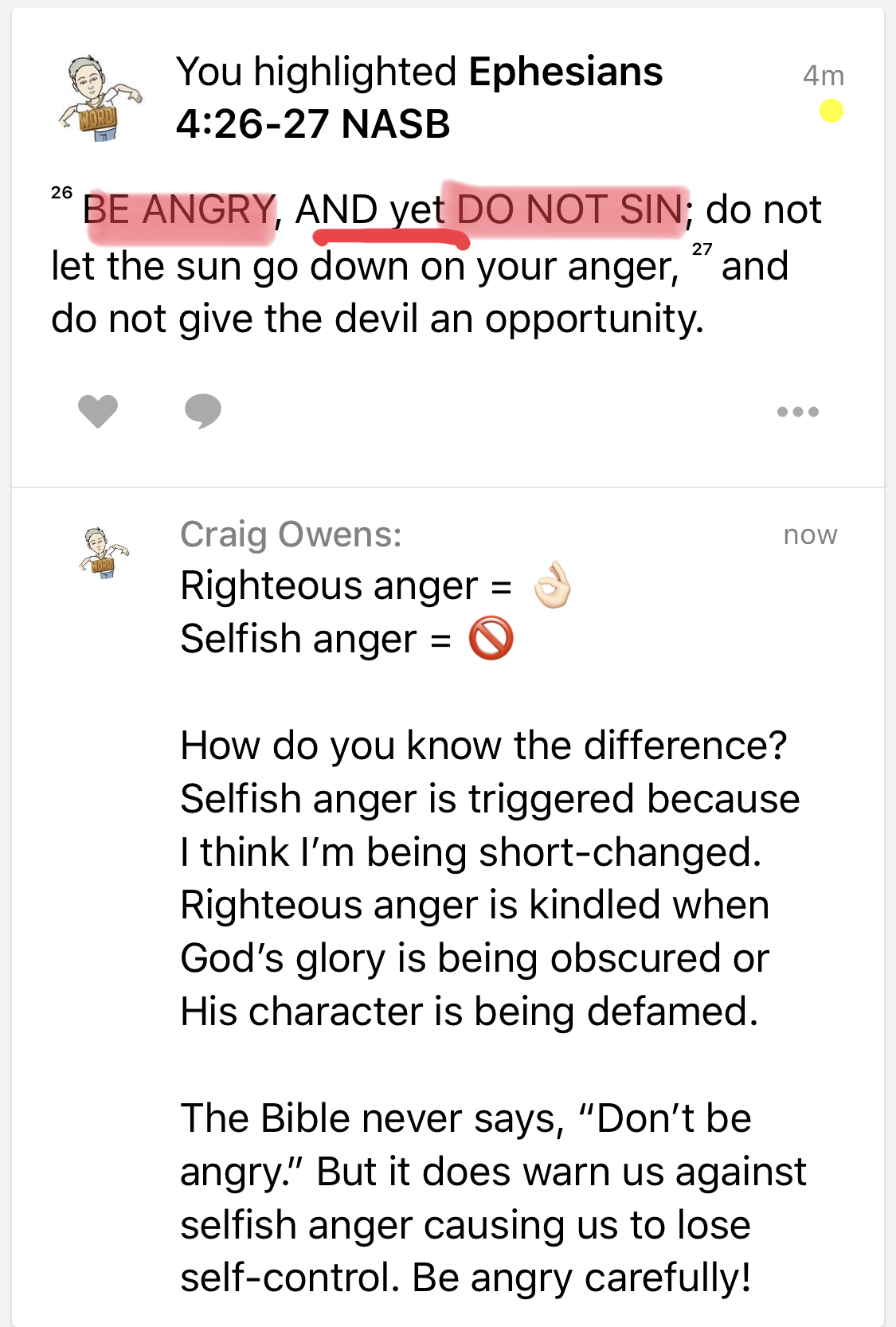
Being angry is not the issue. David said it (and Paul quoted it in Ephesians 4:26): “Be angry; just don’t sin.” God gets angry, but He does not sin. Jesus, in His public ministry, got angry, but He did not sin. We need to search our hearts to make sure our anger has not crossed the line to sin. We have to be angry in a godly way.

I see at least four ways to become angry without crossing the line into sin:

1.  Selfless Anger = anger at sin, but not angry at the sinner.

Love is not rude, it is not self-seeking, it is not easily angered, it keeps no record of wrongs. Love does not delight in evil but rejoices with the truth. (1 Corinthians 13:5, 6)

2.  Slow Anger = lengthen your fuse a bit.

Do not be quickly provoked in your spirit, for anger resides in the lap of fools. (Ecclesiastes 7:9)

My dear brothers, take note of this: Everyone should be quick to listen, slow to speak and slow to become angry, for man’s anger does not bring about the righteous life that God desires. (James 1:19, 20)

Good advice from Thomas Jefferson: “When angry, count to ten before you speak; if very angry, a hundred.”

3.  Protective Anger = when sinners entice others to join them in their sin. God is sad when people leave Him; He is angry at them when they take others with them.

But they put God to the test and rebelled against the Most High; they did not keep His statutes. Like their fathers they were disloyal and faithless, as unreliable as a faulty bow. They angered Him with their high places; they aroused His jealousy with their idols. When God heard them, He was very angry; He rejected Israel completely. (Psalm 78:56-59)

4.  Righteous Anger = against those who are keeping others from coming closer to God.

For I endure scorn for Your sake, and shame covers my face. I am a stranger to my brothers, an alien to my own mother’s sons; for zeal for Your house consumes me, and the insults of those who insult You fall on me. (Psalm 69:7-9)

This verse was recalled by Jesus’ disciples when they saw Him get angry and clear out the Temple in Jerusalem. Jesus was angry because of the religious clutter that was keeping God’s house from being a house of prayer for all nations.

I think everyone is familiar with the acrostic WWJD = What Would Jesus Do?

I’d like to propose something similar: WGGA = Would God Get Angry?

This is a great question to ask to make sure our anger does not cross that line into sin. Get angry—in a godly way—and do not sin.

Standing On A Promise

Just before Joshua’s farewell address to the Israelites, he makes one final comment to sum up the whole campaign that secured Israel’s borders—

Not one of all the Lord’s good promises to the house of Israel failed; every one was fulfilled.

Every one.

You can trust God! You can stand on His promises. They will not fail; they will all be fulfilled.

Dr. Robert Lockyear estimates that there are 7,457 promises of God in the Bible!

Which one are you standing on today? Get into God’s Word, and let His promises get into you. Write them down. Memorize them. Repeat them again and again. Believe that not one of all the Lord’s good promises will fail.

Here are a few you can stand on:

  • He forgets your forgiven sins.
  • He will give you abundant life now, and eternal life later.
  • Nothing can separate you from His love.
  • All things are working together for the good for those who love God.
  • He will never leave or forsake you.
  • He will continue to develop the best in you.
  • He will never place you in a situation where you cannot stand.

(check out all of the biblical references for these promises by clicking here)

“We take away from this most precious promise, and, by refusing to take it in its fullness lose the fullness of its application and power. Then we limit God’s power to keep: we look at our frailty more than His omnipotence. Where is the line to be drawn, beyond which He is not ‘able’? Why should we pare down the promises of God to the level of what we have hitherto experienced of what God is ‘able to do,’ or even what we have thought He might be able to do for us? Why not receive God’s promises, nothing doubting, just as they stand?” —Frances Ridley Havergal

What promise are you standing on today?