Inspiration, Illumination, And Boldness

Listen to the podcast of this post by clicking on the player below, and you can also subscribe on AppleSpotify, or Audible. 

David declared that the Holy Spirit inspired the words he penned. “The Spirit of the Lord spoke in and by me, and His word was upon my tongue” (2 Samuel 23:2). 

Both Jesus and Peter affirm this in the New Testament as well when they make mention that David’s words were given to him by the Holy Spirit (Matthew 22:43; Mark 12:36; Acts 1:16, 4:25). 

It’s not just the words of David, but all Scripture is God-breathed (2 Timothy 3:16; 2 Peter 1:21)! This is why we would be wise to pray before reading our Bibles to ask the One Who inspired the Scripture to illuminate our minds to understand it and guide us into its daily application (John 14:26, 16:13). 

Jesus desired that we go even farther than this. His directive to His followers was for them to be baptized in the Holy Spirit. This initial baptism took place on the first Pentecost celebration after Jesus had ascended to Heaven. Luke records it this way—

And they were all filled (diffused throughout their souls) with the Holy Spirit and began to speak in other (different, foreign) languages (tongues), as the Spirit kept giving them clear and loud expression in each tongue in appropriate words. (Acts 2:4 AMPC) 

And in the subsequent verses Luke makes it clear that these were intelligible languages and intelligent words that served as a testimony to the worldwide visitors that were in Jerusalem—

And when this sound was heard, the multitude came together and they were astonished and bewildered, because each one heard them—the apostles—speaking in his own particular dialect. And they were beside themselves with amazement, saying, “Are not all these who are talking Galileans? Then how is it that we hear, each of us, in our own (particular) dialect to which we were born? Parthians and Medes and Elamites and inhabitants of Mesopotamia, Judea and Cappadocia, Pontus and the province of Asia, Phrygia and Pamphylia, Egypt and the parts of Libya about Cyrene, and the transient residents from Rome, both Jews and the proselytes to Judaism from other religions, Cretans and Arabians too—we all hear them speaking in our own native tongues and telling of the mighty works of God!” (vv. 6-11 AMPC) 

In his sermon that followed this event, Peter states that the baptism in the Holy Spirit—with the physical evidence of speaking in tongues—is an evidence of Christ’s resurrection. “Being therefore lifted high by and to the right hand of God, and having received from the Father the promised blessing which is the Holy Spirit, He has made this outpouring which you yourselves both see and hear” (v. 33). 

Later on, when the Christians were facing the threat of persecution from the Jewish leadership, they prayed. In their prayer, they noted again the Spirit-inspired words that David penned and the desire of Jesus for them to be His missionaries (see Acts 4:24-30). 

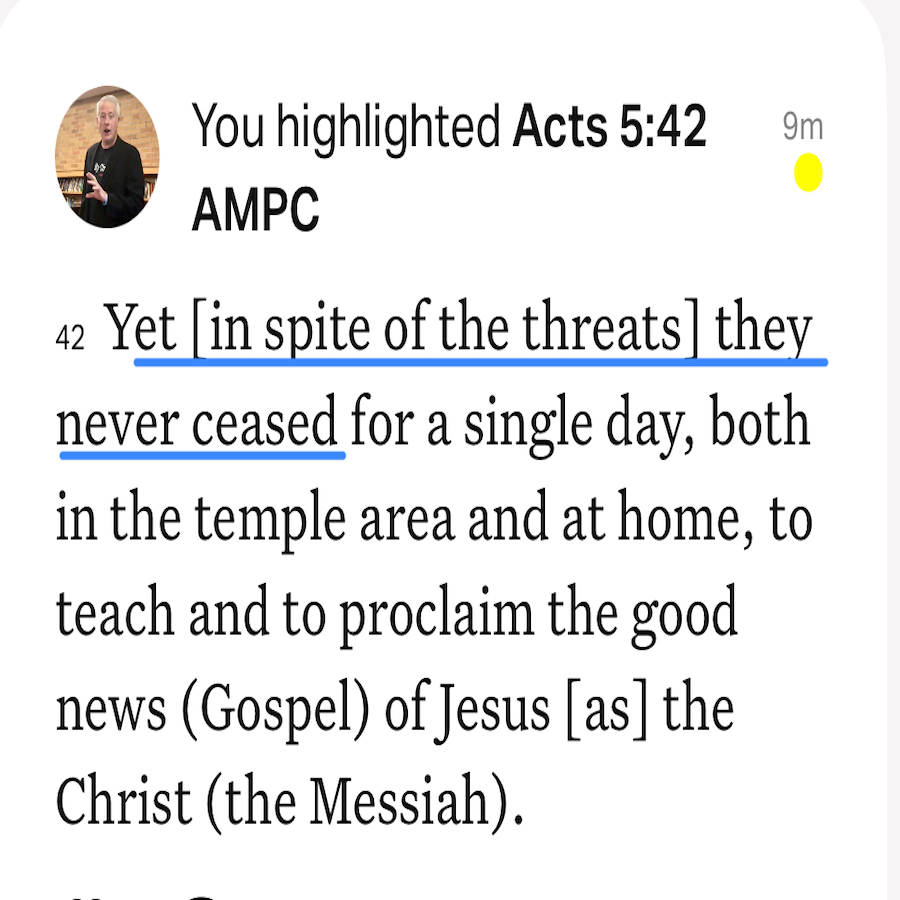
God answers their prayer powerfully! “And when they had prayed, the place in which they were assembled was shaken; and they were all filled with the Holy Spirit, and they continued to speak the word of God with freedom and boldness and courage” (v. 31). 

The Holy Spirit gave us the Scripture, and He illuminates the Scripture to us. 

The Holy Spirit assures us of our salvation, and He empowers us to share this Good News with others. 

The Holy Spirit gives us words to speak, and He gives us the boldness and courage to speak them. 

He speaks, He illuminates, He empowers, He emboldens! If your theology limits the work of the Holy Spirit to some obscure corner of your world, you are robbing yourself of the power to live a God-glorifying, Jesus-promoting life. 

You may be interested in some additional posts and sermons where I discuss more about the initial physical evidence of speaking in tongues as the Holy Spirit empowers Christians—

You may also be interested in an extensive series of messages I have shared called We Are: Pentecostal. 

►► Would you please prayerfully consider supporting this ministry? My Patreon supporters get behind-the-scenes access to exclusive materials. ◀︎◀︎

The Father’s Business

Listen to the podcast of this post by clicking on the player below, and you can also subscribe on AppleSpotify, or Audible. 

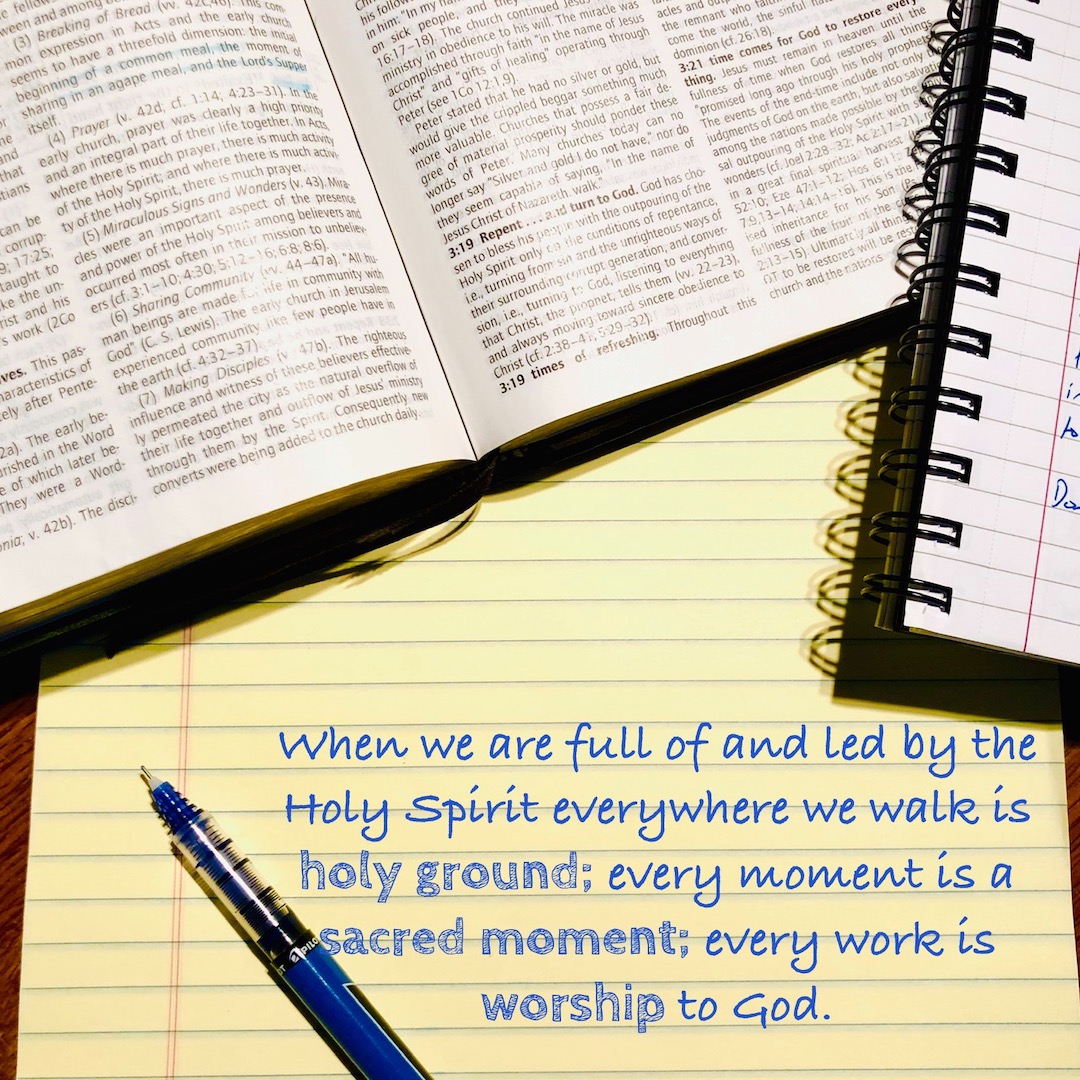
The Holy Spirit’s involvement in our lives isn’t reserved for just the “big” things, but He wants us to be aware of and tuned in to His voice and His thoughts all the time. There shouldn’t be a secular-sacred divide in our activities, but we should make every place holy ground and every moment a divine opportunity for God to be glorified. Or said another way, we shouldn’t have times of work and times of worship, but our worship should be seen in every single thing we do. 

I think everyone of us has experienced at one time or another a poor employer or manager. Maybe it’s an employer that demands results but doesn’t give you the training or the tools to do the job. Or maybe you have the training and tools but you don’t know exactly how much you are able to use these things without crossing a line. 

Maybe you have known a boss that is barely present, but when they do stop by the worksite, they aren’t happy with the work that has been done. On the opposite side, maybe it’s a boss who does everything and then gets mad that you aren’t keeping up or working as hard as them. It’s drudgery working for someone like this! 

But, somewhat surprisingly, Jesus used more work examples to talk about the Kingdom of God than He did worship examples. He talked about farmers, bakers, builders, employers, managers, and employees way more than about worshiping, singing, or preaching. 

One of the few glimpses we have of the early life of Jesus shows Him talking about His mission while on earth. Consider the story of Jesus in the temple in Jerusalem when He was 12 years old (Luke 2:41-49). The phrase in the NIV where Jesus says that He must be “in My Father’s house” can be translated…

  • about My Father’s business (NKJV) 
  • dealing with the things of My Father (MSG) 
  • occupied about My Father’s business (AMPC) 

(Check out all of the Scriptures in this post by clicking here.)

Jesus was consistent about this idea of working while He was on earth (John 5:17, 36; 9:4; 17:4). For Jesus, His work was a delight because it was directed by the Holy Spirit (Luke 3:21-22; 4:1, 18-19; Acts 10:38). 

Remember that I mentioned the unreasonable employer that gives us no training, no tools, no goals for which to aim, but expects us to work for his benefit alone. This was not the case with Jesus! He trained us, provided us with the Holy Spirit to guide us, told us the goal for which we were to aim, and said that both His Father would be glorified and we would be rewarded by our Kingdom work done on earth. 

Jesus wants us to work as He did, and He promised that the Holy Spirit would help us in this (John 14:10-12, 24:49; Mark 16:19-20). 

We saw that Luke 2:49 in the AMPC has Jesus saying, “occupied about My Father’s business.” In Luke 19:13 Jesus tells us to “occupy till I come” (KJV). This word is also translated into phrases like: 

  • put this money to work (NIV) 
  • do business (NKJV) 
  • invest this (NLT) 

Jesus is talking about the “talents” given to His stewards (Luke 19:11-13, 16-23). Every servant received the same thing: one mina. We all have been given one life to live; we all have been given 24 hours in a day; we all have been given opportunities to be occupied about our Father’s business. 

The Holy Spirit as our Counselor is there at every moment, every conversation, every decision to help us hear His voice, think His thoughts, and sanctify every experience. Jesus says that He will reward our occupying until He returns. Just doing things like feeding the hungry, giving water to the thirsty, taking care of those in need. This sounds a lot like the work of Jesus in Luke 4:18-19 and Acts 10:38. This Spirit-empowered work earns the commendation from our Master, “Well done, good and faithful servant! Enter into your Master’s happiness!” 

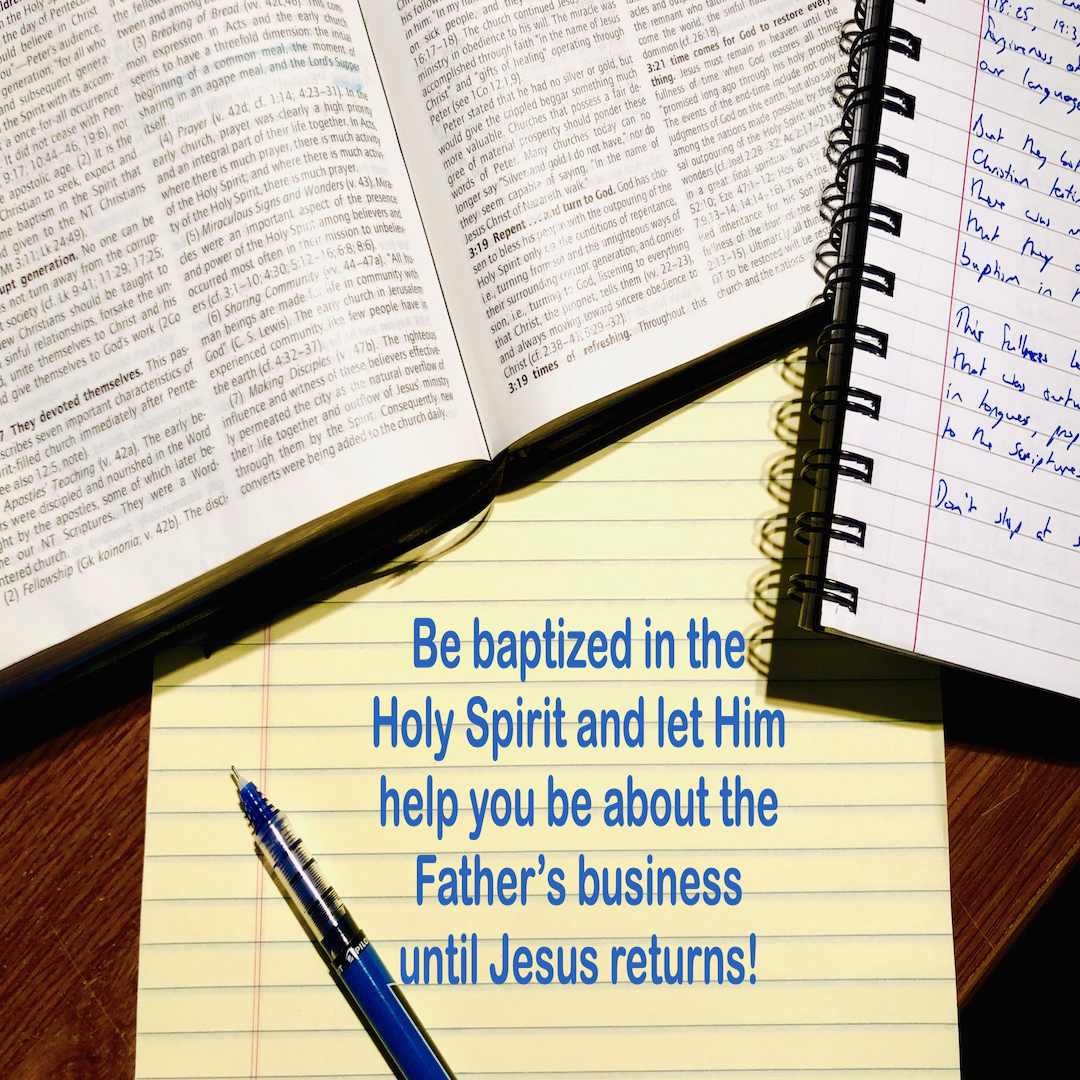
Be baptized in the Holy Spirit and let Him help you be about your Father’s business until Jesus returns. 

If you’ve missed any of the messages in our We Are: Pentecostal series, you can check them all out here. 

►► Would you please prayerfully consider supporting this ministry? My Patreon supporters get behind-the-scenes access to exclusive materials. ◀︎◀︎

Eyewitnesses And Embarrassment

Listen to the podcast of this post by clicking on the player below, and you can also subscribe on AppleSpotify, or Audible. 

In his Gospel, John gives eyewitness testimony to the physical death of Jesus. “Instead, one of the soldiers pierced Jesus’ side with a spear, bringing a sudden flow of blood and water. The man who saw it has given testimony, and his testimony is true. He knows that he tells the truth, and he testifies so that you also may believe” (John 19:34-35). 

John was at Calvary to report this event as an eyewitness, and so were the women who had been so involved with the public ministry of Jesus. 

Matthew, however, was not there. He ran away when Jesus was arrested. So in his historical account, he shares the eyewitness testimony of those who were there—

When the centurion and those with him who were guarding Jesus saw the earthquake and all that had happened, they were terrified, and exclaimed, ‘Surely He was the Son of God!’ Many women were there, watching from a distance. They had followed Jesus from Galilee to care for His needs. Among them were Mary Magdalene, Mary the mother of James and Joseph, and the mother of Zebedee’s sons. (Matthew 27:54-56)

These details in both Matthew and John’s Gospels are what lends credibility to this whole event. I’m sure it was embarrassing to Matthew for him to admit, “I ran away and hid in fear.” I’m sure it pained him again and again when he heard John, the women, and the Roman centurion recounting their eyewitness testimony. 

But this is what makes the reporting of this account real. 

If Matthew and John were attempting to perpetuate a hoax on the world—if they were concocting a conspiracy to fool people about the resurrection of Jesus—they certainly would have told their stories the same way. Matthew could have inserted himself as personally there on Calvary. John and Mark could have listed the names of the other disciples as eyewitnesses. The disciples could have given falsified information to Luke for his Gospel. And all of them could have left out the part about the female testimony, since in their day women were deemed unreliable witnesses in the courtroom. 

The fact that all four of the Gospels relate their accounts as they do—with the embarrassing details intermingled with the eyewitness accounts—is precisely what gives legitimacy to this historical event. 

Details like these are just another factor in a long, long list of evidences that attest to the historicity of all that is recorded in the Bible. 

Earlier in his Gospel, Matthew tells about the doubts of John the Baptizer (Matthew 11:2-6). John was imprisoned and sent his friends to ask Jesus, “Are You really the One?” Jesus sends John’s friends back with eyewitness testimony, and with these words: “Blessed is anyone who does not stumble on account of Me” (v. 6). 

The testimonies of both eyewitnesses and those who were embarrassed that they couldn’t give eyewitness testimony should bolster your faith in all that the Bible says. If you don’t stumble away from these testimonies, you can know the blessing of your faith in Jesus. 

►► Would you please prayerfully consider supporting this ministry? My Patreon supporters get behind-the-scenes access to exclusive materials. ◀︎◀︎

Sanctified Experiences

Listen to the podcast of this post by clicking on the player below, and you can also subscribe on AppleSpotify, or Audible. 

Even with the Voice of the Holy Spirit in our ear and the Mind of God giving us insight, we still “miss it” sometimes. Maybe it’s fear or impatience or immaturity, but we try something on our own and the results are painful. 

I like the maxim, “Sometimes you win, sometimes you learn.” It’s true, but in order to learn I need a proper lens or a wise tutor to help discover those lessons from my experiences. This is what the Holy Spirit does for us: He helps us make senses of our “misses.” Otherwise, if I don’t learn from these painful experiences I will become either arrogant and God opposes this kind of pride (Proverbs 14:7; James 4:6a), or I remain ignorant (Proverbs 15:32; James 4:6b). 

(Check out all of the biblical references in this post by clicking here.) 

Peter heard from Jesus that the baptism of the Holy Spirit was intended to empower the Christians to take the Good News of Jesus to all people—including Gentiles. Peter struggled with this part, as would all good Jews. In their minds, Gentiles weren’t eligible for the blessings of God, especially not the gift of eternal life which would allow them to be in God’s presence forever! 

Before we look at Peter, we need to remember what was happening with Saul/Paul at the same time. Saul met Jesus (Acts 9:3-15), and he then went to Jerusalem (vv. 26-28; Galatians 1:13-19). 

Now let’s go back to Peter. He had just seen a vision from God and heard the Voice of the Spirit (Acts 10:9-16, 19-20). In obedience to this Voice, he went to Cornelius’ house and was given the Mind of God to preach to them. These Gentiles not only accepted Jesus as their Savior but were baptized in the Holy Spirit (vv. 44-48). 

Now let’s switch back to Paul for a moment. Antioch became the home base for Paul and Barnabas (where the believers were first called Christians), and apparently there was a large Gentile population there. At one point, Peter came to visit and struggled with whether or not the Gentile Christians must then convert to Judaism. Peter was struggling with obedience to the vision that God had shown him, his disobedience was beginning to affect others (including Barnabas), and Paul called Peter out on this (Galatians 2:1, 7-14). 

Back in Jerusalem, the Jewish Christians were insisting that the Gentile Christians become Jews. It was this controversy that prompted the Jerusalem Council. At this Council, Peter responded like one who had throughly learned a lesson from his previous “miss” (Acts 15:5-11). 

I like this verse in the Amplified Bible, particularly one phrase: I will praise and give thanks to You with uprightness of heart when I learn by sanctified experiences Your righteous judgments (Psalm 119:7 AMPC). 

Sanctified experiences. A “miss” that the Holy Spirit uses to teach us. The “miss” has been sanctified to become a learning experience. This is what Jesus said the Spirit of Truth would do for us (John 16:13). 

There are things we simply experience, and then there are “sanctified experiences” where the Holy Spirit teaches us an invaluable lesson. These sanctified experiences are what the Holy Spirit uses to bring our thought and conduct into alignment with the perfect standard of God’s Word. 

The Holy Spirit never condemns us for our missteps (Romans 8:1), but uses them for God’s glory (v. 28). 

Just as Paul had to help Peter learn to pay attention to the Voice of the Spirit, the Holy Spirit wants to make us learner-teachers as well. In Psalm 119:7 the Hebrew word for “learn” is lamad which is also the word for “teach.” In other words, I’ve learned it well enough to teach it to another person. Even David with his sinful behavior—a really big “miss”—learned from the lesson from the Spirit of God so well that he could teach others (Psalm 51:10-13). 

Spirit-baptized Christians can lean into the Spirit of Truth to help them learn sanctified experiences from even the difficult things that have happened to them. 

If you’ve missed any of the other lessons in this series, you can find them all here. 

►► Would you please prayerfully consider supporting this ministry? My Patreon supporters get behind-the-scenes access to exclusive materials. ◀︎◀︎

The Mind Of God

Listen to the podcast of this post by clicking on the player below, and you can also subscribe on AppleSpotify, or Audible. 

Last week we talked about the Voice of the Holy Spirit. I love the phrase from 1 Samuel 9:15 where God “told Samuel in his ear” about Saul’s arrival and what he should say to Saul. Then the Holy Spirit’s Voice for all of us is foretold in Isaiah 30:21. 

It’s great hearing the Spirit’s Voice, but He also empowers us to know the Mind of God. 

This is not something that automatically comes to every Christian at the moment they invite Jesus to be their Lord and Savior, as we see mention of immature Christians throughout the New Testament. 

Even after Jesus is resurrected from the dead, we see His followers as unsure, troubled men. We meet their…

  • lack of faith—Luke 24:11; Mark 16:14 
  • wonderment—Luke 24:12 
  • troubled minds—Luke 24:37; John 20:19 
  • lack of understanding of Scripture—Luke 24:44 

(Check out all of the Scriptures in this post by clicking here.)

This is all post-resurrection but pre-conversion, but look at what happens next. After Jesus breathes on them (John 20:22), they are peaceful (vv. 19, 21, 26) and they can now understand the Scriptures (Luke 24:45-48). 

As we’ve said, we shouldn’t stop at salvation. Certainly, Jesus wanted more for His followers than merely salvation. He wants His disciples empowered for witnessing and disciple-making (Luke 24:48; Acts 1:4-5, 8). 

Check out these examples of the Holy Spirit sharing with us the mind of God:

  • Joseph—Genesis 41:16, 38-40 
  • Daniel—Daniel 2:19-23, 27-28, 47 
  • Peter—Acts 2:14f; 3:17-26; 4:8-12 
  • Stephen—Acts 7 
  • Philip—Acts 8:30-35 

And just in case you think this is just for “super spiritual” people, look how the Holy Spirit helps the whole Church share the Gospel—

After they prayed, the place where they were meeting was shaken. And they were all filled with the Holy Spirit and spoke the Word of God boldly. … Those who had been scattered preached the word wherever they went. (Acts 4:31, 8:4).

This was always God’s plan! Paul harkens back to prophecies like Isaiah 55:8-9, Isaiah 40:13, and Jeremiah 31:33 when he writes about Christians having “the mind of God” in 1 Corinthians 2:6-16. 

He says, “These are the things revealed to us by His Spirit” (v. 10). 

What things? “Things God has prepared for those who love Him”—things which human eyes haven’t seen, human ears haven’t heard, human minds haven’t conceived (v. 9). These are the the very thoughts of God Himself! 

Just as my spirit is the only one that knows what’s really in my mind, the Holy Spirit is the only One Who knows the mind of the Father and Son (v. 11). We have been given the Holy Spirit “so that we may understand what God has freely given us” (v. 12). Contrast this with the dull, unfruitful minds of both unbelievers (2 Corinthians 4:4) and carnal Christians (Philippians 3:18-19). 

This mind of God is given to us for our edification so that we can be empowered witnesses and disciple-makers. So don’t stop at salvation, but be baptized in the Holy Spirit, and then keep on being filled with the Spirit. 

If you’ve missed any of the messages in this series, you can check them all out here. 

►► Would you please prayerfully consider supporting this ministry? My Patreon supporters get behind-the-scenes access to exclusive materials. ◀︎◀︎

The Power Of Personal Experience

The religious leaders asked a man who had been healed by Jesus of his blindness  whether he though Jesus had sinned by healing on the Sabbath. He said, “I do not know whether He is a sinner and wicked or not. But one thing I do know, that whereas I was blind before, now I see” (John 9:25). 

I find it interesting that the Pharisees didn’t try to argue whether or not this man had truly been healed—that was obvious to everyone!—but they wanted to discredit Jesus and call Him a sinner because He healed on the Sabbath day.  

Those with a personal experience of Christ’s life-changing power (like this former blind man) are never at the mercy of those with an argument (like the Pharisees). 

In fact, this man who can now see not only has the most sound logic, but he has immediately become an evangelist for Jesus as well! 

The man replied, “Well, this is astonishing! Here a Man has opened my eyes, and yet you do not know where He comes from. That is amazing! We know that God does not listen to sinners; but if anyone is God-fearing and a worshiper of Him and does His will, He listens to him. Since the beginning of time it has never been heard that anyone opened the eyes of a man born blind. If this Man were not from God, He would not be able to do anything like this.” (John 9:30-33)

I love this truism: The man with an experience is never at the mercy of the man with an argument. I have blogged extensively about this. Check out these posts. 

More Popular Than Jesus?

Listen to the podcast of this post by clicking on the player below, and you can also subscribe on AppleSpotify, or Audible. 

In March 1966, at the height of Beatlemania, John Lennon was quoted—

“Christianity will go. It will vanish and shrink. I needn’t argue about that; I’m right and I will be proved right. We’re more popular than Jesus now; I don’t know which will go first—rock ’n’ roll or Christianity. Jesus was all right but His disciples were thick and ordinary. It’s them twisting it that ruins it for me.” 

Maureen Cleave, the reporter who included this quote in her article about the Beatles, tried to clarify that John was talking specifically about the Church of England, especially when John mentions the disciples of Jesus twisting the words and example of Jesus as it is recorded for us in the New Testament. 

But I wonder if the same argument could be made today about the “stars” in the evangelical movement? Many of those who claim to be preachers of the Gospel have both an online and in-person following that rivals that of the Beatles of the 1960s. Their gatherings are rock concert-esque, with their fans spending lavishly on their books, videos, and seminars. 

But here’s my question: Are these “rock star preachers” making Jesus famous or themselves famous? 

How would John the Baptist’s words sound coming out of the mouths of these mega-stars: “[Jesus] must increase, but I must decrease. He must grow more prominent; I must grow less so” (John 3:30 AMPC)? 

Before John was born, the angel Gabriel told Zechariah that John “will be great in the eyes of the Lord” (Luke 1:15). 

Notice: “Great in the eyes of the Lord” is so infinitely better than “great in the eyes of the world”! 

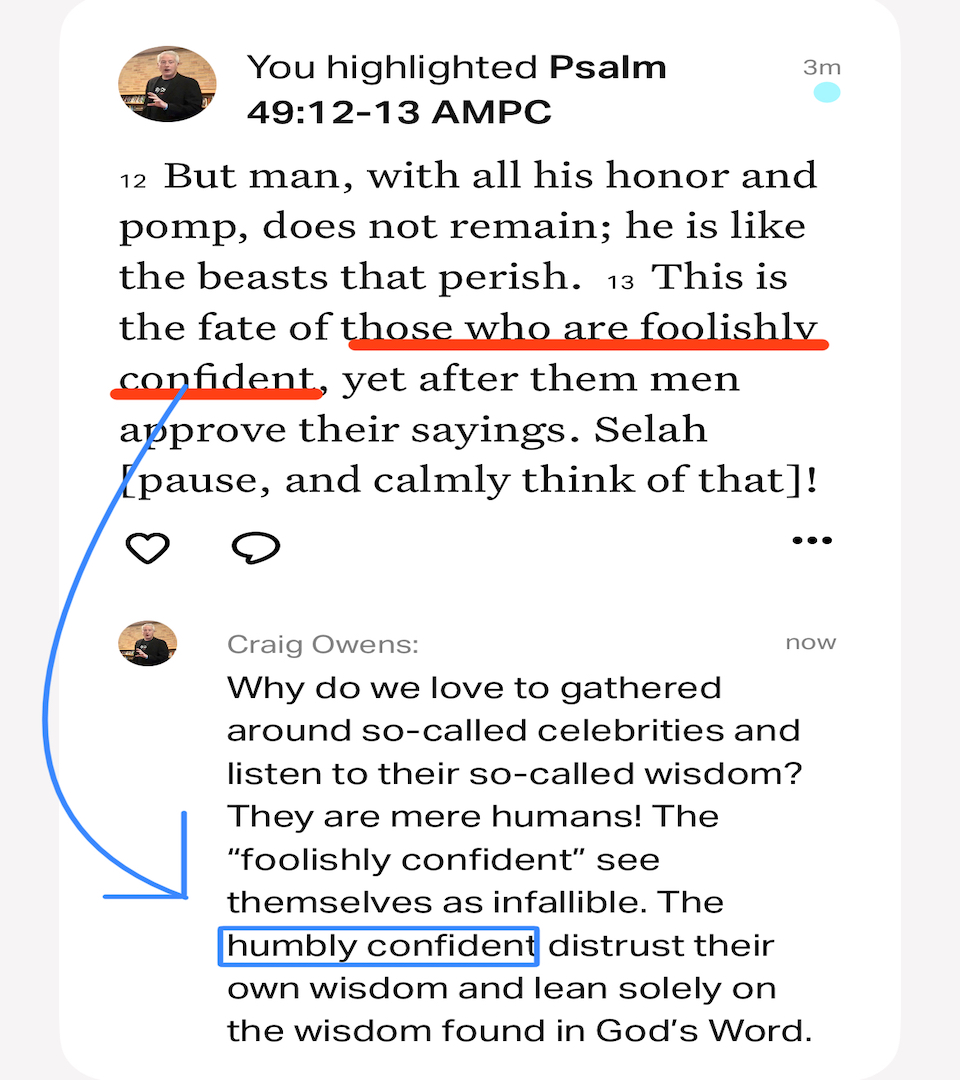
John’s whole life was one of confident humility (or humble confidence). He spoke God’s Word confidently, but wasn’t seeking the praise of men nor intimidated by the criticism of men. As a result, God’s Spirit remained on him in an unmistakable way. 

God will use anyone in the way that He used John, if they will only have the same attitude John had: “I must decrease and Jesus must increase.”

May I suggest this attitude-adjusting prayer for everyone who has been called by God to herald the Good News about Jesus—

Heavenly Father, as I preach today may all eyes move past me and turn to Jesus. “He must increase, but I must decrease. He must grow more prominent; I must grow less so.” Thank You for this opportunity You have given me today to point people to You. May I only be seen as great in Your eyes, but may the world view me only as Your humble servant. 

►► Would you please prayerfully consider supporting this ministry? My Patreon supporters get behind-the-scenes access to exclusive materials. ◀︎◀︎

When The World Fears Christians

Listen to the podcast of this post by clicking on the player below, and you can also subscribe on AppleSpotify, or Audible. 

Here’s an interesting interaction between King Saul and David—

And Saul jealously eyed David from that day forward. … And Saul cast the javelin, for he thought, I will pin David to the wall. And David evaded him twice. Saul was afraid of David, because the Lord was with him but had departed from Saul. (1 Samuel 18:9, 11-12 AMPC)

This exchange in this well-known story got me wondering. I was thinking how Saul had the position of authority over David and he had a javelin in his hand, but the Bible still says that Saul “was afraid of David.” Why would that be? I think even the most atheistic of people intuitively know there is something other-worldly about those in whom the Spirit of God abides, which makes worldly people lash out at them in fear. 

But those who fear God—as David did—don’t fear mortals. Jesus said, “Don’t be afraid of those who want to kill your body; they cannot touch your soul. Fear only God, Who can destroy both soul and body in hell” (Matthew 10:28 NLT). This reverent fearlessness is what galls those who fear the unknown, so they try to silence confident God-followers. 

In these attacks, Jesus tells us not to respond naturally, but supernaturally. “But to you who are willing to listen, I say, love your enemies! Do good to those who hate you. Bless those who curse you. Pray for those who hurt you” (Luke 6:27-28 NLT). 

Peter picked up those words from Jesus and instructed Christians: “Be careful to live properly among your unbelieving neighbors. Then even if they accuse you of doing wrong, they will see your honorable behavior, and they will give honor to God when He judges the world. … For God called you to do good, even if it means suffering, just as Christ suffered for you. He is your example, and you must follow in His steps.” (1 Peter 2:12, 21 NLT). 

Although Saul feared the presence of God in David, he also had to acknowledge the success that came to David because of God’s abiding presence in him, and also, by extension, the success that came to Saul’s kingdom. On the one hand, Saul wanted David dead; on the other hand, he wanted David close by—

So Saul removed David from him and made him his commander over a thousand; and [David] went out and came in before the people. David acted wisely in all his ways and succeeded, and the Lord was with him. When Saul saw how capable and successful David was, he stood in awe of him. (1 Samuel 18:13-15 AMPC) 

When Christians are supernaturally empowered by God, they never have to respond in natural fight-or-flight from those who lash out at them. Let your faithfulness to God be your testimony that points others to Him. 

►► Would you please prayerfully consider supporting this ministry? My Patreon supporters get behind-the-scenes access to exclusive materials. ◀︎◀︎

Jesus said, “If the world hates you, know that it hated Me before it hated you. If you belonged to the world, the world would treat you with affection and would love you as its own. But because you are not of the world [no longer one with it], but I have chosen (selected) you out of the world, the world hates (detests) you.” (John 15:18-19)

The Voice In Your Ear

Listen to the podcast of this post by clicking on the player below, and you can also subscribe on AppleSpotify, or Audible. 

I would like you to think about a wise, loving friend. One who has years of godly wisdom, empathy, loads of patience, and loving boldness. When you talk with them, you know that you will always get good counsel—even if you may not like exactly what they have shared with you, deep down you know it is still sound wisdom. This is what the Holy Spirit—as our Counselor—does for us. 

The Holy Spirit is not merely a force, but He is a Person. Jesus Himself give the Spirit the pronouns “He / Him / His.” 

Then take a look at just the beginning of the Book of Acts. The Holy Spirit does things a person does

  • He speaks God’s Word (1:16; 4:25) 
  • He empowers (2:4) 
  • He can be lied to (5:3, 9) 
  • He can witness events (5:32) 
  • He can be resisted (7:51) 
  • He can encourage (9:31) 
  • He gives wisdom (6:10) 
  • He gives direction (8:29, 10:19) 

I especially want to key in on those last two attributes where the Holy Spirit is speaking to us. 

Samuel grew up during the time of the judges, where everyone did whatever they thought best. This is a time that is described like this, “In those days the word of the Lord was rare; there were not many visions” (1 Samuel 3:1). Visions in the Hebrew language is two words: open communication. In other words, people just weren’t listening for God’s voice. 

Samuel had to learn to hear God’s voice as well (see this passage and all of the other biblical references in this post by clicking here). 

God doesn’t reveal His heart to those who are unwilling to obey. His persistent call is for obedience to His Word and reliance on His provision. So the word of the Lord had to be revealed to Samuel (v. 7). When Samuel said he was listening (v. 10), that was a posture of readiness to obey. 

God wants to reveal His heart to His obedient people. I love how God does this later for Samuel, “Now the Lord had told Samuel in his ear the day before Saul came…” (1 Samuel 9:15). 

This is how Jesus described the Holy Spirit in John 7:37-39, as streams that flow continuously out of our being. And Jesus also calls Him Counselor (John 14:16). 

Isaiah described our Counselor like this, “Whether you turn to the right or to the left, your ears will hear a Voice behind you, saying, ‘This is the way; walk in it’” (Isaiah 30:21). 

Let’s call this GPS = God’s Personal Spirit in us! 

Those who are baptized in the Holy Spirit—utterly yielded to His wisdom—will experience:

  1. More insight into God’s Word—Psalm 119:18 
  2. More timely application of God’s Word—2 Timothy 3:16-17 
  3. More boldness in prayer—2 Samuel 7:27 (same word for in his ear as Samuel experienced) 

All Christians have a deposit of the Holy Spirit in their lives at the moment of salvation. The baptism in the Holy Spirit is a completed yielding to the Counselor’s influence. So don’t stop at salvation, but ask Jesus to send you what the Father has promised (Luke 24:49; Acts 2:33). 

Check out all of the messages in our series leading up to Pentecost Sunday by clicking here. 

►► Would you please prayerfully consider supporting this ministry? My Patreon supporters get behind-the-scenes access to exclusive materials. ◀︎◀︎

Who God Rewards

Listen to the podcast of this post by clicking on the player below, and you can also subscribe on AppleSpotify, or Audible. 

Think of the most well-known Christian evangelist you can imagine preaching before tens of thousands of people all over the world, broadcasting his sermons online, selling books, and being invited to pray with the world’s leaders. 

Now think of a pastor you may know in a rural community ministering to a small congregation. He has no online presence, no books, and is hardly known outside of his own town. 

The apostle Paul would say to both of them, “You are only servants of God.”

“What, after all, is Apollos? And what is Paul? Only servants, through whom you came to believe—as the Lord has assigned to each his task. … This, then, is how you ought to regard us: as servant of Christ (1 Corinthians 3:5, 4:1). 

Only servants of Christ.

God calls His servants to do their servant’s work with care and quality (1 Corinthians 3:10, 14). And he also says, “The one who plants and the one who waters have one purpose, and they will each be rewarded according to their own labor (v. 8). 

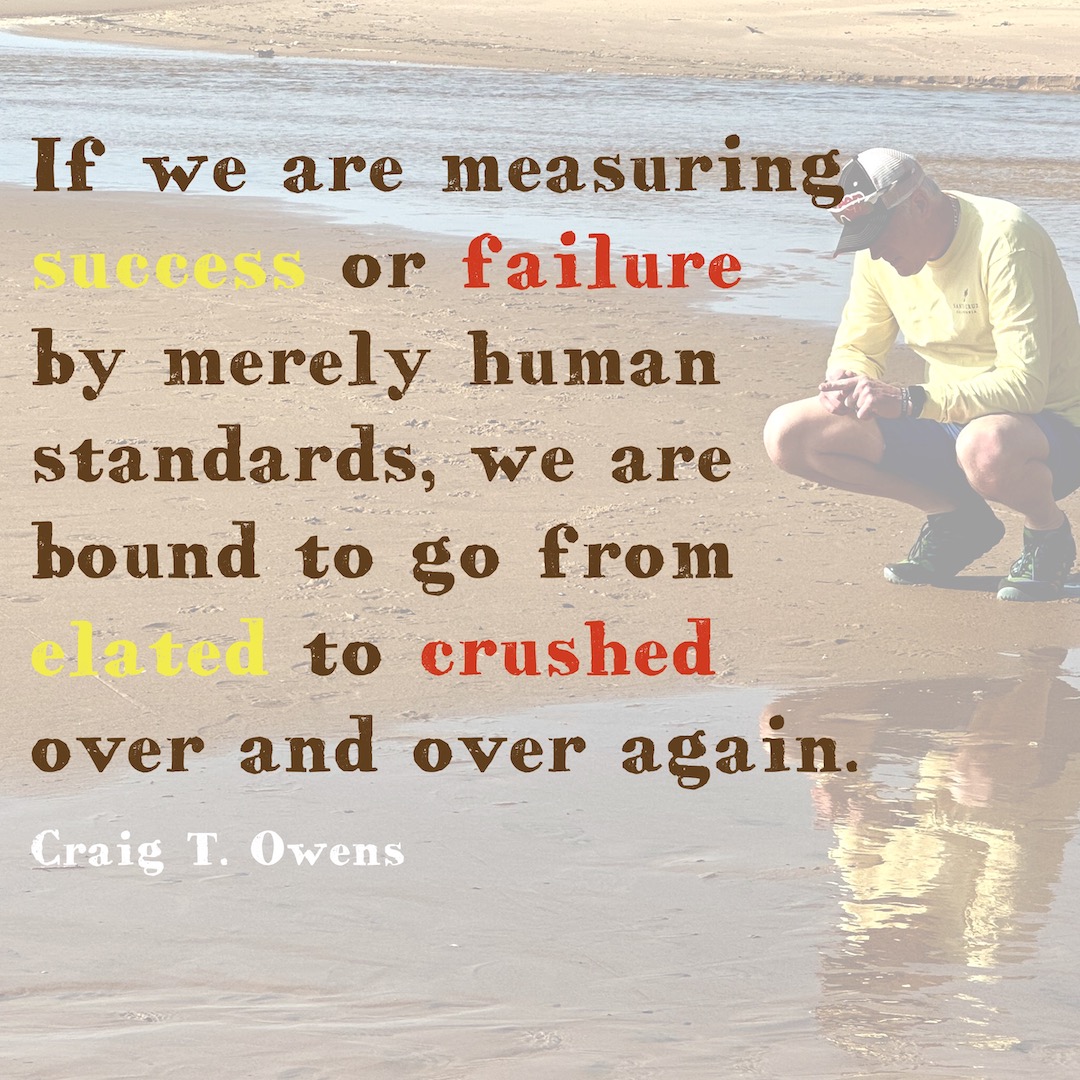
God’s rewards are not for big ministries, but for faithful ministers. 

I talk a lot about faithfulness in my book Shepherd Leadership. In the chapter entitled ‘Stick-to-it-iveness,’ I wrote this—

     Peter instructs us that our example for the flock must be God-honoring. People do what people see. If I would have arrived on that Saturday bent out of shape that things weren’t working out as I had planned, I would have robbed people of the enjoyment that they should have had that day. Remember that when Jesus told us that He had set an example for us (John 13:15), it was an example of putting others’ needs ahead of His own. Did Jesus want to wash those dirty feet? Probably not. But He not only washed them well, but He also had such a good attitude that its impact is still being felt today. 

     Peter was there on that day. He heard Jesus say this about following His example of such others-focused leadership: “Now that you know these things, you will be blessed if you do them.” So Peter reminds his readers that the Chief Shepherd is returning with rewards for the faithful under-shepherds. Occasionally, we will get some rewards here, but keeping our steadfast focus on the rewards and blessings that are still to come will help us stick with our responsibilities, even on those days when no one else seems to notice or even care. 

     Let’s listen to the words of the apostle Paul again: “So, then, no more boasting about human leaders!” (1 Corinthians 3:21).

And let me repeat myself—

God’s rewards are not for big ministries, but for faithful ministers.

►► Would you please prayerfully consider supporting this ministry? My Patreon supporters get behind-the-scenes access to exclusive materials. ◀︎◀︎