Thursdays With Spurgeon—God’s Purpose Prevails

This is a weekly series with things I’m reading and pondering from Charles Spurgeon. You can read the original seed thought here, or type “Thursdays With Spurgeon” in the search box to read more entries.

God’s Purpose Prevails

But He is in one mind, and who can turn Him? and what His soul desireth, even that He doeth (Job 23:13 KJV). But He is unchangeable, and who can turn Him? And what He wants to do, that He does (AMP). 

     Now the fact taught here is that in all the acts of God in providence, He has a fixed and a settled purpose. ‘He is in one mind.’ It is eminently consolatory to us, who are God’s creatures, to know that He did not make us without a purpose and that now, in all His dealings with us, He has the same wise and gracious end to be served. … 

     O believer, ever look, then, on all your sufferings as being parts of the divine plan and say, as wave upon wave rolls over you, ‘He is in one mind!’ He is carrying out still His one great purpose. None of these comes by chance; none of these happens to me out of order; but everything comes to me according to the purpose of His own will and answers the purpose of His own great mind. … 

     We sweat, we toil, and we fail. How often do we come back weeping because we have toiled, as we think, without success! Yet, Christian man, you have not been without success, for ‘He is still in one mind.’ All this was necessary to the fulfillment of His one purpose. You are not lost; your labor has not rotted under the clod. All, though you see it not, has been working together toward the desired end. … 

     From every evil, good has come. And the more the evil has accumulated, the more has God glorified Himself in bringing out at last His grand, His everlasting design. This, I take it, is the first general lesson of the text—in every event of providence, God has a purpose. ‘He is in one mind.’ 

     Mark, not only a purpose, but only one purpose—for all history is but one. There are many scenes, but it is one drama. There are many pages, but it is one book. There are many leaves, but it is one tree. There are many provinces, yes, and there are many lords and rulers, yet there is but one empire and God the one Potentate.

From The Infallibility Of God’s Purpose

All of history is His storyand your life is a part of that Grand Story as well. God doesn’t miss a thing. He is working all things out to accomplish His purpose (see Romans 8:28). Even when it seems nothing is happening, turn your thoughts back to God Whose plans never fail, Whose purposes are never frustrated, Who is always working out His grand plan.

Thursdays With Spurgeon—Study The Right Things

This is a weekly series with things I’m reading and pondering from Charles Spurgeon. You can read the original seed thought here, or type “Thursdays With Spurgeon” in the search box to read more entries.

Study The Right Things

     It is very advantageous to the Christian mind frequently to consider the deep and unsearchable attributes of God. … If we study man and make him the only object of our research, there will be a strong tendency in our minds to exaggerate his importance. We will think too much of the creature and too little of the Creator, preferring the knowledge that is to be found out by observation and reason to the divine truth that revelation alone could make known to us. … 

     The fleeting things of human life and the fickle thoughts and showy deeds of men are as movable and as changeable as the waters of the treacherous deep. But when we mount up, as it were, with eagles’ wings to Him Who sits upon the circle of the earth, before Whom all its inhabitants are as grasshoppers (Isaiah 40:22), we nestle in the Rock of Ages that from its eternal socket never starts and in its fixed immovability can never be disturbed.

From The Infallibility Of God’s Purpose

I read a lot of books. But in the hands-down, it’s-not-even-close category, I read the Bible more than anything else. It is the Book of books because it reveals the eternal Wisdom behind the earth’s wisdom. 

Zig Ziglar used to say, “Every morning I read my Bible and I read the newspaper. That way, I know what both sides are up to.” That’s pretty good!

We read the Bible not just to know the Bible, but to know the One Who authored the Bible. Or, as I like to say it—

My goal in reading the Word God is to get to know the God of the Word better and better.

Charles Spurgeon would never say—nor do I—that you shouldn’t study a variety of topics. Just make sure that your priority is God’s Word. This will give you the greatest insight into other topics and will protect you from humanistic error. 

Thursdays With Spurgeon—The Best Study To Expand Your Mind

This is a weekly series with things I’m reading and pondering from Charles Spurgeon. You can read the original seed thought here, or type “Thursdays With Spurgeon” in the search box to read more entries.

The Best Study To Expand Your Mind

     The highest science, the loftiest speculation, the mightiest philosophy that can ever engage the attention of a child of God is the name, the nature, the person, the work, the doings, and the existence of the great God whom he calls his Father. … It is a subject so vast that all our thoughts are lost in its immensity, so deep that our pride is drowned in its infinity. …

     But while the subject humbles the mind, it also expands it. He who often thinks of God will have a larger mind than the man who simply plods around this narrow globe. …

     Nothing will so enlarge the intellect, nothing so magnify the whole soul of man as a devout, earnest, continued investigation of the great subject of the Deity. …  

     There is one name on which mutability can never be written. One heart never can alter. That heart is God’s; that name Love. 

From The Immutability Of God

The vastness—the infiniteness—of God is something which should much consume us! The psalmists frequently write of the time they spent meditating on God and His awesomeness. 

That word “meditate” means to mull something over and over in your mind; literally, it means “to hum.” Perhaps that’s why the psalms were written as songs, so that it would be easier for people to hum their pondering on how majestic our All-Powerful, All-Loving God is. 

It’s not about the quantity of your Bible reading, but it’s about the quality of your reading. And it’s about what you do with what you have read. Soak in it. Meditate on it. Hum it over and over again throughout the day. Let the truth of God’s majesty lift your mind and spirit to new heights!

This is truly the greatest topic on which you can muse. The illumination of God will expand your mind like no other study in the world can.

Oh Lord my God when I in awesome wonder
consider all the worlds Thy hands have made.
I see the stars, I hear the rolling thunder
Thy power throughout the universe displayed.
Then sings my soul, my Savior God, to Thee,
How great Thou art! How great Thou art! (Stuart Wesley Keene Hine)

Thursdays With Spurgeon—Following The Prompting

This is a weekly series with things I’m reading and pondering from Charles Spurgeon. You can read the original seed thought here, or type “Thursdays With Spurgeon” in the search box to read more entries.

Following The Prompting

     I once while preaching at New Park Street Chapel. I had passed happily through all the early parts of divine service on the Sabbath evening and was giving out the hymn before the sermon. I opened the Bible to find the text, which I had carefully studied as the topic of discourse, when, on the opposite page, another passage of Scripture sprang upon me like a lion from a thicket with vastly more power then I had felt when considering the text that I had chosen. The people were singing and I was sighing. I was in a strait between two, and my mind hung as in the balances. I was naturally desirous to run in the track that I had carefully planned, but the other text would take no refusal and seemed to tug at my skirts, crying, “No, no, you must preach from me! God would have you follow me.” I deliberated within myself as to my duty, for I would neither be fanatical nor unbelieving, and at last I thought within myself, Well, I should like to preach the sermon that I have prepared, and it is a great risk to run to strike out a new line of thought, but as this text constrains me, it may be of the Lord, and therefore I will venture upon it, come what may.

     I had brought myself into great difficulty by obeying what I thought to be a divine impulse, and I felt comparatively easy about it, believing that God would help me and knowing that I could at least close the service should there be nothing more to be said. I had no need to deliberate, for in one moment we were in total darkness. The gas had gone out…. Having no manuscript, I could speak just as well in the dark as in the light…. When the lamps were lit again, I saw before me an audience as rapt and subdued as ever a man beheld in his life. … Thus, providence befriended me. I cast myself upon God, and His arrangements quenched the light at the proper time for me. Some may ridicule, but I adore; others may even censure, but I rejoice.

From The Autobiography of Charles Spurgeon

God can speak to pastors as clearly in his or her sermon preparation time as He can in the very moments before the sermon begins. The key is our obedience to follow the prompting of the Holy Spirit. 

Spurgeon would never advocate that preachers “wing it” every time they step into the pulpit. His own life showed a man of diligent study of the Scripture. But neither would Spurgeon say that preachers have to stick to their prepared remarks no matter what. What I think he would say is: Trust God when you’re studying for a sermon, and trust God when you’re delivering a sermon. Allow the Spirit to change your course at any moment. 

Is this a bit nerve-wracking? Spurgeon would say, “Yes, only when deliberating whether to strike out on the new course.” But notice how once he obeyed that prompting, he felt completely at ease.

Spurgeon also reminds us, “I do not see why a man cannot speak extemporaneously upon a subject that he fully understands. Any tradesman, well versed in his line of business, could explain it without needing to retire for meditation, and surely I ought to be equally familiar with the first principles of our holy faith. I ought not to feel at a loss when called upon to speak upon topics that constitute the daily bread of my soul.”

Thursdays With Spurgeon—“Follow Me”

This is a weekly series with things I’m reading and pondering from Charles Spurgeon. You can read the original seed thought here, or type “Thursdays With Spurgeon” in the search box to read more entries.

“Follow Me”

     “As Jesus passed on from there, He saw a man named Matthew sitting at the tax office. And He said to him, ‘Follow Me.’ So he arose and followed Him” [Matthew 9:9]. … I know another man, not named Matthew, but Charles, and the Lord said to him, “Follow Me,” and he also arose and followed Him. I do not know all that He saw when He looked upon me. I fear that He saw nothing in me but sin and evil and vanity, but I believe that He did say to Himself concerning me, “I see one to whom I can teach My truth, and who, when he gets ahold of it, will grip it fast and never let it go, and one who will not be afraid to speak it wherever he is.” So the Lord saw what use He could make of me. There is an adaptation in men, even while they are unconverted, that God has put into them for their future service. Luke was qualified to write his gospel because he had been a physician, and Matthew was qualified to write the particular gospel that he has left us because he had been a publican. There may be something about your habits of life, and about your constitution and your condition that will qualify you for some special niche in the church of God in the years to come. Oh, happy day, when Jesus shall look upon you and call you to follow Him! Happy day, when He did look upon some of us, and saw in us what His love meant to put there, that He might make of us vessels of mercy meet for the Master’s use! 

From The Autobiography of Charles Spurgeon

What was true of the apostle Matthew and Charles Spurgeon in past history is true of you today! 

God has plans for you. He has implanted a combination of gifts, talents, and personality in you that is unique to anyone else on this planet. He did this because He foresaw how you could be of use in fulfilling His plans for His kingdom.

Listen! Do you hear Him calling? He is saying to YOU, “Follow Me.” Will you answer that call? 

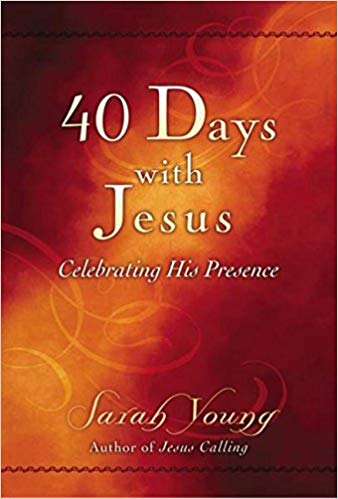
9 Quotes From “40 Days With Jesus”

Sarah Young does a masterful job in helping us hear Jesus speak to us in the first-person, as she weaves Scripture together so beautifully. Check out my full book review by clicking here. 

“Taste and see that I am good. The more intimately you experience Me, the more convinced you become of My goodness.” 

“Follow Me one step at a time. … Keep your mind on the present journey, enjoying My Presence. Walk by faith, not by sight, trusting Me to open up the way before you. … I set the pace in keeping with your needs and My purposes.” 

“Walking in the light of My presence blesses you in many ways. Good things are better and bad things are more bearable when you share them with Me. As you bask in My Love-Light, you are better able to love others and enjoy fellowship with them. You are less likely to stumble or fall because sins are garishly obvious in My holy Light. As you walk in this Light with Me, I encourage you to exult in My righteousness.” 

“Although your new self is being conformed to My image, this process does not erase the essence of who you are. On the contrary, the more you become like Me, the more you develop into the unique person I designed you to be.” 

“Holiness is letting Me live through you. Since I dwell in you, you are fully equipped to be holy. Pause before responding to people or situations, giving My Spirit space to act through you. Hasty words and actions leave no room for Me; this is atheistic living. I want to inhabit all your moments—gracing your thoughts, words, and behavior.” 

“Talk with Me about every aspect of your day, including your feelings. Remember that your ultimate goal is not to control or fix everything around you; it is to keep communing with Me. A successful day is one in which you have stayed in touch with Me, even if many things remain undone at the end of the day.” 

“Do not let your to-do list (written or mental) become an idol directing your life. Instead, ask My Spirit to guide you moment by moment.” 

“Exceeding Joy is for both you and Me. I delight in you now, but this Joy will be astronomically magnified when you join Me in Glory. The Joy you will experience in heaven is so far beyond anything you have known on earth that it is indescribable. Nothing can rob you of this glorious inheritance which is imperishable and will not fade away.” 

“Thankfulness is not some sort of magic formula; it is the language of Love, which enables you to communicate intimately with Me.” 

Thursdays With Spurgeon—The Blessing Of A Promise-Keeping God

This is a weekly series with things I’m reading and pondering from Charles Spurgeon. You can read the original seed thought here, or type “Thursdays With Spurgeon” in the search box to read more entries.

The Blessing Of A Promise-Keeping God

     I do not believe we can preach the gospel if we do not preach justification by faith without works; or unless we preach the sovereignty of God in His dispensation of grace; or unless we exalt the electing, unchangeable, eternal, immutable, conquering love of Jehovah. … 

     All the purposes of man have been defeated, but not the purposes of God. The promises of man may be broken. Many of them are made to be broken. But the promises of God shall all be fulfilled. He is a promise-maker, but He never was a promise-breaker; He is a promise-keeping God, and every one of His people shall prove it to be so.  

From The Autobiography Of Charles Spurgeon

God is not a man, so He does not lie. He is not human, so He does not change His mind. Has He ever spoken and failed to act? Has He ever promised and not carried it through? (Number 23:19)

For the word of God will never fail. (Luke 1:37)

Now I am about to go the way of all the earth. You know with all your heart and soul that not one of all the good promises the Lord your God gave you has failed. Every promise has been fulfilled; not one has failed. (Joshua 23:14)

But joyful are those who have the God of Israel as their helper, whose hope is in the Lord their God. He made heaven and earth, the sea, and everything in them. He keeps every promise forever. (Psalm 146:5-6) 

For all of God’s promises have been fulfilled in Christ with a resounding “Yes!” And through Christ, our “Amen” (which means “Yes”) ascends to God for His glory. (2 Corinthians 1:20)

Our God is a promise-making, promise-keeping God!

Thursdays With Spurgeon—The Life-Changing Power In The Bible

This is a weekly series with things I’m reading and pondering from Charles Spurgeon. You can read the original seed thought here, or type “Thursdays With Spurgeon” in the search box to read more entries.

The Life-Changing Power In The Bible

     When the Spirit came with His divine life and quickened the entire Book to my newly enlightened soul, the inner meaning shone forth with wondrous glory. … Whatever I found to be in His Word, I received with intense joy. … Moreover, I have found that those points of my character that were most weak have been strengthened, while strong passions have been subdued, evil propensities have been kept under, and new principles have been implanted. I am changed; I am as different from what I was as a man could be who had been annihilated and had then been made over again. Nor do I claim any of the credit for this change—far from it. God has done great things for me, but He has done the same for others and is willing to do it for any soul who seeks His face through Jesus Christ and His great atoning sacrifice. …  

     An idea has long possessed the public mind that a religious man can scarcely be a wise man. It has been the custom to talk of infidels, atheists, and deists as men of deep thought and comprehensive intellect, and to tremble for the Christian controversialist as if he must surely fall by the hand of his enemy. But this is purely a mistake, for the gospel is the sum of wisdom, an epitome of knowledge, a treasure house of truth, and a revelation of mysterious secrets. In it we see how justice and mercy may be married; here we behold inexorable law entirely satisfied and sovereign love bearing away the sinner in triumph. Our meditation upon it enlarges the mind, and as it opens to our soul in successive flashes of glory, we stand astonished at the profound wisdom manifest in it.

From The Autobiography Of Charles Spurgeon 

As Spurgeon experienced, all Christians can experience. Think about this—the same Holy Spirit that inspired the written words of the Bible is the same Holy Spirit in you that can illuminate and apply the words of the Bible to your life! 

Bible-reading, Spirit-empowered Christians should be the most informed, creative, wise people you will ever meet. Not because they have studied nature, but because they are getting to know Nature’s God intimately. The Creator can open up the mysteries of creation better than any scientist or philosopher. 

But we don’t read the Bible just to know God’s Word, but we read the Bible to get to know the God revealed in the Word. He said He would reveal Himself to those who earnestly seek for Him. Ask the Holy Spirit to open your eyes, your mind, your heart as you read your Bible. 

9 Quotes From “Shepherding God’s Flock”

T.M. Moore has given pastors a phenomenal training resource in Shepherding God’s Flock. Please be sure to check out my full book review by clicking here. 

“The work of church leaders today—and especially of that class of leaders called elders, with which this study is concerned—has been shaped and conditioned more by the temper of our times than by the teaching of God’s Word.” 

“According to Paul, any church that does not have in place elders—and other leaders working with them—who are functioning as shepherds is a church that is not in order.… A church without a strong ministry of shepherding is a flock without genuine pastoral care, oversight, and equipping. It may be very active, even happy, and may be ‘growing’ in what some consider impressive ways. But without shepherding as the framework and integrating dynamic, such a church will always be something less than what God intends.” 

“Where the work of shepherding is being faithfully pursued, the gospel goes forth with power, lost sheep are located, and the flocks of God grow as He adds new souls to the fold.” 

“Where faithful shepherds are at work, the Lord’s sheep will be well fed. Both milk and the meat of the Word will be their daily diet, according to the needs and callings of each. Well-fed sheep are healthy, strong, and fruitful in their own contributions.” 

“The work of shepherding begins in relationships of mutual love and trust, spiritual friendships where sheep and shepherd know, love, and care about one another.” 

“Only when the people feel known and loved, and only when they know and love those who are called to lead them—only then will they be willing to follow where the shepherds of the church are seeking to take them.” 

“In the Christian life, people tend to live up to or achieve, not the level of their abilities, for their abilities are virtually limitless, given the presence of the indwelling Spirit of God. Rather, they tend to live up to the level of their vision—of what they see for their lives in Christ. Unless we are leading them into God’s vision for their lives, the people of God will settle for something less than the prize of the upward call of God in Christ Jesus.” 

“When temptation arises we can follow one of two courses. Either we will fall through temptation into sin, or we will grow through temptation into a higher stage of sanctification. … The shepherd’s task is twofold: first, he must help the Lord’s sheep to recognize temptation, by grounding them firmly in the law and Word of God; second, he must equip and encourage them in finding the way of escape from temptation, so that they may grow as the Lord intends.” 

“Jesus’ approach to bearing witness was thus energetic, proactive, continuous, compassionate, and pioneering. Should we expect anything less from the shepherds He has left to bring other lost sheep into His fold?”

Thursdays With Spurgeon

Nearly 10 years ago I began a series of posts called “Thursdays With Oswald,” in which I shared the thoughts that were working their way through my heart and mind as I journeyed through the complete works of Oswald Chambers. Now, almost a decade later, I have finished all 1500 pages of his wisdom. 

I think it is wise to frequently spend time with the “old guys”—those whom the years have proven their godly wisdom to be true. So I am now moving on to another prolific writer and speaker, the man called the Prince of Preachers: Charles Haddon Spurgeon. 

As with my series with Oswald Chambers, I will be sharing some passages from the Spurgeon book or sermon I am reading. On some, I will offer some thoughts that I’m contemplating in light of that reading, and on others, I will simply let the Prince’s words speak for themselves. 

Let me begin with three simple quotes: 

“The words of God have more power over me than ever David’s fingers had over his harp strings.” 

“It is better to preach five words of God’s Word than five million words of man’s wisdom.” 

“There is a power in God’s gospel beyond all description.”

I love how completely Spurgeon’s thoughts are grounded on God’s Word! Spurgeon had no formal theological training, but he expounded on Scriptures as few ever did or ever have.