Links & Quotes

link quote

Some good reading from today…

“Go to bed seasonably, and rise early. Redeem your precious time… that not one moment of it may be lost. Be much in secret prayer. Converse less with man, and more with God.” —George Whitefield 

“Lord, let me not live to be useless.” —John Wesley

Jon Bloom looks at narcissism in a different way: Beware The Mirror.

“To be specific, the self-sins are self-righteousness, self-pity, self-confidence, self-sufficiency, self-admiration, self-love and a host of others like them. They dwell too deep within us and are too much a part of our natures to come to our attention till the light of God is focused upon them.” —A.W. Tozer

“Confession isn’t a punishment for sin; it’s an isolation of sin so it can be exposed and extracted.” —Max Lucado

We must learn to tell ourselves the truth on the basis of God’s Word.” —Oswald Chambers

During the cold & flu season, here is a great reason to kiss your sweetie: Kissing helps boost your immune system.

Links & Quotes

link quote

Some good reading from today…

15 good quotes from Soren Kierkegaard.

For the singles, here is 10 guys you should never date and 8 types of women you should never date.

“I can neither teach nor live by the faith of others. I must live by my own faith as the Spirit of the Lord has taught me through His Word.” —Menno Simons

Pretty cool! We just landed a robot on a comet!

Coaches & Parents, Tim Elmore tells us how athletes hide behind their talent and what we can do about it.

Human touch is just as nutritious as the food we eat. So go hug someone!

“The notion that the careless sinner is the smart fellow and the serious-minded Christian, though well-intentioned, is a stupid dolt altogether out of touch with life will not stand up under scrutiny. Sin is basically an act of moral folly, and the greater the folly the greater the fool.” —A.W. Tozer

Thursdays With Oswald—The Discipline In Faith

Oswald ChambersThis is a periodic series with things I’m reading and pondering from Oswald Chambers. You can read the original seed thought here, or type “Thursdays With Oswald” in the search box to read more entries.

The Discipline In Faith

     The element of discipline in the life of faith must never be lost sight of, because only by means of the discipline are we taught the difference between the natural interpretation of what we call good and what God means by “good.” …

     At times it appears as if God has not only forsaken His word, but has deliberately deceived us. We asked Him for a particular thing, or related ourselves to Him along a certain line, and expected that it would mean the fullness of blessing, and actually it has meant the opposite—upset, trouble and difficulty all around, and we are staggered, until we learn that by this very discipline God is bringing us to the place of entire abandonment to Himself.

From Not Knowing Where

Probably every follower of God has experienced what Oswald Chambers describes: We follow God wholeheartedly, fully believing He called us to something, only to get knocked around by trouble.

I’ve been there and done that. It was a whole lot of no-fun while I was in it. And now, looking back on it, I still can’t say that I enjoyed those times. But here’s what I do enjoy now:

  • A closer intimacy with my Savior
  • A greater empathy for others in troubling times
  • An increased sensitivity to the voice of the Holy Spirit
  • A deeper appreciation for God’s Word
  • A strength I wouldn’t have gained without going through that time
  • Discernment and insight I wouldn’t have learned without that trouble

If God calls you, He will not leave you. No matter how painful or difficult your circumstances, if He called you to walk through it, He will do something in it. Discipline yourself to remain totally abandoned to God!

12 Additional Quotes From “Transforming Grace”

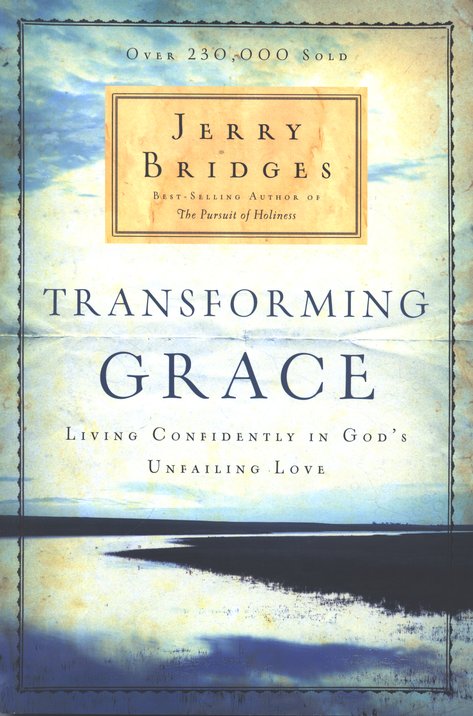
Transforming GraceI already shared a few quotes from Transforming Grace by Jerry Bridges (you can read them by clicking here). Bridges also extensively quoted other authors in this amazing book, so I wanted to share a few of those quotes as well.

“Grace ceases to be grace if God is compelled to bestow it in the presence of human merit…. Grace ceases to be grace if God is compelled to withdraw it in the presence of human demerit…. Grace is treating a person without the slightest reference to desert whatsoever, but solely according to the infinite goodness and supper and purpose of God.” —Dr. C. Samuel Storms

“The most shining deeds and valuable qualities that can be found among men, though highly useful and truly excellent, when set in their proper places, and referred to suitable ends, are, as to the grand article of justification treated as nonentities…. For divine grace disdains to be assisted in the performance of that work which peculiarly belongs to itself, by the poor, imperfect performances of men. Attempts to complete what grace begins, betray our pride and offend the Lord; but cannot promote our spiritual interest. Let the reader, therefore, carefully remember, that grace is either absolutely free, or it is not at all: and, that he who professes to look for salvation by grace, either believes in his heart to be saved entirely by it, or he acts inconsistently in affairs of the greatest importance.” —Abraham Booth

“Perhaps the most difficult task for us to perform is to rely on God’s grace and God’s grace alone for our celebration. It is difficult for our pride to rest on grace. Grace is for other people—for beggars. We don’t want to live by a heavenly welfare system. We want to earn our own way and atone for our own sins. We like to think that we will go to heaven because we deserve to be there.” —R.C. Sproul 

“A lawdriver insists with threats and penalties; a preacher of grace lures and incites with divine goodness and compassion shown to us; for he wants no unwilling works and reluctant services, he wants joyful and delightful services of God.” —Martin Luther, commenting on Romans 12:1

“The great mistake made by most of the Lord’s people is in hoping to discover in themselves that which is to be found in Christ alone.” —Arthur W. Pink

“In the person of Christ God beholds a holiness which abides His closest scrutiny, yea, which rejoices and satisfies His heart; and whatever Christ is before God, He is for His people.” —Arthur W. Pink

“Only what God has commanded in His Word should be regarded as binding; in all else there may be liberty of actions.” —John Owen

“Let us never surrender our judgments or our consciences to be at the disposal and opinions of others, and to be subjected to the sentences and determinations of men. … It is my exhortation therefore to all Christians to maintain their Christian freedom by constant watchfulness. You must not be tempted or threatened out of it; you must not be bribed or frightened from it; you must not let either force or fraud rob you of it. … We must not give up ourselves to the opinion of other men, though they be never so learned, never so holy, merely because it is their opinion. The apostle directs us to try all things and to hold fast that which is good (1 Thessalonians 5:21). It often happens that a high esteem of others in respect of their learning and piety makes men take up all upon trust from such, and to submit their judgments to their opinions, and their consciences to their precepts. This should not be so.” —Samuel Bolton (1645)

“So God supplies perfectly measured grace to meet the needs of the godly. For daily needs there is daily grace; for sudden needs, sudden grace; for overwhelming needs, overwhelming grace. God’s grace is given wonderfully, but not wastefully; freely, but not foolishly; bountifully, but not blindly.” —John Blanchard

“For men have no taste for God’s power till they are convinced of their need of it and they immediately forget its value unless they are continually reminded by awareness of their own weakness.” —John Calvin

“Yet the duties God requires of us are not in proportion to the strength we possess in ourselves. Rather, they are proportional to the resources available to us in Christ. We do not have the ability in ourselves to accomplish the least of God’s tasks. This is a law of grace. When we recognize it is impossible for us to perform a duty in our own strength, we will discover the secret of its accomplishment. But alas, this is a secret we often fail to discover.” —John Owen

“Christian humility does not consist in denying what there is of good in us; but in an abiding sense of ill-desert, and in the consciousness that what we have of good is due to the grace of God.” —Charles Hodge

You can read my full review of Transforming Grace by clicking here.

Thursdays With Oswald—New Healthy Habits

Oswald ChambersThis is a periodic series with things I’m reading and pondering from Oswald Chambers. You can read the original seed thought here, or type “Thursdays With Oswald” in the search box to read more entries.

New Healthy Habits

When the Spirit of God brings a Word of God to us, are we going to wake up and lay hold [Ephesians 5:14-18] of it, or remain in the condition St. Augustine was in—“a little more worldliness; a little less intensity”? … When God tells us to do a thing He empowers us to do it, only we must do the doing. … All we need is grit and gumption and reliance on the Holy Spirit. We must bring the same determined energy to the revelations in God’s Book as we bring to earthly professions. Most of us leave the sweat of brain outside when we come to deal with the Bible. …

When in your soul’s vision you see clearly what God wants, let me advise you to do something physical immediately. If you accompany a moral or spiritual decision with a physical effort you give the necessary initiative to form the new habit. …

How are we going to find out the will of God? “God will communicate it to us.” He will not. His will is there all the time, but we have to discover it by being renewed in our minds, by taking heed to His Word and obeying it. If we are not going to be “conformed to this world; but transformed,” we must use our brains. God does the spiritual, powerful part we cannot do; but we have to work it out, and as we do the obeying we prove… “what is that good, and acceptable, and perfect, will of God” [Romans 12:1-2].

From The Moral Foundations Of Life

Everything we need to form new, healthy, God-pleasing habits has already been given to us in the Bible. Now we need to put our brains and our bodies to work—

God’s Word + Holy Spirit revelation + Concentration + Physical obedience = 

New God-honoring habits

The Love In The Law

Love In The LawWhen I say “Law” what sort of words come to your mind. Do you think of words like: restrictive? killjoy? barriers? hindrances? no fun?

If you’re a Christian, perhaps the same descriptive words come to mind when you think of biblical commandments. Maybe you think, “Don’t do that” (or for those of you who think in King James English: Thou shalt not).

But if we think of the law/commandments that way, that also means we have to think of the Lawgiver that way. In other words, God becomes a Policeman. He is closely watching to see who will break His laws so that He can dispense the appropriate punishment. After all, if the laws are a bunch of no-nos, then Someone has to be watching for law-breakers and handing out the penalties.

If that’s the case, what do we do with the Bible’s description of God that says “God is love”? If the Lawgiver is Love, how does that change our view of the laws themselves?

It must mean that God’s laws are an expression of His love. It must mean that His love is in the laws He has given us.

It must mean that God’s laws are NOT no-nos, BUT yes-yeses. 

Join us this Sunday at Calvary Assembly of God as we talk about The Love In The Law. We’ll be working our way through the Ten Commandments, especially looking at God’s love that make each commandment a giant YES for our lives. Prayerfully, this series will completely change how we view God’s laws and commands.

If you have missed any of the messages in this series, check them out here:

Inconceivable

InconceivableThe “therefores” in Scripture always intrigue me. They are a signal that there is a natural conclusion to the words that just came before the therefore, so it’s important to look at both sides.

The prophet Hosea opens his book with these words: “…the land is guilty of the vilest adultery in departing from the Lord” (Hosea 1:2). The picture is painted of God’s people acting like a wife that has not only abandoned her husband, but turned to prostitution as well. So the list of things that follow God’s therefore are what we might expect—

  • I will block your path
  • I will take away My grain
  • I will take back My wool
  • I will expose your lewdness
  • I will stop your celebrations
  • I will ruin your vineyards
  • I will punish you (Hosea 2:6-13)

Then here is what I find almost inconceivable: the very next word of the very next verse is therefore again, and God says things that, in my mind, are completely unexpected—

  • I will allure you and speak tenderly to you
  • I will restore our marriage
  • I will remove your stains
  • I will obliterate the past
  • I will betroth you to Me forever
  • I will answer your prayers
  • I will restore your crops
  • I will establish you forever
  • I will cancel your divorce
  • I will call you Mine (2:14-23)

This kind of love is mind-blowingly incomprehensible to me. It is so unexpected, so lavish, so overwhelming! This is absolutely the last thing I would have expected God to say, and yet His love is furious and relentless and boundless!

How could I ever slight such a love?!

Mobile, Messy & Meaningful

21st-century Americans in Christ's timeI think we have made the Church and Christianity something different than what the New Testament shows us. We’ve created far too many “things” which simply aren’t in the Bible. That’s not to say these things are wrong, but they may become stumbling blocks to us if we make secondary things the primary thing.

So what is the primary thing about church?

It might surprise you to know that the word church is only used twice by Jesus (Matthew 16:18, 18:17). He used a Greek word ekklesia, which meant a gathering of people called out from their homes into some public place. This word originally had more of a “town hall” meaning to it, but Jesus used this as a starting point to show us true church.

In Christ’s time the church for Him was…

Mobile—wherever He was, church was. Look at the extensive traveling He did. He held as many “church services” in people’s dining rooms as He did in the synagogues.

Messy—often as Jesus was speaking…

  • People constantly coming and going
  • Pharisees yapping and interrupting
  • Kids playing
  • Women sitting at His feet, anointing Him, crying over Him
  • Food and drink were usually involved
  • Foot washing was taking place
  • When He was outdoors: wind, waves, farmers, passers-by…
  • When He was indoors: food being served and eaten, roofs being ripped off…
  • People constantly interrupted His sermons: “Blessed is Your mother…”; “Tell my brother to give me my inheritance…”; “My daughter is dying!…”

Meaningful

  • “I must go through Samaria.”
  • “It’s not the healthy who need a doctor, but the sick.”
  • “Zaccheus, today I’m eating dinner at your house.”
  • “The Spirit of the Lord is upon Me to preach good news to the poor, freedom to the captive, sight to the blind, favor to the oppressed.”

Jesus asked His disciples Who they thought He was (see Matthew 16:13-18). The correct answer was Peter’s declaration, “You are the Christ, the Son of the living God!” Jesus said, “You’re right, and on that declaration I will build My church.”

Our job is to make Jesus known as the Christ, the Son of the living God (v. 16).

Christ’s job is to build His Church (v. 18).

He didn’t tell us to build a building and invite people to come on Sundays.

He didn’t tell us to start a Sunday School or a feeding program or a youth group.

There’s nothing wrong with these things, but they are not the main thing. 

The main thing is Jesus being seen as the Son of the living God. Where we are gathered together in that confession and purpose—even just two or three of us—that’s where His church is (see Matthew 18:20).

We must be mobile, taking a meaningful message into people’s messy lives. That is true church.

God’s Longing

God's LongingHere’s what God says about you and me: “I long to redeem them” (Hosea 7:13). The prophet Hosea has a front row seat, watching God pursue and woo His people, and Hosea records for us God’s longing passion.

The placement of God’s declaration—I long to redeem them—is a wonder to me. It’s right in the middle of a catalogue of His people’s sins. God says:

  • Your kings fall because they don’t call on Me (Hosea 7:7).
  • You don’t realize how weak and powerless you’ve become because you won’t pray to Me (7:9-10).
  • You try to rule yourselves without consulting Me (8:4).
  • You disregard My laws as if they were irrelevant (8:12).
  • You no longer pay attention to My prophets who are calling you back to Me (9:7).

And still in the midst of all this comes, “I long to redeem them.” Astounding!

God tells us what we need to do—

Sow for yourselves righteousness, reap the fruit of unfailing love, and break up your unplowed ground; for it is time to seek the Lord, until He comes and showers righteousness on you. (10:12)

The alternative?

BUT you have planted wickedness, you have reaped evil, you have eaten the fruit of deception. Because you have depended on your own strength and on your many warriors…you will be completely destroyed. (10:13-15)

What will you choose: To seek God OR to depend on your own strength?

God LONGS to redeem you, but you have to ask Him to do so.

My Accent

My AccentThe prophet Amos opens his book with these words: The words of Amos…. Amos was the one God chose to deliver His message, and Amos never forgot that, not did he let his audience forget.

It’s not a filler phrase, but it becomes the accent by which everyone knew Amos’ voice. Over 40 times in this short book Amos uses phrases like “says the Lord,” or “declares the Sovereign Lord.” Amos constantly reminded himself and anyone who heard him speak that he was not speaking his own thoughts, but he was speaking God’s Word.

I wonder: What accent do people hear when I speak?

I want to be so full of God’s Word and His Spirit that the “says the Lord” accent is my accent.

When I speak I want people to not hear me but hear the God Who speaks through me.

My words are fallible, but God’s Word is perfect.

Jesus said that my words reflect what’s in my heart. May my accent make it so evidence that my heart is full of the Word of God.