Staggering Seduction

Listen to the podcast of this post by clicking on the player below, and you can also subscribe on AppleSpotify, or Audible. 

The northern tribes of Israel had been defeat by the Assyrians and gone into exile because of their persistent and unrelenting sins against God. You would think that this would be a vivid enough warning to get the attention of the people of Judah, but sadly it wasn’t. 

King Manasseh sinned and then doubled-down on his sinning. The prophets thundered their warnings, and Manasseh not only kept his sins going but he kept pulling more and more people down into sin with him. 

Isaiah pointed to the example of Israel’s sin—

     Woe to Samaria the crown of pride of the drunkards of Ephraim [the ten tribes], and to the fading flower of its glorious beauty, which is on the head of the rich valley of those overcome and smitten down with wine! … But even these reel from wine and stagger from strong drink: the priest and the prophet reel from strong drink; they are confused from wine, they stagger and are gone astray through strong drink; they err in vision, they stumble when pronouncing judgment. (Isaiah 28:1, 7 AMPC) 

Notice the words like reel and stagger, as though intoxicated by alcohol. 

A mark of an ungodly leader is one who is so intoxicated by his own power that he makes others drunk too. 

Look at this description of Manasseh: “But the people [of Judah] would not listen; and Manasseh seduced them to do more evil than the nations did whom the Lord destroyed before the Israelites!” (2 Kings 21:9). 

The Hebrew word translated “seduced” is the same Hebrew word that Isaiah used for the staggering and going astray of a drunkard. 

This is the power that leaders have for both good and evil. A sober-minded, godly leader can encourage people toward righteousness, but an ungodly leader who is intoxicated by his power seduces people to join him in his unrighteousness. Manasseh was described as “making Judah sin, by doing evil in the sight of the Lord” (v. 16).

Certainly there are people who choose a sinful lifestyle during the tenure of a godly leader, and there are people who steadfastly choose righteousness during the tenure of an ungodly leader. But the Bible issues strong warnings to those leaders who misuse their God-appointed positions of leadership to lead people astray (see Ezekiel 3:17-21, 33:1-9). 

Leaders, be on guard that a position of leadership doesn’t seduce you to stray from righteousness. Don’t forget that God chose you for this role, so to Him you will have to stand to give an accounting of your leadership. I pray you can say that you soberly and sincerely pursued righteousness and led your people in that pursuit as well. I want you to hear, “Well done, good and faithful servant” and not, “Depart from Me.” 

This is part 86 in my series on godly leadership. You can check out all of my posts in this series by clicking here.

►► Would you please prayerfully consider supporting this ministry? My Patreon supporters get behind-the-scenes access to exclusive materials. ◀︎◀︎
The Results Of Abandoning God

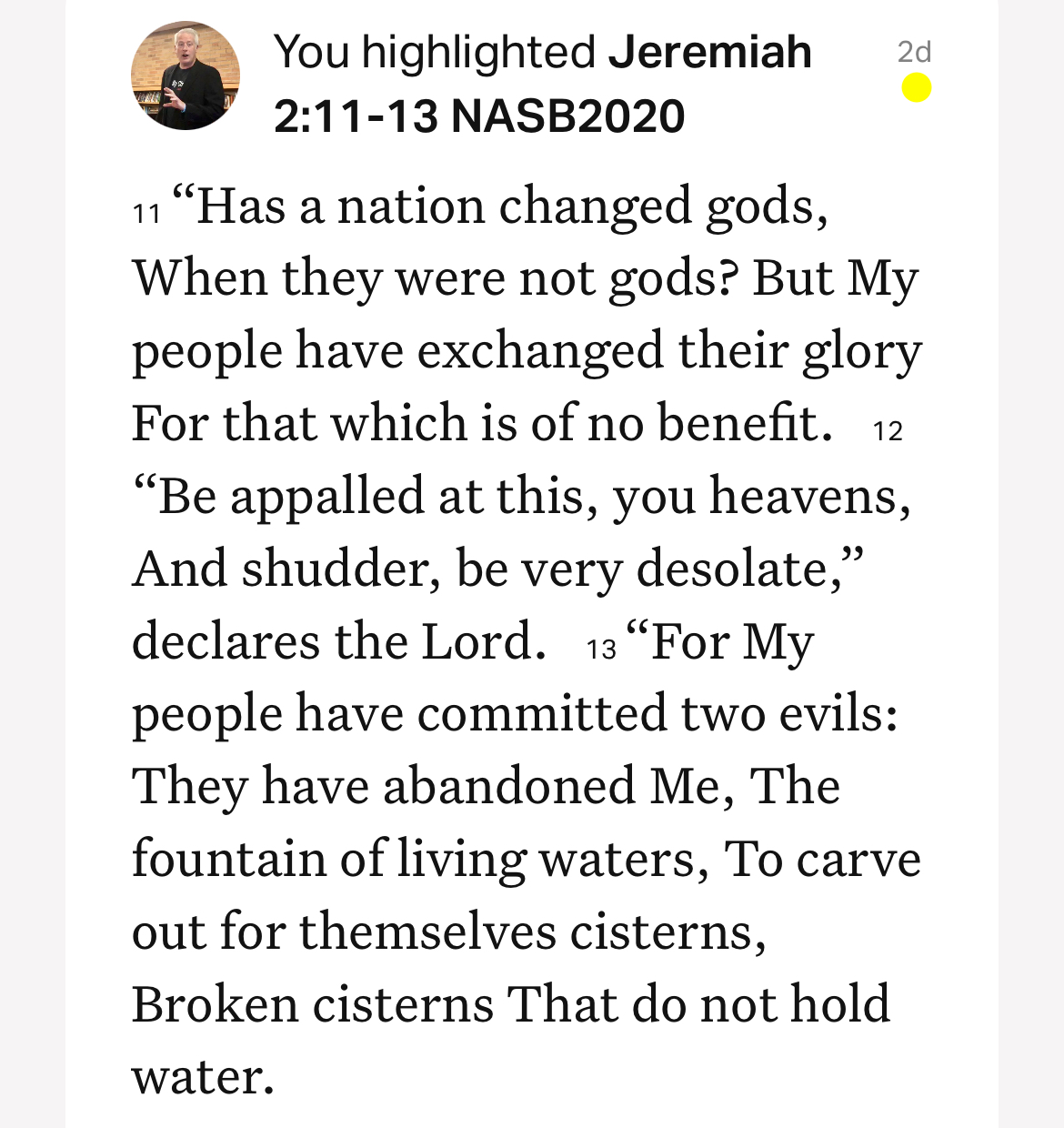
“Has a nation changed gods, when they were not gods? But My people have exchanged their glory for that which is of no benefit. Be appalled at this, you heavens, and shudder, be very desolate,” declares the Lord. “For My people have committed two evils: They have abandoned Me, the fountain of living waters, to carve out for themselves cisterns, broken cisterns that do not hold water. … Your own wickedness will correct you, and your apostasies will punish you; know therefore and see that it is evil and bitter for you to abandon the Lord your God, and the fear of Me is not in you,” declares the Lord God of armies. (Jeremiah 2:11-13, 19) 

This was true of Judah, and it’s just as true today in nations that used to regard the Word of God as their righteous standard. We have abandoned God and we have attempted to satisfy ourselves with things that are transient at best. 

God goes on to outline the results that we are already seeing in our homes, government, and cultures: “‘Your own wickedness will correct you, and your apostasies will punish you; know therefore and see that it is evil and bitter for you to abandon the Lord your God, and the fear of Me is not in you,’ declares the Lord God of armies” (Jeremiah 2:19). 

Here are some thoughts I shared earlier of how to spark a national revival 

You may also be interested in my posts that talk about our personal responsibility to spark a revival:

And I love this observation from Leonard Ravenhill’s exceptional book Why Revival Tarries.

Praying For The “So Thats”

“God, do not remain quiet; do not be silent and, God, do not be still. For behold, Your enemies make an uproar, and those who hate You have exalted themselves. They make shrewd plans against Your people, and conspire together against Your treasured ones. They have said, “Come, and let’s wipe them out as a nation, so that the name of Israel will no longer be remembered.” … Fill their faces with dishonor, so that they will seek Your name, Lord. May they be ashamed and dismayed forever, and may they be humiliated and perish, so that they will know that You alone, whose name is the Lord, are the Most High over all the earth.” (Psalm 83:1-4, 16-18 NASB2020)

Even God’s punishment on the enemies of His people has a redemptive purpose: “So that they will seek Your name … So that they will know that You alone, whose name is the Lord, are the Most High over all the earth.” 

This is why we are to leave judgment in His capable hands. We humans are prone to desire the complete and immediate elimination of all our enemies, but our loving God knows how to dispense punishment in perfect proportion so that evildoers may recognize their sin and repent. 

Yes, we should pray as this psalmist’s Holy Spirit-inspired words direct us. Pray for protection for God’s people, pray for punishment for God’s enemies, but also pray that all of this brings about the “so thats” that will lead these enemies of God to accept His forgiveness that Jesus paid for on the Cross.

There’s Still Time, America

Listen to the podcast of this post by clicking on the player below, and you can also subscribe on AppleSpotify, or Audible. 

This is what the Lord Almighty says: “Cut down the trees and build siege ramps against Jerusalem. This city must be punished…” (Jeremiah 6:6). 

When I read these 2500-year-old words it makes me shudder. Why? Because if we changed “Jerusalem” to “Washington, D.C.” and “Judah” to “America,” the sins of the people sound eerily the same: 

  • arrogantly closed ears refusing to listen to God’s Word 
  • people calling the loving message of the Bible “offensive” 
  • the predominance of greed 
  • deceptive “prosperity” preachers who are only in it for their own personal gain 
  • shameless, detestable lifestyles 
  • open rebellion against God’s laws 
  • constant slandering of God and of people created in God’s image (vv. 10-28)

God says, “This city must be punished.” 

But still, a hope remains. God also says, “Take warning, Jerusalem [or America], or I will turn away from you” (v. 8). 

There is still time for repentance! There is still time to take heed of this loving warning and turn away from sin. That’s what repentance truly means—seeing our sins as disgusting in God’s sight, asking for forgiveness, and turning away from those sins. 

Repentance means an about-face, so that instead of the catalog of sins that I just listed, we instead see:

  • a humility that hears and obeys God’s Word 
  • living in contentment with God’s blessings and not lusting for anything more 
  • listening to preachers who faithfully, lovingly, and boldly speak exactly what God has spoken to their hearts 
  • being ashamed of our former sinful lifestyle, and gratefully receiving the forgiveness that Jesus purchased for us
  • and having a passion to help everyone live in this God-glorifying way

Repent, America! There is still time before God’s judgment falls on us. The historical record is there for all to read: Unrepented sin received God’s righteous judgment. But in His mercy, God is still giving us time to repent today. Don’t miss this golden opportunity! 

►► Would you please prayerfully consider supporting this ministry? My Patreon supporters get behind-the-scenes access to exclusive materials. ◀︎◀︎

The Comfort And The Terror Of God’s Love

Listen to the podcast of this post by clicking on the player below, and you can also subscribe on AppleSpotify, or Audible. 

The Book of Hosea is a love story. It’s a real story telling a much grander story. 

The real story is between a man named Hosea and his wife Gomer. Sometime after their marriage, Gomer became unfaithful to Hosea and became entrapped to someone like a pimp, because it required a rather large payment from Hosea to redeem her. Gomer was restored to Hosea and they lived together faithfully from that point on. 

The grander story is the relationship between God and His people. God’s faithful love redeemed us, but our sin is like that of a cheating wife who has abandoned her husband for another lover. 

God’s love sounds like this:

  • “Let My tender words woo you back to Me” (2:14) 
  • “I will betroth you to Me forever” (2:19) 
  • “My compassion is aroused toward you” (11:8) 
  • “I will not carry out my fierce anger against your sin” (11:9) 
  • “I will care for you in the wilderness” (13:5) 
  • “I will feed you until you are satisfied” (13:6)

But God’s love also sounds like:

  • “I will block your path with thornbushes” (2:5) 
  • “I will ignore you” (4:6) 
  • “I will hide Myself from you” (5:6) 
  • “My sword will flash in your cities” (11:6) 
  • “I will terrify you like a roaring lion” (11:10) 
  • “I will attack you like a mother bear robbed of her cubs” (13:8)

(Check out all of the above references by clicking here.) 

We love the first list—and, indeed, that’s where God would desire us to stay—but the second list is just as loving. 

The opposite of love is not hate, but the opposite of love is apathy. 

God loves us too much—His Son paid too high of a price for us—for Him to let us head down a path that leads to eternal destruction. Listen to how the prophet Isaiah says this:

In all their distress He too was distressed, and the angel of His presence saved them. In His love and mercy He redeemed them; He lifted them up and carried them all the days of old. Yet they rebelled and grieved His Holy Spirit. So He turned and became their enemy and He Himself fought against them. (Isaiah 63:9-10) 

We need both the comfort and the terror of God’s love. 

We need Him to roar His lion’s roar and flash His terrible sword when we are on the path of destruction so that we can return to the path of life and experience His tender voice and bountiful provision. 

When we pray for our wayward loved ones, pray for both God’s sword and His loving words. He knows best which to use. And for ourselves, when we are stricken with fear, use that as an opportunity to ask why we have heard God’s roar or seen His sword flash. Then, if needed, repent and return to His tender embrace. 

God’s love speaks tenderly and roars ferociously because He loves you so very much! 

►► Would you please prayerfully consider supporting this ministry? My Patreon supporters get behind-the-scenes access to exclusive materials. ◀︎◀︎

Judgment Must Start With The Leader

Listen to the podcast of this post by clicking on the player below, and you can also subscribe on AppleSpotify, or Audible. 

Ezekiel 9 is a sobering chapter for anyone, but especially for those in leadership. Listen to the opening verses—

Then I heard [God] call out in a loud voice, “Bring the guards of the city here, each with a weapon in his hand.” And I saw six men coming from the direction of the upper gate, which faces north, each with a deadly weapon in his hand. With them was a man clothed in linen who had a writing kit at his side. They came in and stood beside the bronze altar.

Now the glory of the God of Israel went up from above the cherubim, where it had been, and moved to the threshold of the temple. Then the LORD called to the man clothed in linen who had the writing kit at his side and said to him, “Go throughout the city of Jerusalem and put a mark on the foreheads of those who grieve and lament over all the detestable things that are done in it.”

As I listened, He said to the others, “Follow him through the city and kill, without showing pity or compassion. Slaughter old men, young men and maidens, women and children, but do not touch anyone who has the mark. Begin at My sanctuary.” (Ezekiel 9:1-6)

It is no small thing to be called a leader. God calls leaders and expects them to represent Him well in their leadership assignment. That’s why God’s judgment always starts with those who are called by God to be leaders. 

It starts with me. 

Why? Because as a leader goes, so go the people. The smallest of sins that the leader tolerates in his own life give license to the people to sin even more. So it is right that God’s judgment begins at the top. It is right that God’s judgment on leaders be even more severe (James 3:1). 

Ezekiel reports that God’s glory moved from the temple to the east gate, and then from the east gate to the mountain outside the city (9:3; 10:4, 18-19; 11:23). God was still speaking clearly and distinctly (10:5), but the leaders were so blinded by their sin that they neither noticed God’s glory moving away from them and repented of their sin, nor did they call the people to repentance. 

The only ones who were spared from God’s judgment where those who were grieving and lamenting all the sins of the city. 

If God is going to continue to use me as his leader—if He is going to give me His Word to speak to others—I must be sensitive to His searching of my heart. I must grieve over my own sin first and repent from it. Then I must be a willing servant to speak God’s Word of both judgment and salvation to whomever He sends me. 

A mark of a godly leader is one who grieves and quickly repents over his revealed sins.

It starts at the top. It starts with me. Leaders must be held to the highest of standards.

I hope all godly leaders will join me in this prayer: Father God, may I be usable by You. May I be sensitive to the prompting of Your Holy Spirit, and grieve over my sins. May I be quick to repent and receive Your restoration, so that I can continue to lead other people into an intimate relationship with You. 

This is part 62 in my series on godly leadership. You can check out all of my posts in this series by clicking here.

►► Would you please prayerfully consider supporting this ministry? My Patreon supporters get behind-the-scenes access to exclusive materials. ◀︎◀︎

An Appeal To Preachers

Listen to the podcast of this post by clicking on the player below, and you can also subscribe on AppleSpotify, or Audible. 

…They have turned their backs to Me and not their faces; yet when they are in trouble, they say, “Come and save us!” (God in Jeremiah 2:27) 

In so many ways the USA today resembles ancient Israel. Abortion, prostitution, idolatry, envy, greed, atheism, dirty politics, self-serving church leaders. Our culture calls itself “Christian” but we live anything but. 

God is not allowed to be mentioned in our schools, but the moment there is a school shooting, people cry, “Where was God?! Why didn’t He stop this?!” 

God is banished from the town square, but as soon as a tornado or hurricane or flood levels the town, the people yell, “How could God let this happen?!” 

This was exactly the same lifestyle and same response in Jeremiah’s day. 

When these painfully tragic things happen, there should be a different response: “Consider then and realize how evil and bitter it is for you when you have forsaken the Lord your God and have no awe of Me” (v. 19). 

Typically, this considering takes place post-tragedy. But it really should be considered before disasters strike. Four times in this chapter God calls us to consider “the word of the Lord” (vv. 1, 4, 5, 31). In order for that considering to take place, loving pastor-shepherds need to hold up the mirror of God’s Word to the ungodly lifestyles people are living.

To all of my fellow pastors, I appeal to you to boldly and lovingly proclaim the full counsel of God’s Word. Not just the “pleasant” parts that speak of God’s blessings, but also the calls to repentance that will allow your people to avoid God’s righteous judgment. And don’t wait to only speak about these topics post-tragedy, but make this message a consistent part of your teaching. 

Pastor, if you don’t speak these truths to your flock, how will they know how to live in the way that pleases God? I am praying that God will help you in this. 

►► Would you please prayerfully consider supporting this ministry? ◀︎◀︎

Thursdays With Spurgeon—Mercy Finds The Loophole

This is a weekly series with things I’m reading and pondering from Charles Spurgeon. You can read the original seed thought here, or type “Thursdays With Spurgeon” in the search box to read more entries.

Listen to the podcast of this post by clicking on the player below, and you can also subscribe on iTunes or Spotify.

Mercy Finds The Loophole

And the Lord smelled a soothing aroma. Then the Lord said in His heart, “I will never again curse the ground for man’s sake, although the imagination of man’s heart is evil from his youth; nor will I again destroy every living thing as I have done.” (Genesis 8:21) 

     To begin, then, with the text, we have here a most painful fact that man’s nature is incurable. ‘The imagination of man’s heart is evil from his youth.’ You will remember, before the flood, in the fifth verse of the sixth chapter, it is written, ‘Then the Lord saw that the wickedness of man was great in the earth, and that every intent of the thoughts of his heart was only evil continually’ (Genesis 6:5). After the flood it was just the same. … 

     You might have hoped that after so terrible a judgment, when only a picked and peculiar few, that is, eight, were saved by water, that man began anew with better stock.… It is not one wit so. The same God who, after looking at men, declared that his imagination was evil before the flood, pronounces the very same verdict upon them afterward. …

     I believe that God might justly have condemned the whole race of Adam on account of Adam’s sin and their own guilt. But I do think that this was a blessed loophole through which His mercy could, as it were, come fairly to the sons of men. ‘No,’ He says, ‘I made them not distinct individuals but a race. They fell as a race; they will rise as an elect race. “For as in Adam all die, even so in Christ all shall be made alive” (1 Corinthians 15:22). And ‘For as by one man’s disobedience many were made sinners, so also by one Man’s obedience many will be made righteous” (Romans 5:19).’ … 

     I must have more than nature can give me. More than my mother gave me, more than my father gave me, and more than flesh and blood can produce under the most favorable circumstances. I must have the Spirit of God from heaven.

From Human Depravity And Divine Mercy

When Adam and Eve sinned, God wasn’t scrambling to come up with a Plan B. Jesus is described as the Lamb slain from the foundation of the world (Revelation 13:8), meaning that God had His merciful plan of redemption ready before He even created humans! 

The atoning sacrifice Jesus made on the Cross was the “loophole” that God’s mercy used to pardon our sins. We can never earn our salvation because we are still people with evil hearts. But we can put our faith in the One who took our punishment upon Himself so that His righteousness can be our righteousness. 

O what a Savior! O what mercy God has shown! O how great is His love for us! How shall we escape appropriate retribution if we neglect and refuse to pay attention to such a great salvation…? (Hebrews 2:3)

►► Would you please prayerfully consider supporting this ministry? ◀︎◀︎


Our Joyful Burden

I shared last week that the judgment of God should be a cause for both fear and rejoicingboth regret and comfort—for those who have a relationship with God through Jesus Christ. But for those who have no relationship with God, the judgment of God is a cause for only fear and regret. 

How did Nahum respond to this word of judgment God spoke through him? His opening words say, “The burden against Nineveh. The book of the vision of Nahum the Elkoshite” (NKJV). The Hebrew word for “burden” is almost always associated with a word God has spoken. It’s a realization of God’s weighty glory; it’s never, ever something we should trivialize! 

Prophets don’t just prophesy future events, they also announce in the present tense where people have departed from a lifestyle that robs God of His glory and how they can be forgiven of sins. 

“The prophets foretell (speak to what will happen in the future) and forth-tell (speak to what we should be doing in the present), both in the light of God’s heart for His own glory among all peoples of the world.” —Dick Brogden 

God never makes idle threats nor empty promises. Truly His Word is His bond. Through Nahum, God foretold that Assyria would be utterly destroyed, twice saying, “I am against you” (Nahum 2:13-3:7). 

The world may rejoice at God’s justice on evil (3:19), but how does God feel about carrying out His judgment? Ezekiel records God saying, “Do I take any pleasure in the death of the wicked,” declares the Sovereign Lord. “Rather, am I not pleased when they turn from their ways and live?” (Ezekiel 18:23) 

And Jesus declared, “For God so loved the world that He gave His one and only Son, that whoever believes in Him shall not perish but have eternal life. For God did not send His Son into the world to condemn the world, but to save the world through Him.” (John 3:16-17)

The Bible shows that when I sin, God’s first response is not anger toward me but broken-hearted grief. This is the message that must be both foretold and forth-told by Christians. 

“But what can I do,” you might ask. “I’m just one person. I’m not a big-time evangelist.” That sounds a lot like Nahum. He was just a guy from Elkosh—no special family lineage, no large city to claim as his home. 

God is looking for just one that will speak out His words (Ezekiel 3:17-21). Just one who will be humble enough to search their own heart first and then both boldly and lovingly deliver a message of both judgment and escape (Matthew 7:1-5; James 5:20). 

Foretelling God’s judgment is a burden. Forth-telling God’s forgiveness is a joy. All Christians have been given the joyful burden of this both-and ministry! 

If you’ve missed any of the other messages in our series called Major Lessons From Minor Prophets, you can find the full list by clicking here

The Fear And The Comfort Of God’s Judgment

Near the end of the movie The Princess Bride, the grandson learns that Wesley, the hero of the story, has apparently died. He asks his grandfather, “Who kills Prince Humperdink,” the arch-villain in the story. 

His grandfather replies, “No one. He lives.” 

“You mean he wins!?” blurts out the exasperated boy, “Grandpa, why did you read me this story??” 

We love to see bad guys get what’s coming to them, don’t we? Some of the baddest bad guys—perhaps in all of history—are the kings of Assyria. When the Assyrians in Nineveh repented and God’s judgment didn’t fall on them, Jonah’s response was much like the grandson in The Princess Bride, “God, why did You send me here?!” 

Sennacherib was the king of Assyria who was threatening Judah. Nahum writes a short, scathing prophecy about the destruction that is headed Assyria’s way. This is fulfilled in a small part when God defeats Sennacherib’s army, which leads to Sennacherib then being assassinated by two of his sons.

For Judah, this is a short-lived victory because the two kings which follow Sennacherib turn out to be two of the evilest and ruthless kings of Assyria. Yet Nahum’s prophecy still stands: an ultimate destruction is coming. In 605 BC Assyria was defeated by the Babylonians, and the destruction was so complete that Nineveh’s very existence was questioned until archeological discoveries were made in the 19th century. 

Why is this prophecy given to us? What are we New Testament Christians supposed to do with this promise of judgment? 

Nahum’s name means comfort, so it seems like God’s justice should comfort us. But, interestingly, the root word of his name means to regret or to feel sorry

Why is this? Think about it: You cannot really know what peace is unless you have been through a period of turmoil. Likewise, you cannot truly understand the relief of being spared God’s judgment unless you fully understand the weight and totality of God’s judgment that should fall on you.  

Nahum reminds us that God will never let the guilty go unpunished, and yet in the very next breath he tells us that the Lord is a refuge for those who trust in Him.

God is Just. This is a cause for…

  • …BOTH fear of God’s anger AND rejoicing that He is good 
  • …BOTH humility for our sin AND confidence that He forgives our sin 
  • …BOTH regret that we fall short of God’s righteous standard AND relief that Christ’s blood makes us righteous in God’s sight 

It’s amazing to think that it was MY sin that nailed Jesus to the Cross, but it was HIS love that allowed that to happen so that I could be forgiven! 

God is not willing that any should be separated from Him, but we do have to choose to receive the forgiveness that Jesus purchased for us. 

Assyria’s utter destruction is less than a drop in the bucket compared to eternal separation from God. As C.S. Lewis commented about the end of time: 

“For this time it will be God without disguise; something so overwhelming that it will strike either irresistible love or irresistible horror into every creature. It will be too late then to choose your side. There is no use saying you choose to lie down when it has become impossible to stand up. That will not be the time for choosing: it will be the time when we discover which side we really have chosen, whether we realized it before or not. Now, today, this moment, is our chance to choose the right side. God is holding back to give us that chance. It will not last forever. We must take it or leave it.” 

Today (and every day) is the day for heart-searching, acutely feeling the regret of our sin, and then knowing that our forgiven sins are forgotten sins! 

If you have missed any of the messages in this series on the major lessons from the minor prophets, you can find the full list by clicking here.