Listen to the podcast of this post by clicking on the player below, and you can also subscribe on Apple, Spotify, or Audible.
Paul makes it so clear that the Holy Spirit is a Person with Whom I should be in regular and intimate conversation. In the span of just a few verses in Galatians, Paul uses five different Greek words to fill out the definition for what it means for a Christians to walk by the Spirit.
(1) Walk by the Spirit (Galatians 5:16). This word means to conduct my life at the Spirit’s speed. Not rushing ahead; not lagging behind. As Solomon might say, “Trust the Holy Spirit with all your heart, and do not depend on your own understanding. Seek His will in all you do, and He will show you which path to take” (paraphrase of Proverbs 3:5-6).
(2) Led by the Spirit (5:18). This means to be attached to the One Who is conducting my life. Just like Jesus explained about branches staying connected to the Vine in John 15:1-5.
(3) Live by the Spirit (5:25). To consider the Holy Spirit as my one and only vitalizing Source. He is more important than the air I breathe, the food I eat, or the water I drink.
(4) Keep in step with the Spirit (5:25). I march obediently as a soldier under direction from my Superior Officer; attuned to His voice to obey His every direction.
(5) Live by the Spirit (6:1). This describes one who is filled with and governed by the Holy Spirit’s life-force.
Christians who live this way cannot help but exhibit the fruit of the Spirit in such abundance that their very lives become a living, breathing testimony to others of the delight in walking by the Spirit on every single step of our life’s journey (5:22-23).
Listen to the podcast of this post by clicking on the player below, and you can also subscribe on Apple, Spotify, or Audible.
Would you like to be known as somebody who’s “full of it”? I know that phrase usually has a negative connotation, but I would like to make the case that this is actually a really good thing.
I have blogged and talked and written quite a bit about a godly leader’s reactions being a strong indication of what a leader is truly full of. Three notable leadership posts are:
There’s no secret formula to fruitfulness as a Christian. We just stay connected to Jesus and the fruit will grow. This clip is from this sermon.
I have lots of new content every week, which you can check out on my YouTube channel.
The “Ten Commandments” are not explicitly listed or reiterated in the New Testament. Does that mean they are obsolete? No, says David Mathis, it means they are fulfilled. “Jesus Himself says He did not come to destroy the Law and Prophets, but to do something even more striking: fulfill them (Matthew 5:17). That is, fulfill like prophecy. Not simply keep the Ten in place, or remain under them, or leave them untouched, but fulfill them—first in His own person, and then by His Spirit in His church. He came not to cast off Moses, but to fulfill Jeremiah, and in doing so, He accomplished what is even more radical: establishing Himself as the supreme authority, putting God’s law within His people (rather than on tablets), writing it on their hearts (rather than stone), and making all His people to know Him (Jeremiah 31:31–34).” Check out my post The 10 Commandments in the New Testament.
More archeological evidence supporting to the historicity of the Bible. You can check out the full article, but this paragraph is a good summation: “One of the surprising findings was that, according to the results of their tests, the Broad Wall in Jerusalem, also known as Hezekiah’s Wall, was likely built during the reign of Uzziah, who Scripture says built fortifications in Jerusalem (2 Chronicles 26:9). Another finding was that Jerusalem was much more heavily populated and urbanized in the 12th through 10th centuries BC than some scholars previously thought. This would align with the biblical description of Jerusalem, particularly during the days of David and Solomon.”
“There is much of beauty, goodness, and truth to be discovered in the city of man, as Augustine pointed out toward the end of his great treatise, City of God. But all the culture and best intentions of men turn to corruption apart from the power of God to redeem and renew them. We who live also in the heavenly city now possess the mind of Christ (1 Corinthians 2:16); we are able to see the ways that culture can be ‘taken captive’ from the clutches of sin and unbelief and made to serve the purposes of Christ in all things. Thus, for the honor and glory of God, we commit ourselves daily to using all our time, activities, relationships, roles, responsibilities, and culture to furthering His rule on earth as it is in heaven.” —T.M. Moore
“Have movies and most conventional paleontologists got it all wrong? T. rex and other theropod dinosaurs (the meat-eaters) are often portrayed as intelligent predators that can outmuscle and outsmart their opponents. But is that really supported by science?” A very interesting compilation of research can be found here. The conclusion is exactly right: “God designed dinosaur brains that were perfectly suited for their lifestyles and body size when He created dinosaurs on Day 6 of the creation week (Genesis 1:25).”
Listen to the podcast of this post by clicking on the player below, and you can also subscribe on Apple, Spotify, or Audible.
I’ve talked before about the benefits of calling the Old and New Testaments the First and Second Testaments. This helps me not to subconsciously slip into the thought that “old” means outdated or that “new” means a replacement of what came before it. When I say First and Second I remember that there cannot be a Second without a First, that the First anticipates the Second and the Second fulfills the First.
The people of the First Testament experienced the Spirit of God in an often-repeated phrase: “the Spirit of the Lord came on” someone. It usually came on them for a specific task or season. For instance…
70 leaders to help Moses (Numbers 11:25)
the judges that delivered Israel from their enemies (Judges 3:10, 6:34, 11:29, 14:6, 15:14)
the anointing for Israel’s king (1 Samuel 16:13)
empowerment for prophets to prophesy (Ezekiel 11:5)
When the Holy Spirit came on these men, there was a noticeable supernatural anointing and empowerment, but more times than not these men also had visible and sometimes crippling stumbles.
What happens on the outside often stays on the outside. Sort of like the little boy whose mom brought him to church one Sunday. The little boy was constantly standing up on his chair and disturbing everyone around him. Finally, the exasperated mother whispered, “If you don’t sit down I’m going to take you to the restroom and spank you.” The little boy immediately sat down with his arms tightly crossed. He looked at his mom and said, “Outside I may be sitting down but inside I’m standing up!”
God looks at the heart. He told the Israelites that their inward defiance didn’t outweigh their outward religious practices. And Jesus said that people who prophesied, cast out demons, and performed miracles, but still had an unrepentant heart, would hear Him say, “I never knew you” (Isaiah 1:12-13; Matthew 7:21-23).
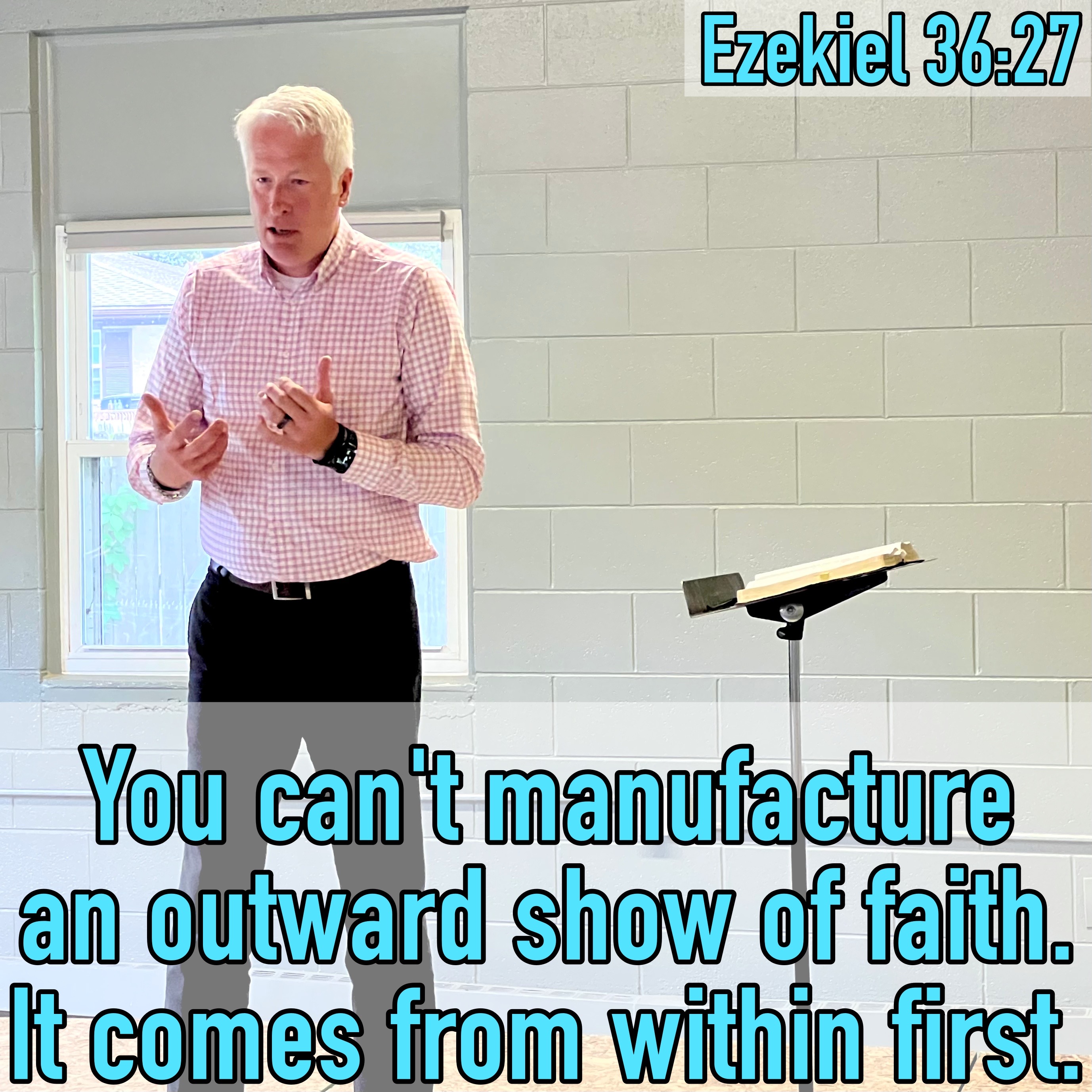
In the First Testament, we see a desire for the Holy Spirit to be more than on—a desire for Him to come in.David prayed, “Create in me a pure heart, O God, and renew a steadfast spirit within me” (Psalm 51:10). And God promised His people, “I will give them an undivided heart and put a new spirit in them … And I will put My Spirit in you and move you to follow my decrees and be careful to keep My laws” (Ezekiel 11:19, 36:27).
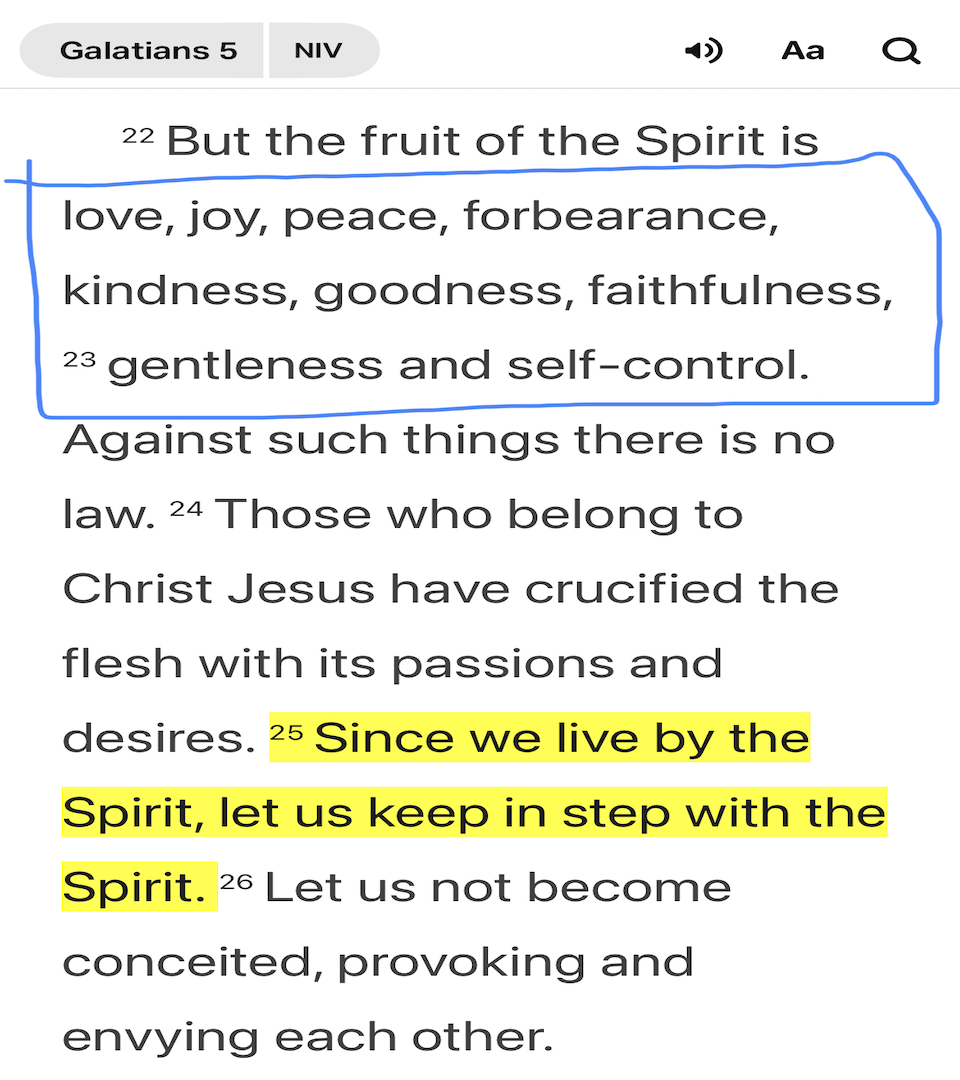
Paul identified this fruit of the Spirit as “love, joy, peace, forbearance, kindness, goodness, faithfulness, gentleness and self-control,” and he concluded with the phrase, “against such things there is no law” (Galatians 5:22-23). The law always sets limits, but when the Holy Spirit abides in us, the production of fruit is limitless!
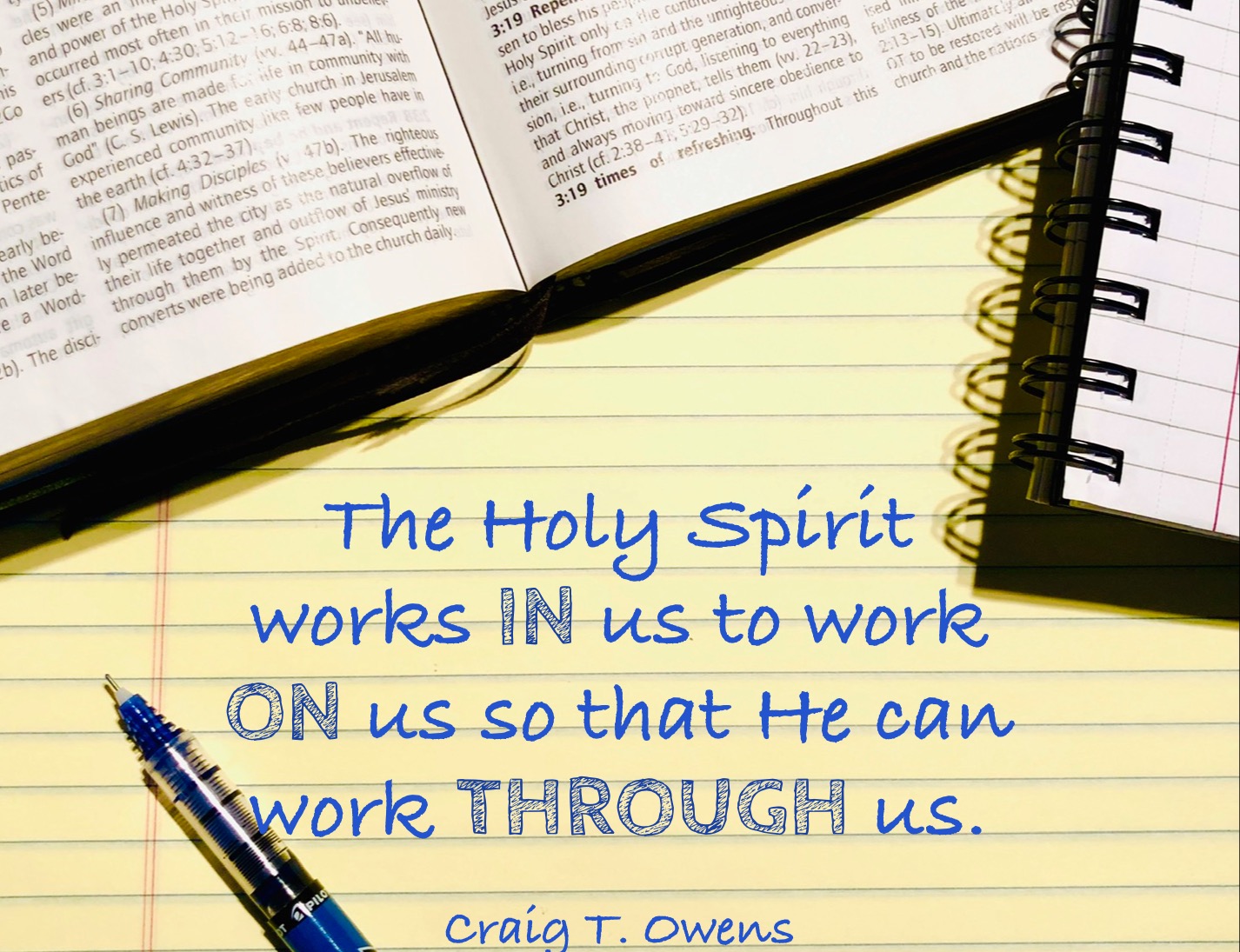
Being baptized in the Holy Spirit means that we allow Him to come in us and then to work on us. It’s only when the Holy Spirit has worked in us that can He flow through us to others. Jesus said that we would receive the Spirit’s empowerment to be witnesses—that’s an inward change that produces an outward fruit.
John uses the word “fellowship” four times in 1 John 1:3, 6-7. This is the Greek word koinonia,which means intimacy of relationship. The whole purpose of the motivational gifts, the operational gifts, and the leadership gifts is to bring maturity and unity to the Body of Christ. This maturity brings out the fruit of the Spirit.
All of these gifts of the Holy Spirit are intended to help us demonstrate the fruit of the Spirit in ways that make the Kingdom of God visible and desirable. A key component is our koinonia that draws us together as one Body. Two key phrases that appear generously throughout the New Testament Church are one another and each other.
Patiently bearing with one another—Ephesians 4:2; Ephesians 4:3 TLB
Speaking the truth in love to one another—Ephesians 4:15; Colossians 3:9
Forgiving one another—Ephesians 4:32; Colossians 3:13
Submitting to one another—Ephesians 5:21
Acting like Jesus toward each other—Philippians 2:5
Doing what is good for one another—1 Thessalonians 5:15
Spurring one another on—Hebrews 10:24
Regularly meeting with one another—Acts 2:46; Hebrews 10:25
Looking after each other—Hebrews 12:15 AMP
Confessing sins to one another—James 5:16
Showing hospitality to each other—1 Peter 4:9
Doing the hard work of getting along with each other—James 3:17-18 MSG
Those things lead to #26, which starts the cycle over again at #1.
Increasing our love for one another—1 Thessalonians 3:12; 2 Thessalonians 1:3; Hebrews 13:1; 1 Peter 4:8
Our koinoniain the church is encouraging for the saints and it is a blessing for the unsaved because of all of the good things a unified, strong, loving church can do. Koinonia ultimately becomes one of the greatest witnessing tools. Jesus prayed—
My prayer is not for them alone. I pray also for those who will believe in Me through their message, that all of them may be one, Father, just as You are in Me and I am in You. May they also be in Us so that the world may believe that You have sent Me. (John 17:20-21)
In our most recent Go Deep Bible study, I was teaching about the fruit of the Spirit found in Galatians 5:22-23—But the fruit of the Spirit is love, joy, peace, forbearance, kindness, goodness, faithfulness, gentleness and self-control.
There are four things that are notable to me in this passage:
(1) This whole section (Galatians 5:16-25) is circular. It begins with the phrase, “Walk by the Spirit,” and it concludes with, “Since we live by the Spirit, let us keep in step with the Spirit.” This tells me that our walk is never done—we never “arrive” but we must continue to walk with the Holy Spirit every day.
(2) The fruit of the Spirit is singular—it’s not “fruits” but “fruit.” That means that the Holy Spirit is working to bring out all of these nine fruit, not just one or two of them.
(3) The list of the fruit of the Spirit is also a circular list—
LOVE for God fill us with love for others → there is JOY in knowing His nearness → PEACE comes in the face of anxiety-causing tribulations → which gives me PATIENCE with others who are anxious without God → then I can have KINDNESS to draw them to God → and GOODNESS that is expressed in kind deeds → and my FAITHFULNESS that creates a sense of stick-to-it-iveness → and GENTLENESS that gives me courage to stand up for what’s right → my SELF-CONTROL keeps the fruit of the flesh in-check → which gives me greater LOVE for God and others…
(4) This whole process of producing more visible fruit in the life of a Christian is called sanctification. I like to remember this word by saying it “saint-ification.” As long as we are still on this earth, there is still work for the Spirit to do in us, so don’t ever become discouraged by this ongoing process of love.
We have been studying the different sets of gifts listed in the New Testament. These gifts are to bring maturity and health to the church. Previously we have looked at:
Near the end of this lesson, I shared something that I hadn’t included in the handouts, but I promised to share it—
LOVE for God fill us with love for others → there is JOY in knowing His nearness → PEACE comes in the face of anxiety-causing tribulations → which gives me PATIENCE with others who are anxious without God → then I can have KINDNESS to draw them to God → and GOODNESS that is expressed in kind deeds → and my FAITHFULNESS that creates a sense of stick-to-it-iveness → and GENTLENESS that gives me courage to stand up for what’s right → my SELF-CONTROL keeps the fruit of the flesh in-check → which gives me greater LOVE for God and others…
T.M. Moore has written a book that I think is a must-read for those who want to “earnestly contend for the faith” (Jude 3)—the orthodox Christianity that is presented in the Scriptures. You can check out my full book review of The Gospel Of The Kingdom by clicking here.
“We can only discern these wayward ‘winds of doctrine’ when we have a clear understanding of the Gospel of the Kingdom. The better we understand and the more wholeheartedly we embrace this Good News as Jesus and the Apostles taught it, the better able we will be to counsel and lead our fellow believers who may be ensnared in the thrall of a ‘different gospel’ and therefore in danger of having believed in vain.”
“In the divine economy now established within the Kingdom of God, the Spirit of God works with the Word of God to build the church and further the reign of Christ. An ethic of love and hope prevails within that realm which serves as a platform for embodying and proclaiming the truth of God and Christ. Salvation comes to those who believe, bringing them into the community of the saints and dramatically affecting every aspect of their lives in relationships of mutual service and love.”
“The Gospel of the Kingdom is not, in the first instance, about you and me going to heaven when we die. It is about the Kingdom of God, first and foremost—about a new reality that has broken into human experience with irresistible, transforming power, making all things new and bringing the knowledge of the glory of God to light in the sight of all men and nations.”
“Apart from the saving mercy of Christ and liberation into His Kingdom, men can look forward only to lives of uncertainty, doubt, disappointment, false hopes, fear, and death.”
“The Gospel of the Kingdom is the power of God for transformation, a transformation so complete and thorough that it finally makes all things new. Those who know this power are changed by the glory of God so that, increasingly, their lives actually begin to reflect the living reality of the risen Christ, their King. The fruits and virtues that flow from their lives, like rivers of living water, are precisely those most to be desired and least in supply in a fallen world.”
“The Kingdom is Good News because it brings power exceeding and abundant to be and do more than we could ever ask or think [Ephesians 3:20]. Here is a power we can never exhaust and that springs up day by day in ever fresher, ever more abounding ways to make all things new in our lives.”
“Joy, it appears, is not determined by what we can see in our immediate environment. Instead, Joy is a condition that attaches to knowing the Lord and being able to see past what is seen in order to engage what is not seen. …The ability to know joy—in spite of any untoward circumstances or conditions—is dependent on the extent to which one actually knows the Lord and is intimately engaged in a relationship with Him. … Your salvation is an experience of living in the Kingdom of God, where we know the hope of glory, experienced and expressed, as a daily reality, then our joy will be more constant and full because our relationship with the Lord will be as much for the ‘here and now’ as for the ‘then and there.’”
“God is always ready to meet us with joy, and He has provided ample means whereby we may engage Him for the joy that is to be known in His presence. Only our slothfulness, distractiveness, or neglect of His salvation—or the idolatry of seeking our joy in places other than the presence of God—can keep us from living in joy now, and in anticipation of the fullness of joy yet to come.”
This is a weekly series with things I’m reading and pondering from Charles Spurgeon. You can read the original seed thought here, or type “Thursdays With Spurgeon” in the search box to read more entries.
Evidence Of Christian Maturity
One of the first evidences that anyone is a child of God is that he hates with a perfect hatred and seeks to live a holy, Christlike life. …
I bless God that I have learned to have very little respect for the vision of the man with the measuring line. When I see an angel with it, I am glad enough; but when I see a man with it, I tell him that he must give me a warrant from God and show me how he is to know the elect by any other method than that laid down by our Lord Jesus Christ: “Ye shall know them by their fruits” (Matthew 7:16). …
He who truly grows in grace does not say, “Dear me! I can feel that I am growing; bless the Lord! Let’s sing a hymn. ‘I’m a-growing! I’m a-growing!’” I have often felt that I was growing smaller; I think that is very probable, and a good thing, too. If we are very great in our own estimation, it is because we have a number of cancers, or foul gatherings, that need to be lanced, so as to let out the bad matter that causes us to boast of our bigness.
From The Autobiography Of Charles Spurgeon
Some Dos and Don’ts for Christian growth:
Do—hate those things that keep you from God’s presence
Do—seek to be conformed to the image of Jesus
Don’t—look at other people as your measuring line
Do—make sure your life is fruitful according to God’s standards
Don’t—brag about your growth
Do—humbly thank God for your growth
Do—be quick to repent of un-Christlike things the Holy Spirit reveals to you
This is a weekly series with things I’m reading and pondering from Oswald Chambers. You can read the original seed thought here, or type “Thursdays With Oswald” in the search box to read more entries.
Jeremiah 2-3
[These are notes from Oswald Chambers’ lecture on Jeremiah 2-3.]
God is the “adornment” of His people; but God says, “My people have forgotten Me days without number”; the dead set of their life has been away from God (Jeremiah 2:32). Forgetting as an infirmity of mere consciousness is one thing; but forgetting by steadfastly refusing to recognize is another thing. These people had deliberately turned out of God’s way. They were wantoning after some other god than the God Who was holy (2:33). …
The thing that shocks us most is not the thing that shocked Jesus most. Social immorality shocks us till we don’t know where we are; but what struck the heart of Jesus Christ with horror was immorality against God, pride against Himself (see Luke 16:15). …
The innocence arising from evil is always like this—“I’ve done nothing.” It is the innocence we are all born with; sooner or later it takes its stand with evil and only knows good by contrast; whereas the innocence arising from the presence of the Spirit of God takes its stand with good and knows evil only by contrast. If we hand our hearts over to God we need never know in experience what Jesus Christ says of the human heart is true (see Mark 7:20-23).
From Notes On Jeremiah
This is a tough concept that takes some quiet introspection in the presence of the Holy Spirit. Christians should ask themselves: Do I know the difference between good and evil because I’m doing evil and the opposite of what I’m doing is good, or because I’m doing good and the opposite of what I’m doing is evil?
Originally, Eve knew evil only as the opposite of how she was living. But when satan tempted her to take the forbidden fruit, Eve now knew evil as something she was doing. Jesus said evil is what would naturally come out of our heart, unless “we hand our hearts over to God” and allow His Spirit to supernaturally bring out of us the Christlike fruit He produces. Is this happening in your life?



 Paul makes it so clear that the Holy Spirit is a Person with Whom I should be in regular and intimate conversation. In the span of just a few verses in Galatians, Paul uses five different Greek words to fill out the definition for what it means for a Christians to walk by the Spirit.





 Craig T. Owens