Timothy D. Padgett asks, “Is there such a thing as Judeo-Christianity?” This is an interesting read, but I especially liked this passage: “This is key. When we speak of Judeo-Christianity, we’re not talking about salvation. We are talking about philosophy, even worldview. A Christian worldview must be just that: Christian. A faithful Jew apart from Christ is no more saved than a devout Muslim or an honest atheist, and any philosophy that leaves out the Incarnation will lack its ultimate hope.”
“A human being without a friend is like a beast: for he lacks someone with whom he can share his joy in prosperity and his sadness in adversity, to whom he may unburden his mind when he is preoccupied, with whom he may talk whenever he has had a particularly sublime or illuminating insight…That person is completely alone who has no friend.” —Aelred of Rievaulx
John Stonestreet and Dr. Glenn Sunshine point out that there are some “who believe that AI is a vehicle through which trans-dimensional, non-human intelligences are communicating with us.” Their post is called The Rise of Technopaganism. Of course, this is nothing new: The apostle Paul addressed mankind creating its own god and worshiping it, just as some are now doing with AI.
“It’s better to look ahead and prepare than to look back and regret.” —Jackie Joyner-Kersee
Listen to the podcast of this post by clicking on the player below, and you can also subscribe on Apple, Spotify, or Audible.
My podcast partner Greg Heeres asked me if I had found one thing that really worked in developing or deepening relationships. My answer is short and to the point.
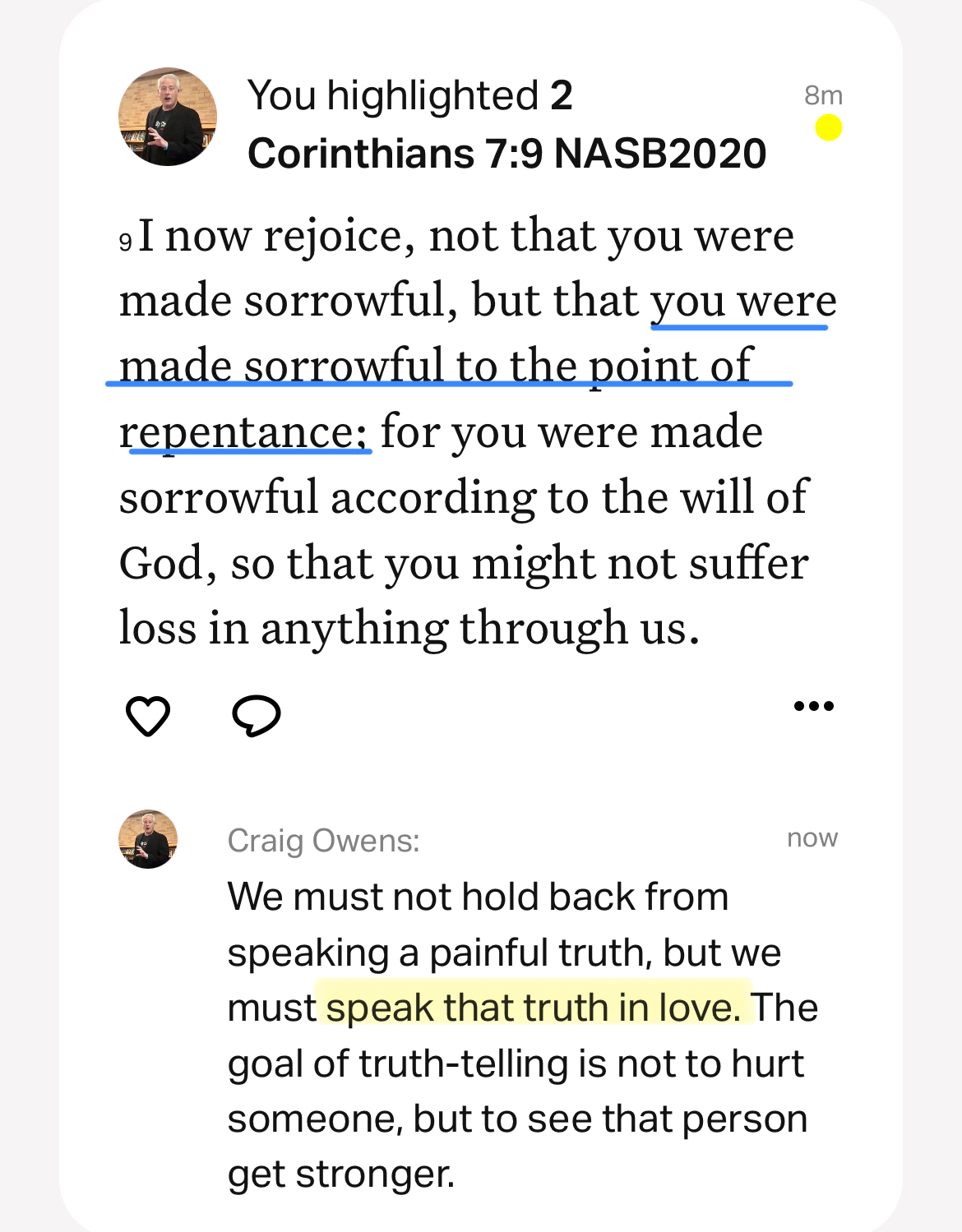
For though I caused you sorrow by my letter, I do not regret it; though I did regret it—for I see that that letter caused you sorrow, though only for a while—I now rejoice, not that you were made sorrowful, but that you were made sorrowful to the point of repentance; for you were made sorrowful according to the will of God, so that you might not suffer loss in anything through us. For the sorrow that is according to the will of God produces a repentance without regret, leading to salvation, but the sorrow of the world produces death. (2 Corinthians 7:8-10 NASB)
Is it okay for you to hurt your friend’s feelings?
I think it is acceptable if those painful words save your friend from a world of hurt.
We must not hold back from speaking a painful truth, but if we do have to share that word, we must ensure that we are speaking that truth in love (Ephesians 4:15). Remember that people don’t care what you know until they know that you care. The goal of truth-telling is not to hurt a friend’s feelings, but to spare that friend a greater pain or to see that friend get stronger.
If you have to speak these words, be sure to water your lovingly truthful words in tears before you share them. As Jesus said, “Remove the plank in your own eye first” (Matthew 7:5).
If you are on the receiving end of painful words, ask yourself, “Is this a friend who loves me and wants the best for me? If so, is there truth in these words?” Even if the words were delivered clumsily, see the love behind the words and find the truth that can help you make a change for the better (Proverbs 27:6, 17).
To dive a little deeper into this topic, check out my video on The Podcast called Speak the truth in love.
Listen to the podcast of this post by clicking on the player below, and you can also subscribe on Apple, Spotify, or Audible.
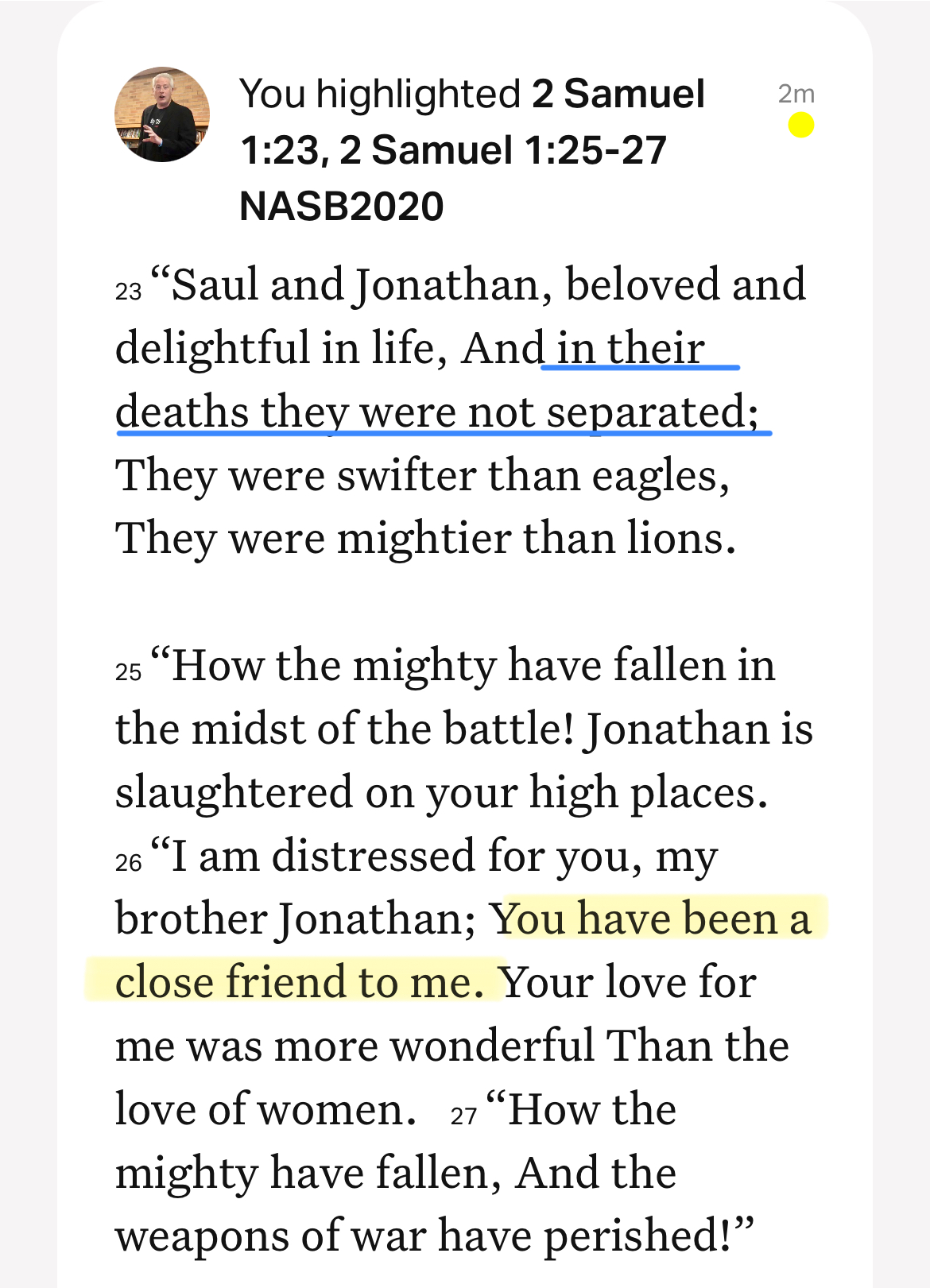
Saul and Jonathan, beloved and delightful in life, and in their deaths they were not separated; they were swifter than eagles, they were mightier than lions. Daughters of Israel, weep over Saul, who clothed you in scarlet, with jewelry, who put gold jewelry on your apparel. How the mighty have fallen in the midst of the battle! Jonathan is slaughtered on your high places. I am distressed for you, my brother Jonathan; you have been a close friend to me. Your love for me was more wonderful than the love of women. How the mighty have fallen, and the weapons of war have perished! (2 Samuel 1:23-27)
It’s not surprising that David honored his friend Jonathan in song after his death. But it is surprising that Jonathan remained faithfully at his father’s side, fulfilling his duties as a son and a prince of Israel, although he did not agree with his father’s treatment of David.
In Jonathan we see the obedience to the fifth commandment: Honor your father and mother (Exodus 20:12).
And it is also surprising that David says nothing bad about Saul in this song of lament, but only praises him for his valiant victories as Israel’s king.
In David we see a true picture of forgiveness—where a forgiven transgression is a forgotten transgression, no longer held by David against his tormentor. Later in his life, David would write about the mind-blowing truth that God obliterates the record of our forgiven sins, never bringing them up again (Psalm 103:10-12)!
Is it any wonder that David and Jonathan became and remained such close friends? From the moment Jonathan first heard David speaking about his trust in God, they became “one in spirit” and forged a covenant friendship that lasted even beyond Jonathan’s life (1 Samuel 18:1-4).
May we learn from these two God-fearing, faithful friends what it really means to honor others, whether we call them friends or others might call them “enemies.”
In my book When Sheep Bite I have a chapter called “When the sheep slander you.” In that chapter, I dive deeper into the lesson leaders can learn from how David treated Saul both during his life and after his death.
Stop praying to yourself! God isn’t impressed with your “powerful” prayer! Jesus tells an interesting story about two men: one thought very highly of his spiritual status and the only could barely lift his eyes. Jesus said that the proud man’s prayer received no help from God, but only the humble man’s prayer was heard. This is a short clip from my series called Kingdom Praying. I have lots of new content every week, which you can check out on my YouTube channel.
“If the fetus gets in the way, ditch it. If the old person gets in the way, ditch it. If you get in the way…” —Francis Schaeffer
“The god of convenience, ruling capriciously in the hearts of men and women, and supported by worshipers of the god of wealth—greedy, self-interested profit-takers in the guise of abortionists and abortion-rights advocates—is the putative lord of life and death where children in the womb are concerned. …Christians must insist that all political candidates seeking their support, at whatever level of government, be firm in their commitment to resist the present abortion regime and expose the lie of the pro-choice agenda by every available means. …The Law of God is holy and righteous and good. Abortion is unholy, unrighteous, and evil. If we want a just and loving society, we will worship God and obey His Law, and we will work to dethrone the god of convenience and to expose the folly and self-interest of all its followers. And we will look to God to explain the nature, meaning, and value of all lives.” —T.M. Moore
Elihu is angry at Job “because he justified himself before God.” Better stated: “Job was more concerned about justifying himself—making himself look good—than he was about making God look good.” Elihu is angry at Job’s three friends because they acted like God and pronounced a guilty verdict against Job. Elihu is righteously provoked. After holding his tongue for 31 chapters, he cannot remain silent any longer!I conclude that Elihu is righteous in his response because God doesn’t have anything negative to say to or about Elihu (as He does with the three friends) at the end of the Book of Job.
Long before the term “fake news” made it into our lexicon, Charles E. Robinson wrote an article in 1934 “as a solemn warning to all Christians” about the rising tide of anti-Semitism. He was especially upset about a book that made an erroneous case blaming Jews for global economic and political turmoil. I am thrilled with the strong spiritual and intellectual legacy in the Assembly of God fellowship!
“There’s a lot of blood, sweat and guts between dreams and success.” —Paul Bear Bryant
The Holy Spirit knows the best place to use us, the best time to use us, and the best way to use us. We must trust Him! I have lots of new content every week, which you can check out on my YouTube channel.
“In our rush to be thanked or appreciated, or even in our shortsighted compassion, we can undermine the good God is patiently working. In that sense our good is actually evil, for it resists the wisdom, love, and transformative lessons of God.” —Dick Brogden, in Proverbs: Amplified and Applied
I love this quote in J.R.R. Tolkien’s Fellowship of the Ring when Merry Brandybuck tells Frodo about the stick-to-it-iveness of his friends: “You can trust us to stick to you through thick and thin to the bitter end. And you can trust us to keep any secret of yours closer than you keep it yourself. But you cannot trust us to let you face trouble alone. … We are your friends, Frodo.”
I love this devotional from John Piper about God-given foes and God-given faith. “The logic of fearlessness in the face of adversity is this double truth: Both your adversity and your faith in the face of adversity are gifts of God.”
Listen to the audio-only version of this podcast by clicking on the player below, or scroll down to watch the video.
On this episode of “The Craig And Greg Show” we talk about how the first episode of The Craig and Greg Show debuted over two years ago on September 15th, 2020, and was appropriately titled “Leaders are Learners.” However, the discussions that became this show go back years before then.
On our 50th episode, Greg and I take you into the bagel shop where many long conversations about leadership became the show you see today.
Thank you for your support over the last fifty episodes. The entire Craig and Greg Show team wishes you a very merry Christmas, and we’re so excited to share more leadership insight with you in 2023 and beyond!
Check out this episode and subscribe on YouTube so you can watch all of the upcoming episodes. You can also listen to our podcast on Spotify and Apple.









 Craig T. Owens