“Although your foot may slip often, yet your heart cleaves to God’s commands and will not let you lie where you fell, but you get up again, resolved to watch your step better. Know this, then, that your sincere respect for the commandment is ample evidence of your title to the promise.
“When David confessed to his love for God’s law he did not question his title to the promise: ‘I hate vain thoughts; but Thy law do I love’ (Psalm 119:113). He did not say that he was free from vain thought but that he hated them. And he did not say that he fully kept the law but he loved it, even though he sometimes failed in total obedience. Because of the testimony which conscience gave concerning David’s love for the law, his faith settled the question once for all: ‘Thou art my hiding place and my shield: I hope in Thy Word’ (Psalm 119:114).”
“It is inner warfare—The 7th [chapter] of Romans is the description of this, the battle between faith and unbelief, between the spirit and the flesh. This war is private, solitary, with no eye upon the warrior; fought in the closet, on the knees, with the Bible as his weapon. …
“It is outer warfare—The enemies are legion; the world, with all its enmities, snares, pomps, pleasures; satan, with his principalities and powers; both of these in combination hating, persecuting, attacking. This is ‘the great fight of afflictions’ (Hebrews 10:32). Thus it is so far public, before men; ‘we are made a spectacle to the world, and to angels, and to men.’ …
“It is daily warfare—It is not one great battle, but a multitude of battles, constant warring: there is no intermission and no discharge in this war. The enemy wearies not, ceases not; nor must we. We wake to warfare each morning, and go out to warfare each day. Everywhere we find the enemy posted, sometimes openly, sometimes in ambush. The conflict is life-long, and it is daily.
“It is warfare not fought with human arms—The weapons of our warfare are not carnal. We do not war after the flesh. It is in divine strength; with the sword of the Spirit; clothed in the whole armor of God. …
“It is warfare in which we are sharers with Christ—He first fought the good fight, as the Captain of our salvation, the Lord strong and mighty; the Lord mighty in battle. The inner warfare indeed was not His, but all the rest was. He fought, when here, the same battles as we; and it is into His warfare that we are called to enter.” —Horatius Bonar, in Light & Truth: Revelation
“We all need to learn the relationship between real faith that could put us into dangerous situations and the real danger of misinterpreting the Scriptures to our own advantage. Wrong interpretations can yield pharisaical commitments to practices and rituals rather than to the Person of Jesus. But true faith that walks the talk and toes the line of true discipleship can be downright dangerous. This is the line the Jesus regularly walked, and it is the same line that He still calls His followers to find and walk today.
In Jesus Always by Sarah Young, we hear Jesus speak the words of Scripture to us in His first-Person voice.
“I am training you to view your life from a heavenly perspective—through eyes of faith. When things don’t go as you had hoped to, talk with Me. Seek My face and My guidance. I will help you discern whether you need to work to change the situation or simply accept it.”
“The more you keep your gaze on Me—in quiet times and busy times—the better you can reflect My glory to other people. … When you are aware that I am present with you, you’re less likely to do or say something that’s displeasing to Me. When you’re struggling with difficult circumstances or painful feelings, awareness of My presence offers courage and comfort.”
“If you aspire to reach the heights—especially the high places of achievement and recognition—be prepared to shoulder the responsibilities that accompany success. But don’t forget to enjoy the satisfaction of accomplishing good things with Me, through Me, and for Me.”
“Pursuing a close walk with Me is the best way to live in the present. Keep bringing your thoughts back to Me whenever they wander. Return to Me joyfully, beloved. I will take great delight in you and rejoice over you with singing.”
“You tend to waste energy trying to determine whether your resources are adequate for the day. You keep checking your ‘power gauge’ instead of looking to Me for My provision. How much better to simply acknowledge your insufficiency when you awaken! This frees you to rely on My boundless sufficiency.”
“Your becoming a Christian was only the beginning of the work I’m doing in you. You need to be made new in the attitude of your mind and to put on the new self—becoming increasingly godly, righteous, and holy. This is a lifelong endeavor, and it is preparing you for heaven’s glory.”
“See Me smiling on you in radiant approval. My limitless love falls continually upon you, like heavenly snowflakes that melt into your upturned face. No matter how distressing your circumstances, this love is sufficient to sustain you. Someday you will even ascend to Heaven on it. I eagerly anticipate the time when I will take you into glory—to be with Me forever!”
Be sure to check out my review of Jesus Always by clicking here, and you can read the first set of quotes I shared from this book here.
If you’d like to be notified immediately when I post more quotes, please subscribe to my blog, and be sure to follow me on Twitter and Tumblr, where I share inspiring quotes every day.
Christian, are you ready to do spiritual battle? You need to make sure you are properly equipped with all the armor God has for you. Check out my review of William Gurnall’s The Christian In Complete Armour by clicking here, and then enjoy this first set of quotes.
“Christ’s blood is the only wine which gladdens God’s heart and satisfies His justice at the same time. … No grape of our own harvest is pressed into this sweet cup. It is as if Christ says, ‘When [God] comes to comfort you with the forgiveness of your sins, He will take of mine, not anything of yours. I purchased your peace with God with My blood, not by your tears of repentance or morning for your sins.’”
“Unbelief is a sin-making sin. … It is a sin which holds out last on the battlefield, the one which the sinner is least aware of, and which the saint ordinarily conquers last. It is one of the chief fortresses to which the devil retreats when other sins are routed.”
“Do you take pleasure in choosing Christ? Do you go to Him not only for safety but also for delight? As the lover said of her bridegroom, ‘I sat down under his shadow with great delight’ (Song of Solomon 2:3). This must be a deliberate choice, wherein the soul seriously weighs the covenant Christ offers and then chooses Him.”
“Faith puts forth an assisting act in prayer. … It assist the soul with persistence. Faith is the wrestling grace. It comes up close to God, reaches out to Him, and will not easily take a denial. … Never before could the Christian know what to do with a promise in prayer until faith teaches him to press in to God with it, humbly yet boldly. … Prayer is the very breath of faith.”
“If a group of men and children were to wade through a brook no deeper than a man’s head, the men would have a definite advantage over the children. But if they tried to cross the ocean, the men as well as the children would need a ship to carry them. And only the insane would try to wade through without the help of a ship just because they are a little taller than the rest.”
“Beware of opposing the Spirit. Does He beam light from His Word into your understanding? Be careful what you do with this candle of the Lord that lights your mind; do not pride yourself in this new insight, or it may be snuffed out in an instant. If the Holy Spirit confirms the light in your understanding so that it sets your conscience on fire with the awareness of sin, do not resist Him. … satan longs for you to quench the Spirit by trying to calm your own conscience.”
“Christian, there are many delights which saints traveling to heaven meet on their way there, besides what God has for them at the journey‘s end. It is the Christian whose faith is strong enough to act upon the promise who finds and possesses these pleasures.”
“A person should no more sit down and be content in his unresolved doubt than one who thinks he smells fire in his house would go to bed and sleep. He will look in every room and corner until he is satisfied that everything is safe. … In spite of his doubts the true believer leans on and desires still to cling to Christ. While Peter’s feet were faltering beneath the water he was lifting up prayer to Christ.”
“Have you ever freely given yourself up to Christ? Everybody professes this, but the presumptuous soul, like Ananias, lies to the Holy Ghost by keeping back the most important part of what he promised to lay at Christ’s feet. The enjoyment of lust is entwined about his heart and he cannot persuade himself to deliver it up to God’s justice. His life is bound up in it, and if God will have it from him He must take it by force; there is no hope of gaining his consent. Is this the picture of your faith? If it is, you have blessed yourself in an idol; you have mistaken a bold face for a believing heart.”
“Faith strips away the veil from the Christian’s eyes so he can see sin in its nakedness before satan disguises it with flattering costumes. Faith enables the soul to recognize not only the nature of sin void of all true pleasure, but also the temporal quality of its frivolous elation. Faith persuades us not to give up God’s sure mercies for satan’s transient thrills.”
I will be sharing more quotes from this book soon. To be notified as soon as those quotes are posted, be sure to subscribe to my blog. In the meantime, every day I share inspiring quotes on Twitter and Tumblr, so make sure you follow me there too!
Have you ever been stumped by someone’s argument against Christianity or the Bible? Has anyone ever made fun of you because the Bible sounds like a fairy tale? Over 100 years ago Oswald Chambers described how our post-Christian world was beginning to treat Christianity and the Bible on which it’s based—
“We have made ambition and competition the very essence of civilized life. No wonder there is no room for Jesus Christ, and no room for the Bible. We are all so scientifically orthodox nowadays, so materialistic and certain that rationalism is the basis of things, that we make the Bible out to be the most revolutionary, unorthodox and heretical of books.”
It’s that “rationalism” that we need to address. We need to ask scoffers and seekers alike, “What makes you so sure of your beliefs? How did you come to that conclusion?”
Every human being exercises some sort of faith—that the chair will hold them when they sit down, that their spouse will honor their marriage vows, and that their worldview is correct. We need to explore what kind of faith they (and we) have:
Unreasonable faith—believing in something in spite of the evidence.
Blind faith—believing in something without any evidence.
Reasonable faith—believing in something because of the evidence.
I want to show evidence that makes it reasonable to believe in the Bible.
Empirical evidence—
The bibliographical test: determining whether the text of the historical record has been transmitted accurately.
Josh McDowell states, “No other work in all literature has been so carefully and accurately copied as the Old Testament.” He can make this claim because the profession of “scribe” was one of the most professional and exacting of all professions. The rigorous standards employed to prove the accuracy of a copy of a biblical manuscript was higher than for any other literature.
Most of our modern-day Bibles are based on a 1000-year-old manuscript. But after the Dead Sea scrolls were discovered, we found biblical manuscripts going back to 250 B.C. that confirmed the accuracy of the manuscripts we already had. This led Dr. Peter Flint to conclude: “The biblical Dead Sea Scrolls are up to 1,250 years older than the traditional Hebrew Bible, the Masoretic text. We have been using a one-thousand-year-old manuscript to make our Bibles. We’ve now got scrolls going back to 250 BC. … Our conclusion is simply this—the scrolls confirm the accuracy of the biblical text by 99 percent.”
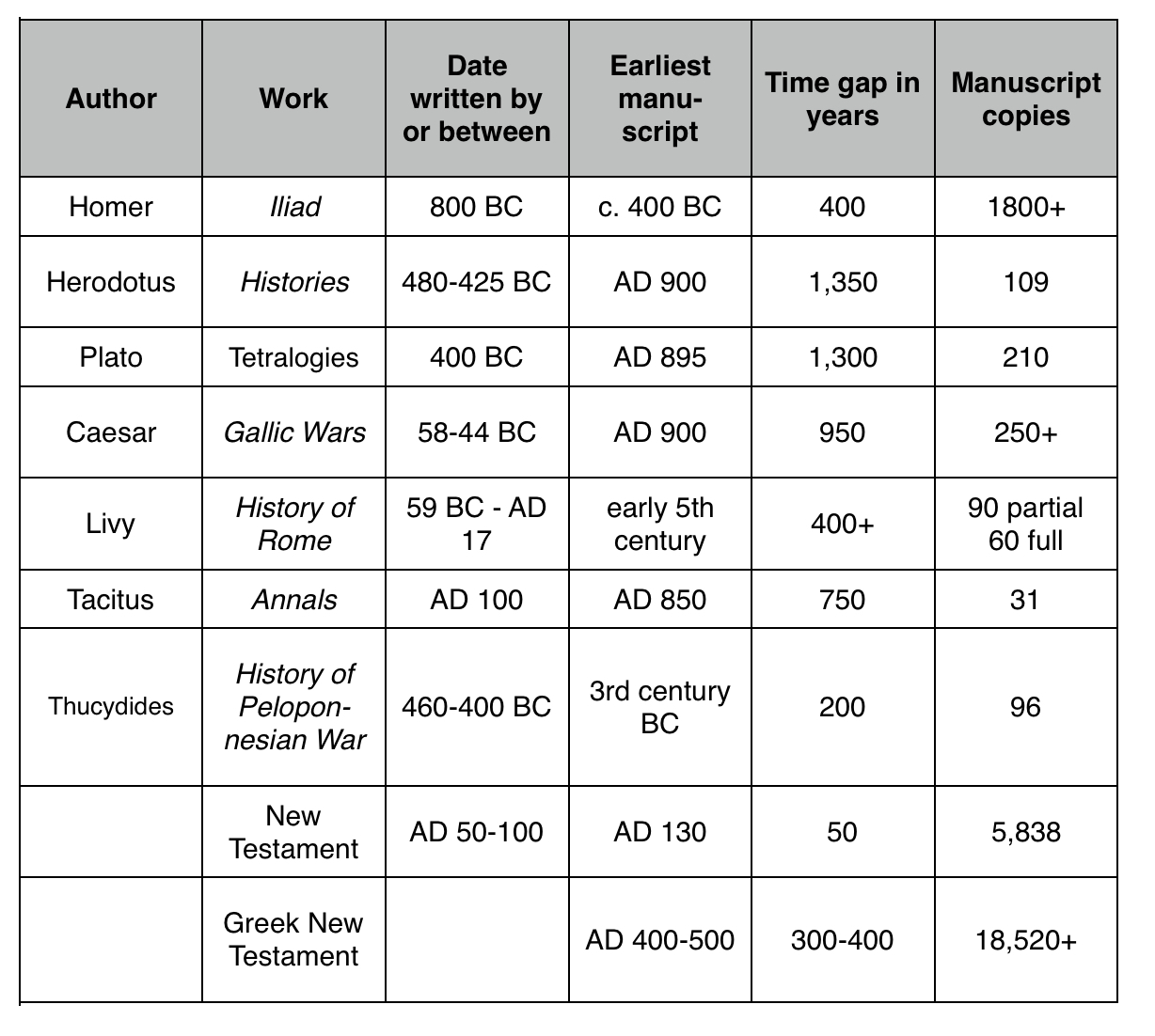
Then regarding the New Testament, Josh McDowell says, “I believe there is more evidence for the reliability of the New Testament than for any other ten pieces of classical literature put together.” Check out this chart reproduced from McDowell’s book God-Breathed to see by comparison to other literature, how close in dating the earliest biblical manuscripts are, and how many of those manuscripts have been discovered!
2. The external evidence test: determining whether the historical record has been verified or affirmed by data outside of itself.
Over one-fourth of the Bible is prophetic, and two-thirds of its prophesies have already been fulfilled. For example, 700 years before His birth, the city in which Jesus was to be born was identified by a man named Micah.
Time and time again archeologists discover articles that verify the claims in the Bible. This led archeologist Nelson Glueck to conclude, “It may be stated categorically that no archeological discovery has ever controverted a single biblical reference. Scores of archeological findings have been made which confirm in clear outline or in exact detail historical statements in the Bible.”
3. The internal evidence test: determining how of the historical record stands up to the test of internal validity.
The Bible was written by 45 different authors, over a span of 1500 years, on 3 different continents, and in 3 different languages. Yet there are no contradictions!
Anecdotal evidence—
Changed lives. My life is one that has been amazingly impacted by the God of the Bible, as was a man named Saul, who had a total about-face after encountering Jesus. As a result, Christianity was spread far and fast through his writings and world travels.
2. Changed societies. Wherever the Christian faith of the Bible has been put into practice, societies improve. Leonard Sweet notes—
“Before Christianity, there were cults that practiced all sorts of human sacrifice as well as self-mutilation and self-castration. Before Christianity, the weak were despised, the poor maligned, the handicapped abandoned. Before Christianity, infanticide was rampant, slavery run-of-the-mill, and gladiatorial combat a form of entertainment. In Jesus’ day, Corinth was famous for its temple prostitutes, continuing a long-standing tradition symbolized by the Corinthian athlete Xenophon.… Aristotle…not only condoned institutionalized slavery but provided an elaborate argument in favor of it. As if that weren’t enough, Aristotle called man ‘begotten’ and woman ‘misbegotten,’ and because a woman’s reasoning was ‘without authority’ accepted no female students.
“Only Jesus and His followers known as the church insisted on the concept of human dignity and the value of every human soul. Only the church built hospitals and took care of the abandoned and disabled. Only the church celebrated charity and selflessness as the highest virtue and elevated the status of women.”
Is all of this “proof positive” that the Bible is God’s Word? No, it’s not. But I think the evidence is compelling enough that it is certainly reasonable to reach this conclusion.
Here are some great application questions from this lesson:
Other than because it says so in the Bible, how do I know that it is God’s Word?
Pastor Phillips Brooks visited Israel in the mid-1800s. While there he visited a small church just outside of Bethlehem. Listening to the worshipful songs being sung in that quiet countryside, he was inspired to pen the words to O Little Town Of Bethlehem.
Because of that quiet setting, notice how Rev. Brooks notices things we often miss—
little town on Bethlehem
in thy dark streets
while mortals sleep
no ear may hear His coming
But little does not mean insignificant. And just because we can’t see or hear something doesn’t mean it doesn’t exist or it isn’t important.
Sometimes we’ve looked and listened and waited and searched for so long that we have given up and we begin to drift off to sleep. We continue to live in our own “little town” surrounded by silence. And we are in danger of missing a miracle right in our midst!
We know today that Jesus was born in Bethlehem. But did you know that this little town was still so obscure in Christ’s day that many people in Israel were unaware of what went on there? (See John 7:41-43). Even after King Herod had gruesomely killed all the baby boys in Bethlehem, scarcely anyone outside of that town knew about it or cared about it.
But God cared. And He knew exactly what He was doing.
But when the proper time had fully come, God sent His Son (Galatians 4:4)—the exact right moment—to be born in Bethlehem—the exact right place (Micah 5:2). Notice even Micah says of Bethlehem though you are small among the clans of Judah, giving birth to the title of Rev. Brooks’ poem.
How small was it? Look at the description of the territory for the tribe of Judah (in Joshua 15), and you can easily glossed over the names of all of the towns. But look more closely and you will see something you didn’t read in that list of towns. Take a close look at all 38 cities: it’s still missing.
There are a couple of very notable figures that dominate the Old and New Testaments, and they have something in common—King David and Jesus both come from the tribe of Judah. And both of them were born in Bethlehem. But in the list of towns in Judah’s territory, there isabsolutely no mention of Bethlehem.
This town either didn’t exist, or it was so “insignificant” that Joshua didn’t even think to mention it. It would be almost another 500 years before David would be born in Bethlehem, and then another 900 years after that before Jesus would be born in this little town of Bethlehem.
God had in mind for the greatest earthly king in Israel’s history and the King of all kings to come from such humble origins… from a village that didn’t even make the list. Bethlehem was ready for these kings at just the right moment!
Jesus said heaven and earth will pass away, but His words will never pass away. What promise in His Word do you need to cling to?
Just as those awaiting the Messiah clung to Micah’s promise until it came to pass, you must find God’s promise for you in His Word, cling to it, and don’t let go until it comes to pass in your little town.
We walk by faith, not by appearance (2 Corinthians 5:7).
“By faith, not appearance; God never wants us to look at our feelings. Self may want us to; and satan may want us to. But God wants us to face facts, not feelings; the facts of Christ and of His finished and perfect work for us.
“When we face these precious facts, and believe them because God says they are facts, God will take care of our feelings.
“God never gives feeling to enable us to trust Him; God never gives feeling to encourage us to trust Him; God never gives feeling to show that we have already and utterly trusted Him. God gives feeling only when He sees that we trust Him apart from all feeling, resting on His own Word, and on His own faithfulness to His promise. Never until then can the feeling (which is from God) possibly come; and God will give the feeling in such a measure and at such a time as His love sees best for the individual case.
“We must choose between facing toward our feelings and facing toward God’s facts. Our feelings may be as uncertain as the sea or the shifting sands. God’s facts are as certain as the Rock of Ages, even Christ Himself, who is the same yesterday, today and forever.” —Lettie Cowman
“No doubt about it. You live your life by faith every day, even in the mundane details. What is faith? My broad definition is beliefs and actions that are based on something considered to be trustworthy—even in the absence of absolute proof.
“You believed the food was safe, so you ate it; you trusted the chair would hold you, so you sat in it; you had luck in the past with computers, random canines, and commutes home—so why not try them again? You didn’t have conclusive evidence that any of these things would workout, but the odds seemed to be in your favor, so you went for it. All of us do similar things—routinely.
“But also in the bigger issues related to religion, God, and eternity. All adopt ‘beliefs and actions’ related to these areas ‘based on something considered to be trustworthy—even in the absence of proof.’ So if you are a Christian, you’re trusting in the teachings of Christ; if a Muslim, you’re trusting in the teachings of Mohammad; if a Buddhist, you’re trusting in the teachings of Buddha.
“Even nonreligious people live in the trust that their nonreligious beliefs are accurate and that they won’t someday face a thoroughly religious Maker who actually did issue a list of guidelines and requirements that they failed to pay attention to.” —Mark Mittelberg, in Today’s Moment Of Truth



 “Although your foot may slip often, yet your heart cleaves to God’s commands and will not let you lie where you fell, but you get up again, resolved to watch your step better. Know this, then, that your sincere respect for the commandment is ample evidence of your title to the promise.



 Craig T. Owens