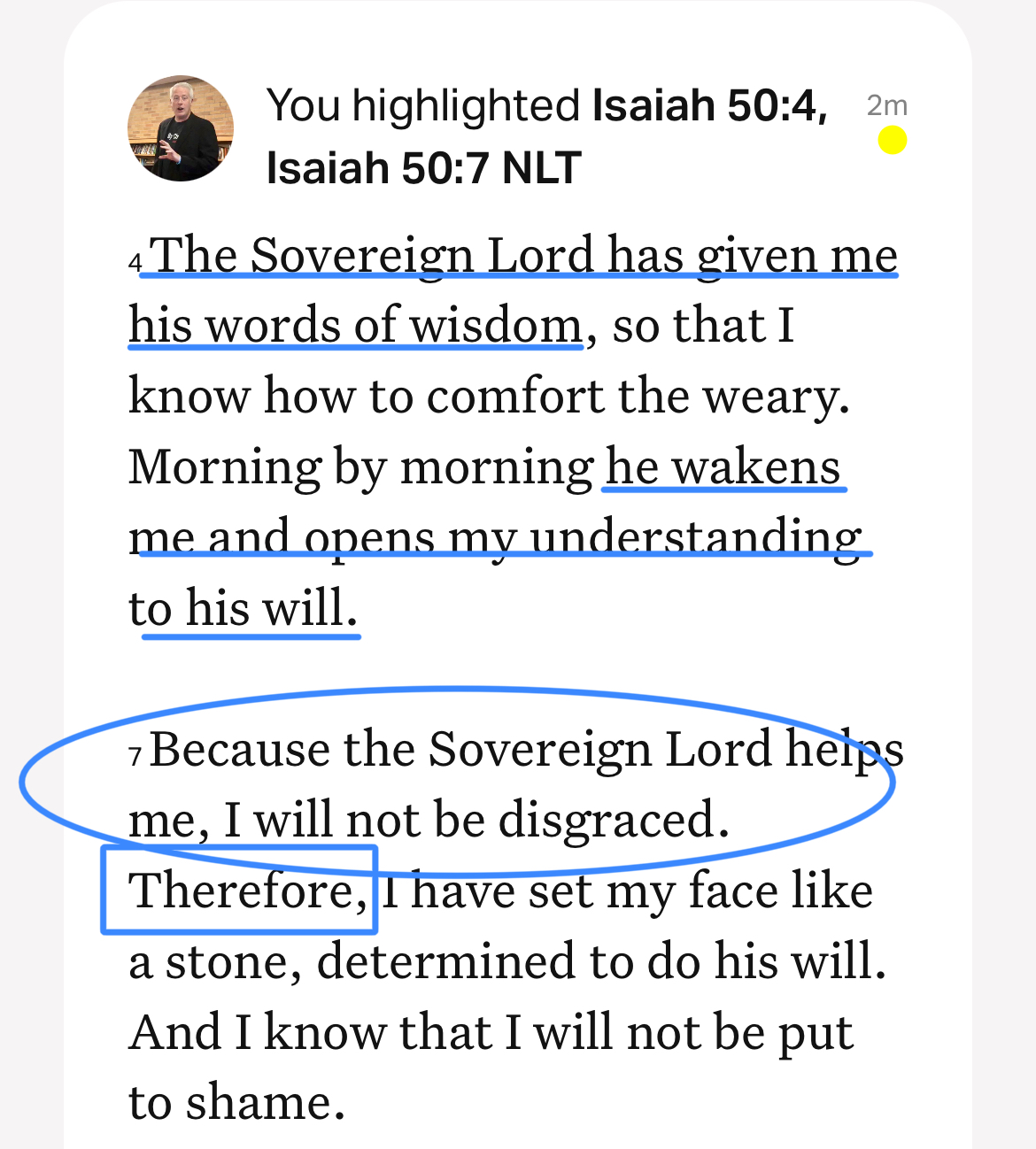
The Sovereign Lord has given me His words of wisdom, so that I know how to comfort the weary. Morning by morning He wakens me and opens my understanding to His will. … Because the Sovereign Lord helps me, I will not be disgraced. Therefore, I have set my face like a stone, determined to do His will. And I know that I will not be put to shame. (Isaiah 50:4, 7 NLT)
Listen to the podcast of this post by clicking on the player below, and you can also subscribe on Apple, Spotify, or Audible.
I’ve noticed how quick some people are to give up when things don’t get them the results they thought they should get, or the results don’t come as soon as they expected.
Anytime we try something new, there is always the potential for failure. Even later on, those who appear to be an expert at something rarely do it perfectly. But in either case, there are three things we need to do if we don’t get the results we expected: (1) reflect, (2) evaluate possible improvements, (3) re-engage.
Even before Jesus commissioned us to take His message of Good News to every street everywhere, He told us not to expect perfect results. In one of His best-known parables, Jesus talked about the farmer sowing seed (see Luke 8:5-8).
Jesus didn’t say, “All of your efforts at sharing the Gospel will be successful.” In fact, He said some efforts would totally fail (falling on the hard path), and some would have only temporary success (falling on the weedy and stony ground). But we keep on sowing the seed because some will fall on good soil and yield a harvest a hundred times more than was sown!
So, as John Wesley said, “Do all the good you can, by all the means you can, in all the ways you can, in all the places you can, at all the times you can, to all the people you can, as long as ever you can.”
The baptism of the Holy Spirit brings dynamic, life-changing power (Acts 1:8). The life that is changed first is our own. Everything about us begins to change.
When people heard Jesus speak, they said, “How did this Man get such learning without having been taught?” (John 7:15). The same Holy Spirit who empowered Jesus to speak is the same Holy Spirit who will empower our words.
When our words are Spirit-empowered words, people can feel it. When our words are matched by our lifestyle, people can’t ignore it (John 7:46; Acts 2:37, 4:13, 6:10)!
Just like salt that influences effortlessly, silently, and irreversibly, we never know what part the salt of our lives is playing in someone else’s life, even if it appears that nothing substantial is happening at all. But God said His word always accomplishes its purpose (Isaiah 55:10-11), which is why we keep on living and speaking as Spirit-empowered witnesses.
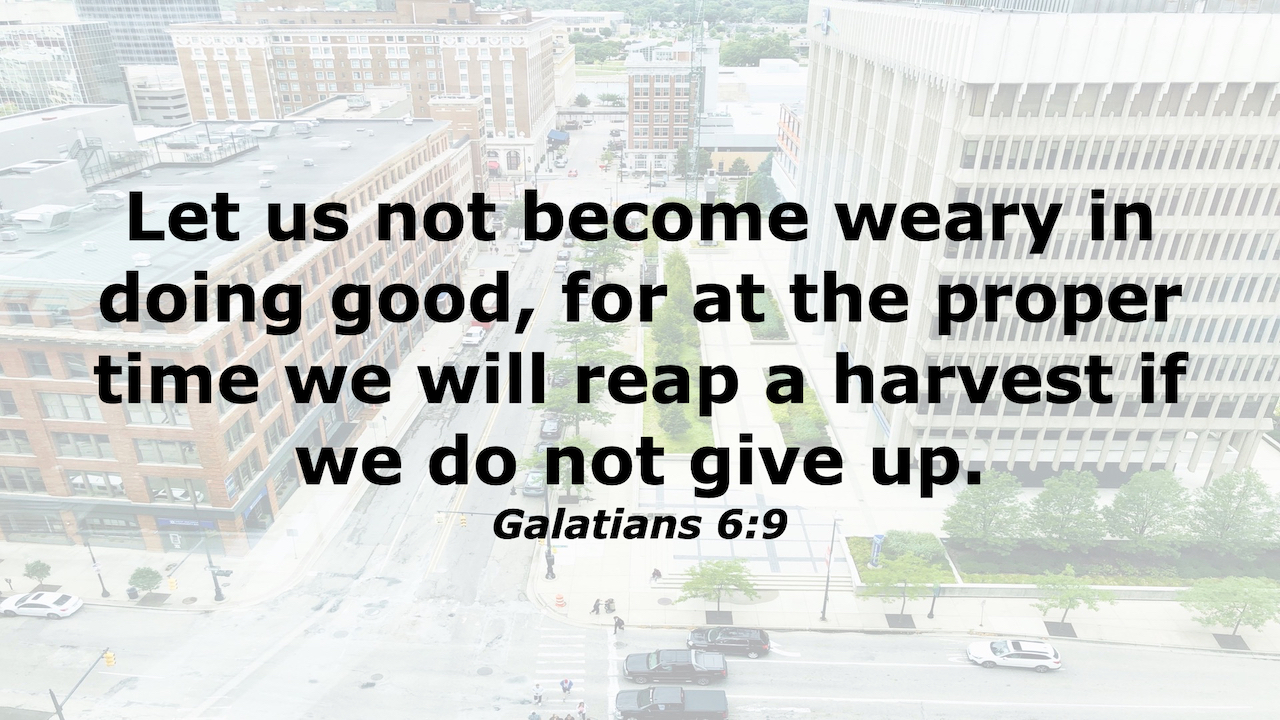
And we live expecting that something is happening—Let us not become weary in doing good, for at the proper time we will reap a harvest if we do not give up (Galatians 6:9).
How do we take this message of Jesus to every street?
Stay yielded to the influence of the Holy Spirit
Regularly and consistently read and apply God’s Word to your own life
Keep sowing in expectation
If your efforts appear to fail: reflect, evaluate, re-engage in expectation
We can be salt without being salty; we can be light without being annoying.
We have been empowered to take the Good News to every street, so let us not become weary in doing this.
Listen to the podcast of this post by clicking on the player below, and you can also subscribe on Apple, Spotify, or Audible.
Jesus sent us and the Holy Spirit empowers us to take the Good News to all nations—all the streets (Luke 24:47-49; Acts 1:8). As we move away from Jerusalem and into Judea, we should expect to see more differences with our audience. And then as we move into Samaria, there will probably be more differences than similarities. Regardless of how little we may have in common with those on other streets, the Holy Spirit still empowers us to witness there.
When we don’t live on someone else’s street, we tend to make some pretty big assumptions about them. For example, until I married a school teacher, I thought, “How nice it must be to be done with work by 3:00 every afternoon and have three months off in the summer!”
Mistakenly, we think we can so easily fix the problems people on other streets have—we think we can show them how simple it is to correct anything out of balance on their street. These are natural thought patterns when so little of our circles overlap.
If you live on Main Street, two streets which are quite different from you are Easy Street and Skid Row. When it comes to finances, there tends to be extremes in our thoughts about the Samaritans that live on those streets—
Those on Easy Street only cares about themselves
Those on Skid Row should work harder
Those on Easy Street have too much—it’s not fair!
Those on Skip Row don’t have enough—it’s not fair!
But here’s the thing: It’s really not about the money but it’s about our attitude about the money.
In Luke 21:1-6, Jesus saw both rich people from Easy Street placing their tithe in the temple treasury, and a poor widow from Skid Row doing the same. Jesus said this widow put in more than anyone else. He was talking in terms of quality, not quantity.
While they were still in the temple, the disciples pointed out how beautifully embellished the temple was. These decorations came from the money those on Easy Street had contributed. Jesus told them not to focus on the temporal temple but on the eternal Kingdom of God.
As I said, Jesus doesn’t have a problem with money, but He does warn us about our ungodly attitude toward money (Luke 8:1-3; Matthew 27:57; Acts 4:32-5:4; Exodus 20:17; Luke 12:13-22).
Even though Easy Street and Skid Row seem to be at opposite ends of the spectrum, I think we are effective witnesses for Jesus on these streets in exactly the same way.
(1) Guard your attitude about money. Remember that Gad often provides for us by giving us a skill, and then making a job available that can use our skill. So let’s be thankful for our God-given jobs. Then we guard our attitude about money by tithing regularly, and making sure that when we bless others financially, we do it without expecting any fanfare (Colossians 3:23; Malachi 3:10; Matthew 6:2-3).
(2) Let God be unique as unique with these folks on Easy Street and Skid Row as He is with you on Main Street. Don’t try to be someone else, and don’t expect others to be you—simply obey what God has spoken to your heart, just as you allow others to obey what God has spoken to their hearts.
(3) Don’t tell, but show how you use the resources God has given to you. It’s not our place to “preach” to others about how they should or shouldn’t be handling their finances, but simply live out the biblical principles outlined above, and let your life show your godly attitude.
(4) Always turn the focus to the eternal. Just as Jesus did with His disciples in the temple, He always reminded people that this world with its perks or tragedies is only temporary. What ultimately matters is where we will spend eternity (Luke 13:1-5).
Money is always a touchy subject with people, so let’s make sure we have our own attitude aligned with Scripture before we try to bring the subject up with others.
If you’ve missed any of the other messages in our Takin’ Him To The Street series, you can find them all here.
We need to be careful of overlooking details we think might be insignificant because we can easily think that our small lives are somehow insignificant. They are not! As Tom Kaastra reminded us last week, we are here on purpose and for a purpose; our lives are eternally significant.
Immediately after His resurrection, the followers of Jesus struggled to wrap their minds around what they had just experienced. Just before His ascension, Jesus explained to them both what had happened already, and what was about to happen (Luke 24:44-49).
Jesus said He had already fulfilled the promised about His crucifixion and resurrection. Luke writes that Jesus “opened their minds so they could understand” (v. 45).
Notice two important things:
The Spirit of Jesus—the Holy Spirit—opens minds
He opens minds to grasp the truth in Scripture
Jesus also says that we are still fulfilling the “what is written” (v. 46) in the the proclamation of the death and resurrection of Jesus. We are fulfilling the prophecy that says the message of Jesus will be preached everywhere to all peoples, so that they also can receive the forgiveness Jesus paid for and repent of their Godless ways.
Who opens minds? The Holy Spirit.
What does the Spirit use as a catalyst to open minds? Our witness.
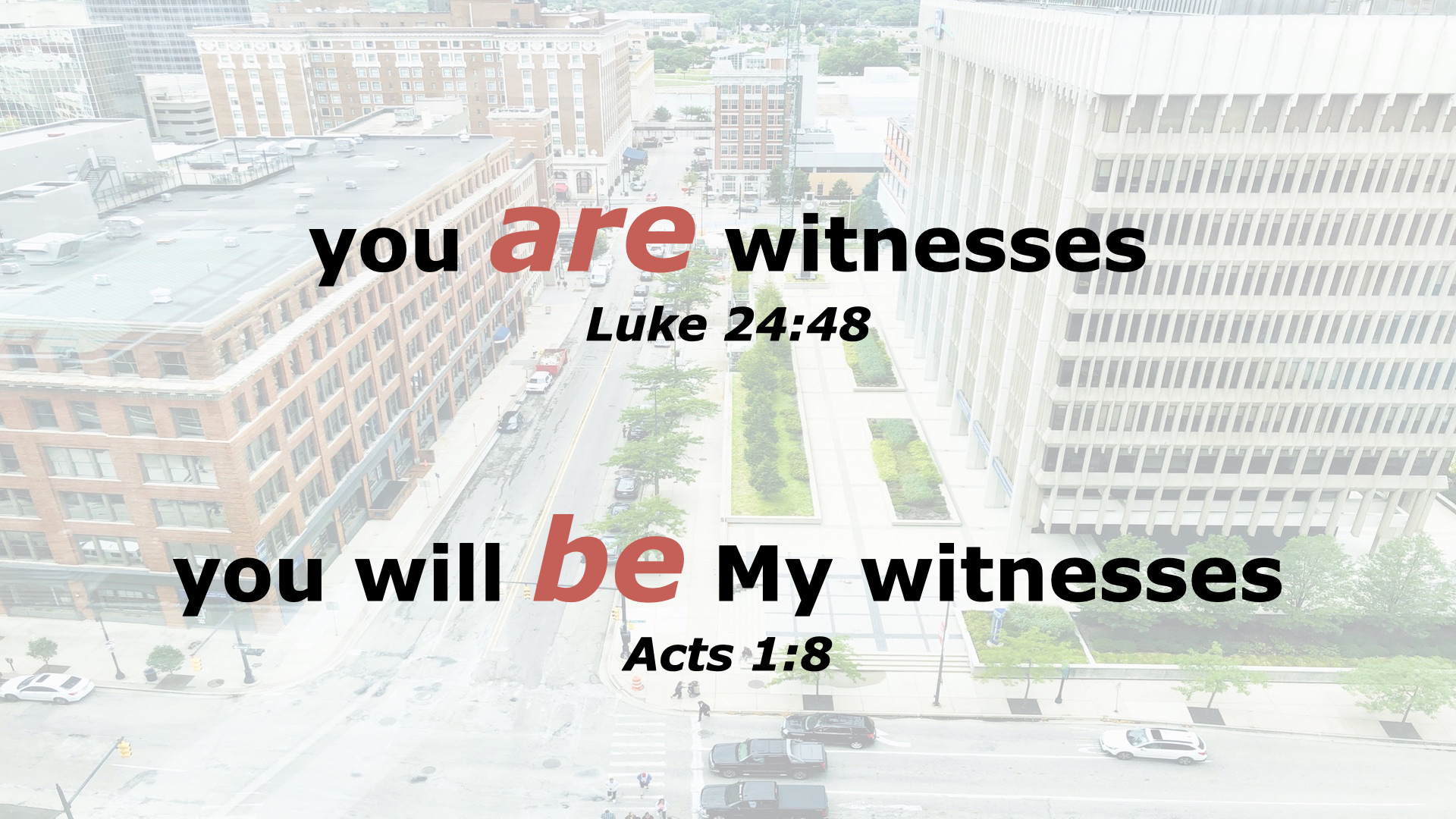
A witness is a truth-teller, who tells their firsthand story and who amplifies their verbal testimony by their Christ-honoring lifestyle. Jesus used two phrases to remind us that witnessing is not something we do, but it is who we are:
you ARE witnesses (Luke 24:48)
you will BE My witnesses (Acts 1:8)
Holy Spirit-baptized Christians are empowered to take Jesus to every street. God has strategically and purposefully placed us on our “streets” to proclaim our witness. From Easy Street to Skid Row, and everywhere in between, we are to fulfill the prophecy of proclaiming this good news to all nations (see 1 Corinthians 9:20-22).
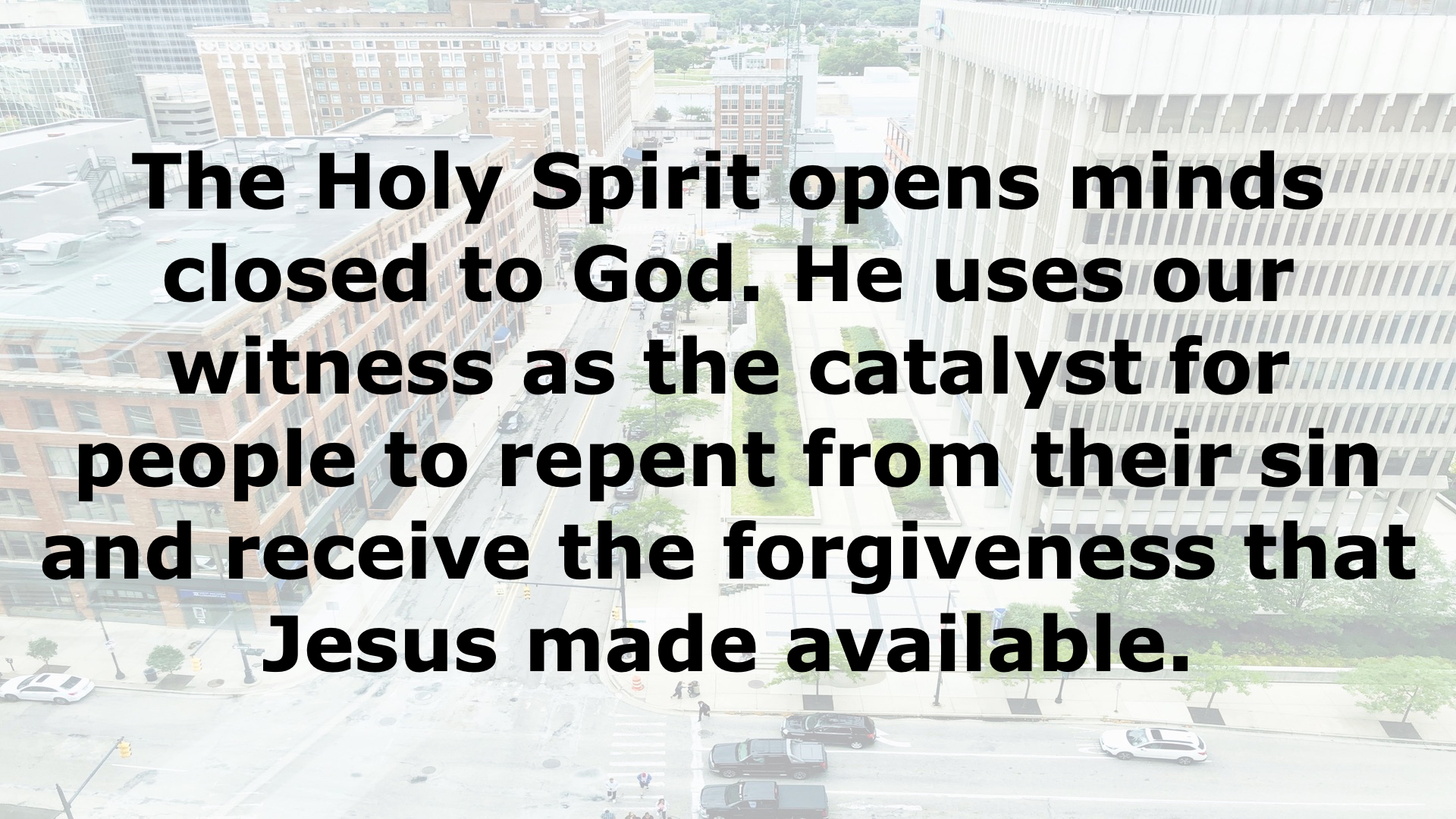
The Holy Spirit opens minds closed to God. He uses our witness as the catalyst for people to repent from their sin and receive the forgiveness that Jesus made available.
I grew up with a phrase ringing in my ears, “The Church moves forward on its knees.”
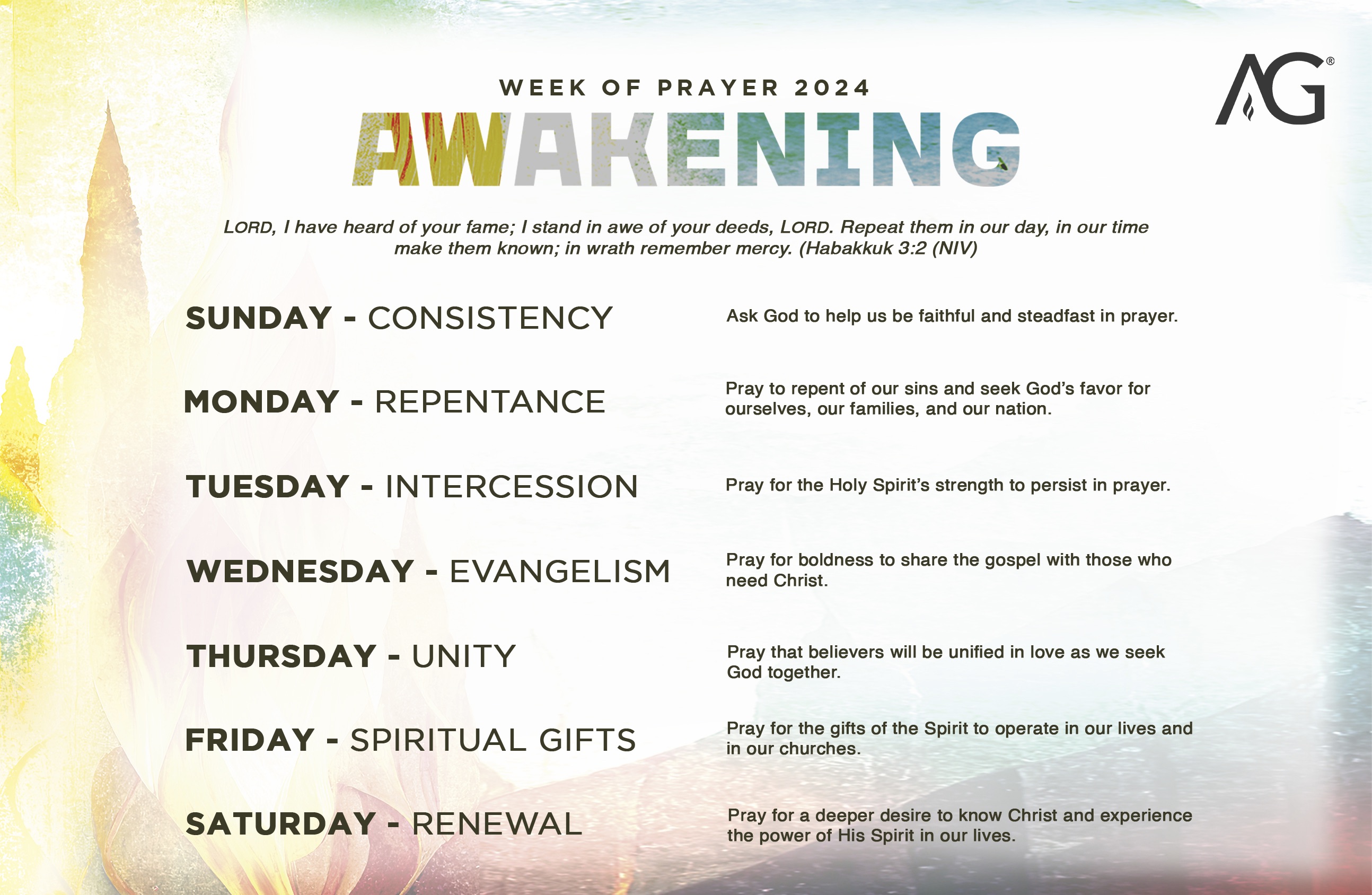
I believe this is true! We cannot expect to be effective in any kingdom-building endeavor if we are not empowered by heavenly help. So we like to begin each new year with a dedicated week of prayer. I invite you to join us in kicking off the new year with a renewed passion for prayer.
Listen to the podcast of this post by clicking on the player below, and you can also subscribe on Apple, Spotify, or Audible.
I’ve talked before about the benefits of calling the Old and New Testaments the First and Second Testaments. This helps me not to subconsciously slip into the thought that “old” means outdated or that “new” means a replacement of what came before it. When I say First and Second I remember that there cannot be a Second without a First, that the First anticipates the Second and the Second fulfills the First.
The people of the First Testament experienced the Spirit of God in an often-repeated phrase: “the Spirit of the Lord came on” someone. It usually came on them for a specific task or season. For instance…
70 leaders to help Moses (Numbers 11:25)
the judges that delivered Israel from their enemies (Judges 3:10, 6:34, 11:29, 14:6, 15:14)
the anointing for Israel’s king (1 Samuel 16:13)
empowerment for prophets to prophesy (Ezekiel 11:5)
When the Holy Spirit came on these men, there was a noticeable supernatural anointing and empowerment, but more times than not these men also had visible and sometimes crippling stumbles.
What happens on the outside often stays on the outside. Sort of like the little boy whose mom brought him to church one Sunday. The little boy was constantly standing up on his chair and disturbing everyone around him. Finally, the exasperated mother whispered, “If you don’t sit down I’m going to take you to the restroom and spank you.” The little boy immediately sat down with his arms tightly crossed. He looked at his mom and said, “Outside I may be sitting down but inside I’m standing up!”
God looks at the heart. He told the Israelites that their inward defiance didn’t outweigh their outward religious practices. And Jesus said that people who prophesied, cast out demons, and performed miracles, but still had an unrepentant heart, would hear Him say, “I never knew you” (Isaiah 1:12-13; Matthew 7:21-23).
In the First Testament, we see a desire for the Holy Spirit to be more than on—a desire for Him to come in.David prayed, “Create in me a pure heart, O God, and renew a steadfast spirit within me” (Psalm 51:10). And God promised His people, “I will give them an undivided heart and put a new spirit in them … And I will put My Spirit in you and move you to follow my decrees and be careful to keep My laws” (Ezekiel 11:19, 36:27).
Paul identified this fruit of the Spirit as “love, joy, peace, forbearance, kindness, goodness, faithfulness, gentleness and self-control,” and he concluded with the phrase, “against such things there is no law” (Galatians 5:22-23). The law always sets limits, but when the Holy Spirit abides in us, the production of fruit is limitless!
Being baptized in the Holy Spirit means that we allow Him to come in us and then to work on us. It’s only when the Holy Spirit has worked in us that can He flow through us to others. Jesus said that we would receive the Spirit’s empowerment to be witnesses—that’s an inward change that produces an outward fruit.
Listen to the podcast of this post by clicking on the player below, and you can also subscribe on Apple, Spotify, or Audible.
Last week we learned that we have a job to do. If we want to see Jesus come back to take us Home, we need to share the Good News with everyone. Jesus said that we didn’t have to obey Him in this Great Commission by ourselves, but we can go in His authority and with the empowerment of the Holy Spirit (Matthew 24:14; 28:18-20; Acts 1:8).
In Acts 1:8 notice that Jesus said we are “be My witnesses.” This isn’t an action first, but they are actions that spring out of who we are. So we need to ask: How are we to be His witnesses? Answer: By being blessed by God!
God has desired that we know the blessing of His presence since the very beginning. He instructed the priests to bless the people with these words:
The Lord bless you and keep you; the Lord make His face shine on you and be gracious to you; the Lord turn His face toward you and give you peace. (Numbers 6:24-26)
The Hebrew word for “peace” in this passage is shalom. One of the most basic definitions for shalom is “nothing missing.” In other words, we are blessed people when we realize there is nothing keeping us back from God’s presence.
If you asked someone in the Old Testament where they thought God’s presence was, they would probably point you to the Tent of Meeting or the Tabernacle in Jerusalem. But that was merely a foreshadowing of what God truly desired for His relationship with us. Jesus promised His followers, “On that day you will realize that I am in My Father, and you are in Me, and I am in you” (John 14:20). So if Jesus is in the Father, and we are in Him, that means we are also in the Father. In this position, we can experience the nearness to the Father that Jesus knows (see Ephesians 1:3-8).
This nearness is our source of peace: Now may the Lord of peace Himself give you peace at all times and in every way. The Lord be with all of you (2 Thessalonians 3:16). In this verse, the Greek word for “peace” is eirene, which means a soul at utter peace with God because it is assured of its eternal Home in God’s presence.
Blessed people are abundance people. Blessed people have all their needs supplied so that they can be a conduit of blessing to others. Our increasing awareness of God’s blessing empowers us to be witnesses for Him.
Let me take you back to the Book of Psalms. In Psalm 67, the psalmist asks for God’s blessing on his life four times in just seven short verses. Why does he desire this blessing? It’s not for himself but for others. Look at just the first two verses of this psalm:
May God be gracious to us and bless us and make His face shine on usTHAT Your ways may be known on earth, Your salvation among all nations.
Recall that Jesus commissioned us to go to all nations and that the Holy Spirit empowers our witness to all peoples. This psalmist is asking for God’s blessing so that he can be a witness to everyone. Nine times he says that he desires that all nations or all peoples will know and worship the Most High God.
God’s blessing on His people is really SO THAT all peoples and nations can see His blessing and turn to Him. One of the roles of the Holy Spirit in a believer’s life is to remind us that we are indeed blessed in Jesus, and that we have a mission to fulfill in taking that blessing to others.
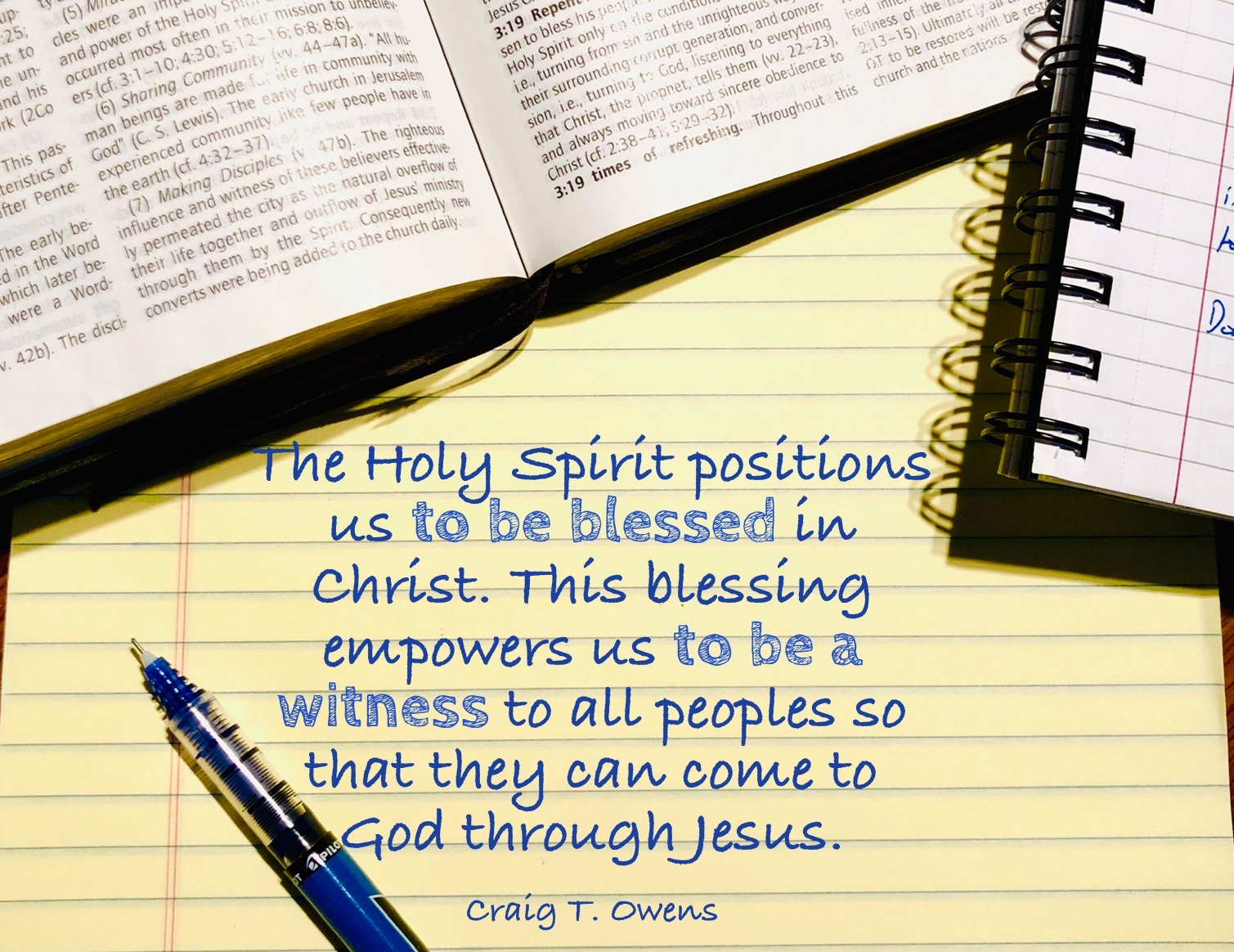
The Holy Spirit positions us to be blessed in Christ. This blessing empowers us to be a witness to all peoples so that they can come to God through Jesus.
It is good for us to pray for the Spirit’s blessing on our lives so that we can BE a blessing to all nations and peoples.
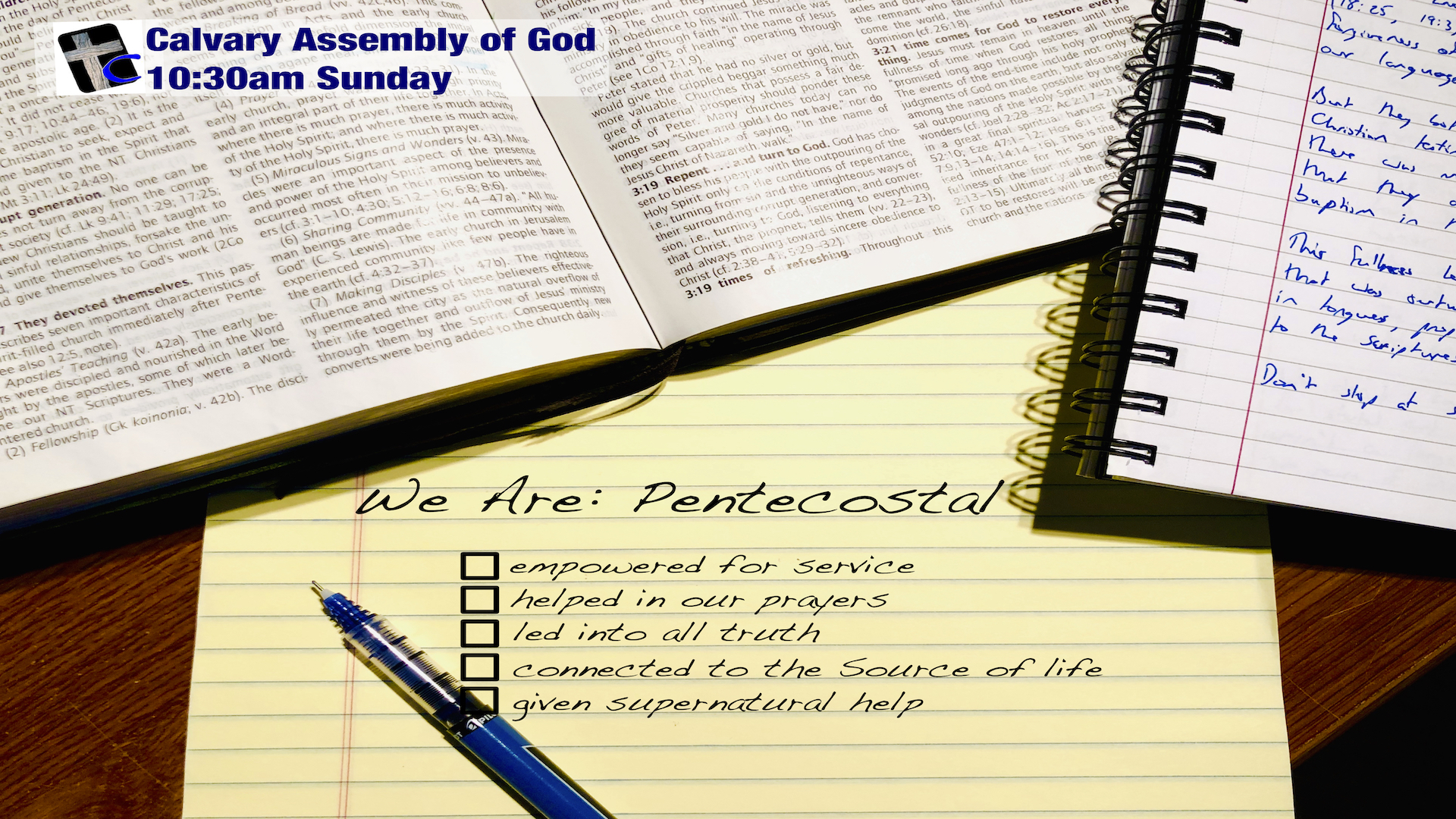
If you would like to check out all of the other messages in our series called We Are: Pentecostal, please click here.
Pentecost for over 1500 years was a celebration in Jerusalem that brought in Jews from all over the world. But on the Day of Pentecost which came just ten days after Jesus ascended back into heaven, the meaning of Pentecost was forever changed!
Followers of Jesus—now empowered by an infilling of the Holy Spirit—began to take the good news of Jesus all over the world. These Spirit-filled Christians preached the Gospel and won converts to Christ even among hostile crowds, performed miracles and wonders, stood up to pagan priests and persecuting governmental leaders, and established a whole new way of living as Christ-followers.
We, too, can be Pentecostal followers of Jesus Christ today. We can experience an anointing and an empowering in our lives that turns ordinary Christianity into extraordinary Christianity!
Please join me this Sunday at Calvary Assembly of God as we rejoin this series. You can check out what I taught in this series in 2019 by clicking here, the messages from 2020 are here, the messages from 2021 are here, and the messages from 2022 are here.