Help!

David and his men are on the run from King Saul, but they hear that the small town of Keilah is being harassed by the Philistines. The bad guys are stealing the harvest from the people of Keilah, making it a very real possibility that they would starve during the upcoming winter. In his usual habit, David prays and asks God if he should help the people of Keilah, and God gives him the go-ahead to attack.

David and his men defeat the Philistines, not only returning the crops that had been stolen but also delivering some livestock that they took from the defeated Philistines. You might expect that David and his men were given a ticker-tape parade. Instead, as soon as David was within the city’s walls, he finds out that the people of Keilah are planning to sell him out to King Saul. Talk about ingratitude!

David and his men flee to the Desert of Ziph, where they won’t be a bother to anyone. Except the Ziphites get word to King Saul that they will gladly turn him over to the King whenever he asks for it.

What is David’s response? As usual, it’s prayer. His prayer is short and straight to the point—

Help, Lord, for the godly are no more; the faithful have vanished from among men.

In other words, David asks God, “Where have all the decent people gone?” It’s no different in our day, as Paul told his friend Timothy that people will only become more hypocritical liars, with their conscience not bothering them a bit!

What I love about David’s prayer is that he quotes God back to God. Check out the quotation mark: “Because of the oppression of the weak and the groaning of the needy, I will now arise. I will protect them from those who malign them.” And then David is quick to add that God’s words never fail! 

I am convinced that our spiritual battles are largely lost or won in our minds. We need to recall God’s Word—Yet this I call to mind and therefore I have hope: Because of the Lord’s great love we are not consumed, for His compassions never fail (Lamentation 3:21-22).

So we cry, “Help!” to God because He is the only One who can help us: The Lord is my Helper; I will not be afraid. What can man do to me? (Hebrews 13:6).

But David has an important question to ask: “How long do we continue to call for help?” Have you ever asked God that?

Jesus said that the key to our successful praying is for us to remain in Him and for His Words to remain in us, like a branch remains connected to the vine (John 15:7). So let me ask you a question: How long should the branch remain connected to the vine before it’s ready to go off on its own?

The answer is simple—if the branch wants to remain alive and fruitful, it must stay in relationship with the vine forever!

So once again, look at how Jesus answers the “How long?” question—Keep on asking and it will be given you; keep on seeking and you will find; keep on knocking reverently and the door will be opened to you. (Matthew 7:7)

“Help!” is a great prayer that God loves to answer. “How long” do we pray that prayer? Until it’s answered … keep on, keep on, KEEP ON!

Thursdays With Oswald—Using The Sword For Good And Not Harm

Oswald ChambersThis is a weekly series with things I’m reading and pondering from Oswald Chambers. You can read the original seed thought here, or type “Thursdays With Oswald” in the search box to read more entries.

Using The Sword For Good And Not Harm

     The priest replied, “The sword of Goliath the Philistine, whom you killed in the Valley of Elah, is here.…” David said, “There is none like it; give it to me.” (1 Samuel 21:9)

     Now it seems quite obvious that if you are not David and are trying to use Goliath’s sword, you will do far more harm to yourself than damage to the enemy. You must be in the direct line of succession to David. … What is the same family connection in this dispensation? Why, those who are born again of the Spirit of God, and those who are so identified with the Lord Jesus that they have entered into the experience of entire sanctification. When they use the Word of God they do not damage themselves, nor hurt other souls; but they do great damage to the kingdom of the devil and bring benefit to the souls of men. …

    The Christian worker must rely on the Holy Spirit to direct them as to what to say in the case of every soul that comes. Do not rely on your memory, do not remember how you dealt with cases in the past, but recognize and rely on the Holy Spirit that He will bring to your remembrance the particular verse for you to apply at this time. … Beware of anything that does not fling you straight back in reliance on the Holy Spirit as the most practical factor you know in bringing it to your remembrance the Word of God and how to apply it. … 

     For the word of God is living and powerful, and sharper than any two-edged sword, piercing even to the division of soul and spirit, and of joints and marrow, and is a discerner of the thoughts and intents of the heart. (Hebrews 4:12)

     A remarkable thing about this Book of God is that for every type of human being we come across there is a distinct, clear line laid down here as to the way to apply God’s truth to it. 

From Workmen Of God

If Christians are going to help others, they have to start with helping themselves. They do this by immersing themselves in the Word of God and allowing the Holy Spirit to show them how to live out the biblical principles. This equips us to help others.

Then when someone in need comes to us, don’t be too quick to draw your spiritual sword. Listen to them and listen to the Holy Spirit. The Spirit of God can direct you to the right Word of God for that person’s need. This is the only way to use the sword of the Spirit in a way that will help others, glorify God, and make you unashamed before God of your conduct.

A Leader’s Observations

When I consider Your heavens, the work of Your fingers… (Psalm 8:3).

David starts and ends this psalm with the same phrase: O Lord, our Lord, how excellent is Your name in all the earth! In the middle, David marvels at the diversity and beauty of God’s creation. David observes…

  • the blue skies
  • the wide-eyed wonder of children
  • the moon and stars
  • the marvel of man
  • the flocks and herds of the field
  • the birds in the air
  • the fish in the seas

David takes nothing for granted. He observes, he sees God, and then he worships God as Creator. David’s constant cycle is—observation and contemplation which leads to adoration.

A mark of a godly leader is one who is continually learning about his Creator.

Don’t ever stop observing; don’t ever stop learning. Become a lifelong learner, and let your contemplation lead you to adoration of our excellent Lord and Creator!

This is Part 18 in my series on godly leadership. You can check out all of my posts on this topic by clicking here.

The Prayers Of David

The life of David is an open book for us. One of the unique things about David’s life is that we get to read both the historical narrative of his life, and his diary-like thoughts recorded in his psalms, songs, and prayers in the Book of Psalms.

David’s prayers are gut-level honest and full of raw emotion.

His prayers are also very helpful for anyone who desires to be as close to God as David was, to be one God describes as “a man after my own heart, who will do everything I want him to do.”

Join me this Sunday as we begin an exploration of the passionate, personal, powerful prayers of David.

The Transparency That God Loves

Have mercy … heal me … deliver me … save me … (Psalm 6:2, 4).

A mark of a godly leader is one who is not afraid to share his vulnerabilities.

David freely admits his fear of punishment, his need for God’s help, and his grief that robbed him of sleep.

But he also admitted just as freely his rock-solid assurance of God’s help:

  • The Lord has heard my weeping
  • The Lord has heard my supplication
  • The Lord will receive my prayer

Godly leaders are confidently transparent before God and before those around them. God delights in that transparency, and He delights to answer vulnerable prayers.

This is Part 17 in my series on godly leadership. You can check out all of my posts on this topic by clicking here.

The Advent “Nicknames” Of Jesus

Most of us who have nicknames didn’t receive them at birth, but they were given to us later on. It might have been because of a memorable incident, or even a character trait that we are known for.

But think about Jesus. Even before His first Advent, He was given numerous “nicknames” or titles that foretold what He was going to do. In the Christmas carol “O Come O Come Emmanuel” four of Christ’s nicknames/titles are key for us today.

It’s so important for us to look back at these First Advent titles because they give us perspective for today and hope for Christ’s Second Advent.

Paul makes it clear that we are living in a time of both already and not yet. We have redemption (Ephesians 1:7), and we are waiting for the day of redemption (Ephesians 4:30). Jesus has already paid for our freedom (First Advent), but we are still awaiting the rewards that will come with His Second Advent.

O come, O come…

  1. …Emmanuel

Literally, this means “God is with His people.” The prophesy was originally given to the prophet Isaiah (see 7:14 and 8:6-10), but it was repeated when Jesus was born (Matthew 1:23). Only One Who was fully God and fully Man could pay the price for our ransom from sin.

  1. …Rod of Jesse 

David, the son of Jesse, prayed, “Who am I, Sovereign Lord, and what is my family, that You have brought me this far?” (2 Samuel 7:18). Yet God was going to continue to keep David’s family line alive (although at times it looked like the dead stump of a long-forgotten tree) to give a throne to Jesus as the King of kings that would once and for all crush satan’s tyranny.

  1. …Dayspring 

When I think of Dayspring, I think of light exploding immediately into the darkness (Isaiah 9:2 and Luke 1:77-78). Jesus Himself told us of His victory over the darkness: I have told you these things, so that in Me you may have [perfect] peace and confidence. In the world you have tribulation and trials and distress and frustration; but be of good cheer [take courage; be confident, certain, undaunted]! For I have overcome the world. [I have deprived it of power to harm you and have conquered it for you] (John 16:33, AMP).

  1. …Key of David

Only Jesus holds the key to open wide our heavenly home (Isaiah 22:22; Revelation 1:8)!

What do you need? 

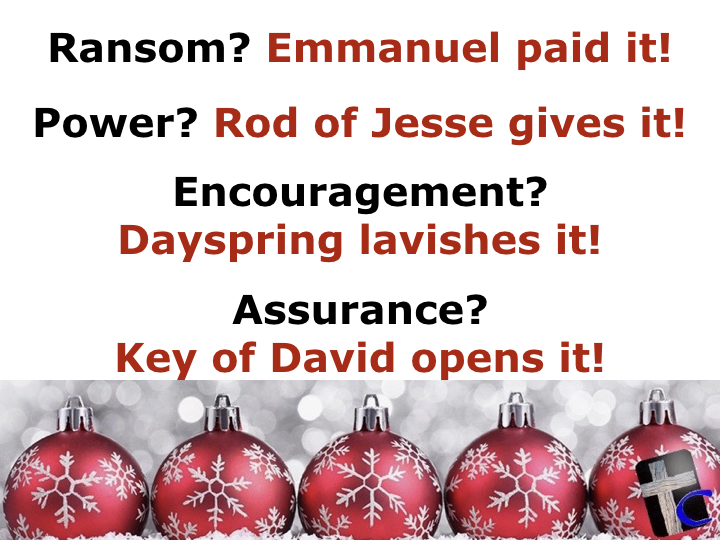
  • Ransom? Emmanuel paid it! 
  • Power to defeat satan? The Rod of Jesse gives it! 
  • Encouragement to press on? The Dayspring lavishes it! 
  • Assurance of your eternal home in Heaven? The Key of David opens it! 

All our longings—all our O come! O come!—are satisfied in Jesus. His First Advent is the already, and His Second Advent gives us hope for the not yet.

If you’ve missed any of the other Christmas carols we have already looked at, you can check them out by clicking here.

A Leader’s Confidence

Give ear to my words, O Lord, consider my meditation. Give heed to the voice of my cry, my King and my God, for to You I will pray (Psalm 5:1-2).

When David prays, he prays with confidence—he is confident that God will hear him.

Where does his confidence come from? From these two truths about the nature of God:

  1. You are a God who takes no pleasure in wickedness (v. 4), so David must confess his sin quickly.
  2. In fear of You I worship (v. 7), so David doesn’t have to cower before God wondering if God will forgive his sin.

David didn’t take the condition of his soul for granted (v. 5), but he came quickly into God’s presence because he knew of God’s mercy to forgive.

Not only was David confident that God would hear his prayer, but he also eagerly anticipated receiving…

  • …God’s answer to his prayer
  • …God’s joy
  • …God’s blessing
  • …God’s protection

A mark of a godly leader is one who prays confidently and then eagerly expects God to answer.

If you want confidence in your earthly leadership, do what David modeled: Enter God’s presence quickly and confidently, and then eagerly anticipate what God is going to do!

This is Part 16 in my series on godly leadership. You can check out all of my posts on this topic by clicking here.

Saturday In The Psalms—Joy In The Desert

A psalm of David when he was in the wilderness of Judah (preface to Psalm 63).

Being in a desert place, you would expect David to say things like, “my soul thirsts,” “my flesh longs,” and “I am in a dry and thirsty land where there is no water.”

But what’s unexpected is what David found that satisfied. Not food and water, but “my soul thirsts for You,” “my flesh longs for You,” and “O God, You are my God.”

David knew that when outward conditions were at their worst, his focus needed to be at its best—and it needed to be on God. So David made the following commitments:

  • Early will I seek You
  • I have looked for You
  • I remember You on my bed
  • I meditate on You in the night watches
  • My lips shall praise You
  • My soul follows close behind You
  • I shall rejoice in God

Because of these commitments, David could reach the following conclusions:

  • Your lovingkindness is better than life
  • My soul is satisfied
  • I will rejoice in the shadow of Your wings
  • Your right hand upholds me

David found joy in the desert by changing his focal point!

I can reach the same conclusions that David reached, IF I am willing to make the same commitments David made.

In the desert places, I must deliberately and continually turn my eyes and thoughts FROM the desert TO God’s goodness.

Saturday In The Psalms—In Over My Head!

Save me, O God! For the waters have come up to my neck! (Psalm 69)

Not just up to David’s neck, but he felt like he was in over his head! Ever been there? You feel like…

  • …there’s no solid ground to stand on
  • …you’re stuck in deep muck
  • …the floodwaters are rising fast

David cried himself dry and hoarse because of the troubles ganging up on him!

One of David’s motivations in asking God for help was not just to alleviate his own suffering, but to not be a burden to other God-followers—“Let not those who wait for You, O Lord God of hosts, be ashamed because of me; let not those who seek You be confounded because of me, O God of Israel.”

So David made his prayer to God, believing that God would completely vindicate and rescue him. And as he prayed, he praised—“Let Your salvation, O God, set me up on high. I will praise the name of God with a song, and I will magnify Him with thanksgiving.”

When you’re in over your head, there’s nowhere else to look but up! 

Our prayer: Holy Spirit, when I feel like I’m in over my head, may You remind me to lift up my prayer and my praise to my Savior. Don’t let other God-followers be ashamed because of me, but let my deliverance be the reason they continue to look expectantly to You!

How To Respond To Bad Pastors

God has ordained that His leaders oversee and administer His ministry. But problems arise in the church when humans change the “His” to “my.”

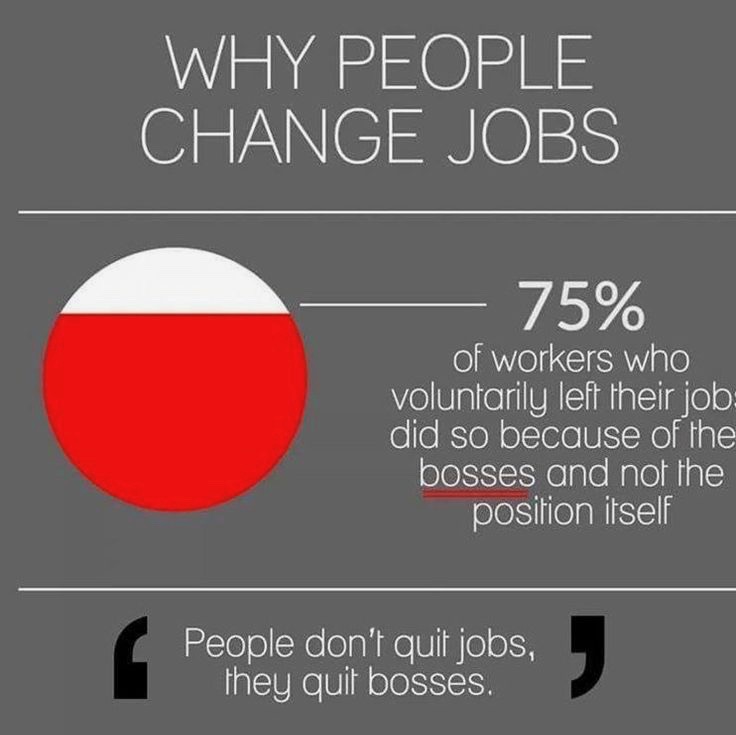
I read a statistic that 75% of people who voluntarily left their jobs did so because of a problem with their boss. In other words, 3-out-of-4 people didn’t quit their job, they quit their boss. In my personal experience this is equally as true in the church world—Most people don’t quit their church, they quit a bad pastor.

Sadly, those who do quit their church usually do so the wrong way. As a result they become either de-churched (they don’t attend anywhere), or cynical in the next church they do attend.

Who is a bad pastor?

  • One who is no longer effective because he is stuck in an old way of doing things
  • One who is theologically off
  • One who is unwilling to admit an error, ask forgiveness, and make amends
  • One who uses his position to build his kingdom instead of God’s kingdom

We have a great example of how to handle a bad spiritual leader in the story of David and Saul (see 1 Samuel 24). David had done nothing wrong, yet Saul was trying to kill him. At one point David’s men urged David to take matters into his own hands, and he almost did. He got close enough to Saul to cut off a corner of his robe, but quickly discovered that was too close. Immediately after doing so David was conscience-stricken!

Then look how David responded:

  • David rebuked his men as he reminded them that Saul was their “master” and “the Lord’s anointed.”
  • David “bowed down and prostrated himself” before Saul as he apologized.
  • David called him his “master,” “father,” and “the Lord’s anointed.”
  • David said he would leave the matter in God’s hands, allowing God to “judge between you and me.”
  • And twice David declared, “My hand will not touch you!”

This humble reply got Saul’s attention. Saul wept as he said, “You have treated me well, but I have treated you badly.” Saul then asked David to be kind to his descendants.

Then this conclusion—David gave Saul his oath, and then went away to a safe place.

The New Testament captures these same ideas for today’s Christians. We are told not to lightly entertain an accusation against spiritual leaders (1 Timothy 5:19), but to submit and obey to biblically-correct leaders (Hebrews 13:17).

The Bible gives us only two options for dealing with spiritual leaders…

SUBMIT & OBEY or WALK AWAY

Two wrongs don’t make a right. Responding in an unscriptural way to an unscriptural pastor’s way is just as wrong as what the pastor was doing wrong in the first place!

So give the bad pastor your oath that you will not lay a hand (or a word!) on them, and then remove yourself to a safe place. Submit and obey, or walk away and leave them in God’s capable hands.

If you’ve missed any messages in this series, you may find the complete list by clicking here.