Links & Quotes

link quote

Some good reading from today…

“We were made not primarily that we may love God (though we were made for that too) but that God may love us, that we may become objects in which the Divine love may rest ‘well pleased.’ To ask that God’s love should be content with us as we are is to ask that God should cease to be God: because He is what He is, His love must, in the nature of things, be impeded and repelled, by certain stains in our present character, and because He already loves us He must labour to make us lovable.” —C.S. Lewis

“Our old history ends with the Cross; our new history begins with the resurrection.” —Watchman Nee

Chick-Fil-A closed for a very honorable reason.

A bit scary: Muslims’ attitude toward non-Muslims.

“It’s easy, and perhaps comforting, to think of all the things the church is doing to try to change the world. But the real question is, what are you doing? Sure, you go to church and try to live a good life. But how intentional are you when it comes to actually impacting the lives of the lost people you rub shoulders with every day?” —Mark Atteberry

“Whatever the currents of public opinion and governmental action, God’s message is constant and glorious. Whether it is a crime to defy Scripture or to defend it, the Church must preach it—both in season and out of season. This is her calling.” —Kairos Journal

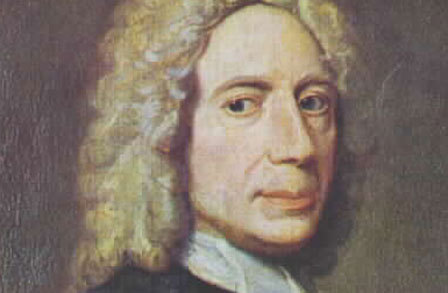
Poetry Saturday—When I Survey The Wondrous Cross

Isaac WattsWhen I survey the wondrous Cross
On which the Prince of glory died,
My richest gain I count but loss,
And pour contempt on all my pride.

Forbid it, Lord, that I should boast,
Save in the death of Christ my God!
All the vain things that charm me most,
I sacrifice them to His blood.

See from His head, His hands, His feet,
Sorrow and love flow mingled down!
Did e’er such love and sorrow meet,
Or thorns compose so rich a Crown?

Were the whole realm of nature mine,
That were a present far too small;
Love so amazing, so divine,
Demands my soul, my life, my all. —Isaac Watts


The Horrors Of Crucifixion

Good FridayWilliam Barclay, in his commentary on the Gospel of John, wrote graphically about the horrors of crucifixion—

   There was no more terrible death than death by crucifixion. Even the Romans themselves regarded it with a shudder of horror. Cicero declared that it was “the most cruel and horrifying death.” Tacitus said that it was a “despicable death.” It was originally a Persian method of execution. It may have been used because, to the Persians, the earth was sacred, and they wished to avoid defiling it with the body of an evil-doer. So they nailed him to a cross and left him to die there, looking to the vultures and the carrion crows to complete the work. The Carthaginians took over crucifixion from the Persians; and the Romans learned it from the Carthaginians.

   Crucifixion was never used as a method of execution in the homeland, but only in the provinces, and there only in the case of slaves. It was unthinkable that a Roman citizen should die such a death. Cicero says: “It is a crime for a Roman citizen to be bound; it is a worse crime for him to be beaten; it is well nigh parricide for him to be killed; what am I to say if he be killed on a cross? A nefarious action such as that is incapable of description by any word, for there is none fit to describe it.” It was that death, the most dreaded in the ancient world, the death of slaves and criminals, that Jesus died.

   The routine of crucifixion was always the same. When the case had been heard and the criminal condemned, the judge uttered the fateful sentence: Ibis ad crucem, “You will go to the cross.” The verdict was carried out there and then. The condemned man was placed in the centre of a quaternion, a company of four Roman soldiers. His own cross was placed upon his shoulders. Scourging always preceded crucifixion and it is to be remembered how terrible scourging was. Often the criminal had to be lashed and goaded along the road, to keep him on his feet, as he staggered to the place of crucifixion. Before him walked an officer with a placard on which was written the crime for which he was to die and he was led through as many streets as possible on the way to execution. There was a double reason for that. There was the grim reason that as many as possible should see and take warning from his fate. But there was a merciful reason. The placard was carried before the condemned man and the long route was chosen, so that if anyone could still bear witness in his favor, he might come forward and do so. In such a case, the procession was halted and the case retried. (emphasis added)

Always remember that Jesus willingly went through this for you and me.

Surely He took up our pain
    and bore our suffering,
yet we considered Him punished by God,
    stricken by Him, and afflicted.
But He was pierced for our transgressions,
    He was crushed for our iniquities;
the punishment that brought us peace was on Him,
    and by His wounds we are healed. (Isaiah 53:4-5, emphasis added)

Thursdays With Oswald—The Historicity Of The Cross

This is a weekly series with things I’m reading and pondering from Oswald Chambers. You can read the original seed thought here, or type “Thursdays With Oswald” in the search box to read more entries.

The Historicity Of The Cross 

     It is essential to have an historic basis for our Christian faith: our faith must be centered in the Life and Death of the historic Jesus. Why is it that that Life and Death have an importance out of all proportion to every other historic fact? Because there the Redemption is brought to a focus. 

     Jesus Christ was not a Man who twenty centuries ago lived on this earth for thirty-three years and was crucified; He was God Incarnate, manifested at one point of history. All before look forward to that point; all since look back to it. The presentation of this fact produces what no other fact in the whole of history ever could produce, viz.: the miracle of God at work in human souls. The death of Jesus was not the death of a martyr, it was the revelation of the Eternal heart of God. That is why the Cross is God’s last word.

From Conformed To His Image

This is THE Fact of history—

For God loved the world so much that He gave His One and Only Son, so that everyone who believes in Him will not perish but have eternal life. God sent His Son into the world not to judge the world, but to save the world through Him. (John 3:16-17)

Thursdays With Oswald−Remorse Is Hell On Earth

This is a weekly series with things I’m reading and pondering from Oswald Chambers. You can read the original seed thought here, or type “Thursdays With Oswald” in the search box to read more entries.

Oswald ChambersRemorse Is Hell On Earth

     Never mistake remorse for repentance; remorse simply puts a man in hell while he is on earth, it carries no remedial quality with it at all, nothing that betters a man.

From Conformed To His Image

I meet people all the time who are sorry for the wrong things they’ve done, and perpetually beat themselves up over those sins. As Chambers says, their remorse has created a hell on earth and it doesn’t do a single thing to help them.

Even a great man like the Apostle Paul felt the hell-on-earth trap of remorse. “I know what the wrong thing is and I don’t want to do it, but I give in and do it anyhow. I say I’m not going to do it again, but I do it again. Oh, what a wretched man I am! (see Romans 7:15-24). That’s where remorse leaves us, and the devil uses that feeling of remorse to condemn us and to imprison us in his hell on earth.

Repentance, on the other hand, is feeling bad for the sin and also asking God to forgive us through the work Jesus Christ did on the Cross—Thanks be to God, who delivers me through Jesus Christ our Lord! (Romans 7:25). As a result of this repentance and forgiveness Paul can then conclude…

So now there is NO CONDEMNATION for those who belong to Christ Jesus. And because you belong to Him, the power of the life-giving Spirit has freed you from the power of sin that leads to death. (Romans 8:1-2)

Remorse imprisons. Repentance and forgiveness are the only things that free us!

Links & Quotes

link quote

These are links to articles and quotes I found interesting today.

“If you asked twenty good men today what they thought the highest of the virtues, nineteen of them would reply, Unselfishness. But if you had asked almost any of the great Christians of old, he would have replied, Love. You see what has happened? A negative term has been substituted for a positive, and this is of more than philological importance. The negative idea of Unselfishness carries with it the suggestion not primarily of securing good things for others, but of going without them ourselves, as if our abstinence and not their happiness was the important point. I do not think this is the Christian virtue of Love.” —C.S. Lewis

“Since the end of World War II, at least 188 countries have drafted at least 729 versions of constitutions, while we’ve made only minor changes to ours through a constitutionally-provided amendment process. Our Constitution is unique in its simplicity, and uniquely effective.” Happy 225th Birthday, U.S. Constitution!

“Faith in God is to be demonstrated, not defined.” —A.W. Tozer

“Let us look to it that in all things we are just—in our trade, in our judgment of others, in our treatment of neighbors, and in our own personal character. A just God cannot bless unjust transactions.” —Charles Spurgeon

“Our old history ends with the Cross; our new history begins with the resurrection.” —Watchman Nee

Adopted By God

Adopted By GodWe have been working through our series on the Book of Ephesians, and I am so excited to share the speaking responsibilities with Tom Kaastra. Tom pastored a church in the Detroit area for nearly 40 years, and he is bringing such a richness of knowledge to this series!

“If you had one son in whom you found unspeakable delight, would it not be normal as a father to want many more? It is exactly so with the Eternal Father, Who by nature and choice, has desired and purposed to have a vast family of human-divine sons who are just like His Only Begotten Son.” —DeVern Fromke

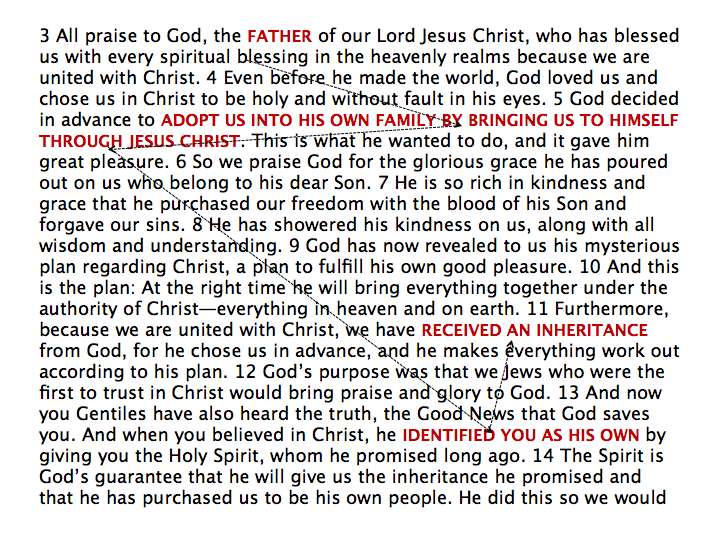
The opening section of Ephesians 1 is just loaded with words of God’s delight:

  • …it gave Him great pleasure… (v. 5)
  • …the glorious grace He has poured out on us… (v. 6)
  • …He is so rich in kindness and grace… (v. 7)
  • …He has showered His kindness on us… (v. 8)
  • …His own good pleasure… (v. 9)

Not only is God’s delight so ample in this section, but so is be the praise toward God which should be bursting out from us:

  • …all praise to God… (v. 3)
  • …so we praise God… (v. 6)
  • …we bring praise and glory to God… (v. 12)
  • …we would praise and glorify Him… (v. 14)

What is this thing in which God is so delighted, and for which we should be so filled with praise?

It is quite simply this: God has revealed Himself to us as a loving Father, His Son has made it possible for us to come into God’s family, and the Holy Spirit has given us the assurance that we have been adopted by our Heavenly Father.

That’s right … God’s plan was to adopt you into His family. When did He come up with this idea?

  • …before He made the world… (v. 4)
  • …God decided in advance to adopt us… (v. 5)
  • …a plan to fulfill His own good pleasure… (v. 9)
  • …He choose us in advance and He makes everything work out according to His plan… (v. 11)
  • …He promised long ago… (v. 13)

God loves YOU so much that He had a plan from before the beginning of time to adopt YOU into His family. That’s what Jesus made possible through His death on the Cross, and what the Holy Spirit is constantly trying to reveal to YOU!! WOW!!

Please join us next Sunday as we continue our study on this amazing book in the Bible.

11 Quotes From “God’s Favorite Place On Earth”

God's Favorite Place On EarthI loved this book! Please read my full book review of God’s Favorite Place On Earth by Frank Viola by clicking here, but my one-word review is: Wow!

Here are a few quotes that especially caught my attention—

“Jesus talked a lot about losing, taking up our cross, denying ourselves, and laying down our lives. These are the fruits of brokenness before God. It’s not hard to spot a Christian in ministry who isn’t broken. Unbroken people don’t know how to lay their lives down and lose. They only know how to try to win. If they’re criticized they retaliate. If they’re attacked, they return fire. If misunderstood, they defend in anger. They are capable of doing all sorts of damage to others in order to save their own ministries and keep their reputations. 

“On the contrary, people who have been broken by the hand of God know how to turn the other cheek. They know how to go the second mile. They know how to give their coats when asked for their shirts. They know how to speak well of those who misrepresent them. They know how to return good for evil. They know how to lose. And in so doing, they exhibit the Spirit of the Lamb and allow God to win.” 

“All service must flow out of a razor-sharp desire to please God rather than a desire to get noticed by others. If it does not, it will lead to either complaint or criticism.”

“As high as God is going to elevate you is as deep as He digs to lay the foundation. Sometimes the brightest light comes from the darkest places. And what doesn’t destroy you ends up defining you in some significant way.”

“Suffering is worldwide and neck deep. But for the Christian, suffering has a special purpose. It’s the chiseling of God designed to transform you into the image of His Son.”

“A Spirit-led man or woman is someone who has faced tragedy, faced loss, looked unbearable and exquisite pain in the face … and has stood his or her ground. With their garments still smoking, these men and women have said before God, mortals, and angels: ‘It is well with my soul. God’s enemy has thrown his best at me, and I’m still here. I’m still on the Rock. I’ve not sunk. I’m still standing. I’ve not been destroyed, and I’ve not gone under. I will continue to follow my Lord, come hell or high water, He is still on the throne!’”

“Christ saves as the Son of God, but He feels as the Son of man.”

“Faith often takes a nosedive when we are on the brink of tragedy. At such times, we forget the Lord’s words. Sometimes confessions and creeds, as important as they are, are not enough to move God to act. Only falling at His feel and weeping will suffice.

“Every crisis in our lives is an opportunity to broaden, deepen, and heighten our revelation of Christ.”

“Basing your faith on God’s performance—what you think He should do according to what you’ve been taught about His promises—is a profound mistake. … Thus the only solid basis for unwavering faith and an unshakable devotion is to believe that God is … and that He does ‘all things well,’ no matter what takes place.”

“Christians aren’t saved from troubles or delivered from problems. We have been given an ascendant life to rise above them.”

“Sharing what one has with others is what keeps our hearts detached from earthly treasures.”

5 Quotes From “Love To The Uttermost”

Love To The UttermostI suggested last week that John Piper’s book Love To The Uttermost is an excellent resource to help guide you through the Holy Week with some fresh insights (you can read my review of this book by clicking here). Here are a few of the fresh insights that stood out to me.

“Luke 12:32 is a verse about the nature of God. It’s a verse about what kind of heart God has. It’s a verse about what makes God glad—not merely about what God will do or what He has to do, but what He delights to do, what He loves to do, and what He takes pleasure in doing. ‘Fear not, little flock, for it is your Father’s good pleasure to give you the kingdom.’ … This is what the word means: God’s joy, His desire, His want and wish and hope and pleasure and gladness and delight, is to give the kingdom to His flock.”

“Jesus was not accidentally entangled in a web of injustice. The saving benefits of His death for sinners were not an afterthought. God planned it all out of infinite love to sinners like us, and He appointed a time. Jesus, who was the very embodiment of His Father’s love for sinners, saw that the time had come and set His face to fulfill His mission: to die in Jerusalem for our sake. ‘No one takes my life from Me,’ Jesus said, ‘I lay it down of my own accord’ (John 10:18).”

“First, we know the depth of someone’s love for us by what it costs him. Second, we know the depth of someone’s love for us by how little we deserve it. Third, we know the depth of someone’s love for us by the greatness of the benefits we receive in being loved. Fourth, we know the depth of someone’s love for us by the freedom with which they love us.”

“[God] does not need us. If we stay away He is not impoverished. He does not need us in order to be happy in the fellowship of the Trinity. But He magnifies His mercy by giving us free access through His Son, in spite of our sin, to the one Reality that can satisfy us completely and forever, namely, Himself.”

“The resurrection of Jesus is given to us as the confirmation or evidence that He was indeed free in laying down His life. And so the resurrection is Christ’s testimony to the freedom of His love. … Of all the great things that Easter means, it also means this: it is a mighty ‘I meant it!’ behind Christ’s death. I meant it! I was free. You see how free I am? You see how much power and authority I have? I was able to avoid it. I have power to take up My life out of the grave. And could I not, then, have devastated My enemies and escaped the Cross? My resurrection is a shout over My love for My sheep: It was free! It was free! I chose it. I embraced it. I was not caught. I was not cornered. Nothing can constrain Me to do what I do not choose to do. I had power to take My life from death. And I have taken My life from death. How much more, then, could I have kept My life from death! I am alive to show you that I really loved you. I freely loved you. Nobody forced Me to it. And I am now alive to spend eternity loving you with omnipotent resurrection love forever and ever. Come to Me, all you sinners who need a Savior. And I will forgive you and accept you and love you with all My heart forevermore.”

Thursdays With Oswald—Redemption

This is a weekly series with things I’m reading and pondering from Oswald Chambers. You can read the original seed thought here, or type “Thursdays With Oswald” in the search box to read more entries.

Redemption

   Redemption is easy to experience because it cost God everything, and if I am going to be regenerated it is going to cost me something. I have to give up my right to myself. I have deliberately to accept into myself something that will fight for all it is worth, something that will war against the desires of the flesh, and that will ask me to go into identification with the death of Jesus Christ, and these things produce a struggle in me. …

   The result of the Redemption in my life must be that I justify God in forgiving me. …In what way are you different in your life? does the reality of the Redemption at work in you justify God in having forgiven you?

From Baffled To Fight Better and Biblical Ethics

I like to think of the death and resurrection of Jesus this way: It cost Him so much, and He wants everything He paid for.

Jesus didn’t coast through, He wasn’t wishy-washy about His decision to go to the Cross, neither was He forced into such a horrific death by crucifixion.

Jesus willingly and lovingly went “all in” to pay the redemption price for our sins. So I’m challenged by Oswald Chambers’ question: Does the reality of the Redemption at work in you justify God in having forgiven you? Does my life show how grateful I am for the price Jesus paid?