It is His word: “No word from God will ever fail.” It is not the way I desire it to be, or the way culture wants it to be, but it is the way the All-Loving, All-Powerful One has already determined it is going to be.
God’s words never fail, but they always prevail. It doesn’t matter how dark, hopeless, or even impossible it may seem, His plan always triumphs!
When I have God’s word on it, I can confidently say, “Worry, be gone! Striving, cease! Doubt, you are a liar! I belong to the One who has spoken His word. I will rest assured in Him until His word prevails. I say as Mary replied to Gabriel, ‘May it be to me as you have said’” (Luke 1:38).
Listen to the audio-only version of this podcast by clicking on the player below, or scroll down to watch the video.
Criticism is baked into leadership. Any change you make, whether good or bad, will be met with some level of criticism either internally or externally. Other times, you’ll be in the position of having to express criticism of a decision someone on your team made.
Navigating criticism in a productive way can be tricky, but luckily Greg and I are here to help! In this episode, we discuss how the right kind of criticism can be empowering for your organization.
[0:27] Leaders will always be criticized, even for the good things they have done.
[1:30] Leaders need both humility and confidence to process criticism in a healthy way.
[4:18] Is criticism different than an assessment? It seems like the word “critic” has been hijacked in a negative way.
[6:00] Defensiveness doesn’t help leaders, but we do need to protect ourselves.
[8:27] How do we give constructive criticism without putting others on the defensive?
[10:22] Why is it hard for people to receive criticism?
[12:55] How should we give feedback to others so that it will be received well?
[16:15] Is there a correlation between criticism and coachability?
[19:57] Let’s remember that many of our teammates have had negative interactions with a critical
leader, so we have to change the climate.
[21:28] What happens if a teammate won’t receive any feedback at all?
[23:20] Greg shares an insightful quote from Winston Churchill.
[25:26] As always, leaders have to go first!
Check out this episode and subscribe on YouTube so you can watch all of the upcoming episodes. You can also listen to our podcast on Spotify and Apple.
Listen to the podcast of this post by clicking on the player below, and you can also subscribe on Apple, Spotify, or Audible.
When we hear the word “if” we hear something that is uncertain: “If only I get that job” or “If I have enough money at the end of the month” or “If we get there in enough time.”
The dictionary tells us “if” has an element of uncertainty. Like when King George III said of George Washington’s decision to step down as the president, “If he does that, he will be the greatest man in the world.”
Sometimes we think of “if” as a condition to receive some sort of award or recognition. Like Rudyard Kipling’s famous poem If—
If you can keep your head when all about you are losing theirs and blaming it on you … [then] Yours is the Earth and everything that’s in it, and—which is more—you’ll be a Man, my son!
We need to be careful of those paradigms when we come to the next song of ascent in Psalm 124, since the word “if” appears twice in the opening two verses.
David is not saying, “Weren’t we lucky that God was there for us” or “I wonder if He will be for us again in the future.” I like how the New Living Translation renders this verse: “What if the Lord had not been on our side?” In other words, He was on our side, therefore look what we avoided!
Far from being a statement of uncertainty, this is a statement of total assurance: It’s saying, “I’m confident of what would have happened if God wasn’t there, and I’m assured of what will happen in the future.” This is why in the next verses David calls on us to praise God in the present tense.
Every one of these songs of ascent can be sung as stand-alone songs, but the Jewish sages believed that these 15 songs are like the 15 steps that go up to the center of the courtyard. No one climbs the steps from their basement, stops after three or four steps, and says, “I was lucky that the first steps held me! Now I’m wondering if the next step is going to fail me or not.” No, the fact that we have already climbed some steps gives us assurance of the stability of the next step.
Look at a quick review of the previous steps:
in Psalm 120 pilgrims climb away from the pull of the dark valleys
in Psalm 121 we read the phrase, “I lift my eyes up to the One who is watching over me”
in Psalm 122 we climb the steps knowing that we aren’t climbing to a throne of judgment but a throne of shalom because of the peace Jesus purchased for us
in Psalm 123 we are called to only have eyes for our Savior who has lavished His grace on us, and who continues to lavish His grace on us
now in Psalm 124 we continue to climb up in growing assurance
The devil loves to use “if” as a weapon to keep us from this confidence. Perhaps the doubt comes like this, “This song was written by David. If I’m not King David—or even a part of the Jewish nation—can I be assured that God is on my side?”
Or perhaps the devil’s doubt comes like this, “If I sin, will God no longer be on my side?”
No, neither our efforts nor our shortcomings increase nor decrease God’s love for us. He loved us before we even knew we needed Him, and our sin cannot diminish His love one iota (Romans 5:20-21; 2 Corinthians 5:21; Ephesians 2:4-5).
When the devil confronted Jesus, he used that little weapon “if” with all three of his temptations. Jesus dismantled those temptations to doubt God by quoting Scripture. So too with Joshua. As he contemplated leading the Israelites into the Promised Land, he may have felt a bit insecure. God told Joshua to continue to meditate on His Word and as a result, Joshua would be strong and courageous.
David’s closing words in Psalm 124:8 is the Source of our doubt-destroying confidence: “Our help is in the name of the Lord, the Maker of heaven and earth!”
Whenever the devil plagues you with doubts, keep your eyes on your Maker, keep His Word in your mouth, and then feel His confidence grow in your heart.
One of the things that contributes to “quiet quitting” is a lack of passion. But when the leader has conveyed a compelling vision for all that the organization is doing, that vision fuels the passion to work excellently. Vision can change a “have to” attitude into a “get to” attitude. Check out the full conversation Greg and I had about quiet quitting on the Craig And Greg Show. I have lots of new content every week, which you can check out on my YouTube channel.
“One important key to success is self-confidence. An important key to self-confidence is preparation.” —Arthur Ashe
“Strange as it may seem, the first rule of gracious speech is sincere listening: ‘So then, my beloved brethren, let every man be swift to hear, slow to speak, slow to wrath’ (James 1:19). Being an attentive and sincere listener is like cutting a swath through the jungle. It creates a path along which conversations can develop and people can journey together.” —T.M. Moore
J. Warner Wallace discusses how scientists who were Christians used their biblical worldview to drive their scientific pursuits. As a result, Christian scientists have been awarded more Nobel Prizes than any other group of scientific contributors!
“The devil will not stand by quietly and watch his realm decline and erode. He counterattacks with rage; his onslaught is fierce. One of the tricks he uses is to preoccupy Christian workers with issues that are detrimental to a healthy relationship with Christ. The scenario is all too familiar: a Christian worker gets busy in the ministry and work takes priority over relationship with God. He no longer has the time to sit at Jesus’ feet in quiet solitude and listen to God’s Word. Spiritual emptiness comes unnoticed and with it vulnerability to satan’s sifting (Luke 22:31-34); dishonest handling of monies or power or an illicit relationship is justified, and whoa! immorality has lured and sent such a Christian worker tumbling. He commits what he has preached against. Sin is dangerous. Sin is destructive. Its price is very costly—separation from God, irreversible stigma, damage to family relations, loss of ministry, loss of reputation, a black mark on God’s work, and the list goes on.” —Sobhi Malek
Our Creator gave us an amazing gift of the human brain! I love the fascinating new discoveries that scientists are continuing to make. Like this one: “To be spatially capable creatures, humans need their brains to tell them 1) where things are in relation to themselves and 2) where everything is in relation to everything else—the so-called allocentric map of space. To navigate an environment, the brain seems to generate a mental representation of its surroundings. This is often called a cognitive map.” Read more about our cognitive map here.
I hope you have had a chance to see the movie “Sound of Freedom.” Thankfully, this has gotten a lot of people talking about how to eliminate sex trafficking. Fight The New Drug has an excellent post on how you can spot and report human trafficking, and you should also check out Operation Underground Railroad, which was founded by Tim Ballard (whom Jim Caviezel portrays in the movie).
“It will be a comfort to me all my life to know that the scientist and the materialist have not the last word, that Darwin and Spencer, undermining ancestral beliefs, stand themselves on a foundation of sand.” —C.S. Lewis
Listen to the podcast of this post by clicking on the player below, and you can also subscribe on Apple, Spotify, or Audible.
Leaders are wired to be either naturally confident or naturally humble. God designed each leader that way on purpose, but we still need to put intentional effort into bringing humility to our confidence or confidence to our humility.
Listen to the podcast of this post by clicking on the player below, and you can also subscribe on Apple, Spotify, or Audible.
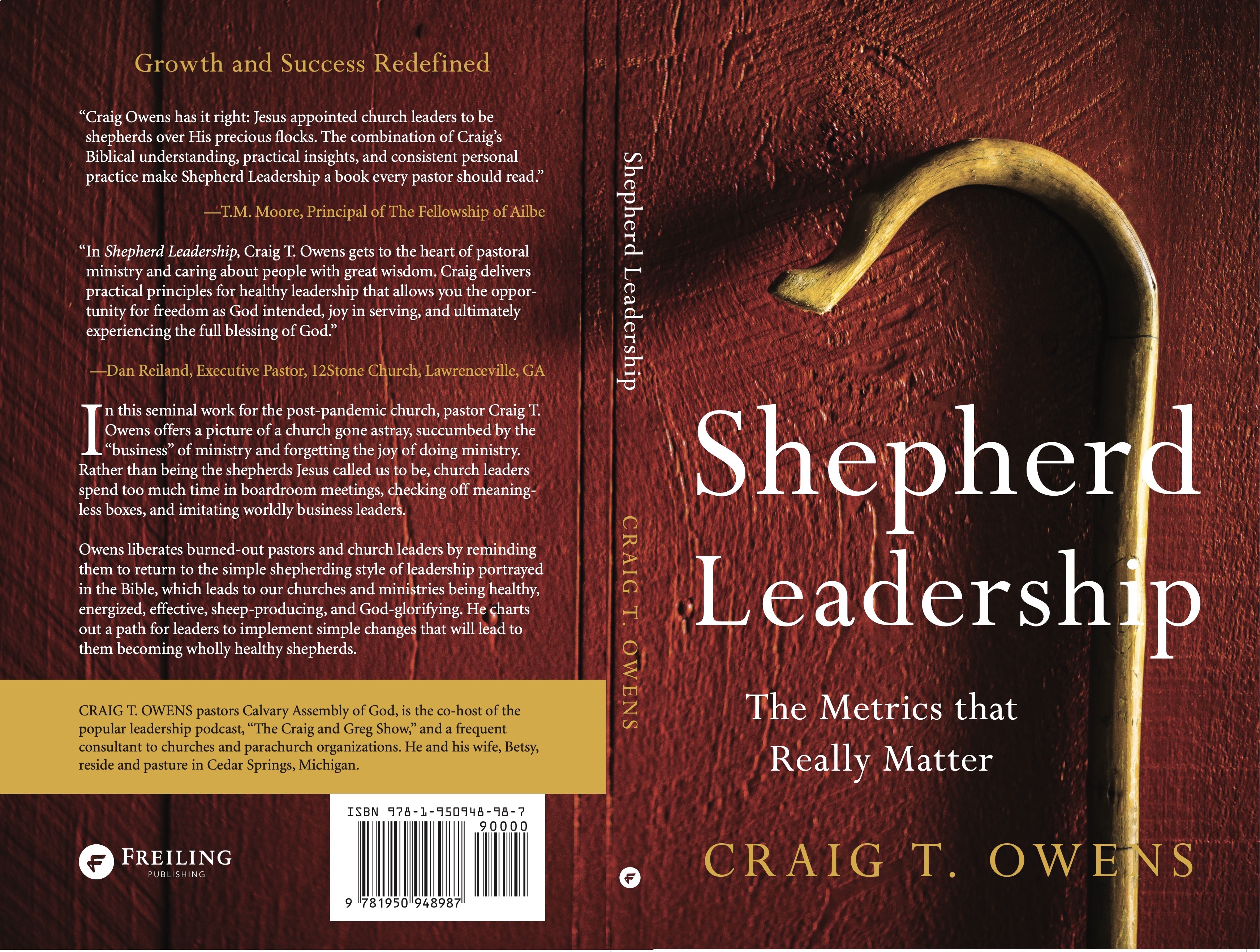
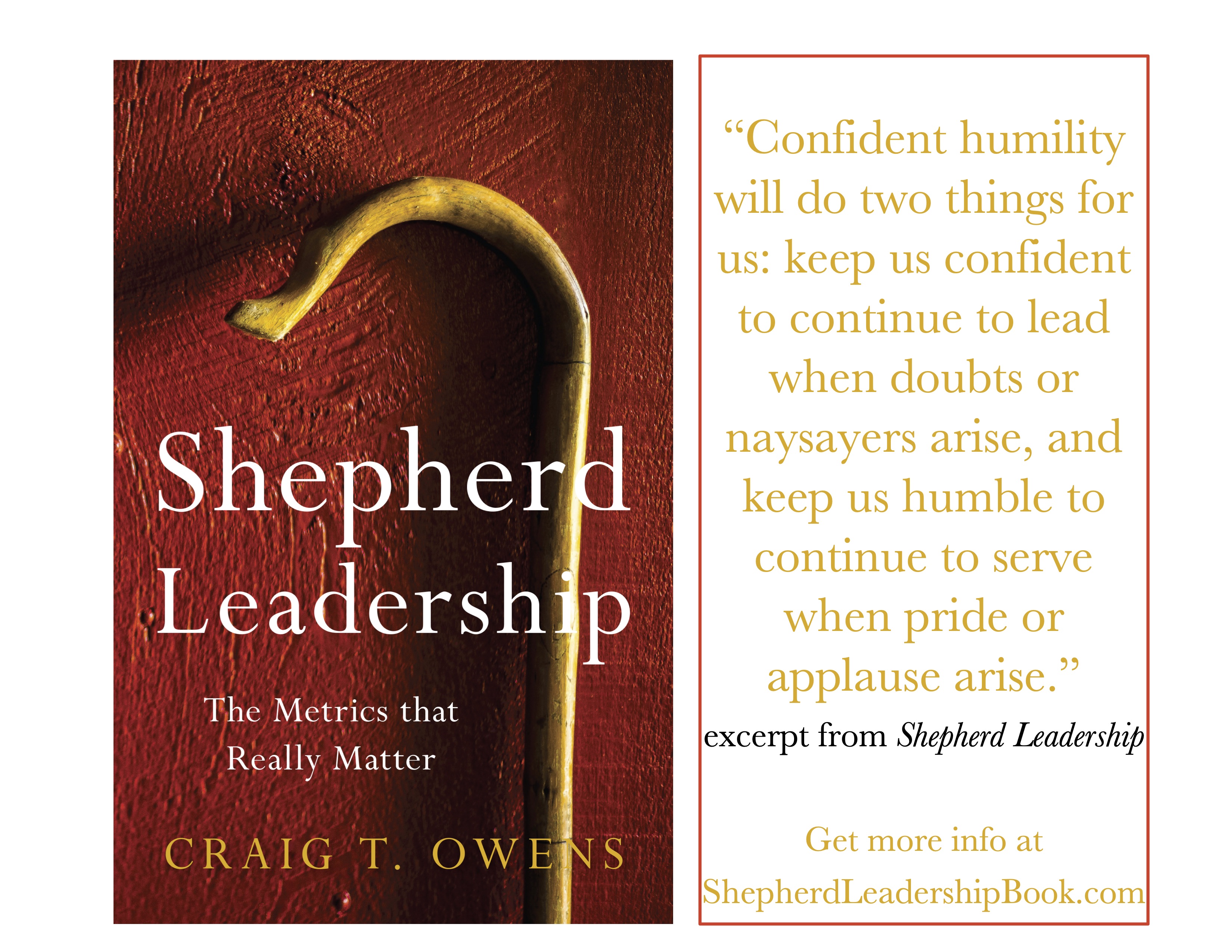
As I was being interviewed on theLeading From Alignment podcast, Jim Wiegand and John Opalewski were asking me about back-to-back chapters in my book Shepherd Leadership where I discuss how a leader’s confidence and humility should be in a healthy tension with each other.
There is an alter-ego superhero I created to help me learn this lesson—his name is Plungerman!
Listen to the podcast of this post by clicking on the player below, and you can also subscribe on Apple, Spotify, or Audible.
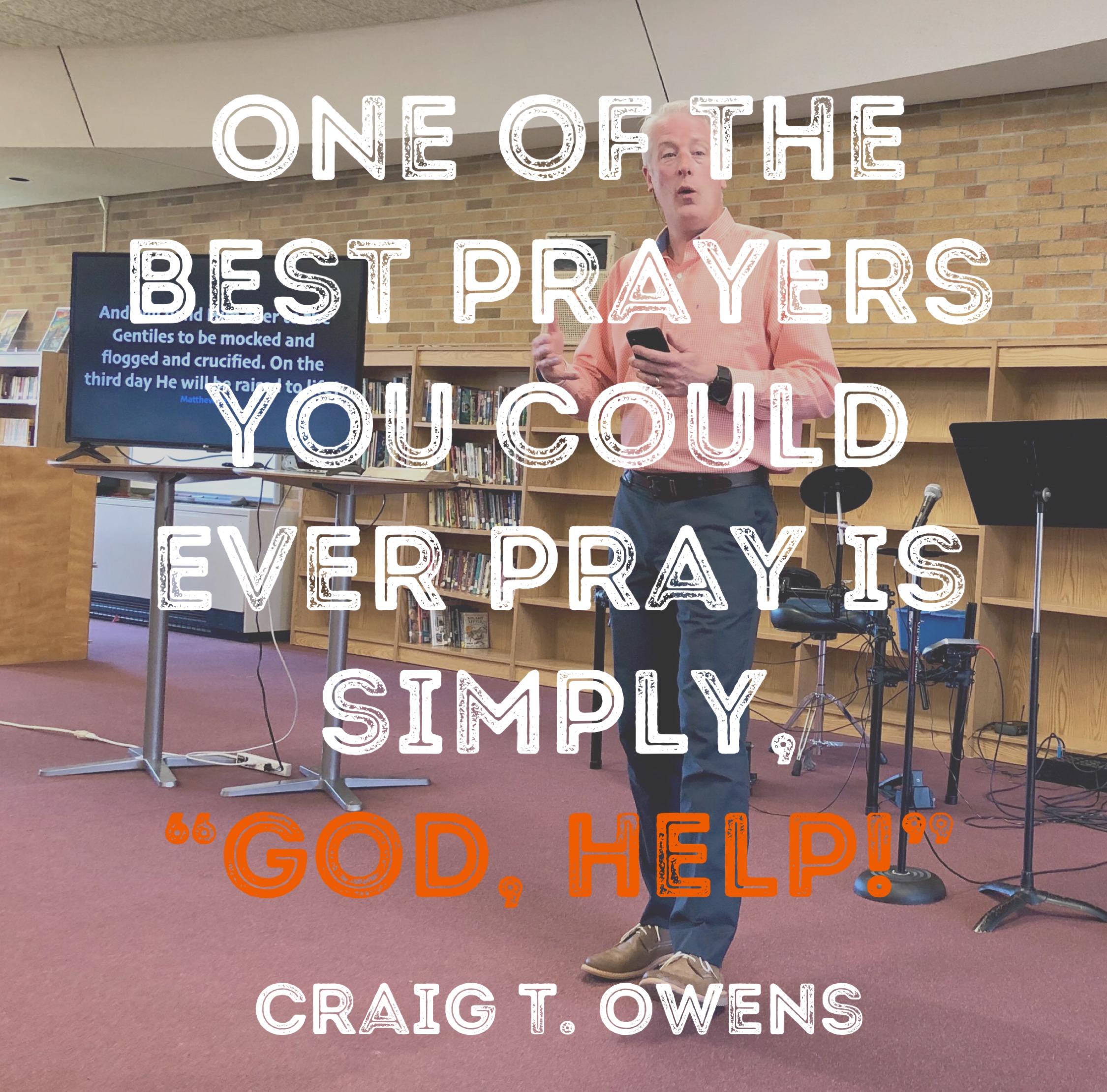
Confidence can become a detriment to a leader’s growth when our confidence keeps us in a place where we refuse to ask for help. Nick Vujicic wisely noted, “An arrogant person does not ask for help and thus is helpless. An arrogant person claims to know everything and thus is clueless. A humble person attracts helpers and teachers.”
Sadly, too many leaders think that if they admit they don’t know something, that will diminish their standing in the minds of those around them. I’ll be the first to confess that this is how I used to view myself in my leadership roles.
But a huge breakthrough for me was in humbly admitting my need and seeing how others delighted to come alongside me to help.
During a training time with some other pastors, I was asked what I thought about “self-help books.”
There are many leaders that believe the lie that God helps those who help themselves. In reality, God delights in those who admit their need for help. The Bible says, “God opposes the proud, but shows favor to the humble” (James 4:6). Unhealthy or insecure leaders don’t admit their need for help, and as a result they put a lid on their leadership potential.
Swallow your pride … humbly admit your need for help … receive the help of God and others … and then watch your leadership influence grow!
Listen to the podcast of this post by clicking on the player below, and you can also subscribe on Apple, Spotify, or Audible.
If you’ve been promoted to a new position, be very aware of how you arrive. If you come in overly confident, you could alienate your new teammates before you even get a chance to get started with them. We have an idea that will help you arrive well and make great connections right from the beginning.
Check out this full conversation on The Craig And Greg Show by clicking here.
Shepherd Leadership: The Metrics That Really Matter is available in print or ebook, and in audiobook through either Audible or Apple.
Listen to the audio-only version of this podcast by clicking on the player below, or scroll down to watch the video.
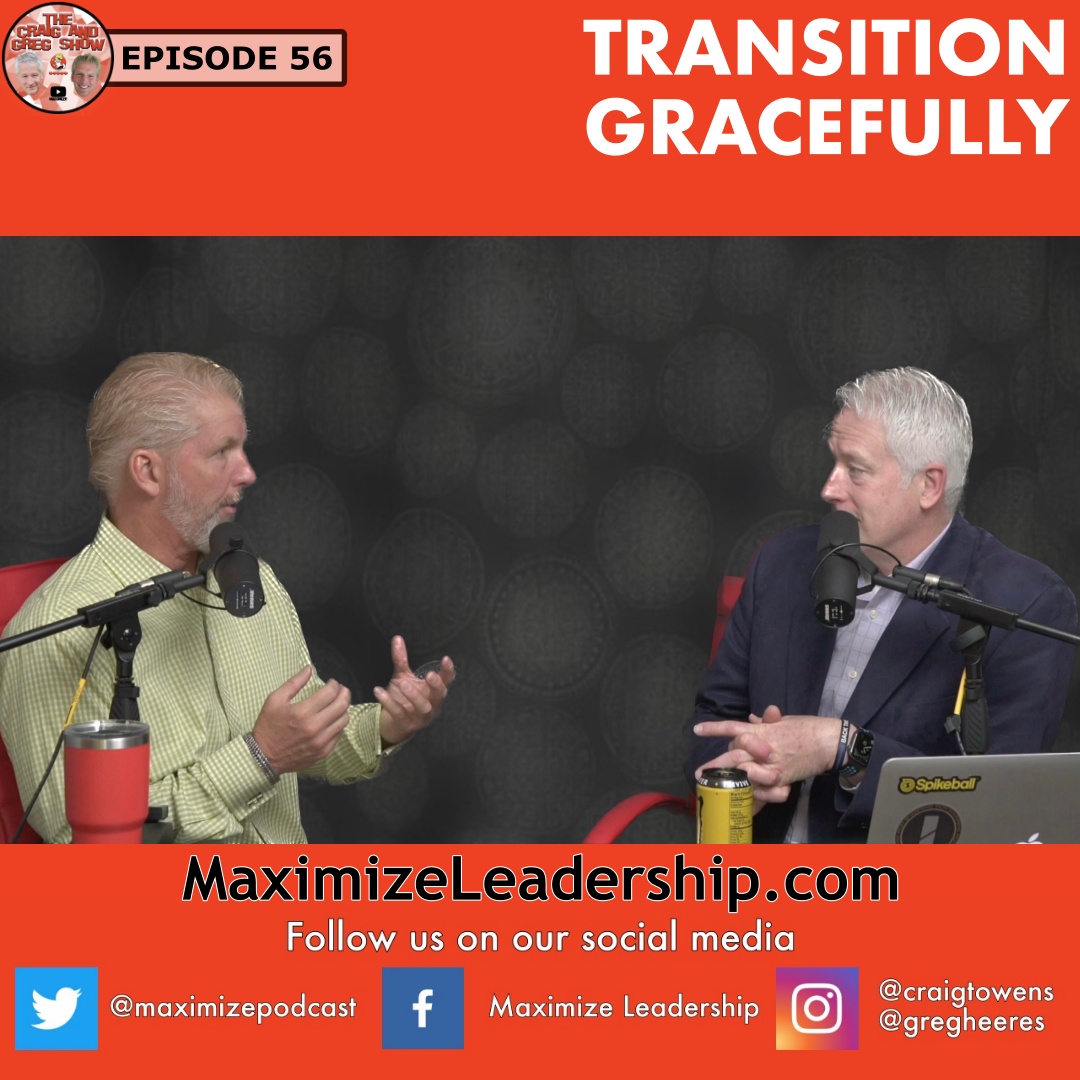
Accepting a new position is a very exciting experience! Whether it’s a promotion in your current organization or an opportunity elsewhere, it’s very tempting to want to immediately throw your full attention into the next project. In this episode, Greg and I discuss the necessity of maintaining a balance between that excitement and recognizing that the people on your team now still need your leadership. This might create more work for you in the short term, but the long-term benefits of transitioning well will be huge for you!
[0:33] Any fresh starts for leaders have to be handled thoughtfully.
[2:44] Leaders of integrity give their best effort all the way to the end.
[4:08] How can we maintain a humble attitude when we have been selected to be promoted to a new position?
[6:08] There are different things to keep in mind when moving to a new position in the same organization vs. moving to a new organization.
[8:02] Both of us share stories about friends who benefitted by leaving their old organizations well, and they identify what the true litmus test for leaving well is.
[10:14] Greg also has a negative example to share.
[11:03] How do senior leaders handle coworkers who leave poorly?
[13:06] How do we keep ourselves from being distracted by our new position while we attempt to finish well in our old position?
[16:15] How do we arrive well in our new position?
[18:35] We need to always keep in mind that we are leaving or joining a team of many—we aren’t a team of one.
[22:57] Finishing well is a compliment to the organization you are leaving, and beginning well is a compliment to the organization you are joining.
Check out this episode and subscribe on YouTube so you can watch all of the upcoming episodes. You can also listen to our podcast on Spotify and Apple.
In my book Shepherd Leadership, I talk about the simple three-word phrase that has helped me maintain this balance: God chose me. The fact that God did the choosing should give me the confidence to cast vision, but the humility that God chose me—out of all of the other people He could have chosen—should bring an appropriate humility that allows me to involve other leaders on my team.
If you would like to watch this full interview on the Leading From Alignment podcast, please go here. And if you would like to check out other clips I’ve already shared, please click here.
I’ll be sharing more clips from this interview soon, so please stay tuned. Shepherd Leadership: The Metrics That Really Matter is available in print or ebook, and in audiobook through either Audible or Apple.



 I love the simple but utterly profound statement the angel Gabriel leaves with Mary. Listen to it from different biblical translations: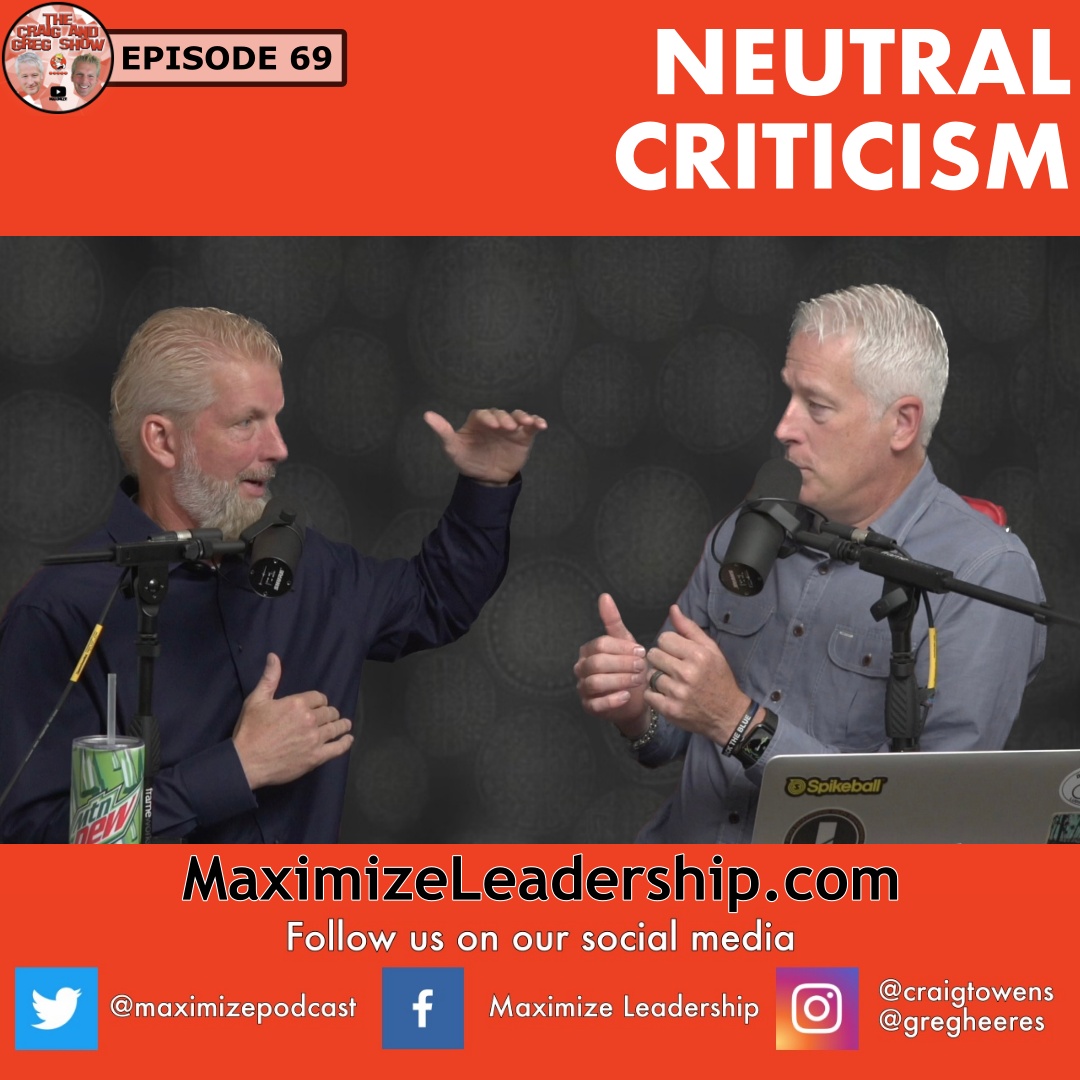






 Craig T. Owens