Pastoral Submission

What do you think of when you hear those words pastoral submission?

We may not be on the same page about this yet. I don’t mean people in a congregation submitting to a pastor. I mean something deeper than that.

Allow me to start with an unusual verse for this topic. Paul wrote,

When Peter came to Antioch, I opposed him to his face… (Galatians 2:11).

First of all, this is the proper way to handle an issue like this. Paul didn’t talk to others, nor run to the leaders in Jerusalem, but he went one-on-one with Peter.

Consider Paul’s relationship to Peter if there was a “corporate flowchart” for the First Century Church—Peter would have been Paul’s superior. Yet, Peter not only received this correction from Paul but continued to speak highly of Paul.

Beginning in the first chapter of Galatians we see Paul’s level of accountability. He answered to God, but he also submitted to other church leaders. Not only that, but this passage (Galatians 2:7-9) tells us that other church leaders submitted to Paul.

When I know God has called me, and I am doing my work for His approval alone, and when I know God has called others, and they too are ministering only for His approval then we can mutually submit to one another.

It’s not a top-down hierarchy in the church, except for Jesus being the Head and all others are below Him. All others (clergy and congregation) in the Body of Christ are on equal standing—no one is more important than any other. Therefore, as we submit to Christ’s Headship, we can also mutually submit to others in the Body.

What keeps us from doing this? Pride! We say, “What will others think of me if I submit?” Pastors think, “If I submitted to someone in my congregation, how could I ever lead this church? People will take advantage of me! No one will ever listen to me again!”

Not true!

When I am fully submitted to Christ, there is no stronger grounds for SERVANT leadership.

I don’t pastor to lead; I pastor to serve. 

I’m not building my church; I’m building Christ’s church. 

I’m not growing my followers; but followers of Jesus. 

Holy God, help me to know who I am in You. You have called me to pastor, so I am Your servant. Help me kill my pride! Help me serve and submit. Help me to build Your Church.

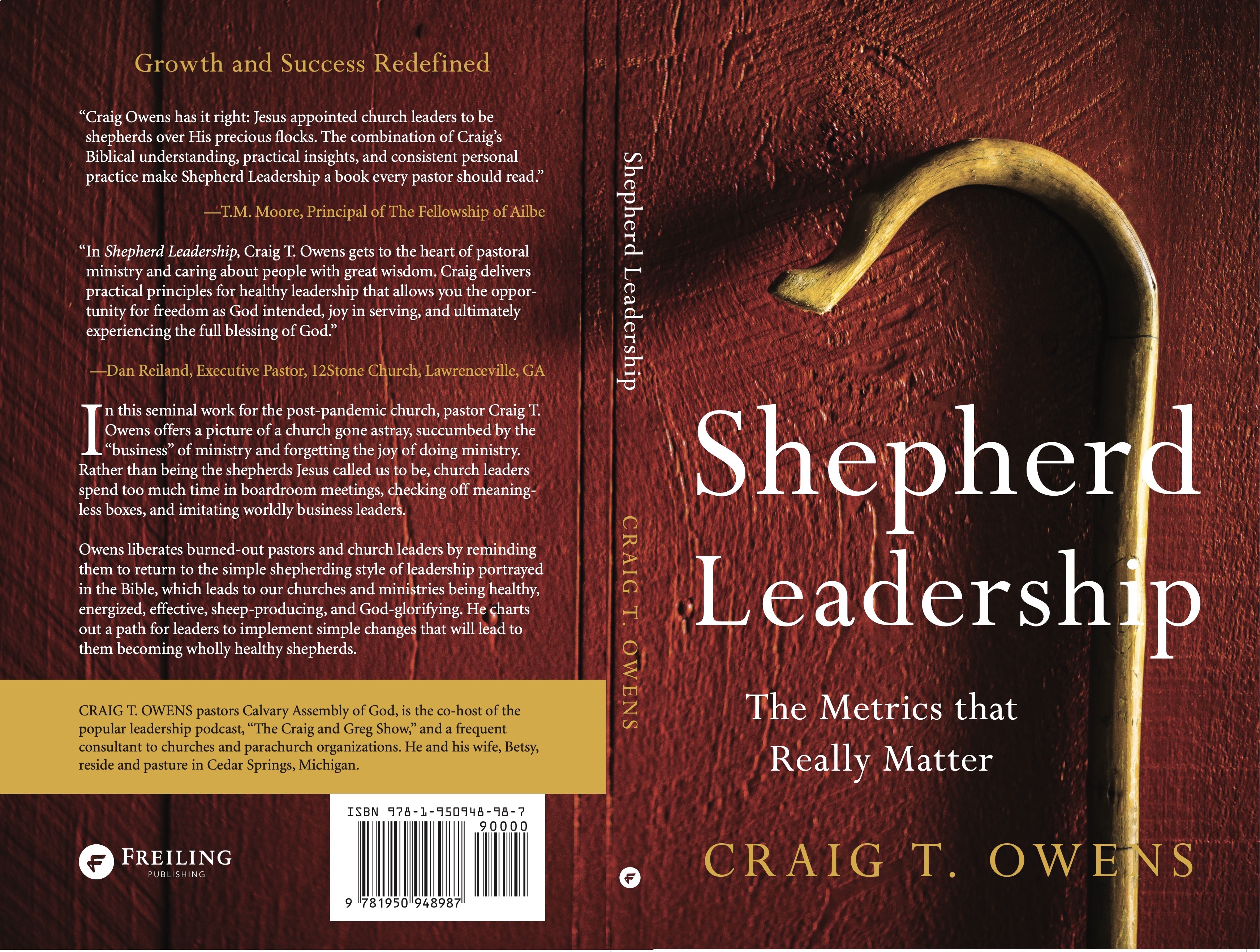
UPDATE: This post was one of the seed thoughts that went into fashioning my book Shepherd Leadership: The Metrics That Really Matter.

Secret Power (book review)

Dwight L. Moody is my kind of pastor: he said exactly what was on his mind. He wasn’t worried about political correctness, or couching his words in comfortable words. He was a modern-day prophet of his day, clearly stating, “Thus says the Lord!” Thankfully for us in our day, D.L. Moody’s books sound just like his sermons. In Secret Power, Moody calls Christians and churches back to a fuller understanding of the role of the Holy Spirit in our lives.

Moody writes:

“How much we have dishonored Him [the Holy Spirit] in the past! How ignorant of His grace, and love and presence we have been? True, we have heard of Him and read of Him, but we have had little intelligent knowledge of His attributes, His offices and His relations to us. I fear He has not been to many professed Christians an actual existence, nor is He known to them as a personality of the Godhead.”

I am convinced that this is true. The Holy Spirit seems “spooky” or out-of-date or inapplicable in many churches. Moody explains this is the reason why our churches are not experiencing the same miracle-working power that was seen in the New Testament church.

As a result, individual Christians are lacking in power in their personal lives, too, because they are not being taught about the role of the Holy Spirit in their churches. As a result, Christians are not soul winners as were New Testament Christians.

A secondary title for this book is “The Secret Of Success In Christian Life And Work.” That success can be yours today if you will only allow God to operate in your life and church in all of His fullness. 

If you are thirsty for this sort of fuller relationship with the Holy Spirit, I encourage you to read this book! You may also want to check out some quotes I shared from this book here and here.

Money And The Church

Unfortunately, far too many financial scandals have tainted the church, and therefore any pastor who mentions tithes or offerings or missions support is usually viewed skeptically.

So sad! Especially because it should NEVER be this way!

The Apostle Paul gives an excellent teaching on financial gifts for church ministry in 2 Corinthians 8-9. I love this example he gives about the Christians in the impoverished area of Macedonia—

Out of the most severe trial, their overflowing joy and their extreme poverty welled up in rich generosity. (2 Corinthians 8:3)

Severe trial … extreme poverty rich generosity…. Want to see this in a modern-day setting? Check out this video:

Wow!! If the homeless can give like that, why can’t we?

Here are some principles Paul lists about giving:

  • Give because God compels you, not because a man compels you (2 Corinthians 8:3-4)
  • Give yourself to God before you give your income (8:5)
  • Give excellently (8:7)
  • Give sincerely (8:8)
  • Give like Jesus gave (8:9)
  • Give what you say you’re going to give, and do it quickly (8:10-15)
  • Give where there is proper accountability and proven credibility (8:16-24)
  • Give generously (9:1-6)
  • Give cheerfully (9:7)
  • Give where God is glorified (9:8-15)

Giving according to these principles removes the taint of anything shady, and puts the focus on God.

What Is Successful Church Ministry?

I like to keep asking myself and my leadership team this question: How do we know if our church is successful? 

The apostle Paul uses two words to help answer these questions: Quality and Faithfulness.

But each one’s work will be shown for what it is; the Day will disclose it, because it will be revealed by fire—the fire will test the quality of each one’s work. (1 Corinthians 3:13)

Now it is required that those who have been given a trust must prove faithful. (1 Corinthians 4:2)

So here are two important questions we need to ask ourselves:

  • Am I doing quality work?
  • Am I faithfully doing my work?

To help answer those questions, I like this thought from Leonard Sweet’s book I Am A Follower:

“The most important metrics we must rely on, the crucial ‘deliverables’ we can present, must focus on the newly formed lives of the disciples we are making, the followers who are following Christ into a place of serving Him by serving others. The most important measure of our faithfulness to Christ must be the extent of transformation into the living image of Christ Himself. …

The quantifiable fruit of our church is not found in the number of people we can gather on a weekly basis. What counts is what is happening in the lives of those who have gathered. …It is quite possible to have a ‘successful’ life—and a ‘successful’ church—without God. But it is absolutely impossible to have a truly fruitful one.”

Again, Paul’s advice here is invaluable:

My conscience is clear, but that does not make me innocent. It is the Lord who judges me. Therefore judge nothing before the appointed time; wait till the Lord comes…. (1 Corinthians 4:4, 5)

Pastor, you need to think about these questions about “success.” But they should be questions framed around your quality and faithfulness of work as revealed to you by the Holy Spirit, not by some “expert” or anyone else.

(By the way, if you’re interested in exploring this further, I framed this question a different way in this post.)

UPDATE: This post was one of the seed thoughts that went into fashioning my book Shepherd Leadership: The Metrics That Really Matter.

Do You LOVE Your Church?

Okay, pastors, here are some tough questions:

  • Do you love your congregation?
  • Do you think they’re some of the greatest people on earth?
  • If you didn’t pastor your church, would you attend your church?
  • Do you enjoy recreating with your church family?

This is an important principle: You cannot treat someone differently than you think about them.

Listen to what Paul said about the church in Rome:

I myself am convinced, my brothers, that you yourselves are full of goodness, complete in knowledge and competent to instruct one another. (Romans 15:14)

Do you hear what high regard Paul had for them? He told them that they were good people, growing in their relationship with Christ, and were competent to be teachers themselves!

Not only did Paul write this to them, but he bragged about them to others too:

Everyone has heard about your obedience, so I am full of joy over you. (Romans 16:19)

Pastor, Jesus called us to feed and care for His sheep. We can do this so much more effectively if we think so highly of those precious people.

I pray that you can answer a resounding, whole-hearted “YES!” to those four opening questions. I think that’s what Jesus would want.

15 Quotes From “I Am A Follower”

I Am A Follower by Leonard Sweet turned my leadership thoughts upside down (or is that right-side up?). I would strongly encourage you to read this book, especially if you are in church “leadership.”

It wasn’t easy to do, but here are 15 great quotes from I Am A Follower —

“The Greek noun perichoresis was the early church’s favorite word to describe the interrelationship of the holy Trinity. When the prefix peri (around) is linked with the root of the verb choreuein (to dance), a compelling metaphor is formed or  ‘choreographed’ to describe the ‘one nature in three Persons’ of God the Father, Son, and Holy Spirit. Literally they ‘dance around.’ The choreia or dance of God is the choreography of the cosmos, the interrelationship of Creator, creation, and life itself, the holy creativity of the All in All.”

“Following is the most underrated form of leadership in existence.”

“The cry for leadership is deafening amid our social disintegration, our moral disorientation. We have come to believe that we have a leadership crisis while all along we have been in a drought of discipleship. The Jesus paradox is that only Christians lead by following.”

“The church has become what [Dwight] Eisenhower predicted: a place where everyone is trying to get everyone else to do what they want done but don’t want to do themselves.”

“Leadership is a function. Followership is an identity. … Leadership is a functional position of power and authority. Followership is a relational posture of love and trust. … Being a follower is less about showing how much you know than showing humble gratitude for how much there is to be known.”

“Have we made Christianity more a moment of decision than a momentum for life? Both are important, but have we spent more time on how you become a Christian than on what it means to live as a Christian? Both are important, but have we made holiness more about a destination than a direction?” 

“But to think we can capture and tame Truth is a delusional trap. In fact, the desire for command and control above our desire to please God dams up the rivers of Living Water.”

“Christ does not ask of His followers great success or great fame or great distinction. Christ expects of His followers what He expected of Himself: simply ‘to do the will of Him Who sent Me.’”

“Never in the history of humanity has knowledge been more accessible and of such quality. But when our thirst for information, expertise, and control begins to outrun our thirst for Christ, we can easily trade the waters of the Spirit for a soda-pop substitute. When we place our faith in fillers instead of allowing the Spirit to fill us, we end up selling out not only Christ but ourselves.”

“Leadership culture is strength based. Followership culture is weakness based. …We bless others naturally through our strengths. But we bless others supernaturally through our weaknesses.”

“The disciples were instructed to feed the sheep, not lead them. Christ will lead them. Jesus is the Shepherd. We are the sheep. All of us.”

“Near the end of John’s gospel we find Jesus’ poignant words: ‘As You have sent Me into the world, so I have sent them into the world.’ Did you catch that sneaky as? Jesus’ commissioning of His disciples was simply an echo of His own commissioning.”

“The relationship between leader and follower is this: leaders are over, followers are among. We are all Jesus followers.”

“The leadership paradigm creates folk heroes. Followership creates heroes who are folk.”

“Jesus told His disciples that the sheep always know the Master’s voice. To follow Jesus is not to demand road signs but to respond to the Voice of the Spirit along the way.”

What Is “Success” For A Church?

“How’s it going,” a fellow pastor asked me. “How’s your church doing?”

If you’re a pastor, you probably get asked this often. How do you answer this question? Do you tell them what your attendance was on Sunday morning? Or about the newest program you’ve started?

When you look in the mirror and ask yourself, “How’s it going,” is your answer related to nickels and noses (offerings and attendance)? Is it how many people complimented your last sermon?

Listen to these sobering words:

Worldliness is not the trap that most endangers us as Christian workers; nor is it sin. The trap we fall into is extravagantly desiring spiritual success; that is, success measured by, and patterned after, the form set by this religious age in which we now live. 

We have a commercialized view—we count how many souls have been saved and sanctified, we thank God, and then we think everything is all right. (Oswald Chambers)

We need to be very careful about how we define “success” in a church setting. Let’s use Jesus as our example:

  • How big was His congregation? Twelve men. One betrayed Him, nine ran away when the going got tough, and one denied he even knew Him. Even after being raised from the dead (!) there were only 120 people in the upper room.
  • How much money did His church have? Not even enough to buy a gravesite for the Messiah.
  • What did people think of His sermons? Some of His sermons made people so mad they wanted to stone Him. And after one sermon the Bible says: From this time many of His disciples turned back and no longer followed Him (John 6:66).

Maybe “success” in the church is more like…

  • …people being reconciled to God. Remembering that “our work is not to save souls, but to disciple them” (Chambers).
  • …seeing disengaged people becoming actively involved in engaging others with the Gospel.
  • …“Never seek[ing] after anything other than the approval of God” (Chambers).
  • …to say with Jesus, “The Spirit of the Lord is on Me, because He has anointed Me to preach good news to the poor. He has sent Me to proclaim freedom for the prisoners and recovery of sight for the blind, to release the oppressed, to proclaim the year of the Lord’s favor” (Luke 4:18-19).

These are just some of my thoughts. What else should be on this list? How would you define “success” in the church?

I have also shared some questions that can help pastors and ministry leaders better gauge the level of effectiveness in their ministry.

UPDATE: This post was one of the seed thoughts that went into fashioning my book Shepherd Leadership: The Metrics That Really Matter.

Co-Workers

Obvious statement #1: Church ministry is not lone ranger work.

I needed to state that not only as a reminder to myself, but to my other pastor friends too. It seems like we can often lose sight of this fact. We can become so focused on the next sermon, the next appointment, the next Board meeting, the next outreach that we are actually worshiping the ministry instead of worshiping God through our ministry.

Oswald Chambers gave this warning:

“Beware of any work for God that causes or allows you to avoid concentrating on Him. A great number of Christian workers worship their work. The only concern of Christian workers should be their concentration on God. … A worker who lacks this serious controlling emphasis of concentration on God is apt to become overly burdened by his work. … Consequently, he becomes burned out and defeated. There is no freedom and no delight in life at all. His nerves, mind, and heart are so overwhelmed that God’s blessing cannot rest on him.”

When we are more focused on the work than on God, we can easily begin to feel over-worked and under-appreciated. And this usually leads to us either bearing down to work harder or to simply throwing in the towel.

There is a healthy alternative: link arms with The Co-Worker—

Walk with me and work with Me—watch how I do it. Learn the unforced rhythms of grace. I won’t lay anything heavy or ill-fitting on you. Keep company with Me and you’ll learn to live freely and lightly.” (Matthew 11:29, The Message)

Link with The Co-Worker, and then you will do ministry out of the overflow of your personal worship. Remember, you are a co-worker, not a solo-worker.

Obvious statement #2: Church ministry is not just for the pastor.

Church member, you too are a co-worker with Christ. And with your pastor.

The apostle Paul reminded the church at Corinth that “we are God’s fellow workers” (1 Corinthians 3:9). In other words, we’re all in this together. You need your pastor, and your pastor needs you.

Allow me to paraphrase a quote from President Dwight Eisenhower:

“Never let yourself be persuaded that one [pastor] is necessary to the salvation of America. When [the Church] consists of one leader and [a bunch of] followers, it will no longer be [the Church].”

The Church is a beautiful thing! It functions best when:

  • Pastor and church member are both linked with Christ
  • The pastor is not a lone ranger
  • The church members are not spectators

Ready? Go BE the Church of Jesus Christ!

How Betsy Made A Memorable First Impression

After this story, I’m encouraging my wife to start a blog of her own! This is a note from her Facebook page from about 3 years ago, but it is too good to keep limited to just her Facebook friends.

Okay so let’s begin.

Last night Craig was speaking at a church for the purpose of evaluating whether or not it would be a good fit for us to pastor. So, just before the service began I ran to the ladies room. It was occupied and I had to wait quite awhile until it was available. By that time, service had already begun. I naturally hurried to get back into service.

Upon entering the sanctuary, Craig was in the middle of praying. I didn’t want to walk up front while he was praying, so I remained in the back until he was finished. I then very gracefully proceeded to the front pew to take my seat.

As is my natural custom, before sitting down, I always smooth out the back of my skirt to avoid unnecessary wrinkles. Upon doing this, I discovered that my skirt was ever so daintily tucked inside my underwear. Yes, it’s true.

My first response was embarrassment, then total mortification, then complete laughter. I was silently laughing for several moments in the front pew. Craig finally leaned over to ask me what was going on. I told him about the situation and he said, “It’s a sign, this can’t be the right place.”

I really don’t know if anyone saw or not, I’m guessing someone did. Thankfully there were no comments to me.

So… I’m telling you, if you want to create a memorable impression this is one way to do it — however, I don’t recommend it.

What do you think? Good first impression? Was this indeed a “sign” for us?

Church-In-A-Box

Did you ever play with a Jack-in-a-box? You turned the crank, listened to the song, and waited for the funny-looking Jack to pop out of the box. Then you stuffed Jack back in the box and did it again.

And again, and again!

It was predictable.

It happened like clockwork. After awhile, though, the predictability became boring, and the Jack-in-a-box ended up collecting dust on the shelf.

Sometimes I’m concerned that our churches are becoming like a church-in-a-box. Like the predictable Jack-in-a-box, we turn the crank of showing up on Sunday, going through the same routine, waiting for God to show up, and then stuffing it all back into the box, only to repeat it all again the next Sunday.

And the next Sunday, and the next Sunday!

It’s predictable. It happens like clockwork. After awhile, though, the predictability can become boring, and our church-in-a-box ends up collecting dust on the shelf.

Here’s what I’m pondering:

  • Why do we meet on Sunday mornings?

There are as many mentions in the Bible about Christians meeting on other days as there are mentions about the first day of the week.

  • Why do we get so hung up on the “order of service”?

None of the New Testament writers taught about that. Yet if you want to anger some folks, just change up the Sunday routine.

  • Why do we dress a certain way to go to church?

Jesus had only one set of clothes, which means He wore the same thing to the synagogue as He wore the rest of the week. Yet we expect people to “dress correctly” for church.

  • Why do we call what happens on Sunday “worship,” and what happens the rest of the week “work”?

Shouldn’t everything we do bring glory to God? Shouldn’t all of our lives be worship?

  • Why do we complain about a church service not “moving us,” when we don’t feel the Holy Spirit moving the other six days of the week?

I’m not trying to pick a fight. Really.

I’m just wondering if perhaps we’ve gotten used to church-in-a-box. And if we have, perhaps we’ve also put God in a box too. Maybe we’ve become so accustomed to showing up on Sunday, dressing a certain way, following a certain routine, singing certain songs, and then expecting God to pop out and thrill us.

And then we put it all away until the next Sunday.

Wouldn’t God be more glorified if we didn’t put Him in a box? If we worshiped Him every day, not just Sunday? If we felt His Spirit animating us in everything we do, not just in the churchy things we do? If He popped up all throughout the week, in all sorts of places (like work, school, the grocery store, home)?

What do you think? Have we put church (and God) in a box? If so, how should we change?