Links & Quotes

link quote

“A Christian mind asks questions, probes problems, confesses ignorance, feels perplexity, but does these things within the context of a profound and growing confidence of the reality of God and of his Christ.” —John R.W. Stott

“How can we expect to chase satan out of our churches, our homes, our troubled children, if we don’t pray? How can parents expect God to impart spiritual power to them when they argue, fight and gossip in front of their kids? How can they expect to possess authority when they go out drinking, and then fly into a rage when they learn their kids smoke pot?” —David Wilkerson

“An increase of love, a more perfect apprehension of Christ’s love is one of the best and most infallible gauges whereby we may test ourselves whether we have grown in grace or not. If we have grown in grace, it is absolutely certain that we shall have advanced in our knowledge and reciprocation of the love of Christ.” —Charles Spurgeon

“Actions have consequences! In the book of Genesis we read how Joseph placed his loyalty above lust when he was tempted by Potiphar’s wife. His primary concern was the preference of God when he said, ‘How can I do this great wickedness, and sin against God’ (Genesis 39:9)? The lesson we learn from Joseph is surprisingly simple: Do what pleases God. Your co-workers want to include a trip to a gentleman’s club on the evening agenda. What do you do? Do what pleases God. Your date invites you to conclude the evening with drinks at his place. How should you reply? Do what pleases God. You don’t fix a struggling marriage with an affair, a drug problem with more drugs, debt with more debt. You don’t get out of a mess by making another one. You’ll never go wrong doing what is right. Just do what pleases God.” —Max Lucado

Seth Godin has a great point: We usually tell people how to do things, but rarely do we tell them why to do things. Check out Seth’s insight here.
The Counselor Helps Renew & Restore

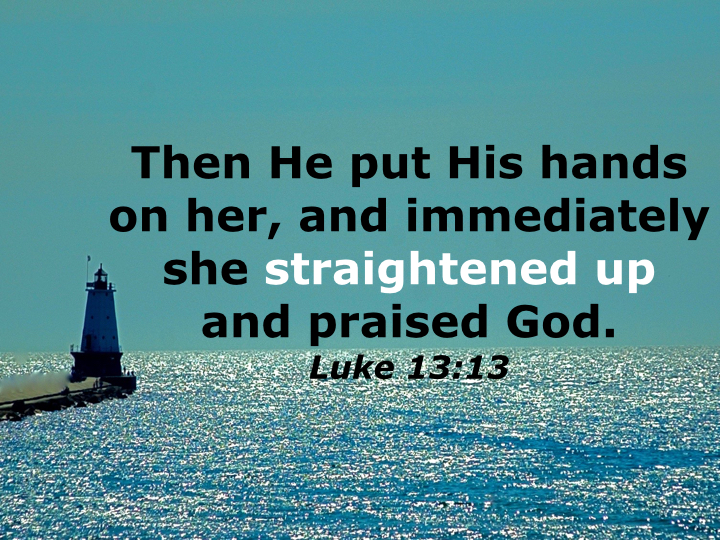
Straighten up2 Timothy 3:16-17 tells us the Holy Spirit-inspired Word of God does four things. Each of these things is also part of the definition of what the Holy Spirit does as our Counselor: teach, reprove, correct, and train.

The word for correct in this verse is the only time this Greek word is used in the Bible. It is the word epanorthosis. The prefix ep- means upon, at, by, across; and the root word -northosis means:

Do you notice the “re” words in this definition? The Holy Spirit wants to come upon us and use His inspired Word to (a) restore us to an upright state, and (b) renew the life and character of Christ in us. This is part of the meaning of being baptized in the Holy Spirit.

Jesus lived on earth as a human being, and as such He did not use His God-ness. As a man Jesus could know God’s thoughts (see Matthew 11:25-26, where Jesus is speaking to God in obvious answer to what the Spirit had been speaking to His mind). Jesus also could know men’s thoughts (see Luke 6:6-9) because He was perfectly attuned to the Holy Spirit.

As Christians, this should be our normal life too.

When we discount our worthiness for The Counselor to restore and renew us—we begin to accept sub-normal as normal, and the normal become miraculous and only obtainable by a few “spiritual giants.”

The Father’s desire is for all of us to bear a strong, unmistakable family likeness to Jesus. Christ relied on The Counselor to tell Him God’s thoughts and men’s thoughts, so we must as well. If you would like to receive all that God has for you, ask Him to baptize you in the Holy Spirit. Then you, too, can enjoy the unbroken fellowship—the restoring and renewing—of The Counselor just as Jesus did.

I will be continuing our series on the Holy Spirit as The Counselor this Sunday, and I would love to have you join us!

Links & Quotes

link quote

“When we look at the love of Christ, we make a wonderful discovery. Love is more a decision than an emotion! Christ-like love applauds good behavior. At the same time Christ-like love refuses to endorse misbehavior. Jesus loved His apostles, but He wasn’t silent when they were faithless. Jesus loved the people in the temple, but He didn’t sit still when they were hypocritical.” —Max Lucado

“One of the great enemies of hope is forgetting God’s promises.” —John Piper

“If you perform deeds of charity with the idea of getting to heaven by them, it is yourself that you are feeding and clothing; all your virtue is not virtue, it is rank selfishness, and Christ will never accept it; you will never hear Him say, ‘Thank you’ for it. You served yourself, and no reward is due. You must first come to the Lord Jesus Christ, and look to Him to save you; you will forever renounce all idea of doing anything to save yourself, and being saved, you will be able to give to the poor without selfishness mixing with your motive.” —Charles Spurgeon

Dave Barringer has a good word for pastors: 8 reasons why being vulnerable is better.

Links & Quotes

link quote

“Let us thirst to know Him of Whom even His enemies said, ‘Never man spake like this Man,’ and His unrighteous judge said, ‘I find no fault in Him.’ Above all, let us long to know Christ in His Person. This year endeavor to make a better acquaintance with the Crucified One. … This year seek to penetrate into His very heart, and to search those deep far-reaching caverns of His unknown love, that love which can never find a rival, and can never know a parallel.” —Charles Spurgeon

“Beware of insulting God by being a pious prude instead of a pure person.” —Oswald Chambers

“To pray well is the better half of study.” ―Martin Luther

“Of all marvelous things, perhaps there is nothing that angels behold with such supreme astonishment as a proud man.” —Charles Caleb Colton

[Video] John Maxwell on humility—

Thursdays With Oswald—No Show Business

Oswald ChambersThis is a periodic series with things I’m reading and pondering from Oswald Chambers. You can read the original seed thought here, or type “Thursdays With Oswald” in the search box to read more entries.

No Show Business 

     We are not here to be specimens of what God can do, but to have our life so hid with Christ in God that our Lord’s words will be true of us, that men beholding our good works will glorify our Father in heaven [Matthew 5:16]. There was no “show business” in the life of the Son of God, and there is to be no “show business” in the life of the saint.

From The Moral Foundations Of Life

It is amazing how loudly a life lived for God speaks!

We don’t have to be on TV or have a YouTube video go viral for people to notice. Jesus made it quite clear that simply living a godly life was attractive enough. So don’t try to put on a show, just be a devoted follower of Jesus Christ and your lifestyle will speak volumes. And, even more importantly, God will be glorified!

Don’t Misuse God’s Name

Representing God's nameYou’ve heard the old nursery rhyme: Sticks and stones may break my bones but words will never hurt me. We all know this isn’t true: words do hurt, and names that people call us may leave lasting wounds.

Words and names are important to God. God used His word to create the universe (God said, “Let there by light”); Jesus was called The Word (see John 1:1); God has named people and even renamed them to reflect their character or destiny.

The most important name of all is God’s own name, so the Third Commandment says, “You shall not misuse the name of the LORD your God…” (Exodus 20:7). How can we misuse God’s name? There are five ways—

(1) As emptiness or nothingness

  • Are our words empty? Do we use filler phrases like “Oh my God!” that neither talk to Jehovah or about Jehovah? We shouldn’t use God’s name unless we’re talking to Him or about Him in a respectful way.

(2) In vanity

  • In reality this means calling ourselves a Christian, but speaking in an un-Christlike way.
  • “Giving God a ‘bad name’ might diminish or demolish people’s belief, respect, and awe for God, a tragedy for a world that needs holiness. … It is a major responsibility to represent God; one which should not be taken lightly.” —Dr. Laura Schlessinger

(3) Being insincere

  • Are our promises empty, or is our word our bond? If we have to use phrases like “I swear to God that I will…” then that means we cannot be trusted on our own merits. When we claim to be Christians but cannot be trusted, we undermine the trustworthiness of God in the minds of other people.
  • “The godly man, therefore, will make promises cautiously but keep them conscientiously once they are made, knowing that irresponsibility and unreliability here are great and grievous sins.” —J.I. Packer

(4) Having an unholy vocabulary

  • Holy means something set apart for a special use. Perhaps there are words we use to describe God that we are also using for lesser things. It might be good to listen to how the Holy Spirit would challenge us to have a unique vocabulary to talk to or about our unique God.

(5) Worthlessness of conduct

  • As the cliche goes, “What you do speaks so loudly that I cannot hear what you are saying.” So we need to make sure that we both talk like Jesus talked and live like Jesus lived.

Anything less than these standards just may be misusing God’s holy name and character by misrepresenting Him or giving Him a “bad name.” What do you think?

If you have missed any of the messages in our series The Love In The Law, you can find them all by clicking here.

Links & Quotes

link quote

Some good reading & watching from this weekend…

“Godly men do expel the aerial powers, ejecting them from their possession by exorcisms, not by pacification: and they break their temptations by prayer not unto them but unto God against them. For the devils neither conquer nor chain any man but by the fellowship of sin. And so His name that took on Him humanity and lived without sin, confounds them utterly.” —Augustine

[VIDEO] John Maxwell talks to us about how to handle pressure.

“What we need is a zealous hunger for God, an avid thirst after righteousness, a pain-filled longing to be Christlike and holy. We need a zeal that is loving, self-effacing and lowly.” —A.W. Tozer

Yummy: 10 foods to lower bad cholesterol.

[VIDEO] Another great tribute to Derek Jeter.

Grateful that the Kurds are standing up to ISIS and defending Christian.

More evidence that so-called “climate change” is more hype than substance, as an actor (not a scientist) is appointed by the United Nations as their representative.

“I saw regenerate souls among the Baptists, among the Presbyterians, among the Independents, and among the church folks—all children of God, and yet all born again in a different way.” —George Whitefield, during his 1740 trip to America

Thursdays With Oswald—What The Spirit Does

This is a weekly series with things I’m reading and pondering from Oswald Chambers. You can read the original seed thought here, or type “Thursdays With Oswald” in the search box to read more entries.

What The Spirit Does      

     The majority of us “hang on” to Jesus Christ, we are thankful for the massive gift of salvation, but we don’t do anything towards working it out. That is the difficult bit, and the bit the majority of us fall in, because we have not been taught that that is what we have to do, consequently there is a gap between our religious profession and our actual practical living. …      

     The great factor in Christian experience is the one our Lord continually brought out, viz., the reception of the Holy Spirit who does in us what He did for us, and slowly and surely our natural life is transformed into a spiritual life through obedience.

From Conformed To His Image

There is a process whereby the Holy Spirit brings our Christ-likeness from us; it’s called sanctification (or as I like to say it, saint-ification).

This is how the Spirit forms us into God’s saints. But here’s the key point: we have to let the Spirit do His work. If we say, “No thanks, I’d rather not work on that area of my life,” He will leave you alone.

But, oh, the rewards that we miss out on when we don’t receive all that the Holy Spirit has for us!

Altar To Alter

Listen to the podcast of this post by clicking on the player below, and you can also subscribe on AppleSpotify, or Audible.

The process of sanctification—or as I like remember the word: saint-ification—is the process whereby the Holy Spirit develops Christlike character in us. His process is immediate, personalized, and ongoing. In other words, the Spirit is intimately and immediately involved in every aspect of our lives.

Christlikeness in us is described in the Bible with phrases like…

  • Being made new in the attitude of your minds; and putting on the new self, created to be like God in true righteousness and holiness (Ephesians 4:23-24).
  • Conformed to the likeness of God’s Son (Romans 8:29).

The Holy Spirit is often portrayed as fire. In fact, the Bible says that Jesus will baptize you with the Holy Spirit and with fire (Matthew 3:11). This is because in order for Christlike character to be formed in us, that character will have to be forged in us. Forged in the Spirit’s fire.

Look at two examples:

  • Until the time came to fulfill his dreams, the Lord tested Joseph’s character (Psalm 105:19).
  • Even though Jesus was God’s Son, He learned obedience from the things He suffered (Hebrews 5:8).

Here’s what I’ve learned—

We must altar our lives so that the Holy Spirit can alter our lives.

Unless we yield to what the Holy Spirit wants to do with us, He cannot and will not bring about the changes that will lead to more Christlikeness being revealed in us.

It may be painful to altar our lives, but the apostle Paul says, “I consider that our present sufferings are not worth comparing with the glory that will be revealed in us” (Romans 8:18).

You altar, and then watch the Holy Spirit alter your life in a way that reveals God’s glory!

►► Would you please prayerfully consider supporting this ministry? ◀︎◀︎

Links & Quotes

link quote

Here are the links to some interesting reading I found this weekend.

“The dominant model of how speech works is that it is planned in advance—speakers begin with a conscious idea of exactly what they are going to say. But some researchers think that speech is not entirely planned, and that people know what they are saying in part through hearing themselves speak.” Check out more of this fascinating report You Don’t Always Know What Youre Saying.

A balanced approach is vital. “Beware any teacher or preacher who has little use for doctrine or church history.” —T.M. Moore

“Lastly, as the best advice I can give, seek more of the Spirit of God, for this is the way to become Christ-like. Vain are all your attempts to be like Him till you have sought His Spirit. Take the cold iron, and attempt to weld it if you can into a certain shape. How fruitless the effort! Lay it on the anvil, seize the blacksmith’s hammer with all your might; let blow after blow fall upon it, and you shall have done nothing. Twist it, turn it, use all your implements, but you shall not be able to fashion it as you would. But put it in the fire, let it be softened and made malleable, then lay it on the anvil, and each stroke shall have a mighty effect, so that you may fashion it into any form you may desire. So take your heart, not cold as it is, not stony, as it is by nature, but put it into the furnace; there let it be molten, and after that it can be turned like wax to the seal, and fashioned into the image of Jesus Christ.” —Charles Spurgeon

John Stonestreet has a timely reminder in his commentary Race And Redemption.

A great piece on euthanasia: What Happened To Switzerland?