Life Or Death?

Life or deathSince Jesus predicted His death on a Cross, and His resurrection from the dead three days later, and since that really happened(!), I think that it would be wise to consider the other words Jesus said!

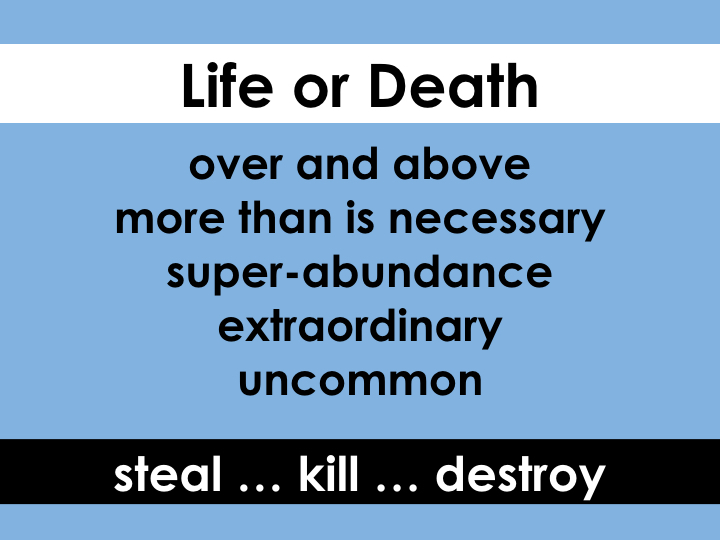
Here’s an important one—The thief cometh not, but for to steal, and to kill, and to destroy: I am come that they might have life, and that they might have it more abundantly (John 10:10).

It’s a pretty clear distinction: One way brings death and the other way brings life. But not just any kind of life.

The Greeks had three words for “life”—

  1. Bios from which we get our word biology. We can see when something is alive because of its biological growth.
  2. Psuche from which we get our word psychology. Plants might be biologically alive, but they don’t have the psychological life of a human.
  3. Zoe. This is the word Jesus used in John 10:10. It’s the word that means “life force” or better stated it’s God’s life.

God is a Triune God: Father, Son, and Spirit. When God created humans, we were created in His “trinity” image—Let Us make man in Our image (Genesis 1:26). Adam was created with bios, psuche, and zoe life. God told Adam and Eve that if they sinned, they would die (Genesis 2:17). When they did eat that forbidden fruit, they remained biologically and psychologically alive, but the zoe life force was cut off.

Jesus came to restore that! He came to bring us back to the state God originally intended for us, which meant He had to go to the Cross to become our sin, so that we could be forgiven and brought back to life.

Placing your faith in Jesus Christ’s work on the Cross means a complete about-face. The devil wants to steal from you, kill you, and destroy your soul for eternity. But Jesus came that you could have zoe in a way that was above-and-beyond, super-abundant, extraordinary and uncommon!

To get this life, Jesus asks us to do something that He did—If anyone would come after Me, he must deny himself and take up his cross and follow Me (Matthew 16:24).

Jesus isn’t calling for our hands and feet to be nailed to a wooden Cross. But He is calling for our selfish thoughts to be crucified (Matthew 16:23), and for us to give no more attention to our old sinful life.

I think this passage in Romans captures that thought so well—

Could it be any clearer? Our old way of life was nailed to the Cross with Christ, a decisive end to that sin-miserable life—no longer at sin’s every beck and call! What we believe is this: If we get included in Christ’s sin-conquering death, we also get included in His life-saving resurrection. We know that when Jesus was raised from the dead it was a signal of the end of death-as-the-end. Never again will death have the last word. When Jesus died, He took sin down with Him, but alive He brings God down to us. From now on, think of it this way: Sin speaks a dead language that means nothing to you; God speaks your mother tongue, and you hang on every word. You are dead to sin and alive to God. That’s what Jesus did. That means you must not give sin a vote in the way you conduct your lives. Don’t give it the time of day. Don’t even run little errands that are connected with that old way of life. Throw yourselves wholeheartedly and full-time—remember, you’ve been raised from the dead!—into God’s way of doing things. Sin can’t tell you how to live. After all, you’re not living under that old tyranny any longer. You’re living in the freedom of God. (Romans 6:6-14)

The choice is yours: the rip-off, destruction, and death the devil offers OR the abundant, overflowing, extraordinary, more-than-is-needed, zoe life that Jesus offers.

Life or death. Your choice.
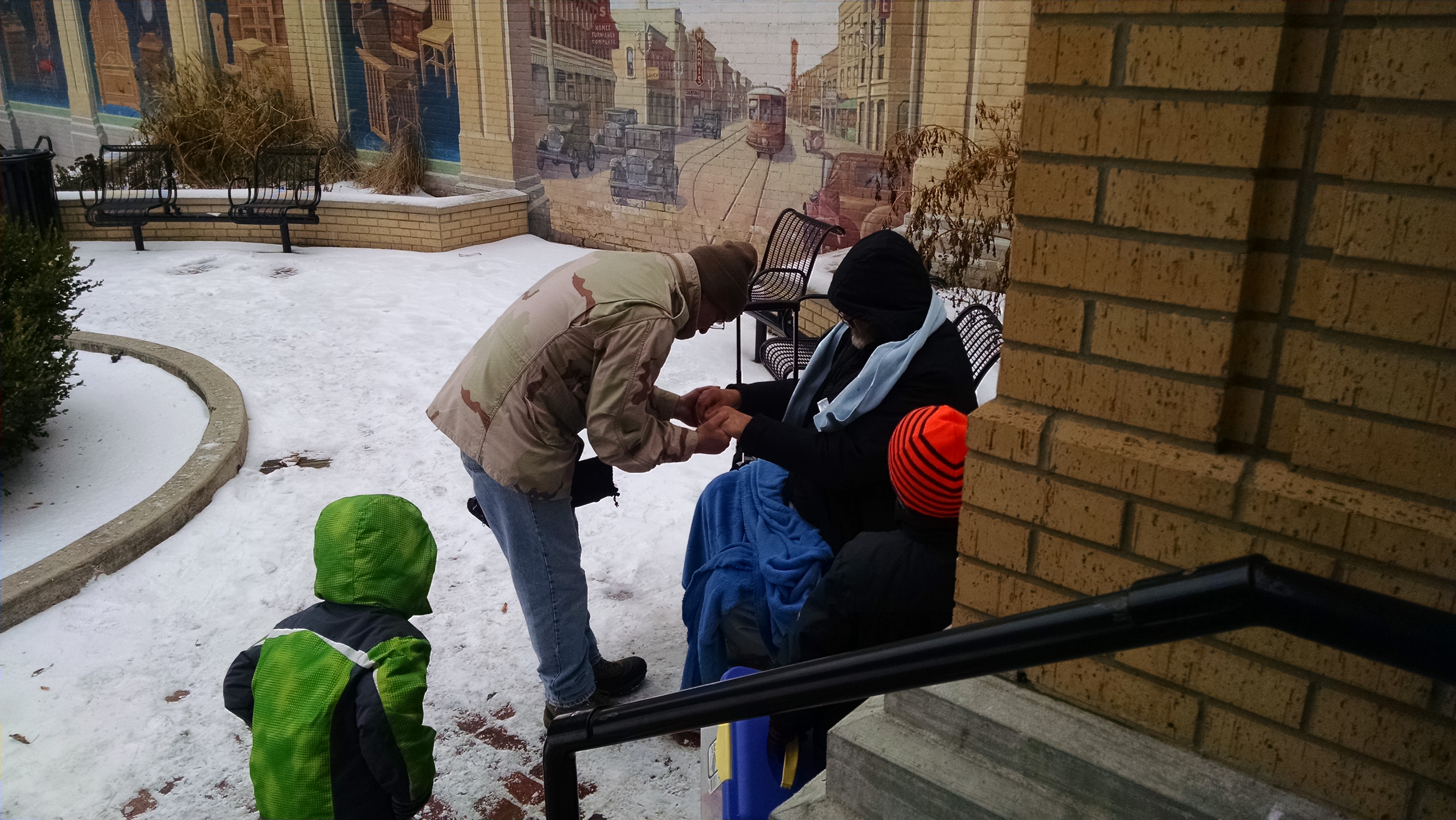
Encampment Of Blessings

I am so proud of our Sunday School class! They don’t just talk about being disciples of Jesus Christ, they live it out daily.

33-Scott & HungarianOn New Year’s Day, they braved the frigid temperatures to minister to needy people in the inner city of Grand Rapids. They are going back again on Saturday, April 23.

You can help in several ways:

  1. Go with them on April 23. They will be leaving 1:00pm.
  2. Donate some items that they will be passing out. You can find a complete list here → Encampment of Blessings
  3. Make a financial donation. If you cannot purchase these items, you may make a financial donation via PayPal on the church’s website. Please write “Encampment” on the memo line.
  4. Help with the organization of all the donated items on Sunday, April 17, right after church.
  5. Pray that God will use this outreach to open doors for these folks to hear and see the love of Jesus.

Jesus said, “For I was hungry and you gave Me something to eat, I was thirsty and you gave Me something to drink, I was a stranger and you invited Me in, I needed clothes and you clothed Me, I was sick and you looked after Me, I was in prison and you came to visit Me. Then the righteous will answer, ‘Lord, when did we see You hungry and feed You, or thirsty and give You something to drink? When did we see You a stranger and invite You in, or needing clothes and clothe you? When did we see You sick or in prison and go to visit You?’ The King will reply, ‘Truly I tell you, whatever you did for one of the least of these brothers and sisters of mine, you did for Me.’” (Matthew 25:35-40)

Did Jesus Rise From The Dead?

4 Ways To Evaluate Biblical Evidence

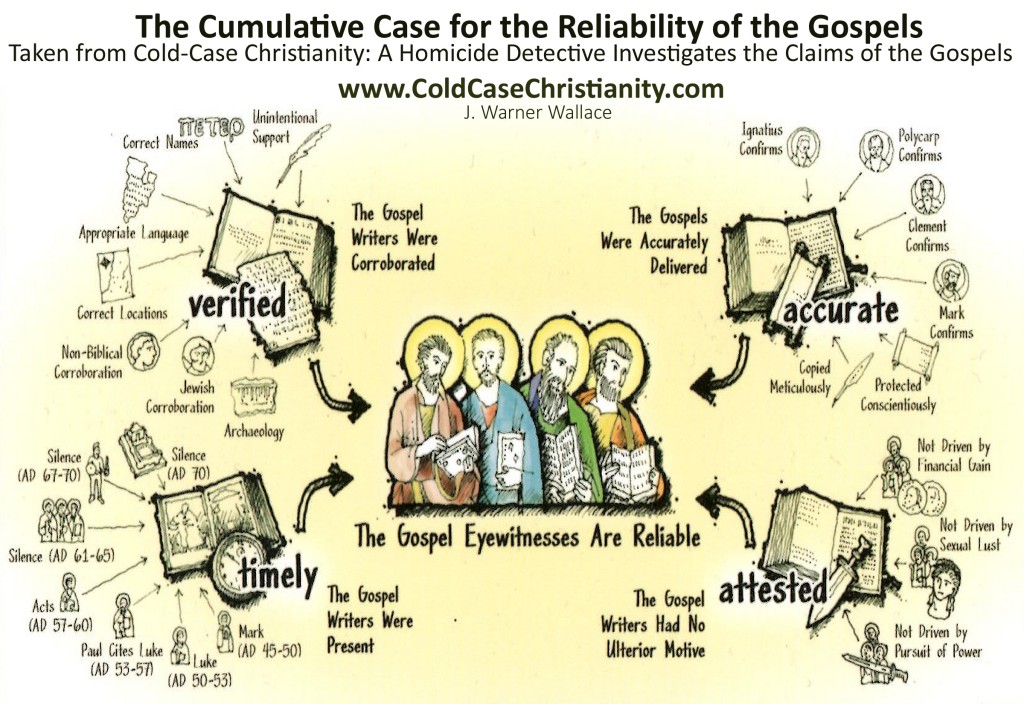
Reliability of the GospelsTo be honest, if someone hasn’t heard the biblical account of the life of Jesus Christ before, it can sound quite fantastic! Jesus was born of a virgin, lived a sinless life, performed miracles no one had seen before, died a horrific martyr’s death, was raised back to life three days later, and then ascended back into heaven until He returns to Earth again.

But as fantastic as this sounds, there is still enough evidence to reasonably believe it’s all true. An unreasonable faith believes in something in spite of the evidence; a blind faith believes in something without any evidence; and reasonable faith believes in something because of the evidence.

The Bible gives us eyewitness testimony about the life of Jesus which we can matter-of-factly evaluate. 

In a modern-day court of law, eyewitness testimony is evaluated on…

  • …the determination that the witnesses were actually present.
  • …the ability to corroborate their testimony.
  • …the consistency of their testimony over time.
  • …any biases they have that would cause them to exaggerate or misrepresent their testimony.

Let’s consider the testimony of the four Gospel writers: Matthew, Mark, Luke and John.

(1) Were The Eyewitnesses Present?

  • Luke is considered a credible historian, even by modern standards. He wrote the book of Acts following the ascension of Jesus into Heaven. Because he did not mention three major events in Jewish history (the Jewish uprising, the Roman siege of Jerusalem in response to that uprising, and the Roman destruction of the temple), we can determine that Acts was written before 61 AD.
  • Luke wrote the Gospel that bears his name before he wrote Acts. The Apostle Paul referenced portions of Luke’s Gospel in letters we can date by Paul’s Roman imprisonment, which means Luke was written prior to 53-57 AD.
  • Luke uses the Gospel of Mark as one of his references, which means Mark was probably written in 45-50 AD, just 10-15 years after the events of Christ’s life.
  • Mark was closely associated with the Apostle Peter, who was most assuredly Mark’s “source” in writing his Gospel, and Peter was one of the original twelve apostles called by Jesus.
  • Matthew and John were both apostles of Jesus, living and working closely with Jesus for over three years.

(2) Is Their Testimony Corroborated?

  • Archeological finds continually demonstrate the accuracy of the people, titles, places and details the Gospel writers mention.
  • Outside—or extra-biblical—sources like Josephus (a Jewish historian who wanted to preserve the purity of Judaism), Tacitus (a Roman historian), and Mara Bar-Serapion (a Syrian historian)—all who wrote between 40-70 AD—affirm things like where Jesus lived, the miracles He performed, the manner of His death, His resurrection, and the changed lives of people who believed in Jesus Christ.
  • In addition, Paul wrote of the “five hundred of the brothers” who were also eyewitnesses to the resurrected Christ (1 Corinthians 15:3-8).

(3) Has Their Testimony Remain Unchanged Over Time?

  • The history and accuracy of the scribes had already been demonstrated in the preservation and transmission of the Old Testament over a period of 1400 years.
  • These same scribal techniques were not only used in the transmission of the New Testament, but in subsequent years the Masoretic scribes became even more meticulous in the techniques they used.
  • The “chain of custody” of evidence can be absolutely traced from the Gospel authors, to their students, and to the writings of the Church Fathers.
  • In fact into the third-century AD, the writings of the Church Fathers contain so many direct quotations from the New Testament, that we can almost completely reconstruct the New Testament from their writings.

(4) Is Their Testimony Unbiased?

  • These eyewitnesses didn’t gain anything financially by their testimony. In fact, many of them lost or gave up all their possessions to tell others about Jesus.
  • They didn’t gain political power or influence that could save their own lives. All of the original apostles (except John) died a gruesome martyrs’ death.
  • In short, they had nothing to gain by making up and reporting a false story about Jesus.

All of these points make it reasonable to believe the evidence presented in the Bible about Jesus Christ is true. Check out this video where I elaborate a little more on each of these points—

If you live in the Cedar Springs area and don’t have a home church, I would love for you to visit with us Easter Sunday morning at 10:30am. We’ll be examining the evidence for Christ’s resurrection from the dead. Click here to get more details.

Why The Cross?

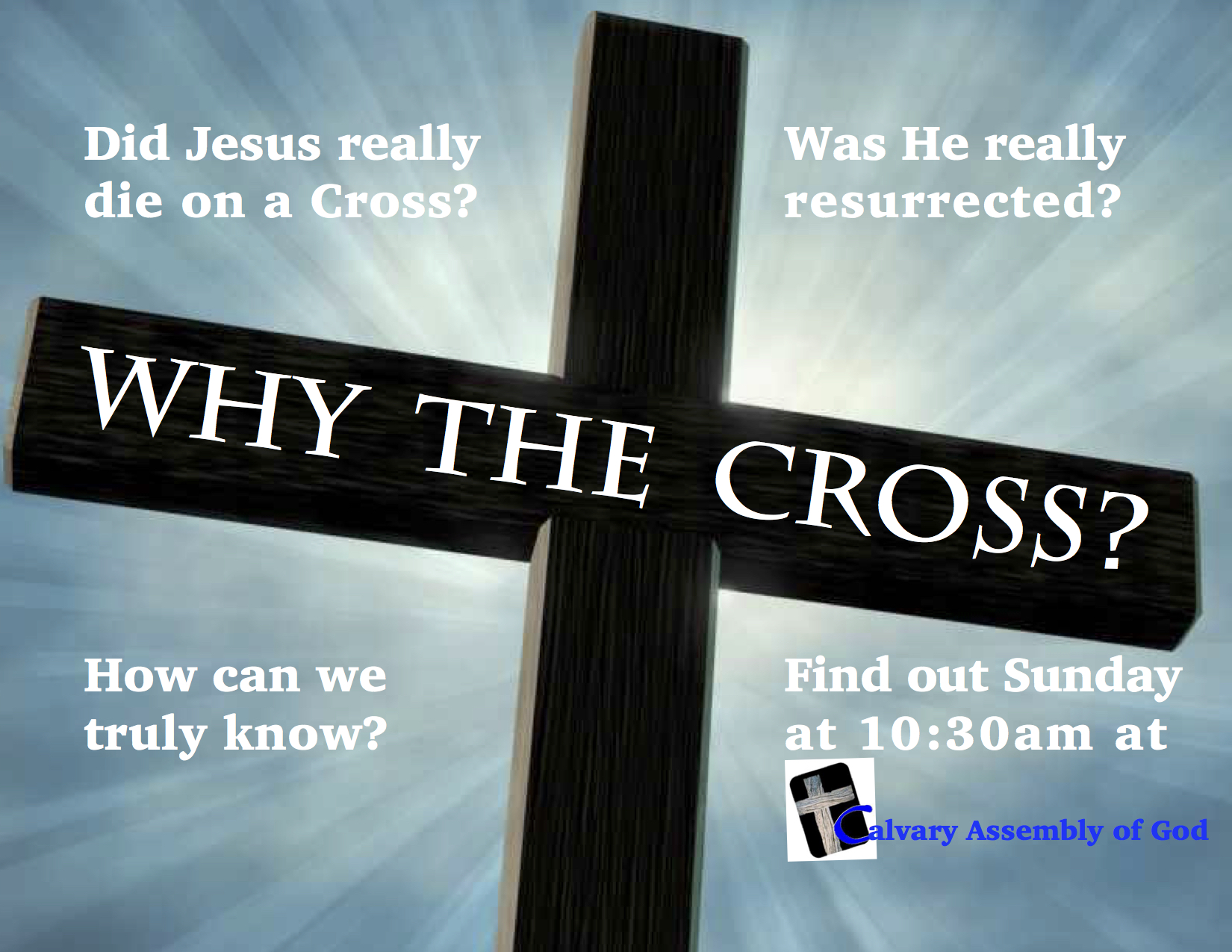
Why The CrossCrucifixion seems so extreme (click here to read The Horrors of Crucifixion)! Why would God allow His Son to go through this?

But perhaps we should back up a step or two. Before asking why the Cross maybe there are some other questions we should explore. Questions like…

  • Did Jesus actually die?
  • Is the account true that Jesus came back to life?
  • How can we know for sure?
  • Is this just too fantastic to believe? Or is the evidence reasonable?

These are questions we must all wrestle with, especially those who call themselves Christians. After all, Christian means a follower of Jesus Christ who believes that Jesus in fact died on a Cross and was raised back to life three days later.

Join me this Sunday was we explore the reliability of the evidence. Then on Easter Sunday morning we will consider the claims that Jesus died and came back to life, as well as the claims that this is all make-believe stuff.

You won’t want to miss this! Click here to find a map to our meeting place. If you cannot join us in person, we will be broadcasting live on Periscope (click here to find the account to follow to be notified when the broadcast begins).

3 Bible Studies For You To Try

Book by book studyLast week I spoke and wrote about some tools you might use to study your Bible. Now I’d like to share some Bible study projects you might try with those new tools. As always, I recommend that beginning Bible studies go verse by verse through the Bible. I believe you will lay a strong foundation for your faith when you systematically put God’s Word into your heart.

Book By Book

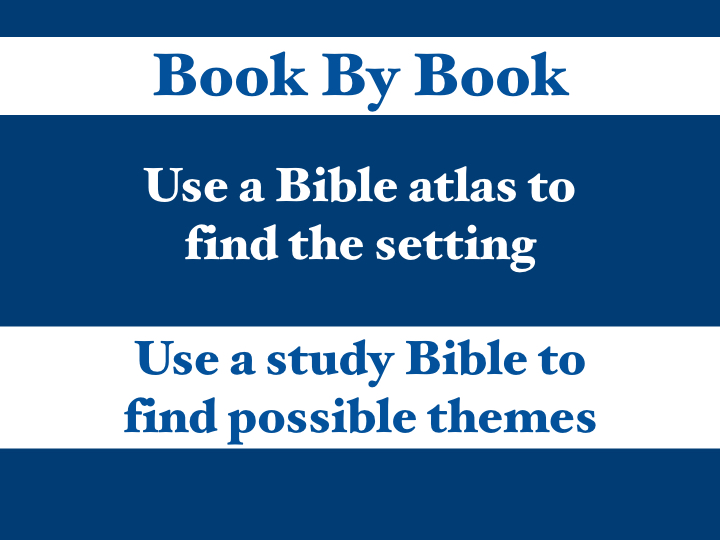
I’ll use the book of Ephesians as an example. Using my Bible atlas I find that the city of Ephesus is located along an important trade route, and it is the Roman capital of the province of Asia. My Full Life Study Bible tells me that because so much trade passed through this city, this letter was probably intended to be a circular letter for all of the communities near Ephesus. As a result, Paul is not addressing any specific problems in this church, but writes theological ideas for a broad spectrum of people.

As I begin reading, I paused in the first verse when I came to the phrase “the faithful in Christ.” I asked myself, “What does it mean to be faithful IN Christ? Can I be faithful outside of Him?” By the time I got to verse 3, I saw a similar phrase: “every spiritual blessing in Christ.” Now I went back and used a blue highlighter (there’s nothing special about blue, it just happened to be the first highlighter I grabbed), and marked those two “in Christ” phrases. I see two more in verse 4: “He chose us in Him” and “holy and blameless in His sight.” Going through the whole book I discovered 36 times the phrases “in Christ” or “in Him.” This is helpful to me to know the kind of security I have in Jesus.

Another thing that stood out to me were Paul’s prayers for the church. I see His very moving prayers in passages like 1:15-19 and in 3:14-21. I also see in 6:18 that he tells us to pray all kinds of prayers for ourselves and for others. And I see in 6:19 that Paul asked the church to pray for him too.

And always look for “therefore” phrases. For example in 4:24-25 or 4:32-5:1. The “therefore” phrases tell us how to live or think in light of the ideas that were just shared.

Chapter By Chapter

A good place to do this is in the Psalms or Proverbs. These are usually stand-alone chapters. When reading the chapters in these two books, I love reading them in parallel with other translations. For example, check out this from Psalm 1.

In Psalm 59, notice the superscript (or introduction). This gives us some background information to the psalm. Using my concordance, I found that this psalm was written this time in David’s life.

There is usually a theme to each chapter of the Proverbs, so try to discover that. In Proverbs 2, I noticed the “if … then” statements. In the first four verses I see things like “IF you will seek wisdom like this,” and then in verses 5-22 I see a whole bunch of blessings that follow the “then” that starts verse 5.

Word By Word

Sometimes I like to go really deep in a passage, so I slow down and look at it word by word. Here you need to use a Strong’s Concordance of the Bible. I like the one available on Blue Letter Bible. For example, next to 2 Peter 1:5, you can hover over the word “Tools” and select “Interlinear.” Clicking on “Interlinear” you will see all of the Greek words that make up this verse. By clicking on the Strong’s number, you can see the definition of that Greek word. Scrolling down a bit, you can see all of the other verses where that Greek word is used in the New Testament.

None of these tools are meant to take the place of the Holy Spirit. He is called the Spirit of Truth, and since He is the One who inspired all of the Scripture, ask His help before you begin any Bible study.

Here are two more Bible studies for you to try.

In this video I go into more detail on how I undertake all of these Bible studies. And be sure to join us next week as we take another look at different types of Bible studies.

8 Must-Have Bible Study Tools

Bonhoeffer - study the BibleIt’s been said that if the only tool a man has in his toolbox is a hammer, he tends to see every problem as a nail. In other words, we try to force every project to be handled in the exactly same way.

Sadly, for many Christians, the same is true with our knowledge of the Bible. If we have limited tools, we try to make every situation look like something we can fix with that smaller toolbox. It’s not enough for us to know only a couple of verses or a few biblical principles, and then try to use those tools to handle all of life’s situations. So let me share some basic tools that will help you expand your biblical toolbox.

Time and cultureThink about how much your culture has changed just in the 70-80 years since your grandparents were born. Think about how wardrobes have changed, and technology, and manners and customs. The earliest book of the Bible was written about 1400 BC, and the most recent book was written about 100 AD. To better understand the things I read in the Bible, here are some tools I like to use:

LanguageEven the English language has changed a lot since William Shakespeare penned his famous plays. But consider that the Bible was written in languages that are even older (not to mention they’re languages other than English!). To really get the full meaning of a passage, here are some tools I use:

Chain of pearls—The Bible is not a collection of isolated, independent stories or concepts, but it is a beautiful string of pearls. Every part connects to the rest of the Scripture. So some resources I use to help me discover how the pearls are strung together include:

What did I miss? What are your favorite Bible study tools? In the comments, please share books, commentaries, or online resources that you use to maximize your study of God’s Word.

This Sunday I’ll be sharing some different styles of Bible studies we can all do. If you live in the Cedar Springs area, please come join a really great group of people at Calvary Assembly of God. Otherwise, watch us on Periscope.

4 Terrible Ways & 4 Great Ways To Study Your Bible

Isaac Newton Bible study.001There are two Greek words in the New Testament that have to do with trying to figure things out. One of them leads to less knowledge, and one opens the way for greater learning. Not surprisingly, Jesus never used the first way, but He confronts people who try to.

The first Greek word is defined as learning through self-calculation. In other words, I try to get at the right answer by either teaching myself, or by talking with people who don’t know any more than I do. This way leaves me in the dark.

For example, notice the phrase “discussed among themselves” in Matthew 16:7 and Mark 11:31. These are people who wanted to try to get answers without going to someone who could teach them. So that leads to four terrible ways to study your Bible—

  1. Approach your Bible with a know-it-all attitude.
  2. Try to figure out what the Bible is saying all on your own.
  3. Try to be your own Bible teacher.
  4. Grade your own tests as to your answers being right or wrong.

These are not only terrible ways to learn, but they are the exact opposite of what God desires. God says things like, “Come, let us reason together” (Isaiah 1:18), and “Call to Me and I will tell you things you do not know” (Jeremiah 33:3).

There is another Greek word which means to learn by having a conversation with someone more knowledgable than myself. So that means four great ways to study your Bible are—

  1. Ask the Holy Spirit to illuminate Scripture to you (John 16:13).
  2. Study the Bible in a daily systematic way (Acts 19:9).
  3. Don’t take anyone else’s word for what the Word says (Acts 17:11).
  4. If you’re confused, ask God to make it clear to you (Jeremiah 33:3).

Luke records an important story for us that took place on the day Jesus was raised from the dead. Two men were walking along “discussing these things with each other,” but not consulting the Scriptures. The result: they were sad and confused. Jesus join them on their journey (although they didn’t recognize Him at first), and took them to the Scriptures that showed them the answers for which they were yearning. They even said, “When He talked to us from the Scriptures, that’s when our hearts burned within us!” (see Luke 24:13-32).

You can try to figure life out on your own, and you will probably end up stymied like the religious leaders in Mark 11, or downcast like the disciples in Luke 24. Or you can ask the Holy Spirit to show you truths from the Scriptures, and have your eyes opened, like the two disciples after Jesus met with them. I think the choice is obvious!

Join me next week as we continue our series How To Study Your Bible.

4 Reasons To Study Your Bible

Commitment to readYou probably hear Christians say quite frequently, “You should read your Bible.” But one thing you may not hear as often is why you should read your Bible. There are probably many more reasons, but here are four reasons why I believe reading your Bible should be a daily part of your life.

(1) To help spot errors.

When the devil tempted Jesus, it is noteworthy that Jesus didn’t try to use logic, or persuasion, or even willpower. Every temptation was blocked by Jesus saying, “It is written” as He quoted Scripture.

In the second temptation, the devil tried the same tactic. He, too, quoted a couple of verses from the Psalms, but he took them out of their context. So notice Christ’s reply, “It is also written” (Matthew 4:7). The best way to spot error is to know the full counsel of God’s Word. This tactic the devil tried with Jesus wasn’t something new, but it was something he used on the very first humans: “Did God really say…” (Genesis 3:1), and he will try it again on you!

(2) To clarify your emotions.

Most of us allow our emotions to control our actions. Or sometimes we wrestle with, “My heart says one thing, but my head says something else!” In this tug-of-war, we allow our emotions to determine our beliefs, and then our beliefs determine our actions. This is not only dangerous, but it is contrary to what the Bible teaches.

The healthy way to respond is by fully knowing what we believe, and then acting according to our beliefs. Our proper emotional response will then follow those actions.

Look at the example of Jesus in John 2:13-16. He was ticked off at how people were misusing His Father’s house, and He did some serious house cleaning! Just reading those four verses, you may get the idea that Christ’s emotions carried Him away. But check out verse 17, in which we see He was acting in accordance to His beliefs, which were fully grounded in Scripture.

(3) To know prophesy.

All of the Scriptures point to Jesus, so all of the Scriptures are illuminated by Christ (Luke 24:27, 45). If you want to know what is happening in our world, turn to the pages of Scripture and see how Jesus is revealed. This will help you put even current events into perspective.

(4) To give sound answers.

When people need help, I want to be able to give them real answers. Not my opinion, but truth that they can apply. The Apostle Peter told us to always be prepared to give people an answer that is based on our knowledge of Jesus (1 Peter 3:15).

“Beware of saying, ‘I haven’t time to read the Bible, or to pray’; say rather, ‘I haven’t disciplined myself to do these things.’” —Oswald Chambers

Can I challenge you to do something I challenged my whole church to do … Make a commitment to read the Bible every day for the next seven days. See what happens as God meets with you, and reveals Himself and His wisdom to you, every day.

We’ll be learning some Bible study strategies next Sunday, and I invite you to join us.

How To Study Your Bible

How To Study Your BibleMaybe first we should ask, “Why should we study the Bible?” Many people loudly proclaim, “All that is needed for salvation is faith in Jesus.” This is correct, but remember this—Faith [for salvation] comes from hearing the message, and the message is heard through the Word of Christ (Romans 10:17).

Then after our faith in Jesus brings us the forgiveness for our sins, there is an ongoing process of walking out our faith, something the Bible calls sanctification. Here again the Bible plays a vital role. Jesus prayed for His followers this way: Sanctify them by the truth; Your Word is truth (John 17:17).

The bottom line … Our Christian walk is nearly impossible to maintain without the resources found in the Scriptures! 

But the Bible is a large book, and many people don’t know where or how to begin to study it. That’s why we are taking the time to learn together some practical ideas for studying God’s Word.

Please join us at Calvary Assembly of God over the next few weeks as we learn the practices which will help us make the most of our time studying the Bible. If you cannot join us in person, we will be broadcasting all of our messages live on Periscope (follow @craigtowens to be notified when the broadcasts begin).

If you are ready to take your Bible study to a new level, please join us beginning this Sunday!