Is Love Touchy-Feely?

mowt-loveOne of my greatest joys is investing in people, and then watching them develop their God-given gifts. One such man is my friend Scott Troost.

I began a series at the beginning of the month talking about things I have come to appreciate, and I asked a couple of my friends to join with me. Last week Josh Schram shared his appreciation with wise counsel, and this week Scott shared what he’s come to appreciate about love.

Is “puppy love” real love? Is love even supposed to have a feeling? If there are no feelings associated with love, how can you know that you are indeed loving? Scott shares his personal journey on what he’s come to appreciate about love, and I sincerely hope you will watch this video of his message…

Links & Quotes

link quote

“People most affected by fear are those who hang around negative people. If you’re going to control the negative thoughts in your life, you’ve got to get away from negative people as much as you can.” —Rick Warren

“Liberty cannot be established without morality, nor morality without faith.” —Horace Greeley

“It’s natural enough in our species, as in others, that the young birds should show off their plumage—in the mating season. But the trouble in the modern world is that there’s a tendency to rush all the birds on to that age as soon as possible and then keep them there as late as possible, thus losing all the real value of the other parts of life in a senseless, pitiful attempt to prolong what, after all, is neither its wisest, its happiest, or most innocent period. I suspect merely commercial motives are behind it all: for it is at the showing-off age that birds of both sexes have least sales resistance!” —C.S. Lewis

“Don’t make a decision, large or small, without sitting before God with an open Bible, an open heart, and open ears. Philippians 2:13 says, ‘God is working in you to help you want to do and be able to do what pleases Him.’” —Max Lucado

“Strange as it may seem, one of the primary purposes of being shaken by suffering is to make our faith more unshakable. Faith is like muscle tissue: if you stress it to the limit, it gets stronger, not weaker. That’s what James means here [James 1:2-3]. When your faith is threatened and tested and stretched to the breaking point, the result is greater capacity to endure. … If you think your suffering is pointless, or that God is not in control, or that He is whimsical or cruel, then your suffering will drive you from God, instead of driving you from everything but God—as it should. So it is crucial that faith in God’s grace includes the faith that He gives grace through suffering.” —John Piper

“The promise, made when I am in love and because I am in love, to be true to the beloved as long as I live, commits me to being true even if I cease to be in love. A promise must be about things that I can do, about actions: no one can promise to go on feeling in a certain way. He might as well promise never to have a headache or always to feel hungry.” —C.S. Lewis

“It’s the lives of the saints, not the arguments of the theologians and philosophers, that covert people.” — Pope Benedict XVI

C.S. Lewis On Agape

C.S. Lewis“Of course taking in the poor illegitimate child is ‘charity.’ Charity means love. It is called Agape in the New Testament to distinguish it from Eros (sexual love), Storgë (family affection) and Philia (friendship). So there are 4 kinds of ‘love,’ all good in their proper place, but Agape is the best because it is the kind God has for us and is good in all circumstances. There are people I mustn’t feel Eros towards, and people I can’t feel Storgë or Philia for; but I can practice Agape to God, Angels, Man and Beast, to the good and the bad, the old and the young, the far and the near. You see Agape is all giving, not getting. Read what St. Paul says about it in First Corinthians Chap. 13. Then look at a picture of Charity (or Agape) in action in St. Luke, chap 10 v. 30-35. And then, better still, look at Matthew chap 25 v. 31-46: from which you see that Christ counts all that you do for this baby exactly as if you had done it for Him when He was a baby in the manger at Bethlehem: you are in a sense sharing in the things His mother did for Him. Giving money is only one way of showing charity: to give time and toil is far better and (for most of us) harder. And notice, though it is all giving—you needn’t expect any reward—how you do gets rewarded almost at once.” ―C.S. Lewis

Weekend Quotes

“quotes”

Some challenging quotes from this weekend:

“A wise man will make haste to forgive, because he knows the true value of time, and will not suffer it to pass away in unnecessary pain.”  —Samuel Johnson

“The noblest revenge is to forgive.” —Thomas Fuller

“Being deeply loved by someone gives you strength, while loving someone deeply gives you courage.” —Lao-tzu

“Love keeps no records of wrongs. … It always protects, always trusts, always hopes, always perseveres.” —Apostle Paul (1 Corinthians 13:6-7)

And for my pastor friends: “There will always be new ways to do good works and speak good words which are not presently in our experience or repertoire. So in all our studies, let us study to acquire new insights and visions of how we can serve others through good works. And in all our teaching and preaching, let us not grow negligent in exhorting the people of God to do likewise.” —T.M. Moore

Ian & Larissa

I first became aware of this amazing love story two years ago, and this story has continued to astound me! I am so excited to hear about the book that will be coming out soon. In the meantime, you can keep up with Ian & Larissa Murphy by checking out their blog, and you can help pay for Ian’s physical therapy by buying one of his paintings.

Links & Quotes

link quote

These are links to articles and quotes I found interesting today.

[VIDEO] Great challenge from John Maxwell about being our best.

It doesn’t matter what you do … Your Job Is More Important Than You Think.

“You see Agape is all giving, not getting. Read what St. Paul says about it in First Corinthians Chap. 13. Then look at a picture of Charity (or Agape) in action in St. Luke, chap 10 v.30-35. And then, better still, look at Matthew chap 25 v.31-46: from which you see that Christ counts all that you do for this baby exactly as if you had done it for Him when He was a baby in the manger at Bethlehem: you are in a sense sharing in the things His mother did for Him. Giving money is only one way of showing charity: to give time and toil is far better and (for most of us) harder. And notice, though it is all giving—you needn’t expect any reward—how you do gets rewarded almost at once.” —C.S. Lewis

Parents and teachers, this is good advice from Tim Elmore on working with ‘difficult’ students: How To Lead An Outlier.

David Wilkerson has a solid word for those in a difficult marriage: Is There Any Hope?

John Stonestreet addresses Generation XXX: Responding To Our Pornified Culture.

Don’t let him get away with it! How Harry Reid Is Trying To End Debate In The Senate.

Love Is… (part 3)

Love Is… worsheet 3True love—or the Greek word agape—is a hard-working verb. It’s not mushy. It’s not puppy love. It’s not even romantic. It’s a love that is determined to love another no matter what! It’s the kind of love God extended toward us when we weren’t doing anything worthy of His love, and it’s the kind of love Jesus told we as us His disciples would be known for.

We just wrapped up a series called Loving The Unloveable where we explored what the Bible says about how we are to live out this agape love, especially to those who seem “unloveable.” We went through a list of 15 facets of this love spelled out in 1 Corinthians 13.

You can read about the first five facets by clicking here.

You can read about the second set of attributes by clicking here.

Here are the final five—

Love is protecting

  • The King James Version says love bears all things. So we need to ask, “What does love bear?”
  • The Greek word means: “protecting by covering with silence.”
  • In other words, we bear with the insults of an unloveable/unloving person by refusing to talk about them in a negative way.
  • Agape doesn’t talk about people (unless it’s a conversation with God); agape only talks lovingly to people. Agape protects their reputation.

Love is trusting

  • Love has a high confidence in success. Not my success, but God’s success. So we keep believing for a breakthrough; keep trusting God to accomplish something; keep doing our part in pointing out the best (or the best that is yet to be) in others.

Love is hopeful 

  • The Amplified Bible says: love’s hopes are fadeless under all circumstances.
  • So we work now, but we are always looking forward to the future with joy and full confidence.
  • Think about a farmer: After he plants the seed, he doesn’t see it any more. But his outlook remains hopeful. So he waters a seed he cannot see. He fertilizes a seed he cannot see. He works the ground for a seed he cannot see.
  • Our acts of love may be planting a seed, or fertilizing, or watering. Every part is vital; no part can be skipped. And we remain hopeful of a harvest.
  • Let us not become weary in doing good, for at the proper time we will reap a harvest if we do not give up. (Galatians 6:9)

Love is persevering

  • I love the Greek definition: “enduring through every circumstance without ever weakening.”
  • Never let your love waver. Keep on being patient, and kind, and forgiving, and all of the other characteristics of agape listed in 1 Corinthians 13. All of them are irreplaceable and effective! 

Love is maturing

  • Love continues to grow up.
  • Agape is creative, never stagnant or stuck in a rut. Agape finds new ways to express itself.

Here’s where the real test comes in: How will you apply these attributes of love to someone in your life? More specifically: to someone you think is “unloveable”?

I know you have someone in your life that you think is unloveable. With that person’s face clearly in mind, how will you fill in the blanks:

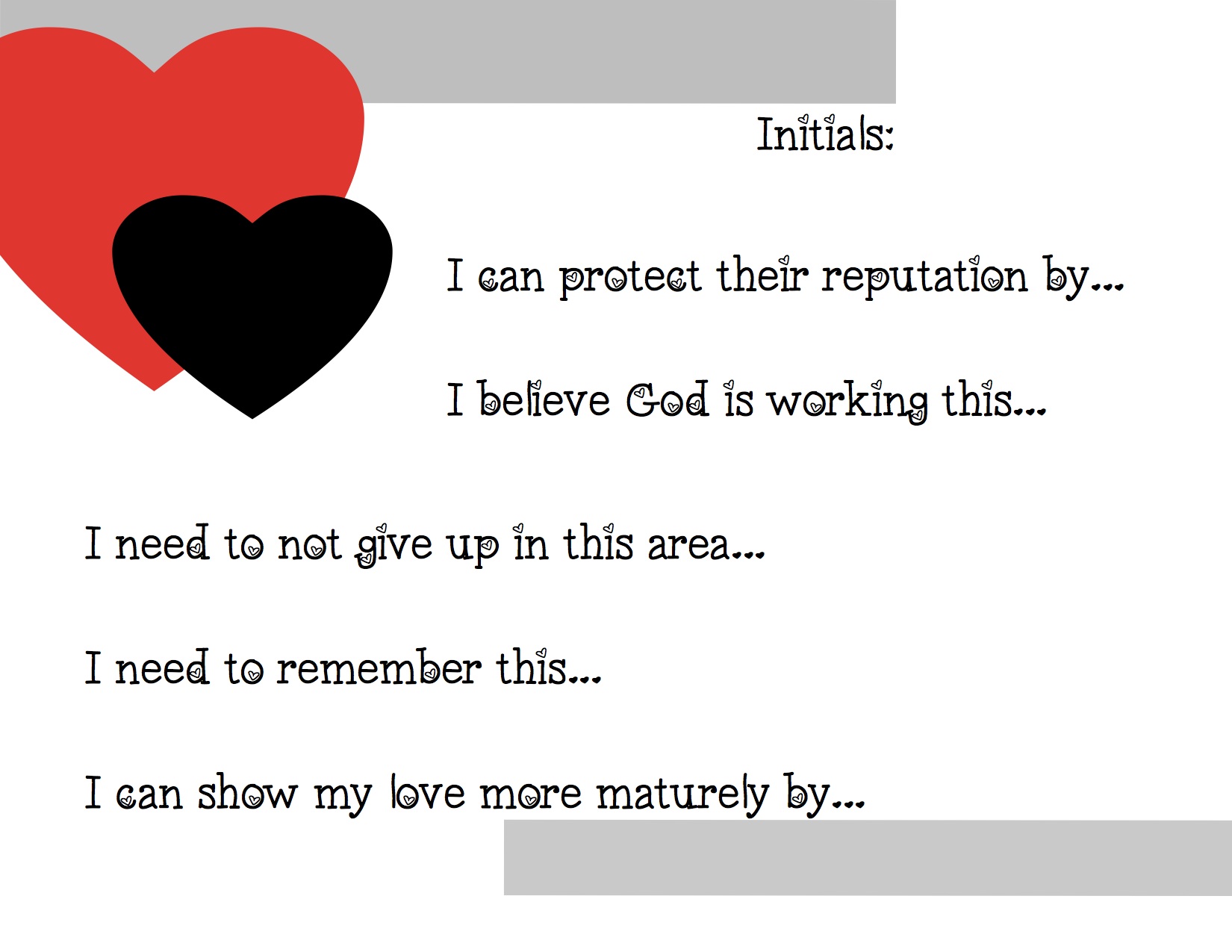
  1. I can protect their reputation by…
  2. I believe God is working in this…
  3. I need to not give up in this area…
  4. I must remember this…
  5. I can how my love more maturely by…

If you would like a downloadable PDF of this worksheet, click here -–> Love Is… worsheet 3

If you would like to download the other worksheets, or if you missed any of the messages in our Loving the Unlovable series, you can check them all our here.

They All Agree

It’s extremely rare that a 19th-century pastor, Jesus Christ, and a noted atheist would all agree on something. But as we wrapped up our series on love today, I had to share these quotes (the added emphasis in the quotes is mine)—

“Never offer men a thimbleful of gospel. Do not offer them merely joy, or merely peace, or merely rest, or merely safety; tell them how Christ came to give men a more abundant life than they have, a life abundant in love, and therefore abundant in salvation for themselves, and large in enterprise for the alleviation and redemption of the world. … Only this fuller love can compete with the love of the world.” —Henry Drummond

“If you love only those who love you, why should you get credit for that? Even sinners love those who love them! And if you do good only to those who do good to you, why should you get credit? Even sinners do that much! … By this all men will know that you are My disciples, if you truly love one another.—Jesus (Luke 6:32-33; John 13:35)

“Nothing can penetrate the loneliness of the human heart except the highest intensity of the sort of love the religious teachers have preached.” —Bertrand Russell

Love Is… (part 2)

Love is… worksheet 2We are taking a practical look at the incredible definition of love in 1 Corinthians 13. We’re doing this in the context of learning how to love the “unloveable”—or maybe I should say, loving those who are the most resistant to real love. If we can show them love, how much more will the love of Jesus be seen!

All of these verbs are present tense verbs. That means they aren’t exhausted in the past, and they aren’t waiting for future conditions to improve—they are in operation NOW.

Far too many people know Christians more by what we’re against than by what we’re for. So where the biblical text say “love does not” or “love isn’t,” I’ve changed it into the positive “love is.”

You can read about the first five attributes love love by clicking here.

The next five attributes are:

Love is graceful

  • The root word means something that should be covered up, or something we’re ashamed of. Because our words and actions are graceful, they are things we wouldn’t have to defend, or explain, or apologize for later. They are words and actions that wouldn’t embarrass us.
  • Agape will do nothing that misbecomes it.” —Matthew Henry

Love knows our relationship > my rights

  • True love “does not demand its own way” (New Living Translation) nor does it “insist on its own rights” (Amplified Bible). Instead it always seeks ways that the relationship can be repaired or enhanced, even if that means giving up something I consider to be “my right.”
  • NOTE: I’m not saying that you become a doormat. This is not a license for someone to abuse you, but it is a call for us to balance our responses. Romans 12:18 says as far as it depends on you, live at peace with everyone.
  • Here are some great balancing verses. Balance Proverbs 26:4-5 (here is a video where I expand on this idea), and then balance Philippians 2:3-4.

Love is even-tempered

  • The Amplified Bible says it well: love is not touchy or fretful or resentful.
  • This Greek word means not getting stirred up or exasperated. So we need to lighten up!
  • There are some places where we’ve become too sensitive, too touchy, too short-fused. The fire of hurt has replaced the fire of love. So Matthew Henry advises us: “Where the fire of love is kept in, the flames of wrath will not easily kindle, nor long keep burning.”

Love is forgiving

  • The New International Version says love keeps no record of wrongs.
  • This Greek phrase speaks of an accountant tallying up the hurts (where there is an overdrawn account), seeing there is a debt to be paid back, and then appointing himself as the bill collector. True love cancels those IOUs.
  • We don’t forgive others because they deserve forgiveness, but we forgive others because we received forgiveness from God that we did not deserve!
  • For if you forgive people their trespasses [their reckless and willful sins, leaving them, letting them go, and giving up resentment], your heavenly Father will also forgive you. (Matthew 6:14 AMP)

Love is God-honoring

  • Agape loves what God loves and hates what God hates.
  • Agape loves when people find God’s truth, and hates anything that blocks that pursuit.
  • Agape loves the sinner and hates the sin.
  • “The sins of others are the grief of an agape spirit [not] its sport or delight; they will touch it to the quick….” —Matthew Henry

Here’s where the real test comes in: How will you apply these attributes of love to someone in your life? More specifically: to someone you think is “unloveable”?

I know you have someone in your life that you think is unloveable. With that person’s face clearly in mind, how will you fill in the blanks:

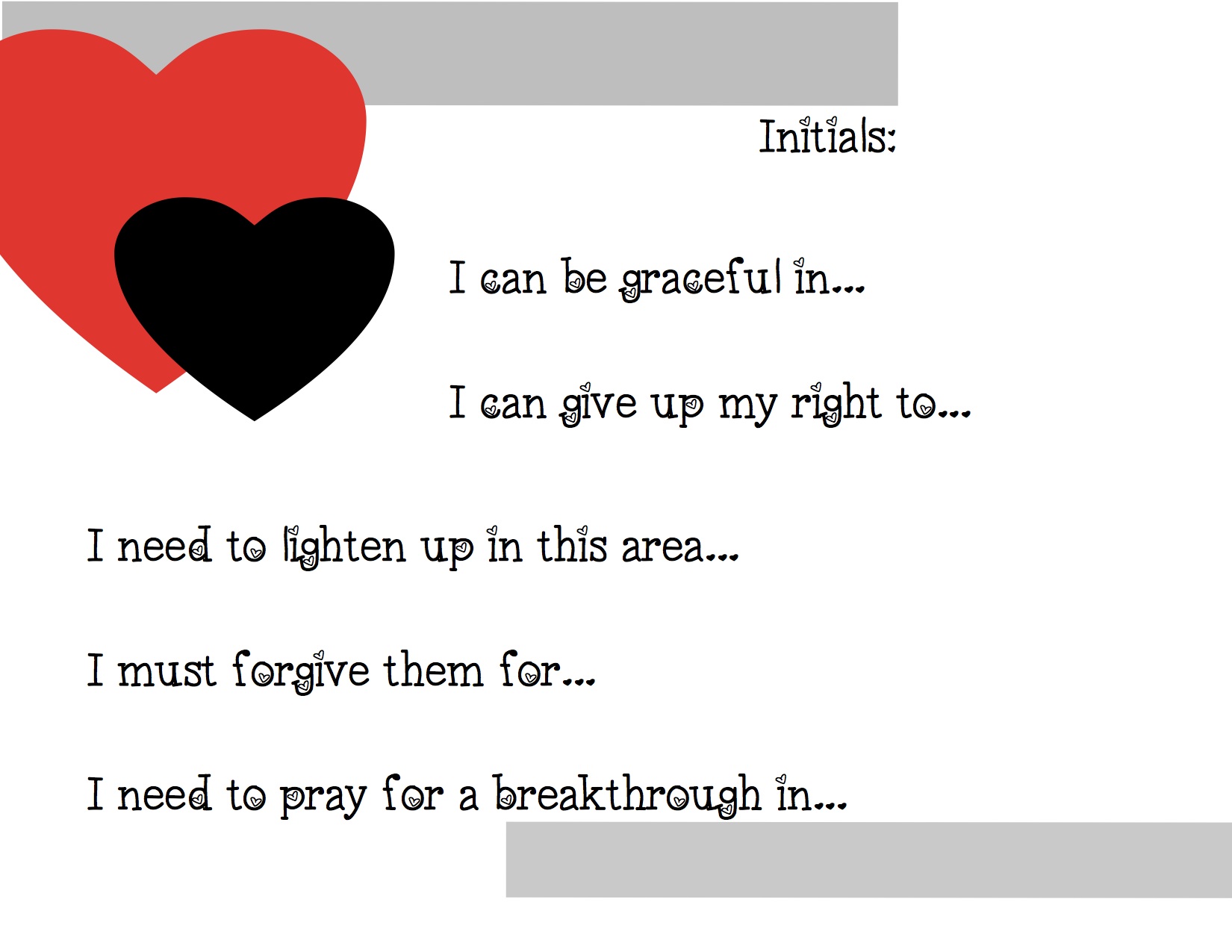
  1. I can be graceful in…
  2. I can give up my right to…
  3. I need to lighten up in this area…
  4. I must forgive them for…
  5. I need to pray for a breakthrough in…

If you would like a downloadable PDF of this worksheet, click here –> Love is… worksheet 2

If you missed any of the messages in our Loving the Unlovable series, you can check them all our here.

Beautiful

Plumb beautifulLove is not an emotion. Real love is a commitment. Real love discovers beauty in another that they couldn’t even see themselves.

Guys, this song from Plumb is written from a woman’s perspective; it’s what she wants you to see in her. Valentine’s Day is a great day to start discovering, appreciating and celebrating the beauty in her… but don’t let it stop there. Let it become more beautiful every day!