Do It Again, Pastor!

Monday morning is one of my favorite times. I reflect back on the great things God did in our service the day before, and I look ahead with anticipation to what He is going to do in this next Sunday. If I look at this here-comes-Sunday-again cycle through merely human eyes, it can appear quite overwhelming. But God has called me to do this, and He energizes me by His Holy Spirit.

I love these words from Pastor James MacDonald—

“Only a pastor who preaches biblically for the glory of Jesus and the feeding of souls, week after week, can understand that pressure. It’s like finals week in college—but it happens every week. Explaining a Bible passage is child’s play compared to digging out a word from the Word about the WORD for your people.

“Can you give your best to it again, Pastor? Can you breathe on a passage of Scripture that is now unfamiliar, until it bursts into flame by the faithful ministry of the Holy Spirit in response to your hard work? Can you stoke that fire until it is bursting within you to be proclaimed as the ‘Bread of Life’?

“Yes, you can—and when you have, you will be exhausted but deeply satisfied in what God will do in and through you as a result. And you will count the days until you GET to do it again.”

Pastor, you can do it again! Doing God’s will, preaching His Word, should be your greatest joy and your greatest source of strength. This is why I don’t like to take Monday as my day off: I get so much more nourishment and refreshment from my time in God’s presence on Monday morning than I would get anywhere else.

Meanwhile [Jesus’] disciples urged Him, “Rabbi, eat something.” But He said to them, “I have food to eat that you know nothing about.” Then His disciples said to each other, “Could someone have brought Him food?”

“My food,” said Jesus, “is to do the will of Him who sent Me and to finish His work.”

(John 4:31-34)
What Does It Mean To Fear God?

Fear GodWhat does it mean to fear God? Does it mean we cower before Him? That He is utterly unapproachable? Or maybe it means we’re always looking over our shoulder wondering if God is coming after us in anger?

Let me ask the question another way:

  • Are you afraid that you won’t buy the right Christmas gift for someone?
  • Are you afraid that you’ll forget someone?
  • Are you afraid that your response won’t be right when you open a gift?
  • Are you afraid you’ll offend a family member by something you say or do?
  • Do other people’s opinion of you factor into your decisions?

If you answered “Yes” to the above questions, you have a fear problem. That is: you fear letting other people down.

I think this was the issue for Joseph in the Bible (Matthew 1:18-25). When he found out that Mary was pregnant before their marriage, Joseph carefully deliberated his response. Based on the meaning of the words had in mind and considered, and examining the way the angel told Joseph to “Fear not,” it appears that Joseph, too, lived in this same fear of letting others down.

But here’s the issue: Joseph placed greater value on people’s opinions than he did on God’s opinion. And what makes it even worse is that Joseph simply assumed what people would say about him, as he never actually asked anyone.

The angel challenged Joseph to re-evaluate his value system. To give greater weight to God’s opinion than to man’s opinion. In short, to change his fear of man to fear of God.

That’s really what it means to fear God: To give greater weight to His Word and His opinion than to anyone or anything else.

The wise king Solomon explored everything he could to find the meaning of life. He tried money, education, art, travel, women, food, power, and the like. At the end of his exploration, he came to this conclusion—

Now all has been heard; here is the conclusion of the matter: Fear God and keep His commandments, for this is the whole duty of man. (Ecclesiastes 12:13).

We should be living for the approval of an Audience of One. 

We should be longing to hear, “Well done, good and faithful servant” from our Creator. 

We should be listening only for the applause from nail-scarred Hands. 

“The remarkable thing about fearing God is that when you fear God you fear nothing else, whereas if you do not fear God you fear everything else.” —Oswald Chambers

If you have missed any of the messages in our Fear Not! series, you can find them all by clicking here.

You Need “Grey Heads”

Tim DilenaI know that all of us can benefit from an older, wiser person speaking into our lives, but I am especially concerned about pastors. Too many times pastors are seen by others as the “go-to guy” for anyone who needs help, and we pastors begin to believe that we don’t need to go to anyone else for help.

This is a dangerous attitude of pride!

Check out this short 4-minute teaching from my friend Rev. Tim Dilena about the value of “grey heads” in our lives—

My fellow pastor, humble yourself and accept the help of a wise mentor. It will not only enhance your ministry, it could literally save your ministry from crumbling.

The Heavy Responsibility of Shepherding

My dear pastor, our task is not an easy one. It is one of heavy responsibility: Caring for God’s sheep.

They are God’s sheep. They are not your sheep or my sheep. But you and I have been given the stewardship care of God’s precious lambs.

I hope these words God spoken through the prophet Ezekiel don’t describe you. But may all of us pastors take them as a sober reminder of the weightiness of our role as the under-shepherds of God’s flocks…

Then this message came to me from the Lord: “Son of man, prophesy against the shepherds, the leaders of Israel. Give them this message from the Sovereign Lord: What sorrow awaits you shepherds who feed yourselves instead of your flocks. Shouldn’t shepherds feed their sheep? You drink the milk, wear the wool, and butcher the best animals, but you let your flocks starve. You have not taken care of the weak. You have not tended the sick or bound up the injured. You have not gone looking for those who have wandered away and are lost. Instead, you have ruled them with harshness and cruelty. So My sheep have been scattered without a shepherd, and they are easy prey for any wild animal. They have wandered through all the mountains and all the hills, across the face of the earth, yet no one has gone to search for them.

“Therefore, you shepherds, hear the word of the Lord: As surely as I live, says the Sovereign Lord, you abandoned My flock and left them to be attacked by every wild animal. And though you were My shepherds, you didn’t search for My sheep when they were lost. You took care of yourselves and left the sheep to starve. Therefore, you shepherds, hear the word of the Lord. This is what the Sovereign Lord says: I now consider these shepherds My enemies, and I will hold them responsible for what has happened to My flock. I will take away their right to feed the flock, and I will stop them from feeding themselves. I will rescue My flock from their mouths; the sheep will no longer be their prey.” (Ezekiel 34:1-10)

UPDATE: This post was one of the seed thoughts that went into fashioning my book Shepherd Leadership: The Metrics That Really Matter.

Thursdays With Oswald—The Etceteras

This is a weekly series with things I’m reading and pondering from Oswald Chambers. You can read the original seed thought here, or type “Thursdays With Oswald” in the search box to read more entries.

The Etceteras 

     Do you regard yourself as a highly respectable, dignified Christian? Are you religiously self-important, placing yourself where you fancy you ought to be placed, in stately surroundings? If so, you are not following Jesus Christ’s example. 

     If you cannot do ordinary things and live as nobody anywhere, you are not a saint. Jesus left Heaven and lived nowhere of any importance all His earthly life. There is a religiosity that is inspired by the devil, that gathers its skirts around it and says, “No, I cannot be in ordinary places, or in ordinary avocations; I am a servant of God.” Then you will be found nowhere but in the very commonest of common places.

     You say you are called to be a missionary, a minister, a Christian worker: you are called to be a disciple of Jesus Christ, other things are etceteras. 

From God’s Workmanship 

I can think of only one reasonable response to this: I need to go look in the mirror and ask the Holy Spirit to show me where I’ve been more focused on the etceteras than I have on being a disciple of Jesus Christ.

Labor Of Love

Labor of loveGod is not unjust; He will not forget your work and the love you have shown Him as you have helped His people and continue to help them. (Hebrews 6:10)

I don’t work for God’s blessings. I work for God because He has already blessed me! My labor is a labor of love and gratitude!

How do I show I love God?

I help others.

Not just once, but continually. In the next two verses the writer of Hebrews goes on to say that my labor of love should be:

  • Diligent
  • Sincere
  • For as long as I’m alive
  • Without any laziness
  • Through faith
  • With patience

No coasting. No waiting for others to serve me first. No slacking.

God has blessed me so that I can be a blessing to others. This is how I show my gratitude for the blessings of God I have been given—

HARD WORKING LOVE

For those who have been loved by God there’s no other way to live and love.

Learning To Stop Complaining

A.W. Tozer“The heart’s fierce effort to protect itself from every slight, to shield its touchy honor from the bad opinion of friend and enemy, will never let the mind have rest. Remember that always the greatest Christians have come out of hard times and tough situations. Tribulations actually worked for their spiritual perfection in that they taught them to trust not in themselves but in the Lord who raised the dead. They learned that the enemy could not block their progress unless they surrendered to the urgings of the flesh and began to complain. And slowly, they learned to stop complaining and start praising. It is that simple—and it works.” —A.W. Tozer

The End?

Listen to the podcast of this post by clicking on the player below, and you can also subscribe on Apple, Spotify, or Audible.

When Jesus was arrested, almost all of His disciples ran away. Peter, however, stayed somewhat close to Jesus, but not for the reason I originally thought.

Meanwhile, Peter followed Him at a distance and came to the high priest’s courtyard. He went in and sat with the guards and waited to see how it would all end. (Matthew 26:58 NLT)

Peter waited to see how it would all end.

Peter thought, “This is the end, roll the credits, turn out the lights, we can all go home now.”

When we think we can figure out how it will all end, our faith is too small. It’s not our story—it’s HIS story. And God’s story never ends for those who love Him. Their story is a perpetual, never-ending love story that gets better and better as eternity rolls on!!

Don’t put a period where God hasn’t put one. Don’t look for how it’s going to end. If you are a follower of God, you have His eternal life. That means the story never ends. It goes on and on and on and on….

Trust in the Lord always, for the Lord God is the eternal Rock. (Isaiah 26:4)

►► Would you please prayerfully consider supporting this ministry? My Patreon supporters get behind-the-scenes access to exclusive materials. Like this exceptional Bible study tool to help with Creation apologetics. ◀︎◀︎

Are You Worthy Of God’s Favor?

Listen to the podcast of this post by clicking on the player below, and you can also subscribe on Apple, Spotify, or Audible. 

Today some call her “the holy mother” and revere her as a saint. But 2000 years ago, Mary saw herself as only an ordinary, faceless, fame-less, Israelite girl.

  • She came from Nazareth (a town of which people said, “Can anything good come from Nazareth?!”)
  • Nazareth was in the region of Galilee (an area of which people said, “No one special has ever come from Galilee”)
  • She was pledged to be married (probably a marriage that she had no say in)
  • And she was a young teenager

What did Mary think of herself? We can infer her self-image from what went on her mind when God’s angel greeted her with the words, “Greetings, you who are highly favored! The Lord is with you.”

She was greatly troubled and wondered what kind of greeting this might be. Psychologists today would describe Mary’s response as inner dissonance—the feeling that something is not quite right, but she couldn’t put her finger on exactly what was wrong. The phrase greatly troubled is a single Greek word which means agitated and perplexed by doubts.

In short: the way the angel greeted Mary didn’t jive with the way Mary saw herself (see Luke 1:26-38).

Mary, like many of us still today, didn’t think she was worthy of God’s attention, let alone His special blessings.

But the word the angel used when he said she was highly favored is a wonderful word! It’s root word is grace, and it only appears twice in the New Testament. This word means God’s grace which is constantly reaching out to us, even when we’re unaware of it. Look at the other passage where this word is used—

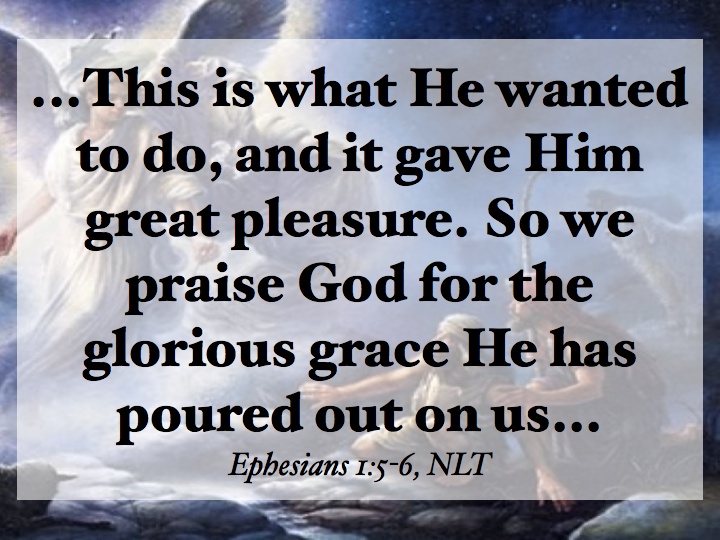
God decided in advance to adopt us into His own family by bringing us to Himself through Jesus Christ. This is what He wanted to do, and it gave Him great pleasure. So we praise God for the glorious grace He has poured out on us who belong to His dear Son. (Ephesians 1:5-6 NLT)

How amazing! God wants to adopt you! It’s something that brings Him great pleasure, so He constantly pours out the blessing of His grace on us!

Are you worthy of God’s favor? YES!! Not because you did anything to earn it, but because Jesus paid the price for you on the Cross.

Now you need to respond the way Mary did. The angel told Mary to “Fear not!” The verb tense implies that Mary needed to stop fretting about her (un)worthiness, and simply accept the grace that God was extending to her. In other words, she needed to see herself as God saw her.

Mary’s response should be our response: “I am the Lord’s servant. May it be to me as you have said.”

If you have missed any of the messages in our Fear Not! series, you can find them all by clicking here.

►► Would you please prayerfully consider supporting this ministry? My Patreon supporters get behind-the-scenes access to exclusive materials. ◀︎◀︎

Showers Of Blessings

My Word will not return emptyAs the rain and the snow come down from heaven, and do not return to it without watering the earth and making it bud and flourish, so that it yields seed for the sower and bread for the eater, so is My word that goes out from My mouth: It will not return to Me empty, but will accomplish what I desire and achieve the purpose for which I sent it. (Isaiah 55:10-11)

Pastor, please carefully read these words from Oswald Chambers, written nearly a century ago, but still so relevant for us today—

“God’s Word is a seed. The ‘seed-thought’ idea is one that preachers and evangelists need to remember. We imagine we have to plough the field, sow the seed, reap the grain, bind it into sheaves, put it through the threshing machine, make the bread—all in one discourse. … 

“The truth is we don’t believe God can do His work without us. We are so anxious about the word, so anxious about the people who have accepted the word; we need not be, if we have preached what is a word of God it is not our business to apply it, the Holy Spirit will apply it. Our duty is to sow the word, see that it is the word of God we preach, and not ‘huckster’ it with other things, and God says it will prosper in the thing whereto He sends it. …

“He says, ‘My word…will not return to Me empty.’ Every temptation to exalt the human, human experience, human interests and blessings, will fall short; the only thing that prospers in God’s hands is His own word.”

From God’s Workmanship, emphasis added

I need to be reminded of that again. Perhaps, my fellow pastor, you needed it to. This Sunday just preach the word God has given you, and then let the Holy Spirit take it from there. God WILL bring the harvest in His time.

UPDATE: In the final chapter of my book Shepherd Leadership (a chapter entitled “Applause”) I wrote this:

      Did you catch that? Twice Paul reminds us that it is God who makes things grow [1 Corinthians 3:4-8]. God, not man. So is the only successful ministry the one that harvests? How did they harvest without someone watering the seed? What exactly were they watering if no one had planted any seeds? And even with everyone doing the work, it is still God who makes things grow. 

      According to Paul, what does God reward? It’s not numeric growth, but shepherds “will be rewarded for their own hard work … the work the Lord gave us.”