7 Final Quotes From “The Ministry Of God’s Word”

The Ministry Of God's WordI’ve been sharing some of the many quotes I highlighted in Watchman Nee’s book The Ministry Of God’s Word. You can read previous quotes by clicking here, here, here, here, and here. This is a book that I have called a must read for pastors, and you can read my full book review by clicking here.

“A minister of the Word ought to be attentive to how he speaks. The words he speaks must come through discipline, since God creates the words for us through His disciplining us. … How much you can speak depends upon how much you have learned inwardly. … It is more than your preaching His Word; you as a person must be so chiseled and tested by Him that the word which comes out of you is God’s Word.” 

“Let us realize that the minister of the Word must be tried first. Without any trial there can be no word. If other brothers and sisters should enter into trial before you, you have nothing to help them. Even if you should try to say something, it falls as an empty word. What use is an empty word? Word is formed in fire. … Hence the ministers of the Word are those who are chosen by God to be dealt with first, to be tried first, and to know the Lord first, so that they may minister Christ to God’s children. … If we expect to have a big ministry we should be ready to receive more dealings.”

“The Word of God is full of emotion. It should not be recited verbatim in a mechanical way. It ought to be pressed out through deep feeling. … One’s emotion must be so refined that he can rejoice when God’s Word is joyful and wail when the Word of God is sorrowful. His feeling follows the Word of God closely. This is not performance. Please never learn to perform. … The more spiritual a man is, the richer his feeling. … The more lessons one learns before God the more enriched his feeling will be.” 

“A minister of the Word should know that God is building up his ministry through each trial and difficulty. Do not be so foolish as to deem it best to flee from trial. If no thorn, then no grace, hence no power and little ministry. You may speak the Word but you do not possess the strength of the spirit to push it out. You need the Word; you also need a usable spirit.”

“In preaching the gospel, if you make men a little bigger, you make the gospel somewhat smaller. … Spiritual humility comes through our being enlightened by God to a real knowledge of our self, where as soulish self-abasement is the result of looking at man, comparing ourselves with others, and being afraid of men.” 

“We need to take good care of our mind that it may be usable when God wants it.”

“He who desires to minister the Word must learn how to speak simply. … Always remember that God’s Word is for men to understand, not for them to become confused about. … Hence a very important point in ministering the Word is to climb high before God. The higher we climb the more God’s Word is released. God rejects low thought, low-quality persuasion, cheap metaphors or words. Reach high and yet be clear.” 


Links & Quotes

link quote

Some good reading from today…

“A good mind is also a good possession. And, further, a pure inner life is a valuable possession. Hedge in, then, this possession of thine, enclose it with thought, guard it with thorns, that is, with pious care, lest the fierce passions of the flesh should rush upon it and lead it captive, lest strong emotions should assault it, and, overstepping their bounds, carry off its vintage.” —Ambrose of Milan

“Unlike in physics and chemistry, very few of the findings in the social sciences can be characterized as incontrovertible. But there’s one major exception: the impact of fatherlessness on American children. To name but a few grim examples, 63 percent of teen suicides are from fatherless homes; 90 percent of homeless children and runaways are from fatherless homes; and 71 percent of all high school dropouts are from fatherless homes.” —Eric Metaxas

Great historial article: What Can Pentecostals Learn From John Wesley?

A former abortion worker testifies, “We would find women’s weaknesses and work on them” to convince them to have an abortion.

Joel Osteen says he doesn’t like the term “prosperity preacher” applied to him, and then describes what he believes (which sounds a lot like a prosperity doctrine to me!). John Piper debunks this garbage better than I can in this video.

4 Ways Selfishness Ruins Your Life.

[VIDEO] Ted Cruz blasts the attempt by Democrat Senators to obliterate the First Amendment.

“We only know God in His works, but we are forced by science to admit and to believe with absolute confidence in a Directive Power—in an influence other than physical, or dynamical, or electrical forces.” —William Thomson (Lord Kelvin)

Thursdays With Oswald—God Makes The Church Go

Oswald ChambersThis is a weekly series with things I’m reading and pondering from Oswald Chambers. You can read the original seed thought here, or type “Thursdays With Oswald” in the search box to read more entries.

God Makes The Church Go

     The Church is a separated band of people who are united to God by the regenerating power of the Spirit, and the bedrock of membership in the Church is that we know who Jesus is by a personal revelation of Him. The indwelling Spirit is the supreme Guide, and He keeps us absorbed with our Lord. 

     The emphasis today is placed on the furtherance of an organization; the note is, “We must keep this thing going.” If we are in God’s order the thing will go; if we are not in His order, it won’t.

From Conformed To His Image

It’s not clever tactics, or great preaching, or amazing music that makes the Church go. It’s only our focus on Jesus.

11 Quotes From “Holy Fire”

Holy FireHoly Fire by R.T. Kendall is an excellent book for dyed-in-the-wool Pentecostals, and for those who believed the operational gifts of the Holy Spirit have ceased. You can read my book review by clicking here. Below are a few quotes I highlighted in this book.

“So if you feel threatened by the Holy Spirit, is it because you are happily in your comfort zone? Are you afraid of what the Holy Spirit might do to you? What He would require of you? What He might ask you to do? Do you think you will lose something if you make yourself vulnerable and totally open to Him? Are you afraid He will embarrass you? Do you think you will lose your identity? Do you think you might have to change?”

“The canon of Holy Scripture is closed. It is final. Absolute. Incontrovertible. It is God’s complete and final revelation. No word that will come in the future will be equal to the Bible in level of inspiration. This means that any leading, prophetic word, word of knowledge, or vision one may have today must cohere with Holy Scripture. If it doesn’t, it must be rejected.”

“The Holy Spirit is our best and only reliable Teacher. In fact, He is the only Teacher who matters. Whatever teaching you hear or read (including this book)—whoever the preacher or teacher, if the Spirit does not apply it and witness it to your heart (which He is most capable of doing), you should learn to hold that teaching in abeyance—if not dismiss it.” 

“The Spirit ‘guides’ us into truth—showing what is there but what cannot be seen without Him opening our eyes. It is humbling for prideful people to admit to the need of the Holy Spirit. The cost? Our pride being shattered. But once we are broken and enabled to see our stubbornness, the Spirit will show us amazing things—in Scripture.”

“The Holy Spirit leads us to praise the Lord Jesus as He deserves.” 

“Don’t come short of discovering how real God is because some well-meaning person says this kind of relationship with God is not possible today.”

“Unbelief is doubt that degenerates to a conscious act of the will. … But when we consciously decide that God did not say what He did—and we can do it better; or that He is not going to keep His word—or manifest Himself, and then put ourselves above His Word, we cross over a line. This is dangerous stuff.” 

“Do you know the context of Hebrews 13:8? Verses 7 and 9 point to one thing: sound teaching. … Whereas we have a perfect right to apply Hebrews 13:8 against cessationist teaching, the immediate context refers to doctrine. Sound theology. The writer wanted the teaching of Jesus to remain the same yesterday and today and forever. Knowing His Word and His ways.”

“What if God in some cases keeps some skeptics from seeing the miraculous even though it actually takes place? What if miracles are largely for those believers in God’s family who have accepted the stigma of being ‘outside the camp’ (Hebrews 13:13)? After all, why didn’t the resurrected Christ appear to everybody on Easter Sunday? One might choose to argue that this would have been a reasonable thing to do if God truly wanted everybody to believe on His Son. Why did Jesus reveal Himself only to a few? Why didn’t Jesus knock on Pontius Pilate’s door on Easter morning and say, ‘Surprise!’? Why didn’t Jesus go straight from the empty tomb to Herod’s palace and say, ‘Bet you weren’t expecting Me!’ He appeared only to a few—those who were His faithful followers. I also suspect that God sometimes allows just a little bit of doubt when it comes to the objective proof of the miraculous. This keeps us humbled. And sobered.” 

“The Holy Spirit can therefore be quenched by a doctrine that does not allow for Him to show up. … It also seems to me that one of the more serious fallouts of being a cessationist is that it can eliminate any expectancy for God to work powerfully in our hearts and lives. One may become too content with his or her sheer intellectual grasp of the gospel. The consequence is that we don’t even consider—much less expect—that God will manifest His power in our lives.”

“This to me is serious—and a very precarious position to take, namely, ruling out categorically the possibility of God manifesting His glory in signs and wonders today and deleting a great portion of the Bible for today. Consider how much the Bible has to say about God’s power. Healing. Signs and wonders. Revelation of truth by the Holy Spirit. Consider what is left in Holy Scripture when you rule out the miraculous or the gifts of the Holy Spirit.”

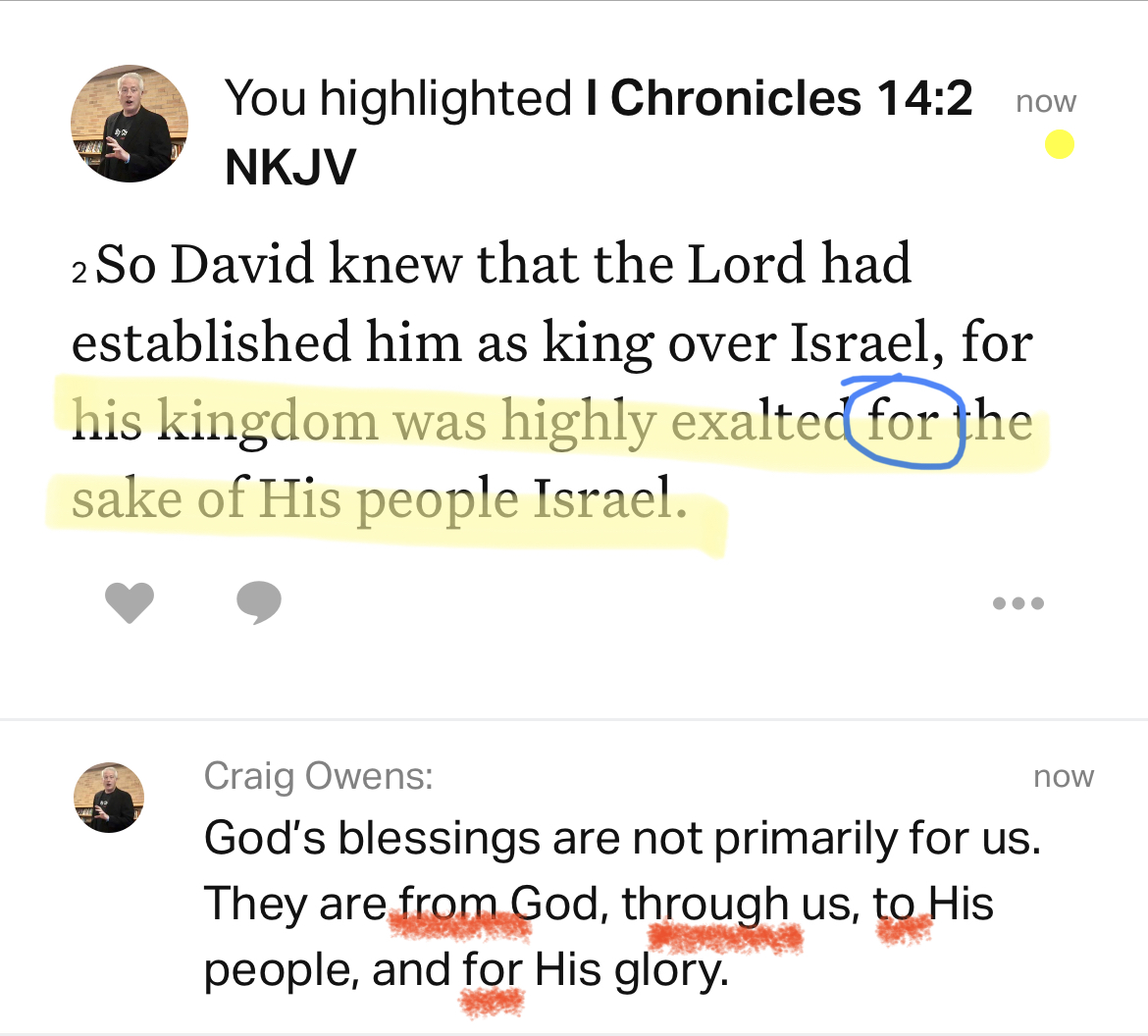
God’s Blessings Aren’t Primarily For You

God's blessingsGod’s blessings are wonderful, and we should pray for them, but they are showered upon us for a specific purpose.

“May God be gracious to us and bless us and make His face shine upon us…” is the prayer of the psalmist. Why does he pray this?

“…SO THAT Your ways may be known on earth, Your salvation among the nations.” (Psalm 67:1-2)

God’s blessings are sent to His people SO THAT the whole earth will know Him and praise Him, and turn to Him for their salvation.

God’s blessings aren’t primarily for my benefit, but for His!

“And God, our God, will bless us. God will bless us, SO THAT all the ends of the earth will fear Him.” (verses 6-7)

Sola Deo gloria—it’s all for His glory!

So, yes, Lord, pour out Your blessings on me again and again SO THAT all people may know You and Your salvation. May all who see Your blessing on me turn to You as their God too!

Links & Quotes

link quote

Great reading (and watching) today.

[VIDEO] John Maxwell reminds us of the value of delays.

Dr. James Dobson defends his comments at the National Day of Prayer address.

[VIDEO] Dr. Brian Mattson discusses the place of the Apocrypha.

[INFOGRAPHIC] Exercise helps your memory.

“The surprise comes for many people that such a tiny little brain is able to form such a rich memory described as a cognitive map,” says co-author Randolf Menzel. Actually, the surprise for me is that many people refuse to believe this amazing little brain was created by an amazing Creator. See how bees build mental maps to get back home.

Holy Fire (book review)

Holy FireI believe the subtitle of R.T. Kendall’s book Holy Fire is the most apt description of this work: A Balanced, Biblical Look at the Holy Spirit’s Work in Our Lives. Truly this book is both biblical and balanced.

“I am writing this book (1) to introduce the Holy Spirit as if you did not know very much about Him, (2) to show the inconsistency of the teaching of some evangelicals, but (3) also to warn you of strange fire that is about,” says Dr. Kendall.

It seems lately there is a great deal of UNbalance when discussing the Holy Spirit, and much “theology” being preached which doesn’t have a firm biblical foundation. Some want to emphasize the Spirit’s role so much that they almost exclude God the Father and God the Son. Others want to so downplay the role of the Holy Spirit in our lives today that they have almost become binitarians. Kendall stated, “The Holy Spirit does not belong to you. Are you Charismatic? He is bigger than your signs and wonders event. Are you Reformed? He will not be limited by your theology.”

Sticking close to the words of Scripture, R.T. Kendall walks us through the various roles of the Holy Spirit in our lives. He brings in the insights of other notable thinkers from Martin Luther, to John Calvin, to Jonathan Edwards, to George Whitefield, and Dr. Martyn Lloyd-Jones. Even for someone like me who grew up in the Pentecostal tradition, I learned so much from this book!

Holy Fire is not written in a scholarly tone, but in a conversational style that made me feel I was talking with R.T. Kendall. This allowed me to drink in what Rev. Kendall was saying, process it, compare it with Scripture, and reach my own conclusions.

An excellent book that is very timely for the Christian era in which we currently live. Whether your background is Pentecostal or Reformed, there is so much to be learned from Holy Fire.

Links & Quotes

link quote

Some good reading from today.

John Stonestreet explains why pornography is wrong.

“We can preach the Gospel of Christ no further than we have experienced the power of it in our own hearts.” —George Whitefield

“I cannot blame him [George Washington] for having acted according to his ideas of duty in obeying the voice of his country. I am still determined to be cheerful and happy, in whatever situation I may be; for I have also learned from experience that the greater part of our happiness or misery depends upon our dispositions, and not upon our circumstances.” —Martha Washington

“All of the examples that we have in the Bible illustrate that glad and devoted and reverent worship is the normal employment of moral beings. Every glimpse that is given us of heaven and of God’s created beings is always a glimpse of worship and rejoicing and praise because God is who He is.” —A.W. Tozer

John Piper brilliantly confronts “gender non-conformists” in his post “Genitalia Are Not Destiny”—But Are They Design?

It’s tough to say which is worse: denying a victim’s humanity or acknowledging it and hurting them anyway.” Read more of Adam Peters’ post How Planned Parenthood Dehumanizes Its Prey.

For baseball fans (especially Detroit Tigers fans) check out the batters who hit the most home runs in Tiger Stadium.

Chilly Chilton uses a quote from C.S. Lewis to challenge us to Make Small Big.

Avoid “decision fatigue.” 5 Ways To Make Fewer Decisions.

Noble Revenge

Noble revengePerhaps one of the most counter culture things a Christian will ever do is to forgive. More specifically, to forgive God’s way in which the offending party is forgiven and the offense is no longer counter against him.

But this isn’t what today’s culture teaches us. Instead they say things like—

  • “I’ll forgive them only if they’re really, really, REALLY sorry for what they did….
  • …and I’ll forgive them only if they ask for forgiveness…
  • …and then only I’ll only forgive them a certain number of times…
  • …and most importantly, I may forgive, but I’ll never forget.

Why do we feel this way?

  • We buy into the old line: “Hurt me once, shame on you; hurt me twice, shame on me,” and we don’t want to feel shame.
  • We like to be in control. If we hold on to slights and injuries, then we have a trump card we can play later—“You owe me” or “This is why I don’t trust you.”
  • We mistakenly think that forgiveness makes us appear weak, like our offender won and we lost. And we certainly don’t want them to think they can take advantage of us again.
  • Because if they take advantage of us again it’s right back to, “Hurt me once…” so I’m going to make a preemptive strike and not forgive them.

Yes, forgiveness could make us appear vulnerable. Yes, we could be hurt again by the same offender. And, yes, we could be viewed as weak. But—The foolish thing that has its source in God is wiser than men, and the weak thing that springs from God is stronger than men (1 Corinthians 1:25, AMP). Total forgiveness is foolish looking in the natural, but it has God’s blessing on it.

With this in mind, the Apostle Paul wrote—

But Jesus said to me, “My grace is sufficient for you, for My power is made perfect in weakness.” Therefore I will boast all the more gladly about my weaknesses, so that Christ’s power may rest on me. That is why, for Christ’s sake, I delight in weaknesses, in insults, in hardships, in persecutions, in difficulties. For when I am weak, then I am strong. (2 Corinthians 12:9-10)

When we are totally reliant on Christ, that’s when His power rests on us. When we say, “I’m going to do this my way,” we block ourselves off from Christ’s grace and power and strength.

We need to remember HOW MUCH God has forgiven in us—He forgave ALL my sins and He no longer counts any of my treachery and rebellion against me. With this in mind, how dare I hold on to the comparatively small injuries others have inflicted on me (see Matthew 18:21-35).

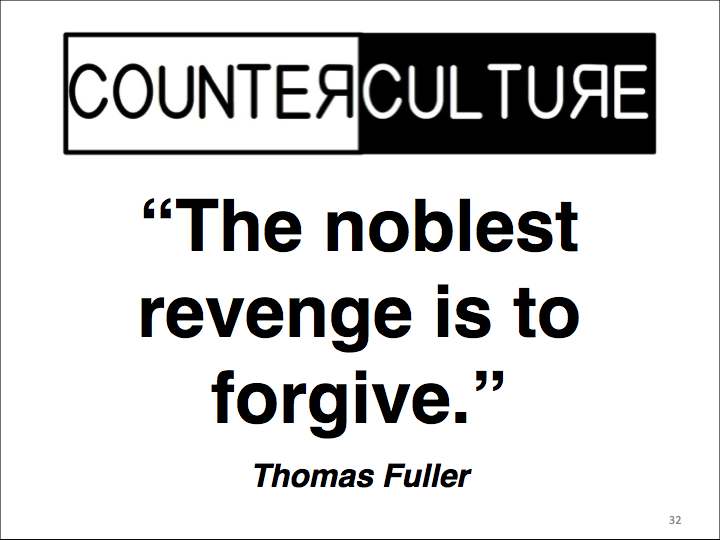
“The noblest revenge is to forgive.” —Thomas Fuller


Forgiveness gives me a nobility.
Forgiveness sets me free from the hurt.
Forgiveness makes me a child of God.
Forgiveness gives me God-sent strength.
Forgiveness is counter culture.
Because forgiveness glorifies God, and not my wound.

What are you waiting for? Get free today by giving and receiving forgiveness.

Weekend Quotes

“quotes”

Some challenging quotes from this weekend:

“A wise man will make haste to forgive, because he knows the true value of time, and will not suffer it to pass away in unnecessary pain.”  —Samuel Johnson

“The noblest revenge is to forgive.” —Thomas Fuller

“Being deeply loved by someone gives you strength, while loving someone deeply gives you courage.” —Lao-tzu

“Love keeps no records of wrongs. … It always protects, always trusts, always hopes, always perseveres.” —Apostle Paul (1 Corinthians 13:6-7)

And for my pastor friends: “There will always be new ways to do good works and speak good words which are not presently in our experience or repertoire. So in all our studies, let us study to acquire new insights and visions of how we can serve others through good works. And in all our teaching and preaching, let us not grow negligent in exhorting the people of God to do likewise.” —T.M. Moore