Listen to the podcast of this post by clicking on the player below, and you can also subscribe on Apple, Spotify, or Audible.
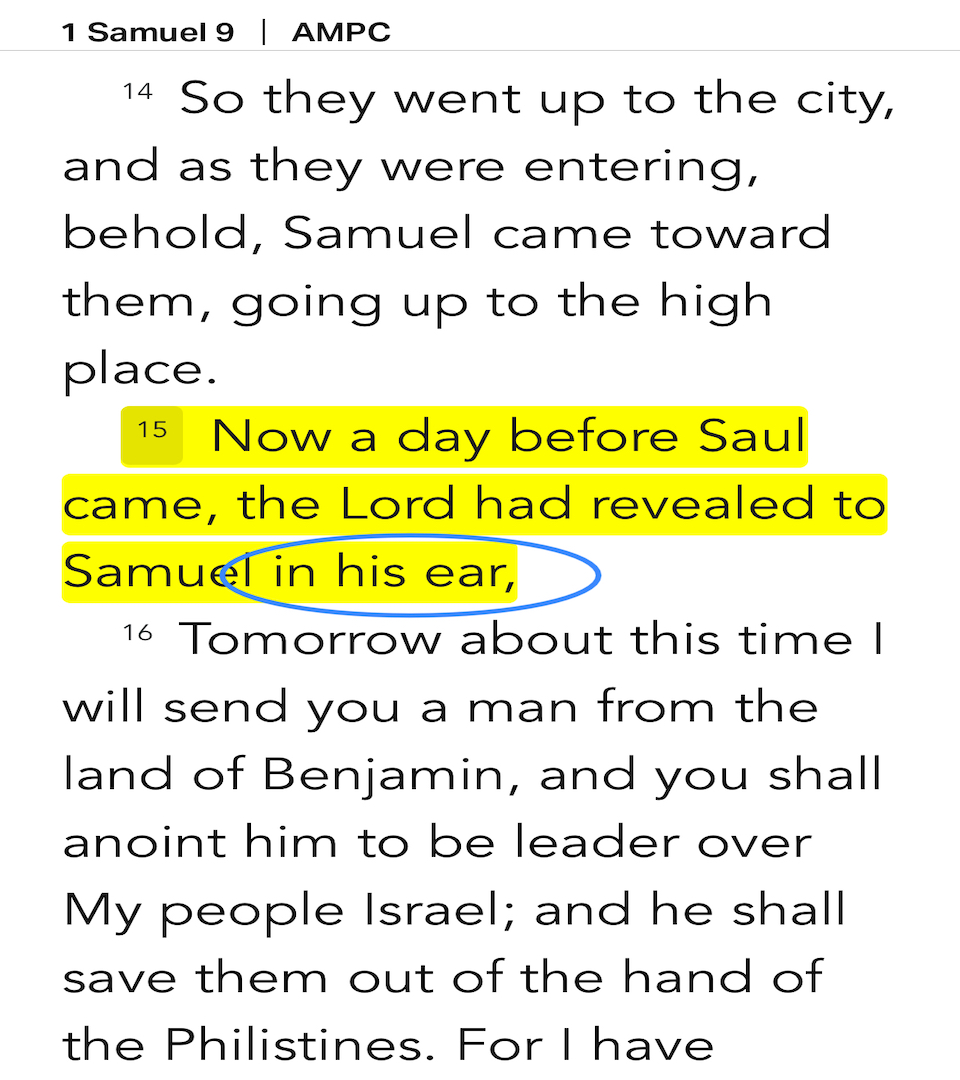
Last week we talked about the Voice of the Holy Spirit. I love the phrase from 1 Samuel 9:15 where God “told Samuelin his ear” about Saul’s arrival and what he should say to Saul. Then the Holy Spirit’s Voice for all of us is foretold in Isaiah 30:21.
It’s great hearing the Spirit’s Voice, but He also empowers us to know the Mind of God.
This is not something that automatically comes to every Christian at the moment they invite Jesus to be their Lord and Savior, as we see mention of immature Christians throughout the New Testament.
Even after Jesus is resurrected from the dead, we see His followers as unsure, troubled men. We meet their…
This is all post-resurrection but pre-conversion, but look at what happens next. After Jesus breathes on them (John 20:22), they are peaceful (vv. 19, 21, 26) and they can now understand the Scriptures (Luke 24:45-48).
As we’ve said, we shouldn’t stop at salvation. Certainly, Jesus wanted more for His followers than merely salvation. He wants His disciples empowered for witnessing and disciple-making (Luke 24:48; Acts 1:4-5, 8).
Check out these examples of the Holy Spirit sharing with us the mind of God:
Joseph—Genesis 41:16, 38-40
Daniel—Daniel 2:19-23, 27-28, 47
Peter—Acts 2:14f; 3:17-26; 4:8-12
Stephen—Acts 7
Philip—Acts 8:30-35
And just in case you think this is just for “super spiritual” people, look how the Holy Spirit helps the whole Church share the Gospel—
After they prayed, the place where they were meeting was shaken. And they were all filled with the Holy Spirit and spoke the Word of God boldly. … Those who had been scattered preached the word wherever they went. (Acts 4:31, 8:4).
This was always God’s plan! Paul harkens back to prophecies like Isaiah 55:8-9, Isaiah 40:13, and Jeremiah 31:33 when he writes about Christians having “the mind of God” in 1 Corinthians 2:6-16.
He says, “These are the things revealed to usby His Spirit” (v. 10).
What things? “Things God has prepared for those who love Him”—things which human eyes haven’t seen, human ears haven’t heard, human minds haven’t conceived (v. 9). These are the the very thoughts of God Himself!
Just as my spirit is the only one that knows what’s really in my mind, the Holy Spirit is the only One Who knows the mind of the Father and Son (v. 11). We have been given the Holy Spirit “so that we may understand what God has freely given us” (v. 12). Contrast this with the dull, unfruitful minds of both unbelievers (2 Corinthians 4:4) and carnal Christians (Philippians 3:18-19).
This mind of God is given to us for our edification so that we can be empowered witnesses and disciple-makers. So don’t stop at salvation, but be baptized in the Holy Spirit, and then keep on being filled with the Spirit.
The apostle Paul demonstrates how a confident leader empowers his teammates to soar—he believed the best in them! Check out the full conversation Greg and I had on The Craig and Greg Show about leaders as gardeners.
In the spirit of C.S. Lewis’ Screwtape Letters, in this post Grimgod talks to his nephew Globdrop about the battle over the definition of masculinity. “If total amnesia of man and woman was not our aim, what was? Stripping those definitions of unwanted details. Man reclaimed that he is, not what he is. They reclaimed the temple, yes, but what remains? The gold, carried away. The glory, departed. They raise their flag above ruins. Is this their triumph—that a man is what his body tells him? Is this all? What is a man? A male adult human. What is the difference? Chromosomes. Bone density. Muscle mass. Voice depth. This is the meager strip of land they repossessed, and we smile at it.”
A recent discovery of a mosasaur fossil in Mississippi has evolutionists buzzing about macro evolution. But the facts say otherwise: “The fossil record shows mosasaurs have always been mosasaurs. These and other terrestrial and marine creatures were buried in a series of violent events one could easily attribute to a massive flood. Proteins, pigment, and other biomolecules uncovered in mosasaur bone provide compelling evidence that these reptiles existed recently—as in thousands of years ago.”
A missionary who thought his years of ministry had accomplished nothing and his daughter who had been estranged from her father both discovered just how much God had done through their ministry.
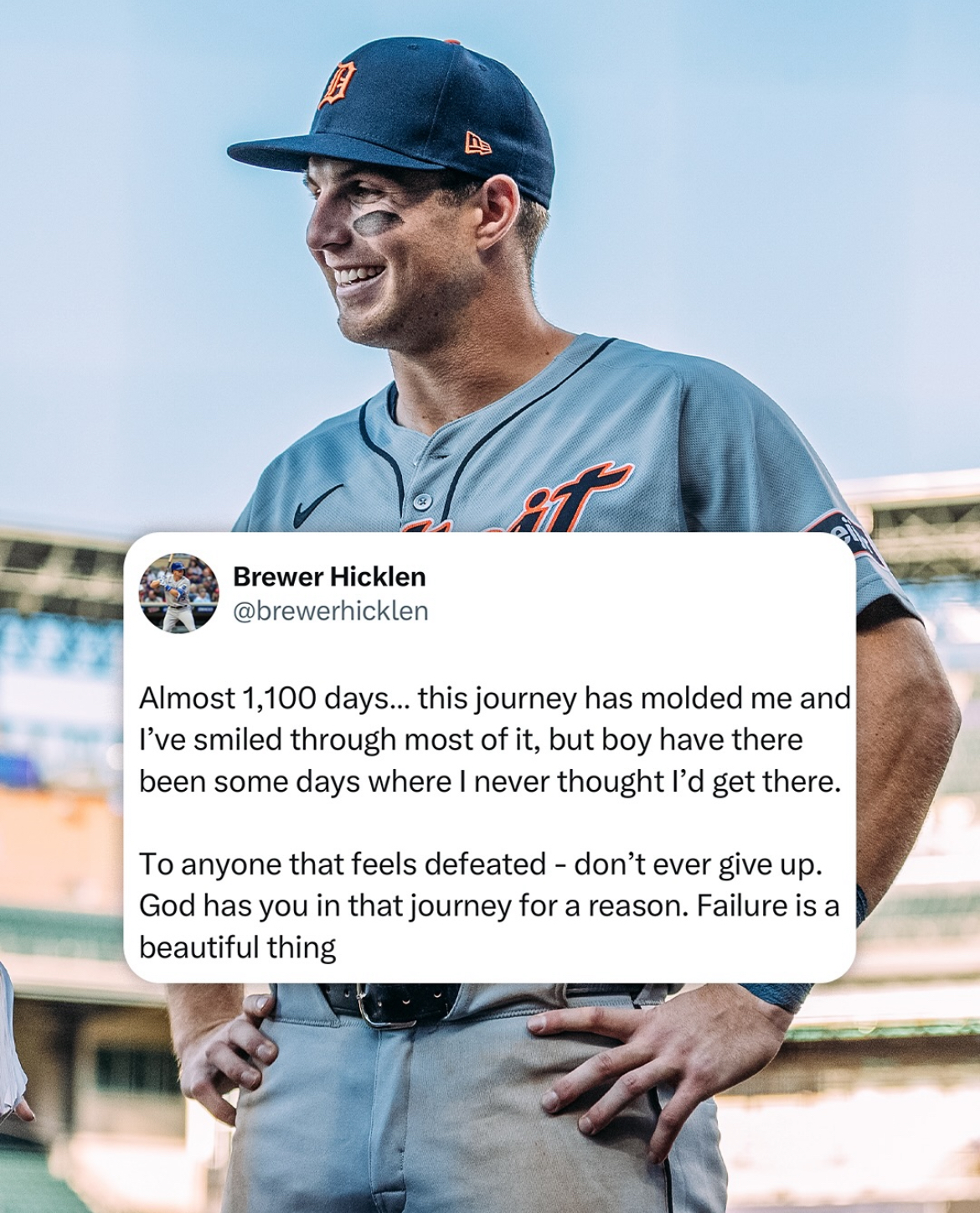
I love this perspective from Detroit Tigers player Brewer Hicklen, “Almost 1100 days… This journey has molded me and I’ve smiled through most of it, but boy have there been some days where I never thought I’d get there. To anyone that feels defeated—don’t ever give up. God has you in that journey for a reason. Failure is a beautiful thing.”
“Four considerations seem to hold especially in the case of friendship: love, affection, security, and delight. Friendship involves love when there is a show of favor that proceeds from benevolence. It involves affection when a certain inner pleasure comes from friendship. It involves security when it leads to a revelation of all one’s secrets and purposes without fear or suspicion. It involves delight when there is a certain meeting of the minds—an agreement that is pleasant and benevolent—concerning all matters….” —Aelred of Rievaulx
“Psychologist Henry H. Goddard studied tired children and found that they had a burst of energy when he said something encouraging to them. But when he said something negative, they became even more tired.” With that in mind, here’s a 30-second rule to help you better engage others in conversation.
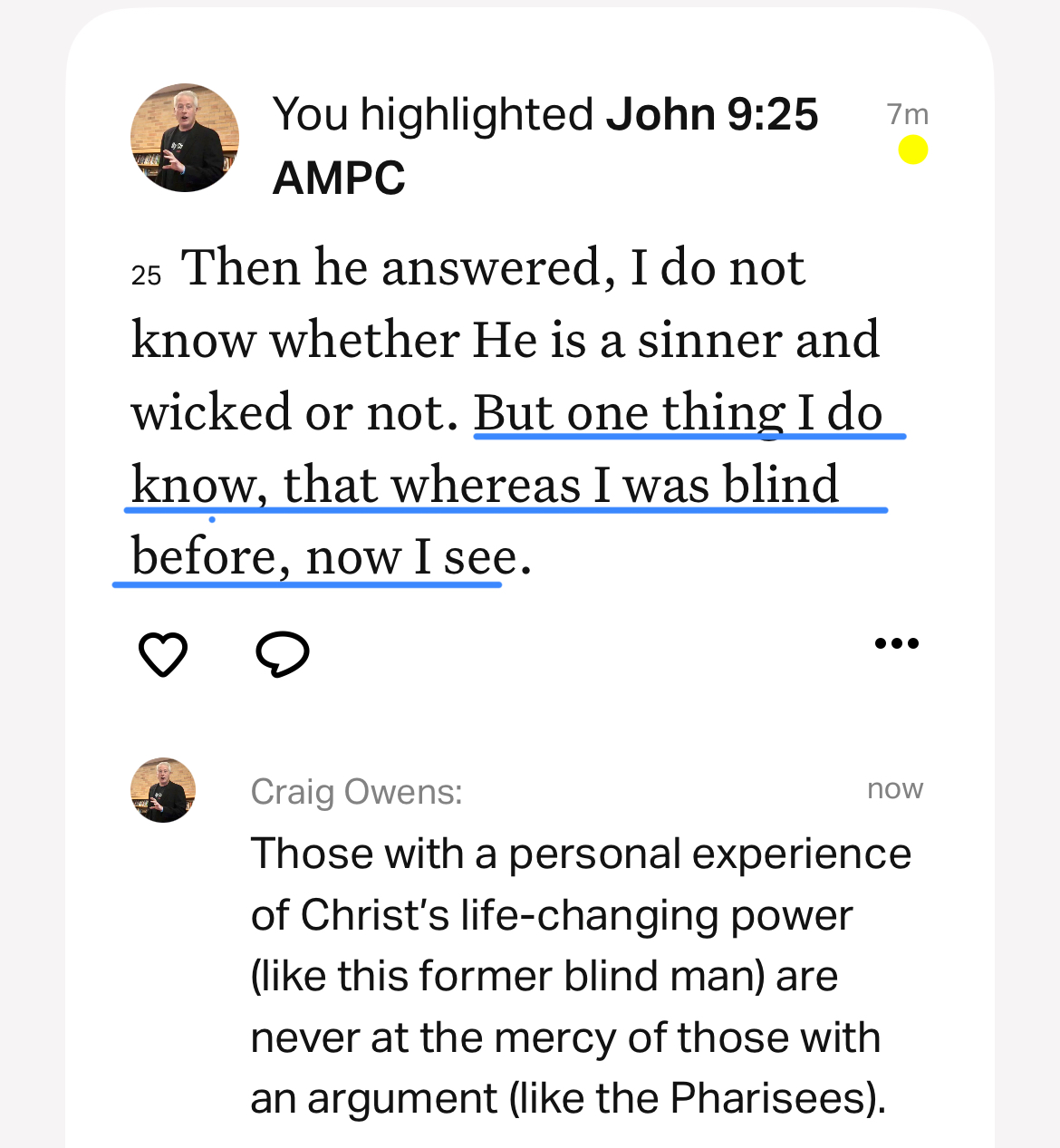
The religious leaders asked a man who had been healed by Jesus of his blindness whether he though Jesus had sinned by healing on the Sabbath. He said, “I do not know whether He is a sinner and wicked or not. But one thing I do know, that whereas I was blind before, now I see” (John 9:25).
I find it interesting that the Pharisees didn’t try to argue whether or not this man had truly been healed—that was obvious to everyone!—but they wanted to discredit Jesus and call Him a sinner because He healed on the Sabbath day.
Those with a personal experience of Christ’s life-changing power (like this former blind man) are never at the mercy of those with an argument (like the Pharisees).
In fact, this man who can now see not only has the most sound logic, but he has immediately become an evangelist for Jesus as well!
The man replied, “Well, this is astonishing! Here a Man has opened my eyes, and yet you do not know where He comes from. That is amazing! We know that God does not listen to sinners; but if anyone is God-fearing and a worshiper of Him and does His will, He listens to him. Since the beginning of time it has never been heard that anyone opened the eyes of a man born blind. If this Man were not from God, He would not be able to do anything like this.” (John 9:30-33)
I love this truism: The man with an experience is never at the mercy of the man with an argument. I have blogged extensively about this. Check out these posts.
Listen to the podcast of this post by clicking on the player below, and you can also subscribe on Apple, Spotify, or Audible.
I was honored to be invited to offer the commencement address for some amazing students graduating from the Parent Teacher Co-op program.
I think we rush too quickly through our celebrations. It seems that at each milestone, we pause only briefly to move on toward the next milestone. But if we don’t celebrate well, we are actually setting ourselves up for a disappointing future.
It’s very telling that after the perfection of Creation, God took time to celebrate His own handiwork. And then He called us to do the same. That’s what a sabbath really is: A time to celebrate what God has done for us, and what He has empowered us to do for His glory. I think the reason many older people become more contemplative and nostalgic is because they rushed through their life without taking time for sabbath celebrations.
If you look at the history of the Israelites, you will see majestic mountain peaks followed by depressing valleys. What sent them sliding into their valley was one thing: forgetfulness. Time and time again, God sends His prophet to chastise the Israelites for failing to take a sabbath rest. They forgot to honor God and celebrate Him, but instead they rushed along to the next thing. What brought them out of their valley and back to the mountain was also one thing: remembering. Celebrating God for who He is.
So I challenged these graduates—and you—with this. At each milestone in your life…
Thank God for His blessings
Celebrate your own hard work.
Recognize the help you’ve received from others.
Determine which lessons to keep, which to enhance, and which to leave behind.
Find someone to share the journey with you.
Don’t forget to remember!
I would suggest at a minimum celebrating the sabbath each week as God gave us that example, but you may find that you have a moment to celebrate even a small win in the middle of the day in the middle of your week. If you do that, I think your appreciation for God’s blessings will keep you even more dependent on His abiding presence.
You may also be interested in a couple of related blog posts and videos:
Listen to the podcast of this post by clicking on the player below, and you can also subscribe on Apple, Spotify, or Audible.
In March 1966, at the height of Beatlemania, John Lennon was quoted—
“Christianity will go. It will vanish and shrink. I needn’t argue about that; I’m right and I will be proved right. We’re more popular than Jesus now; I don’t know which will go first—rock ’n’ roll or Christianity. Jesus was all right but His disciples were thick and ordinary. It’s them twisting it that ruins it for me.”
Maureen Cleave, the reporter who included this quote in her article about the Beatles, tried to clarify that John was talking specifically about the Church of England, especially when John mentions the disciples of Jesus twisting the words and example of Jesus as it is recorded for us in the New Testament.
But I wonder if the same argument could be made today about the “stars” in the evangelical movement? Many of those who claim to be preachers of the Gospel have both an online and in-person following that rivals that of the Beatles of the 1960s. Their gatherings are rock concert-esque, with their fans spending lavishly on their books, videos, and seminars.
But here’s my question: Are these “rock star preachers” making Jesus famous or themselves famous?
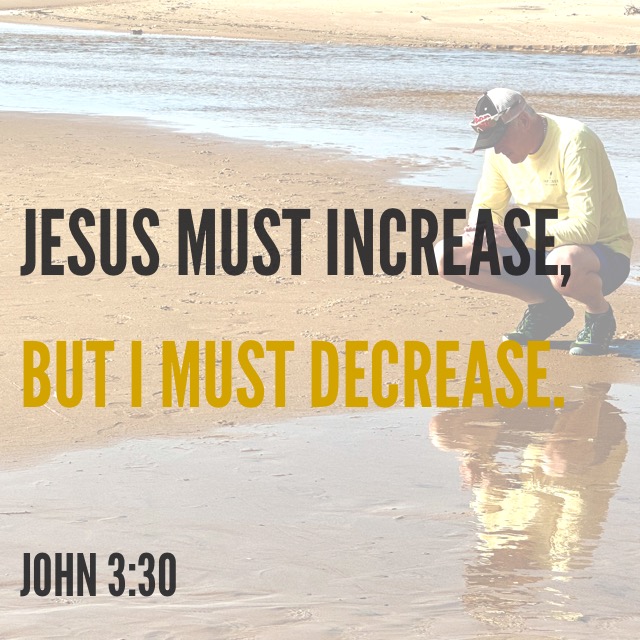
How would John the Baptist’s words sound coming out of the mouths of these mega-stars: “[Jesus] must increase, but I must decrease. He must grow more prominent; I must grow less so” (John 3:30 AMPC)?
Before John was born, the angel Gabriel told Zechariah that John “will be great in the eyes of the Lord” (Luke 1:15).
Notice: “Great in the eyes of the Lord” is so infinitely better than “great in the eyes of the world”!
John’s whole life was one of confident humility (or humble confidence). He spoke God’s Word confidently, but wasn’t seeking the praise of men nor intimidated by the criticism of men. As a result, God’s Spirit remained on him in an unmistakable way.
God will use anyone in the way that He used John, if they will only have the same attitude John had: “I must decrease and Jesus must increase.”
May I suggest this attitude-adjusting prayer for everyone who has been called by God to herald the Good News about Jesus—
Heavenly Father, as I preach today may all eyes move past me and turn to Jesus. “He must increase, but I must decrease. He must grow more prominent; I must grow less so.” Thank You for this opportunity You have given me today to point people to You. May I only be seen as great in Your eyes, but may the world view me only as Your humble servant.
Listen to the podcast of this post by clicking on the player below, and you can also subscribe on Apple, Spotify, or Audible.
Here’s an interesting interaction between King Saul and David—
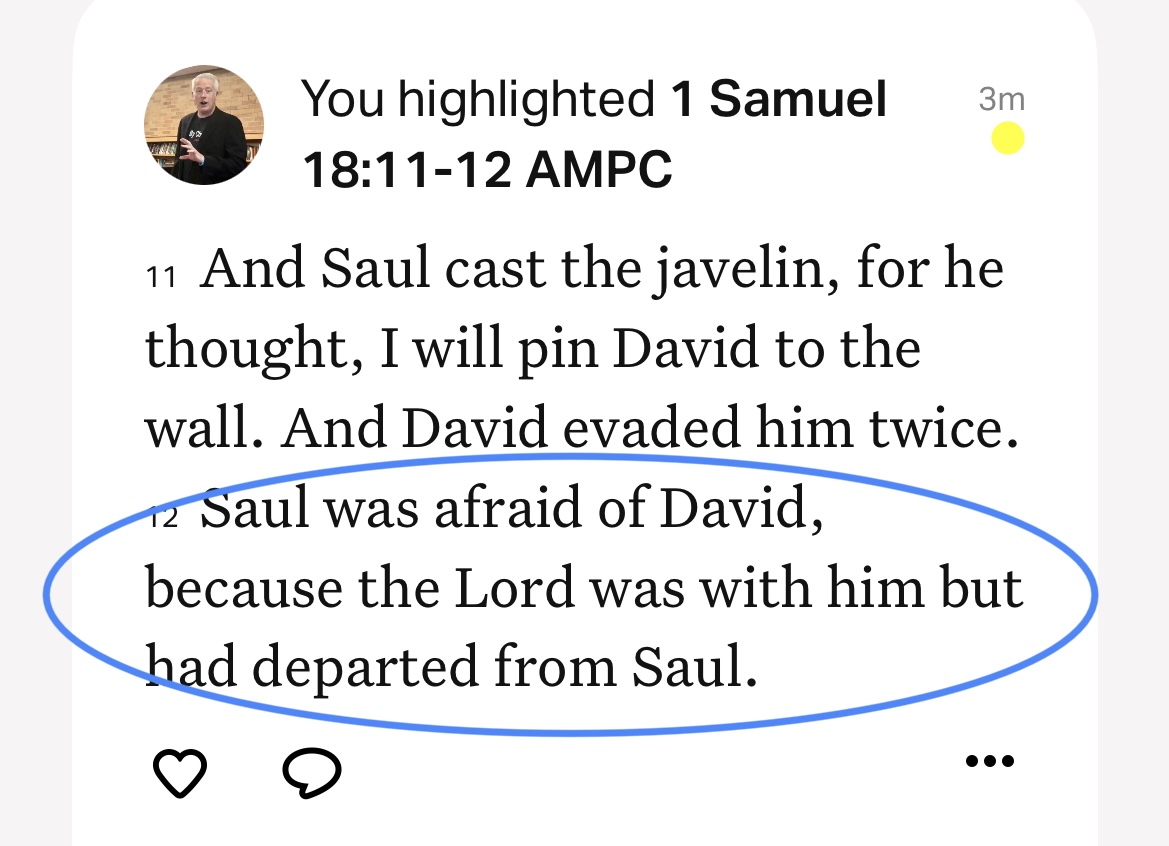
And Saul jealously eyed David from that day forward. … And Saul cast the javelin, for he thought, I will pin David to the wall. And David evaded him twice. Saul was afraid of David, because the Lord was with him but had departed from Saul. (1 Samuel 18:9, 11-12 AMPC)
This exchange in this well-known story got me wondering. I was thinking howSaul had the position of authority over David and he had a javelin in his hand, but the Bible still says that Saul “was afraid of David.” Why would that be? I think even the most atheistic of people intuitively know there is something other-worldly about those in whom the Spirit of God abides, which makes worldly people lash out at them in fear.
But those who fear God—as David did—don’t fear mortals. Jesus said, “Don’t be afraid of those who want to kill your body; they cannot touch your soul. Fear only God, Who can destroy both soul and body in hell” (Matthew 10:28 NLT). This reverent fearlessness is what galls those who fear the unknown, so they try to silence confident God-followers.
In these attacks, Jesus tells us not to respond naturally, but supernaturally. “But to you who are willing to listen, I say, love your enemies! Do good to those who hate you. Bless those who curse you. Pray for those who hurt you” (Luke 6:27-28 NLT).
Peter picked up those words from Jesus and instructed Christians: “Be careful to live properly among your unbelieving neighbors. Then even if they accuse you of doing wrong, they will see your honorable behavior, and they will give honor to God when He judges the world. … For God called you to do good, even if it means suffering, just as Christ suffered for you. He is your example, and you must follow in His steps.” (1 Peter 2:12, 21 NLT).
Although Saul feared the presence of God in David, he also had to acknowledge the success that came to David because of God’s abiding presence in him, and also, by extension, the success that came to Saul’s kingdom. On the one hand, Saul wanted David dead; on the other hand, he wanted David close by—
So Saul removed David from him and made him his commander over a thousand; and [David] went out and came in before the people. David acted wisely in all his ways and succeeded, and the Lord was with him. When Saul saw how capable and successful David was, he stood in awe of him. (1 Samuel 18:13-15 AMPC)
When Christians are supernaturally empowered by God, they never have to respond in natural fight-or-flight from those who lash out at them. Let your faithfulness to God be your testimony that points others to Him.
Jesus said, “If the world hates you, know that it hated Me before it hated you. If you belonged to the world, the world would treat you with affection and would love you as its own. But because you are not of the world [no longer one with it], but I have chosen (selected) you out of the world, the world hates (detests) you.” (John 15:18-19)
Listen to the podcast of this post by clicking on the player below, and you can also subscribe on Apple, Spotify, or Audible.
I would like you to think about a wise, loving friend. One who has years of godly wisdom, empathy, loads of patience, and loving boldness. When you talk with them, you know that you will always get good counsel—even if you may not like exactly what they have shared with you, deep down you know it is still sound wisdom. This is what the Holy Spirit—as our Counselor—does for us.
The Holy Spirit is not merely a force, but He is a Person. Jesus Himself give the Spirit the pronouns “He / Him / His.”
I especially want to key in on those last two attributes where the Holy Spirit is speaking to us.
Samuel grew up during the time of the judges, where everyone did whatever they thought best. This is a time that is described like this, “In those days the word of the Lord was rare; there were not many visions” (1 Samuel 3:1). Visions in the Hebrew language is two words: open communication. In other words, people just weren’t listening for God’s voice.
Samuel had to learn to hear God’s voice as well (see this passage and all of the other biblical references in this post by clicking here).
God doesn’t reveal His heart to those who are unwilling to obey. His persistent call is for obedience to His Word and reliance on His provision. So the word of the Lord had to be revealed to Samuel (v. 7). When Samuel said he was listening (v. 10), that was a posture of readiness to obey.
God wants to reveal His heart to His obedient people. I love how God does this later for Samuel, “Now the Lord had told Samuel in his earthe day before Saul came…” (1 Samuel 9:15).
This is how Jesus described the Holy Spirit in John 7:37-39, as streams that flow continuously out of our being. And Jesus also calls Him Counselor (John 14:16).
Isaiah described our Counselor like this, “Whether you turn to the right or to the left, your ears will hear a Voice behind you, saying, ‘This is the way; walk in it’” (Isaiah 30:21).
Let’s call this GPS = God’s Personal Spirit in us!
Those who are baptized in the Holy Spirit—utterly yielded to His wisdom—will experience:
More insight into God’s Word—Psalm 119:18
More timely application of God’s Word—2 Timothy 3:16-17
More boldness in prayer—2 Samuel 7:27 (same word for in his ear as Samuel experienced)
All Christians have a deposit of the Holy Spirit in their lives at the moment of salvation. The baptism in the Holy Spirit is a completed yielding to the Counselor’s influence. So don’t stop at salvation, but ask Jesus to send you what the Father has promised (Luke 24:49; Acts 2:33).
Check out all of the messages in our series leading up to Pentecost Sunday by clicking here.
If someone is gossiping to you about others, you can be sure that they are gossiping to others about you—shut it down! Check out this full message about gossips.
I hope you celebrated your Mom on Mother’s Day weekend. This is a great perspective from the Axis newsletter: “Some in our culture say motherhood is a prison, or a trap set by the patriarchy. Pop singer Chappell Roan, for example, recently said she didn’t know any people who have kids and are happy. Others say it’s a paradise—with ‘momfluencers’ online making it look like having kids is a nonstop joyride where the lighting is always perfect and nobody ever cries. When ‘prison’ and ‘perfection’ are presented as the only two options, it’s no wonder U.S. birth rates are declining. One way to honor mothers this year is to admit that motherhood is work—albeit spirit-forming, richly rewarding work—and that we can’t expect to see all the fruit of that labor within our lifetime. Hales writes, ‘Christian parenting is about continually pointing to Jesus as the Author and Perfecter of our faith, clinging to the reminder that He who began a good work in us and our children will complete it.’”
In his study Bible, Dr. Henry Halley offered this comment on 1 Corinthians 6:11. “The greatest proof of the new birth is a changed life. Children of God now suddenly love the following:
They love Jesus. Before conversion the sinner might hold Christ in high esteem, but after conversion they love the Savior (1 John 5:1-2).
They love the Bible. We should love God’s Word as the psalmist did in Psalm 119. There he expresses his great love for God’s Word 17 times.
They love other Christians. ‘We know that we have passed from death to life, because we love each other. Anyone who does not love remains in death’ (1 John 3:14).
They love their enemies (Matthew 5:43-45).
They love the souls of all people. Like Paul, they too can cry out for the conversion of loved ones. ‘Brothers and sisters, my heart’s desire and prayer to God for the Israelites is that they may be saved’ (Romans 10:1).
They love the pure life. John says that if anyone loves the world, the love of the Father is not in them (1 John 2:15-17).
They love to talk to God. ‘Speaking to one another with psalms, hymns, and songs from the Spirit. Sing and make music from your heart to the Lord’ (Ephesians 5:19).”
T.M. Moore and I share the same passion for pastors to operate as shepherds. Moore wrote, “Shepherds equip the saints who take up the works of the ministry that build the church. The work of shepherding is hard. It’s not a program that you run from time to time, hoping to enlist new folks in the training. It is the ongoing, body-building means whereby the Lord’s flocks are nourished and become equipped to use their Spirit-given gifts (1 Corinthians 12:7-11) and power (Acts 1:8) to grow their church in unity and maturity in the Lord.” Moore also wrote an endorsement for my book Shepherd Leadership.
John Piper has a thoughtful and biblical response to a question about Christians losing their rewards in Heaven. In part, he says, “All the good deeds that God approves and rewards are works of faith and the fruit of the Spirit. So, let’s get the idea of merit for these good deeds totally out of our minds.” He goes on to show the Scriptures that secure our promised rewards from God.
Paleontologists have discovered an amazing dinosaur graveyard off the coast of southern Chile. The fossilized remains here gave ample evidence to the global Flood described in the Bible.



 And some other blog posts you could read to go deeper on this topic:






 Craig T. Owens